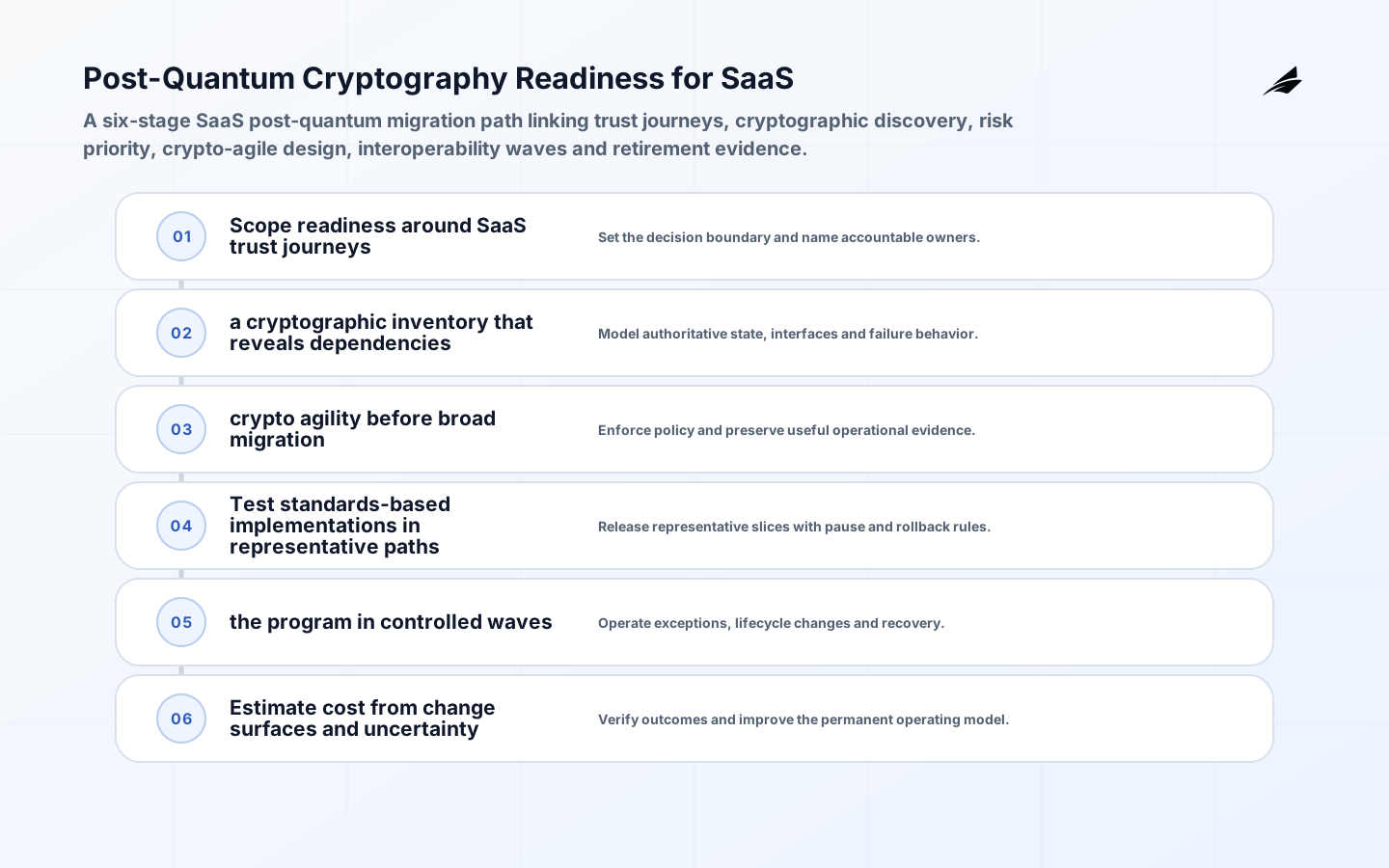
Post-quantum cryptography readiness for SaaS is the work required to locate quantum-vulnerable public-key cryptography, prioritize it by business and data risk, create replaceable cryptographic interfaces and migrate safely as supported standards and implementations mature. NIST finalized FIPS 203 for ML-KEM, FIPS 204 for ML-DSA and FIPS 205 for SLH-DSA in August 2024. That milestone enables implementation work, but it does not mean every SaaS dependency, client, identity provider, certificate authority or managed cloud service is ready for immediate replacement.
A credible readiness service separates inventory and engineering preparation from production deployment. It also recognizes the shared-responsibility reality of SaaS: cryptography may live in application code, runtimes, service meshes, edge providers, cloud key managers, identity platforms, databases, backup tools, customer integrations and software-update systems. This guide defines scope, cost drivers, risks, delivery waves and acceptance evidence. The companion SaaS PQC checklist and SaaS PQC FAQ provide implementation detail.
Scope readiness around SaaS trust journeys
Map the journeys where public-key cryptography establishes confidentiality, identity or software integrity: browser and API TLS, service-to-service connections, customer single sign-on, administrative access, webhook signatures, token verification, database connections, backup transfer, artifact signing and customer-managed keys. Trace each journey through clients, libraries, gateways and external providers. Record the security purpose because key establishment and digital signature migrations use different standards, dependencies and acceptance tests.
Classify data by confidentiality lifetime and consequence. Harvest-now-decrypt-later risk is most relevant when encrypted traffic or stored material could be captured today and remain valuable in the future. Separately identify authenticity that must remain verifiable for years, such as signed releases or audit evidence. Combine data lifetime with service criticality, internet exposure, replacement lead time and customer obligations. This creates a prioritized register instead of treating every RSA or elliptic-curve use as equally urgent.
| SaaS surface | Cryptographic purpose | Readiness evidence |
|---|---|---|
| Public and private APIs | TLS key establishment and authentication | Client, edge and origin capability map |
| Identity federation | Assertion and token signatures | Issuer, verifier and rollover compatibility |
| Software supply chain | Artifact and update signatures | Signer, format and deployed verifier inventory |
| Long-lived data exchange | Confidentiality in transit and at rest | Data lifetime and capture exposure assessment |
Build a cryptographic inventory that reveals dependencies
Combine source and binary analysis, runtime TLS observation, certificate inventories, cloud configuration, key-management records, SBOM data and supplier questionnaires. A useful record names business service, environment, cryptographic function, algorithm and parameters, protocol, implementation, key or certificate owner, data class, client population, external dependency and evidence date. Include confidence because automated tools can miss dynamically selected providers, embedded libraries and cryptography hidden inside managed services.
Turn inventory into dependency graphs. A SaaS team may update its runtime but still depend on an edge network, mobile client, enterprise proxy or customer webhook receiver that cannot negotiate the new mechanism. Signed artifacts may remain constrained by bootloaders or agents deployed years earlier. Link each observation to owners and change mechanisms. Add controls to detect new quantum-vulnerable dependencies during architecture review, procurement and CI so discovery does not become a one-time spreadsheet.
Create crypto agility before broad migration
Crypto agility is the ability to change algorithms, parameters, certificates, keys and implementations without redesigning the product. Centralize policy in maintained libraries or platform services, remove hard-coded identifiers and key lengths, version signatures and envelopes, and support overlapping trust material during rollover. Keep algorithm allowlists explicit and protect against downgrade. Agility does not mean turning on every option; it means moving predictably among approved options with observable configuration and tested rollback.
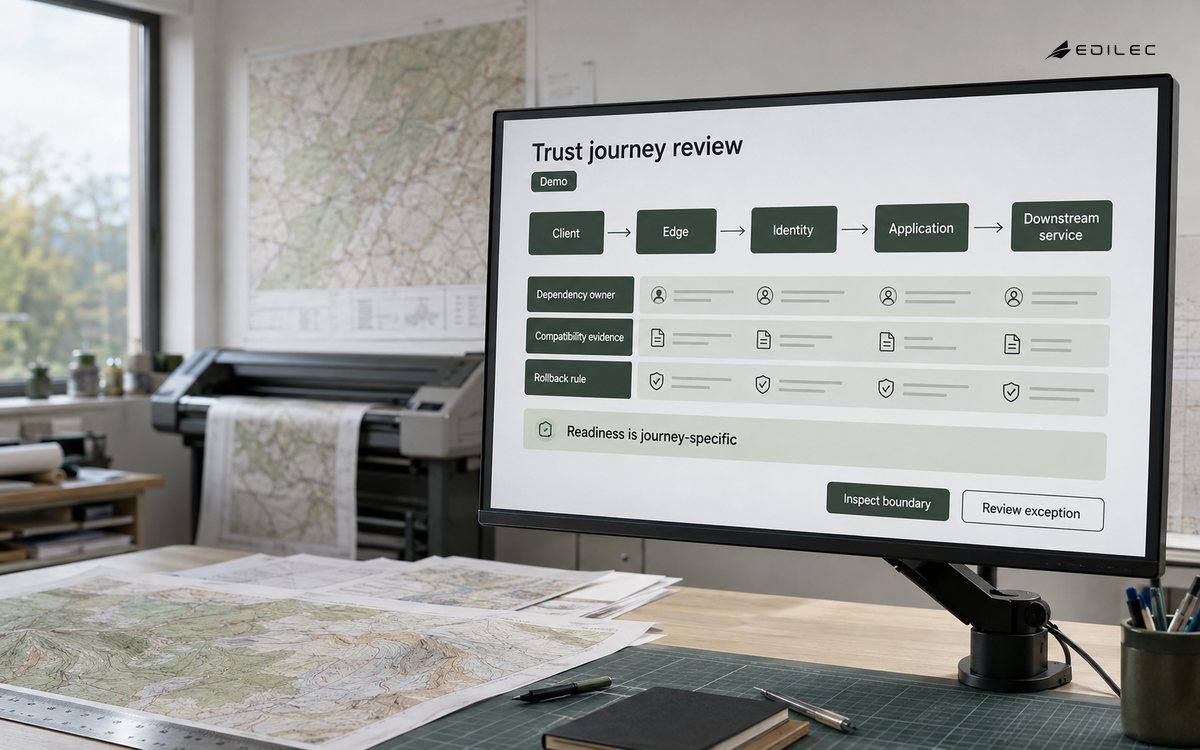
Separate provider abstraction from policy. A wrapper can reduce application changes, but it must expose security-relevant failures and not flatten different mechanisms into an unsafe lowest common denominator. Design key management for larger objects, different operation times and new validation constraints. Rehearse certificate and signing-key rollover before adding post-quantum algorithms. A team that cannot rotate current credentials reliably is not ready for a more complex migration.
| Workstream | Primary output | Acceptance question |
|---|---|---|
| Discovery | Owned cryptographic register and dependency graph | Can critical journeys be traced end to end? |
| Agility | Versioned interfaces, policy and rollover automation | Can an approved mechanism change without redesign? |
| Interoperability | Representative client and provider matrix | Do intended peers negotiate and verify correctly? |
| Operations | Telemetry, runbooks and retirement evidence | Can failures be contained and obsolete options removed? |
Test standards-based implementations in representative paths
Use finalized NIST algorithms through maintained, validated or otherwise appropriate implementations for the assurance context. Avoid presenting an experimental protocol draft as a final interoperability requirement. Test key generation, encapsulation or signing through the actual application interfaces, then measure handshake or message size, latency, CPU, memory, network fragmentation and failure behavior. Include older clients, enterprise proxies, service meshes, hardware modules, certificate tooling and external integrations.
Hybrid deployment can reduce transition risk when a supported protocol combines classical and post-quantum security, but it adds bytes, computation and operational states. Document how the combination works and which component selects it. Verify downgrade resistance and observe actual negotiation. Keep fallback bounded by customer cohort, reason and expiry; an indefinite classical fallback can leave the risk unchanged while creating the appearance of migration.
Deliver the program in controlled waves
Wave one establishes governance, data-lifetime analysis, inventory, supplier engagement and architecture standards. Wave two proves centrally controlled internal paths with limited client diversity. Later waves address public APIs, customer federation, signing, partner integrations and long-lived clients. Sequence by dependency readiness and risk, not by whichever demo is easiest. Each wave requires a compatibility matrix, performance baseline, rollback rule, observability and authority to pause.
Use customer communication as engineering input. Enterprise customers may terminate TLS through their own proxies, pin certificates, validate webhook signatures with older libraries or require evidence tied to contract language. Publish capability and transition information without promising unsupported dates. Offer test endpoints or sandboxes where practical. Record exceptions and compensating measures. A migration that surprises customers can become a reliability incident even when the cryptography itself is correct.
Estimate cost from change surfaces and uncertainty
Cost comes from discovery coverage, remediation, provider upgrades, interoperability laboratories, client support, dual operation, performance capacity, assurance, documentation and program management. Estimate by journey and dependency cohort. Separate readiness investment from production migration and ongoing agility. Include contract and procurement effort for cloud, identity, observability, certificate and security vendors. A quote focused only on replacing algorithms in application code omits the dominant SaaS coordination work.
Track risks including hidden cryptography, immature protocol support, incompatible clients, larger-message failure, performance regression, supplier delay, unsupported hardware, downgrade, key-management errors and false inventory confidence. Use explicit assumptions and revisit them as NIST, IETF, providers and validation programs evolve. NSA’s requirements apply specifically to National Security Systems; other organizations should not copy parameters or deadlines without mapping their own obligations and risk context.
Accept readiness through evidence, not a maturity label
Readiness acceptance should prove that critical services and long-lived data are mapped, records have owners and dates, suppliers have documented capabilities, agile interfaces are tested, and one representative path can negotiate or verify an approved post-quantum mechanism in a controlled environment. Review inventory coverage against production telemetry and procurement records. Record unresolved unknowns rather than turning incomplete discovery into a high score.
Operational acceptance includes rotation, monitoring, incident and retirement exercises. Teams should identify failed negotiation, rejected signatures and unexpected fallback without collecting secret material. Runbooks must distinguish product defect, client incompatibility and provider limitation. When old algorithms are retired, remove configuration, credentials and trust paths deliberately. The program becomes durable when cryptographic dependency review enters normal architecture, procurement, release and service-management work.
Review post-quantum cryptography readiness for saas: scope, cost, risks and delivery plan as a living operating capability after launch. At each review, compare the documented boundary with production configuration, recent incidents, support work, supplier changes and measured outcomes. Sample evidence rather than relying only on aggregate status. Record decisions, owners and due dates, and retire controls or reports that no longer support a real risk or business need. This cadence keeps architecture, policy and day-to-day practice aligned as customer volume, integrations, regulations and team responsibilities change.
Key takeaways
- Prioritize SaaS cryptography by trust journey, data lifetime, exposure and replacement lead time.
- Build an owned dependency graph, not only a certificate inventory.
- Establish tested crypto agility before broad production replacement.
- Use finalized standards while treating protocol drafts and provider roadmaps according to their maturity.
- Budget for clients, suppliers, interoperability, dual operation and retirement evidence.
Frequently asked questions
Should SaaS companies start post-quantum work now?
Yes. Inventory, data-lifetime analysis, supplier engagement, crypto-agility improvements and controlled testing are useful now. Production migration timing should follow risk, finalized standards, supported protocols, appropriate implementations and customer interoperability.
Does PQC require replacing symmetric encryption?
The main quantum threat addressed by current migration planning is to public-key cryptography used for key establishment and signatures. Symmetric and hash choices still require appropriate parameters and lifecycle management, but they are not replaced in the same way as RSA or elliptic-curve public-key mechanisms.
Is quantum key distribution an alternative for ordinary SaaS?
QKD requires specialized physical links and operational assumptions. NSA states that post-quantum cryptography is generally more cost-effective and maintainable for its context. Internet SaaS products normally prioritize standards-based PQC and crypto agility rather than dedicated QKD infrastructure.
What makes a SaaS PQC readiness assessment complete?
Completion means defined critical scope, evidence-backed inventory, risk prioritization, supplier status, target architecture, tested representative paths, funded waves, operational runbooks and a process that keeps the inventory current. A scanner export alone is not a readiness assessment.
Conclusion
Post-quantum readiness for SaaS is a dependency and lifecycle program. The practical sequence is to understand sensitive journeys, discover cryptography, build agility, test standards-based mechanisms with real clients and providers, and migrate in observable waves. That approach creates value before a full production transition: it reduces hidden dependency risk, improves current credential rotation and gives customers a credible plan grounded in evidence rather than quantum timelines or vendor claims.