Quantum computing advancements are accelerating, but current quantum computers cannot break modern encryption. The real threat lies in the future capability of quantum computers to compromise cryptographic systems within decades. Businesses must act now to implement crypto agility—a strategic shift toward cryptographic systems that can be rapidly updated without disrupting operations. This article provides a practical roadmap for business teams to achieve this transition without waiting for quantum computing to become a viable threat. The focus is on actionable steps, not theoretical timelines, ensuring organizations can prepare for quantum threats while maintaining operational continuity.
What is Crypto Agility?
Crypto agility refers to the ability of a system to rapidly change cryptographic algorithms and keys without significant operational disruption. Unlike traditional systems that lock cryptographic protocols in place, crypto-agile systems allow for seamless transitions between encryption methods. This capability is critical in the face of evolving threats, particularly quantum computing advancements. The National Institute of Standards and Technology (NIST) defines crypto agility as a foundational requirement for modern cybersecurity strategies, emphasizing its role in maintaining resilience against emerging threats.
- Crypto agility enables organizations to switch encryption algorithms without reconfiguring entire systems.
- It supports rapid key rotation and updates in response to new vulnerabilities.
- It reduces the risk of long-term cryptographic exposure by allowing frequent updates.
Why Business Teams Need to Act Now
Business teams often delay crypto agility initiatives due to perceived complexity and cost. However, the consequences of inaction are severe. Quantum computers could break current public-key cryptography on an uncertain future timeline, rendering existing encryption obsolete. This timeline is shorter than many organizations expect, making proactive preparation essential. The National Cybersecurity Center of Excellence (NCCOE) highlights that businesses must start planning now to avoid costly, disruptive transitions later.
The urgency stems from the fact that many organizations still rely on outdated cryptographic standards. For example, RSA-2048, widely used for secure communications, is vulnerable to quantum attacks once sufficiently powerful quantum computers exist. While current quantum computers lack the processing power to break these standards, the risk is not theoretical—it is a matter of time. Business teams must prioritize crypto agility to protect sensitive data and maintain trust with stakeholders.
The NIST Post-Quantum Cryptography Standard
NIST has been standardizing post-quantum cryptography (PQC) since 2016. The process involves selecting algorithms that are resistant to quantum attacks while maintaining efficiency. The current standard includes lattice-based, hash-based, and multivariate algorithms. Lattice-based cryptography, such as the CRYSTALS-Kyber algorithm, is the most promising for widespread adoption due to its balance of security and performance. This standard provides a clear path for businesses to transition to quantum-resistant encryption without waiting for quantum computers to become viable threats.
| Algorithm Type | Example Algorithms | Security Level | Use Case |
|---|---|---|---|
| Lattice-Based | CRYSTALS-Kyber | High | Secure communications, key exchange |
| Hash-Based | SPHINCS+ | Very High | Digital signatures |
| Multivariate | Rainbow | Medium | Short-term digital signatures |
Practical Steps for Business Teams
Business teams can implement crypto agility through a series of concrete actions. First, conduct a cryptographic asset inventory to identify systems using vulnerable algorithms. Second, prioritize critical systems for migration based on risk exposure. Third, develop a phased migration plan that aligns with business cycles rather than technical timelines. This approach ensures that resources are allocated efficiently without disrupting daily operations.

- Perform a cryptographic asset inventory to identify vulnerable systems.
- Prioritize critical systems based on data sensitivity and business impact.
- Develop a phased migration plan that aligns with business cycles and operational needs.
Quantum Threat Assessment
A thorough quantum threat assessment helps businesses understand their exposure to quantum attacks. This involves evaluating the current cryptographic standards in use, assessing the potential impact of quantum decryption, and identifying systems that could be compromised. The assessment should focus on critical assets like customer data, financial records, and intellectual property. Organizations must also consider the time until quantum computers become capable of breaking current encryption standards.
For instance, a business using RSA-2048 for secure communications may need to migrate to a quantum-resistant algorithm on an uncertain future timeline to avoid future vulnerabilities. However, the exact timeline depends on the organization's current infrastructure and the rate of quantum computing advancements. The National Cybersecurity Center of Excellence emphasizes that businesses should start with a realistic assessment of their quantum threat exposure rather than speculative timelines.
Key Implementation Challenges
Crypto-agility work also has to fit legacy constraints, product support, operational windows, procurement, and applicable legal or contractual obligations. Do not treat a cryptographic library upgrade as proof that every protocol, certificate, key store, device, archive, and partner path can change safely. Record the owner and evidence for each dependency, and involve qualified legal and compliance specialists where retention, signatures, identity, or regulated records are affected.
One significant challenge is the need for key rotation. In traditional systems, keys are rotated periodically, but in crypto-agile systems, keys must be updated more frequently to maintain security. This requires robust key management infrastructure and processes to ensure seamless transitions without compromising data integrity.
| Challenge | Impact | Mitigation Strategy |
|---|---|---|
| Legacy system integration | Disruption in critical operations | Phased migration with minimal downtime |
| Resource constraints | Delayed migration timelines | Prioritize high-risk systems first |
| Regulatory compliance | Legal and financial penalties | Align with existing compliance frameworks |
Business Impact of Delayed Action
Delaying crypto agility initiatives can have severe business consequences. Organizations that do not act may face data breaches, loss of customer trust, and regulatory fines. For example, a financial institution that continues to use RSA-2048 without transitioning to quantum-resistant algorithms could experience a breach after a cryptographically relevant quantum computer becomes available, creating potentially material remediation, continuity, and trust costs.
The financial impact of delayed action is compounded by the need for emergency migration after quantum computers become viable. Businesses that have not prepared may face higher costs due to the complexity of retrofitting systems and the potential for operational disruptions. The National Institute of Standards and Technology warns that organizations must balance short-term operational needs with long-term security requirements to avoid catastrophic outcomes.
Quantum Agility vs. Quantum Readiness
Quantum agility refers to the ability to rapidly adapt cryptographic systems in response to evolving threats, while quantum readiness involves preparing for the potential impact of quantum computing. Business teams must distinguish between these concepts to avoid confusion. Quantum agility is a proactive strategy that ensures systems can be updated quickly, whereas quantum readiness focuses on mitigating the effects of quantum threats once they materialize.
Business teams often conflate quantum agility with quantum readiness, leading to misaligned strategies. Quantum agility is about the capability to change cryptographic systems without disruption, while quantum readiness addresses the preparedness for potential quantum threats. Organizations that focus solely on quantum readiness without implementing quantum agility may find themselves unprepared for rapid changes in cryptographic standards.
Quantum Threats Demanding Immediate Crypto Agility: A Business-First Roadmap
Quantum attack vectors and impact assessment
Quantum adversaries can exploit Shor's algorithm to break RSA and ECC, while Grover's algorithm reduces brute-force search complexity. Organizations must identify cryptographic assets with high exposure to quantum attacks, including legacy systems using asymmetric encryption for secure communications and digital signatures. Impact assessments should prioritize systems where data confidentiality or integrity is critical, such as financial transactions, government communications, and intellectual property protection.
Post-quantum cryptography selection criteria
Selecting post-quantum cryptographic algorithms requires evaluating NIST-standardized candidates like CRYSTALS-Kyber for key encapsulation and CRYSTALS-Dilithium for digital signatures. Organizations must assess algorithm performance in high-latency environments, side-channel attack resilience, and compatibility with existing infrastructure. The selection process should include testing with real-world data to validate performance metrics under operational conditions.
- NIST-standardized lattice-based algorithms (CRYSTALS-Kyber, CRYSTALS-Dilithium) for robust post-quantum security
- Hybrid approaches combining classical and post-quantum algorithms to ensure backward compatibility
- Performance benchmarks for latency, memory usage, and computational overhead in real-world scenarios
Quantum attack mitigation strategy
Implementing quantum-resistant cryptographic protocols requires phased migration strategies that minimize operational disruption. Organizations should establish a quantum-safe fallback mechanism for critical systems, such as using temporary RSA keys with a 2048-bit modulus for systems transitioning to post-quantum cryptography. Continuous monitoring of quantum threat intelligence feeds is essential to detect emerging attack vectors and adjust mitigation strategies proactively.
Failure handling must include automated rollback procedures for cryptographic migrations, ensuring that systems revert to pre-migration states if post-quantum implementation fails. Organizations should conduct regular stress tests to validate the resilience of quantum-resistant systems under high load conditions and simulate quantum attack scenarios to identify vulnerabilities before they are exploited.
Governance for quantum readiness
Quantum readiness governance requires cross-functional teams to oversee cryptographic transitions, including IT security, compliance, and business operations. Establishing a quantum readiness committee with authority to approve migration timelines and budget allocations ensures alignment with business objectives. Regular audits of cryptographic asset inventories must be conducted to track the status of systems transitioning to post-quantum cryptography.
- Cross-functional quantum readiness committee with IT security, compliance, and business operations representatives
- Quarterly audits of cryptographic asset inventories to track migration progress
- Clear escalation paths for quantum security incidents to ensure rapid response
Key takeaways
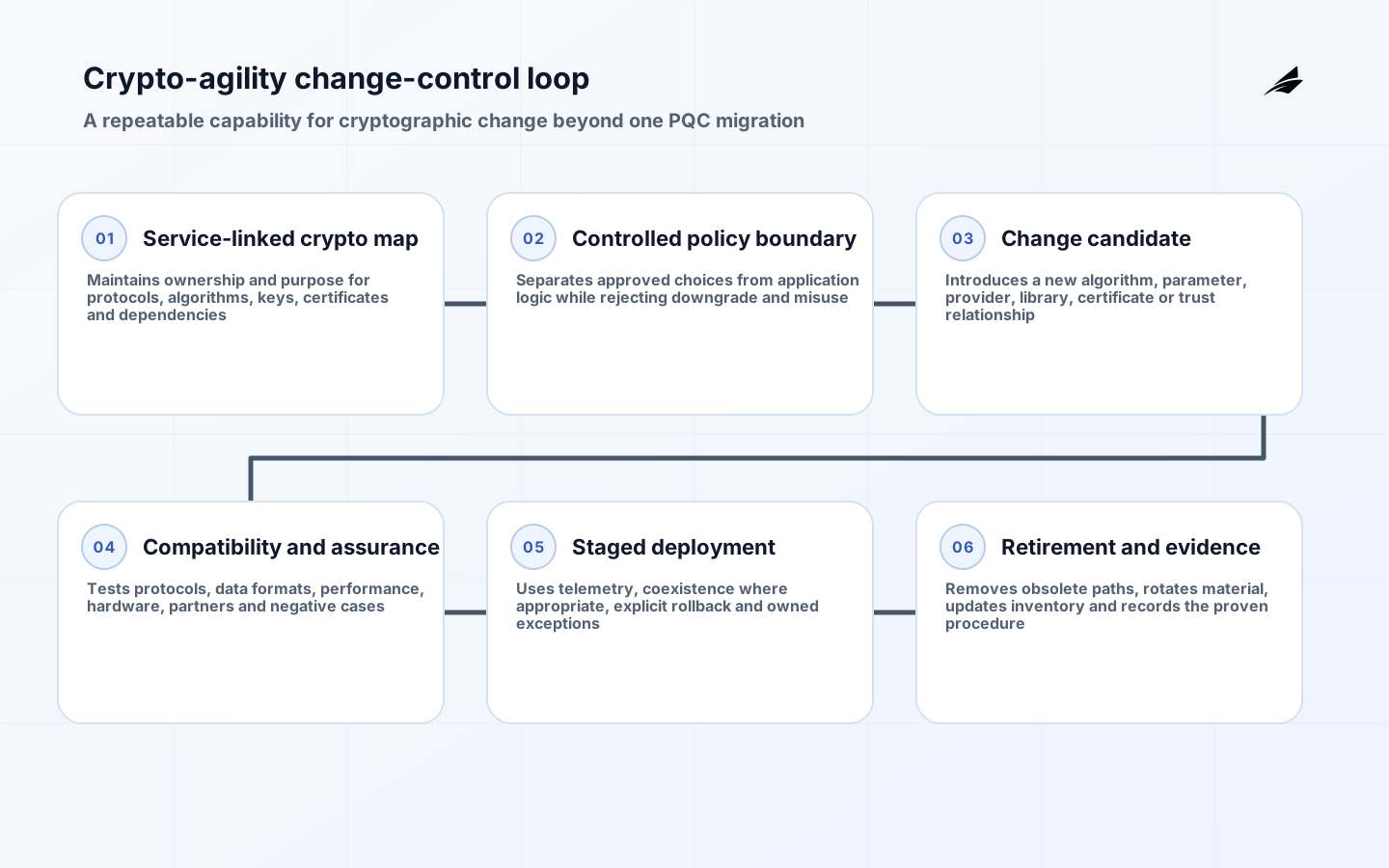
- Crypto agility is the repeatable ability to locate, change, test, deploy, and retire cryptographic mechanisms; it is broader than one PQC upgrade.
- Build an inventory around cryptographic use and dependencies, not only algorithm names in source code.
- Separate policy from implementation where feasible, but preserve explicit constraints so arbitrary or downgraded algorithms cannot be selected.
- Exercise certificate, key, protocol, library, hardware, partner, archive, and rollback changes before an emergency forces them.
- Use PQC migration as a concrete test of the organization’s change capability while following current standards and product guidance.
Frequently asked questions
Is crypto agility the same as post-quantum readiness?
No. Post-quantum readiness addresses migration away from quantum-vulnerable public-key cryptography. Crypto agility is the broader capability to change cryptographic algorithms, parameters, keys, certificates, protocols, implementations, and trust relationships for many reasons, including vulnerabilities, policy changes, interoperability, and PQC.
What belongs in a cryptographic inventory?
Record the business service, data or transaction protected, cryptographic purpose, protocol, algorithm and parameters where observable, implementation and library, key and certificate stores, hardware dependencies, owners, vendors, partners, environments, exposure, data lifetime, and tested replacement path. Discovery tools help, but interviews, configuration review, traffic observation, procurement records, and validation are also needed.
Should applications be allowed to choose any algorithm through configuration?
No. Agility should not become unrestricted choice. A controlled policy layer should permit approved combinations for a defined context, reject downgrades, preserve interoperability requirements, and produce evidence of the active configuration. Changes need authorization and testing because algorithm substitution can alter key sizes, messages, performance, hardware support, and failure behavior.
Which systems should be made agile first?
Prioritize systems that protect long-lived sensitive data, sign software or firmware, anchor identity or trust, have wide dependencies, require long procurement cycles, or cannot be updated easily. Combine consequence, exposure, secrecy lifetime, technical feasibility, and vendor readiness rather than relying on a speculative date for a quantum computer.
Conclusion
A credible crypto-agility roadmap turns cryptography from an invisible fixed dependency into an owned change process. Begin with service-linked discovery, select a representative migration slice, prove interoperability and operational evidence, and close the loop by retiring old mechanisms and updating the inventory. PQC provides urgency and a valuable test case, but the durable outcome is the ability to respond safely to the next cryptographic change without rediscovering every dependency under incident pressure.