Post quantum cryptography readiness services for enterprise teams should produce an owned inventory, risk-based migration roadmap and tested ability to change cryptography. They should not begin with a blanket replacement project or an unsupported date prediction for a cryptographically relevant quantum computer. The immediate business problem is long migration lead time, hidden dependencies and data that may need confidentiality beyond the lifetime of current public-key protections.
This FAQ is for security, architecture, infrastructure, procurement and product teams. Use the enterprise PQC delivery plan and enterprise readiness checklist for program execution. The broader PQC implementation checklist provides additional control detail.
Which post-quantum standards are ready to use?
NIST finalized FIPS 203 for ML-KEM, FIPS 204 for ML-DSA and FIPS 205 for SLH-DSA in August 2024. ML-KEM supports key establishment; ML-DSA and SLH-DSA support digital signatures. NIST selected HQC for future standardization as an additional key-establishment option, but selection is not the same as a final FIPS. Enterprises should follow applicable regulator, customer and protocol guidance rather than choosing algorithms directly from academic candidates.
A standardized algorithm still needs correct protocol integration, implementation, validation, key management and interoperability. Use maintained libraries, hardware, cloud services and products that identify the exact approved algorithm and mode. Do not create proprietary hybrid constructions or replace well-reviewed protocols with raw cryptographic primitives. National security systems should follow current NSA and CNSS policy, which may differ from general enterprise guidance.
| Need | Current planning reference | Enterprise action |
|---|---|---|
| Key establishment | NIST FIPS 203, ML-KEM | Track protocol and product support; test performance |
| Primary signatures | NIST FIPS 204, ML-DSA | Assess code signing, documents, identity and PKI |
| Hash-based signatures | NIST FIPS 205, SLH-DSA | Evaluate where its properties and size fit |
| Diverse future KEM | HQC selected for standardization | Monitor; do not treat selection as final standard |
| Transition capability | NIST crypto-agility guidance | Remove hard-coded algorithms and parameters |
How should an enterprise prioritize quantum risk?
Prioritize by information lifetime, exposure, cryptographic function, replacement lead time and business consequence. Data that must remain confidential for many years deserves early attention because it can be collected now and attacked later. Long-lived firmware signatures, device roots, code-signing systems, certificates embedded in equipment and products with slow replacement cycles can also require early design changes even when day-to-day confidentiality is short.
Create a scoring model the business can challenge. Include data sensitivity and required protection period, whether traffic is externally observable, algorithm and key size, product support horizon, asset lifecycle, protocol dependency and migration reversibility. Separate key establishment, encryption and signatures; their risks and replacement paths differ. Review priorities when NIST, protocol bodies, suppliers or sector authorities update guidance.
What belongs in a cryptographic inventory?
Inventory where cryptography is used in applications, services, networks, certificates, PKI, secrets management, databases, backups, messaging, file exchange, code signing, firmware, devices and third-party products. For each occurrence, record owner, business service, data or artifact protected, algorithm, parameters, library or product, protocol, key location, certificate authority, dependency, environment and replacement mechanism. Link findings to software and hardware inventories rather than creating an isolated spreadsheet.
Discovery tools can inspect code, binaries, network traffic, configurations and certificate stores, but no single method sees everything. The NCCoE migration project treats cryptographic discovery and interoperability as distinct workstreams. Combine automated scans with architecture review, supplier questionnaires and operator interviews. Validate a sample manually and record coverage limits. Unknown ownership is itself a risk requiring remediation.
What evidence should suppliers provide?
Ask for the product's cryptographic inventory, affected features, supported PQC algorithms and protocols, implementation availability, validation status, hybrid or transition approach, performance constraints, upgrade path, fallback behavior, telemetry and retirement plan for vulnerable algorithms. Require exact versions and dates rather than a 'quantum safe' label. Clarify which migration actions belong to the supplier, integrator and customer.
Include cryptographic change in procurement and renewal. Contracts should address security updates, support lifetime, data export, incident notification and evidence needed to verify configuration. For embedded or operational technology, ask whether key sizes, memory, bandwidth and trust stores can accommodate change. A roadmap is useful only when it aligns with the enterprise's required protection period and replacement window.
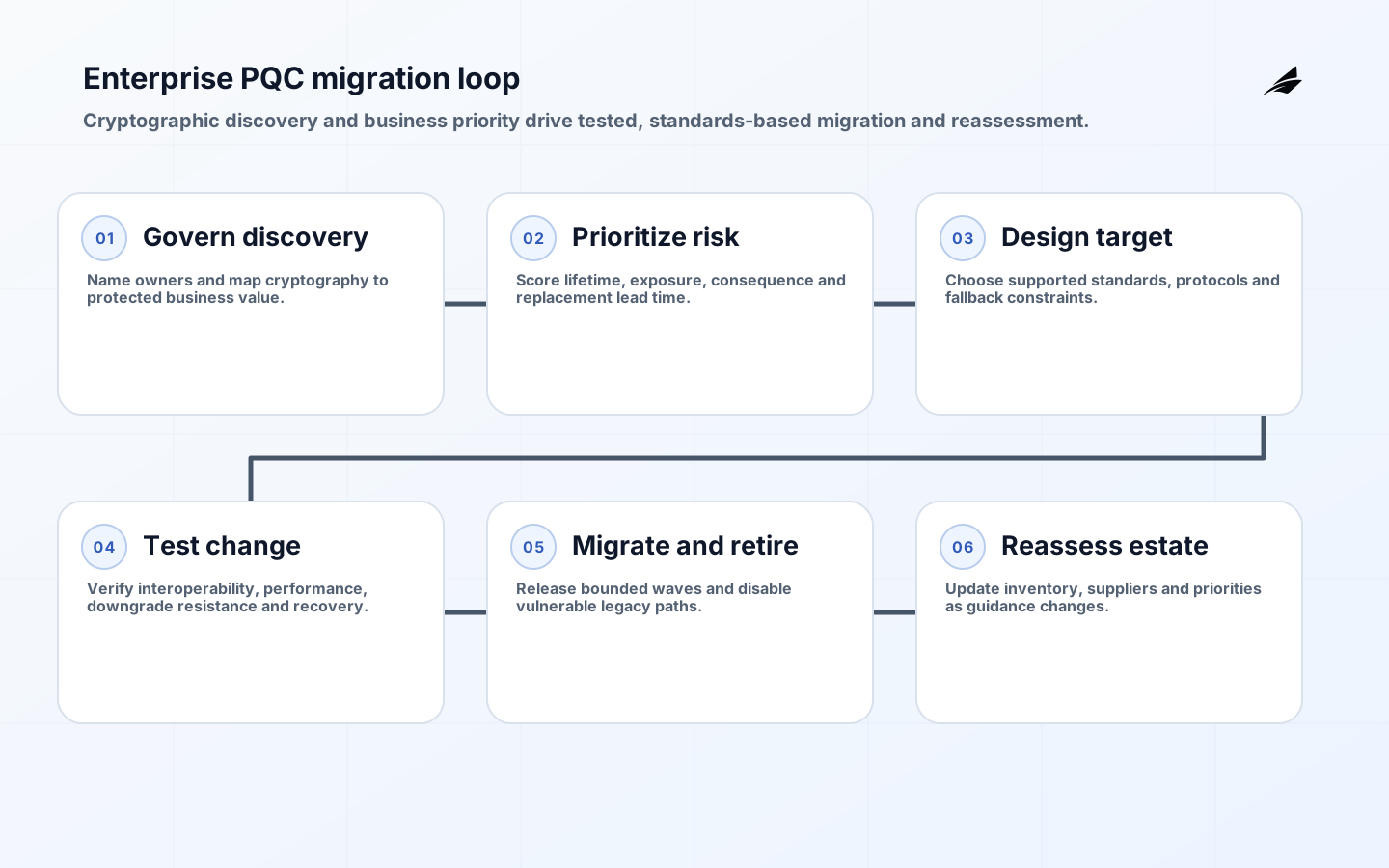
How should the PQC migration loop work?
- Govern: name executive, cryptographic, asset and service owners.
- Discover: map cryptography to data, business services and dependencies.
- Prioritize: score exposure, protection lifetime, consequence and lead time.
- Design: choose standards-based target patterns and fallback constraints.
- Test: verify interoperability, performance, observability and recovery.
- Migrate: release in bounded waves and disable vulnerable paths when approved.
- Reassess: update inventory and priorities as standards and products change.

Start with a representative, reversible path such as a test certificate chain, service connection or signing workflow whose consumers are known. Measure handshake size, latency, CPU, memory, certificate or signature size, logging, middlebox compatibility and failure behavior. Test mixed-version environments and downgrade resistance. Hybrid modes may help transition in some protocols, but they add complexity and must come from the protocol or product specification, not local invention.
What does crypto agility require?
NIST defines crypto agility as capabilities to replace and adapt algorithms across protocols, applications, software, hardware, firmware and infrastructure while preserving security and operations. In practice, avoid algorithm-specific database fields, fixed buffer assumptions and scattered configuration. Centralize approved policy where appropriate, expose version and algorithm telemetry, support staged rotation, and keep rollback constrained so an emergency response does not silently restore an unsafe option.
Test agility through exercises. Replace an algorithm or certificate profile in a non-production path, identify every consumer, observe errors and measure restoration. Include business continuity, supplier escalation and customer communication. The goal is not unlimited runtime switching; it is a governed ability to make future cryptographic changes without rediscovering the estate or interrupting critical service unexpectedly.
| Readiness evidence | Why it matters | Owner |
|---|---|---|
| Coverage-scored crypto inventory | Shows known and unknown exposure | Security architecture and asset owners |
| Data protection lifetime map | Prioritizes harvest-now risk | Data and risk owners |
| Supplier migration evidence | Exposes external lead times | Procurement and service owner |
| Interoperability test results | Finds protocol and performance limits | Engineering and platform teams |
| Algorithm retirement proof | Confirms old path is unavailable | Change owner and assurance |
| Updated recovery runbook | Prevents unsafe emergency fallback | Operations and incident command |
How should timelines and governance be set?
NIST's current PQC project guidance says organizations should begin migration and describes a transition in which quantum-vulnerable algorithms are deprecated and ultimately removed from NIST standards by 2035, with high-risk systems moving earlier. That is not a universal deadline for every private system or permission to wait. Set internal dates from protection lifetime, asset replacement cycles, supplier readiness and applicable policy.
Create a cross-functional steering group with authority over architecture standards, procurement, risk acceptance and migration waves. Track inventory coverage, unknown owners, high-priority findings, supplier commitments, tested paths, migrated services and retired algorithms. Document exceptions with expiry and compensating controls. Budget for discovery and lifecycle work, not only new cryptographic libraries; integration, certificates, hardware and operational change often dominate effort.
How should legacy algorithms be retired and assured?
After migration, remove vulnerable algorithms from negotiation, trust stores, configuration, build paths and disaster-recovery images according to approved policy. Confirm that clients cannot downgrade to the old option and that emergency runbooks do not restore it. Re-scan the service and observe production telemetry for negotiated algorithms, certificate profiles and failed legacy attempts. Keep the evidence linked to the original inventory record.
Independent assurance should sample high-priority migrations, reproduce configuration, inspect protocol behavior and verify ownership rather than re-run the same discovery report. Update architectural standards, approved libraries and procurement requirements so new projects do not reintroduce quantum-vulnerable dependencies. Feed retired findings and unexpected compatibility failures into the discovery method; inventory quality should improve with each wave.
Decommission temporary hybrid endpoints, test certificates and compatibility bridges after their defined transition purpose ends. Long-lived transition machinery can become a poorly monitored attack surface. Record residual exposure where a supplier or protocol is not ready and reassess it at a date tied to evidence, not an open-ended waiver. Include that exposure in recurring service, architecture and supplier risk reviews.
Key takeaways
- Use finalized NIST standards through supported protocols and products.
- Prioritize by protection lifetime, exposure, consequence and replacement lead time.
- Build an owned cryptographic inventory with explicit coverage limitations.
- Demand version-specific supplier evidence instead of broad readiness claims.
- Test interoperability and crypto agility before high-consequence migration waves.
Frequently asked questions
Does quantum risk require replacing AES?
The principal urgent migration concerns are quantum-vulnerable public-key algorithms used for key establishment and signatures. Symmetric cryptography is affected differently. Follow current NIST parameter and sector guidance rather than assuming every cryptographic primitive needs the same replacement path.
Is quantum key distribution the enterprise answer?
It is a different technology with specialized infrastructure and operational limitations. NSA does not recommend quantum key distribution for national security systems unless identified limitations are overcome. Most enterprise readiness programs should focus on standardized post-quantum cryptography and crypto agility in existing digital systems.
Should companies wait for a confirmed quantum-computer date?
No. The useful planning variables are data protection lifetime, system replacement time and dependency complexity, not a speculative breakthrough date. Inventory and agility improve current cryptographic governance even if threat timing changes.
Conclusion
Enterprise PQC readiness is a controlled modernization program. Know where vulnerable public-key cryptography protects long-lived value, prioritize it with business owners, test standards-based replacements and prove that legacy paths are retired. An enduring inventory and crypto-agile operating model matter as much as the first algorithm migration because cryptographic change will not end with this transition.