A crypto agility roadmap prepares an organization to replace cryptographic algorithms, protocols, keys, libraries and dependent products without losing security or continuity. It is broader than a post-quantum project. Certificate expiry, protocol flaws, implementation vulnerabilities, policy changes and supplier end-of-life can all force transitions. NIST’s updated crypto-agility guidance emphasizes operational mechanisms as well as strategy, which means the roadmap must connect discovery, ownership, architecture, testing, deployment and evidence.
Post-quantum migration makes that capability urgent. NIST has standardized ML-KEM, ML-DSA and SLH-DSA, while CISA, NSA and NIST advise organizations to build a quantum-readiness roadmap and inventory vulnerable public-key cryptography. The implementation challenge is not simply selecting an algorithm. Teams need to locate cryptography embedded in protocols, code, devices, documents, identities, partners and recovery paths; determine which suppliers support safe transitions; and prove that changed formats, performance and trust chains work end to end.
Set governance and transition triggers
Assign an executive risk owner, cryptographic architecture owner and system-level owners. Define approved mechanisms, exceptions, evidence and change authority. The policy should not hard-code one timeless list; it should describe how algorithms become approved, restricted or prohibited and how urgent changes are communicated. Establish triggers such as a new standard, credible cryptanalysis, implementation vulnerability, supplier notice or regulatory deadline. Each trigger needs a triage route that can assess exposure and order work.
Separate confidentiality and signature risk. Long-lived encrypted data can be exposed to harvest-now-decrypt-later attacks, while signatures protect software updates, identities, transactions and retained records. A system may require both ML-KEM migration for key establishment and a different plan for signatures. Record data secrecy lifetime, key lifetime, artifact validation lifetime and replacement lead time. This prevents a visible TLS upgrade from being mistaken for completion while code signing or embedded devices remain unchanged.
| Inventory object | Fields to capture | Why it changes priority |
|---|---|---|
| Protocol endpoint | Version, cipher, certificate, peer and data class | Shows exposed network negotiation and interoperability |
| Application library | Package, version, API, algorithm and owner | Finds hard-coded or duplicated implementation |
| Key and certificate | Purpose, store, lifetime, issuer and rotation path | Reveals trust-chain and replacement constraints |
| Signed artifact | Producer, verifier, algorithm and validation lifetime | Protects software, documents and evidence |
| Device or appliance | Firmware, hardware root, supplier and support date | Identifies long lead-time and non-upgradable assets |
| Partner interface | Contract, format, test contact and cutover window | Makes external coordination visible |
Build a living cryptographic inventory
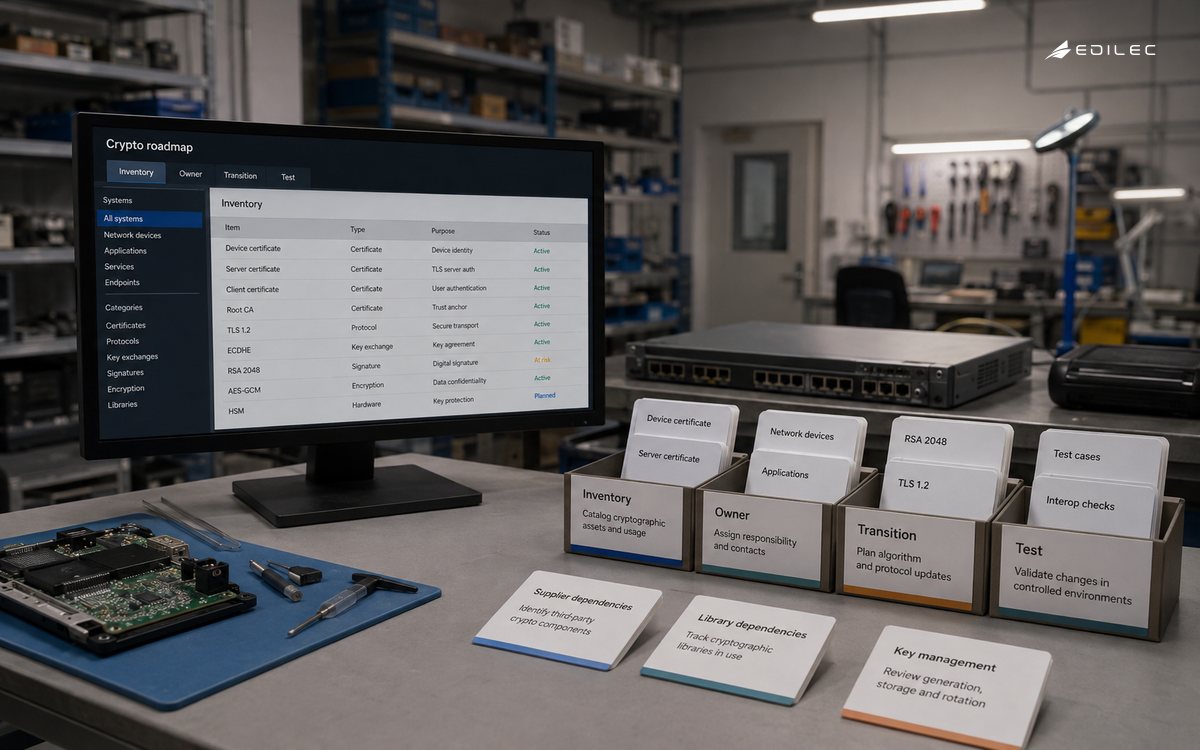
Combine configuration scans, certificate records, source and dependency analysis, network observations, key-management logs, architecture documents, procurement data and owner interviews. No single scanner sees cryptography inside application payloads, hardware, partner formats or dormant recovery procedures. Store the inventory in a system that supports relationships: service to endpoint, endpoint to library, library to algorithm, key to owner and business process to confidentiality requirement. Record confidence and last verification rather than presenting unknowns as complete data.
Prioritize by consequence and transition difficulty. Consider sensitive-data lifetime, external exposure, signature lifetime, criticality, algorithm vulnerability, supplier readiness, testability and number of dependent parties. Group repeated technologies into migration patterns, but preserve system-specific acceptance. A shared load balancer upgrade can cover many endpoints; a payment terminal, archived signature or manufacturing device may need a separate path. Procurement should require cryptographic inventories, supported alternatives, update mechanisms and transition timelines from suppliers.
Remove algorithm choices from business logic
Create controlled cryptographic interfaces or services so applications request an outcome—establish a secure channel, sign an artifact, protect a field—without constructing algorithms directly. Centralization can improve policy and observability, but it must not become a fragile universal dependency. Use supported platform libraries and hardware security modules where appropriate, version interfaces and preserve algorithm identifiers with protected data. Formats must be self-describing enough to support old and new material during a transition.
Design for coexistence. Large migrations rarely switch every producer and consumer simultaneously. Plan dual trust, dual verification or hybrid establishment only where standards and product support make the construction defensible. Avoid inventing cryptographic combinations. Define downgrade resistance, negotiation policy and the moment old mechanisms stop being accepted. Keep rollback bounded: operational rollback may restore a compatible release, but it must not silently re-enable a mechanism already prohibited for security reasons.
Test transitions across complete workflows
Create interoperability fixtures for certificates, keys, messages, documents and signed artifacts. Test generation, storage, distribution, use, rotation, revocation, recovery and destruction. Measure payload and signature size, handshake latency, memory, CPU and hardware capacity under representative load. Exercise old-to-new, new-to-old, mixed fleet, expired trust, unknown algorithm and corrupted material. For retained records, prove that future verification remains possible under the approved archival model.
Include operational failure: a key service unavailable, a supplier device not upgraded, a certificate chain rejected, a queue holding old-format messages or a disaster-recovery environment restored from an earlier image. Capture logs without secret material and make algorithm use observable by service and version. A migration dashboard should distinguish inventory discovered, owner confirmed, design approved, test passed, deployed and legacy disabled. Counting upgraded endpoints alone conceals unsupported verifiers and dormant paths.
Deliver the roadmap in controlled waves
Start with inventory and policy foundations, then select representative pilots: one externally negotiated protocol, one internal application, one signing workflow and one constrained device if relevant. Use the pilots to discover library, format, performance and supplier constraints before scheduling the fleet. Sequence high-risk and long-lead systems early, but do not begin with the least understood critical service. Establish canary cohorts, stop criteria and support coverage for each wave.
Every migration item should name owner, dependency, target mechanism, prerequisite, test evidence, deployment window, rollback boundary and retirement proof. Track exceptions with expiry and compensating controls. Update incident response and recovery documentation because emergency certificates, offline backups and golden images can reintroduce old cryptography. When a wave completes, verify that deprecated algorithms are disabled and remove unused code, keys and trust anchors rather than leaving a permanent compatibility mode.
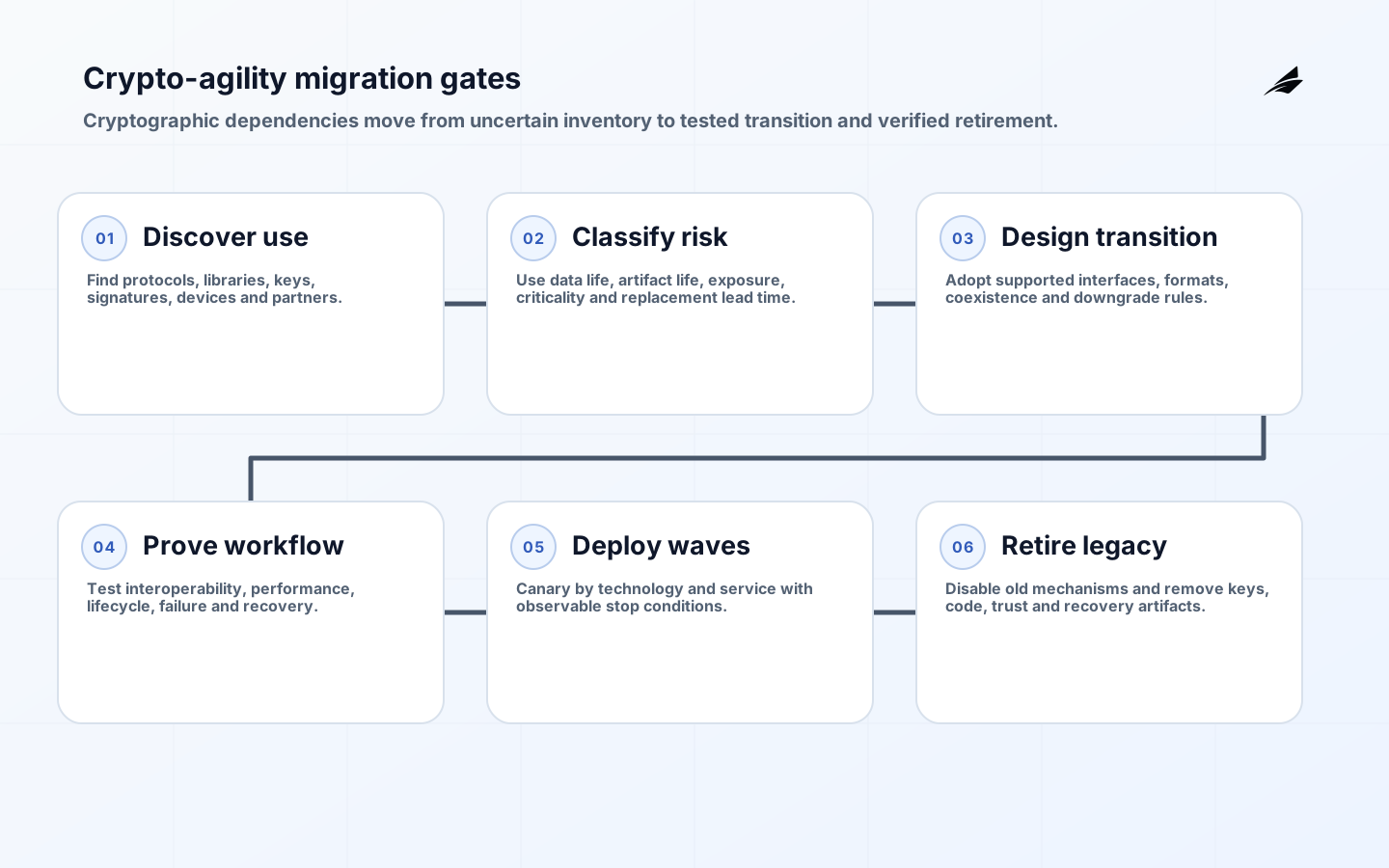
| Roadmap gate | Required evidence | Completion decision |
|---|---|---|
| Discover | Correlated inventory with owner and confidence | Scope is measurable and unknowns are explicit |
| Classify | Data lifetime, signature lifetime, criticality and exposure | Priority reflects risk and lead time |
| Design | Supported standard, interface, coexistence and rollback plan | No bespoke cryptography or silent downgrade |
| Prove | Interoperability, performance, lifecycle and recovery tests | Complete workflow supports the transition |
| Deploy | Canary telemetry, incident coverage and supplier readiness | Wave can expand safely |
| Retire | Legacy use absent and old keys, code and trust removed | Compatibility does not become permanent |
Implementation checklist
Review the roadmap quarterly and whenever standards or supplier commitments change. NIST publications should be treated as authoritative inputs, while actual product support and applicable regulation determine deployment timing. Keep architecture, inventory and acceptance evidence together so the organization can answer where a mechanism is used and how quickly it can change. Crypto agility becomes real only after a second transition can reuse the process without rediscovering the estate.
- Approve governance, transition triggers, exception handling and emergency change authority.
- Inventory protocols, libraries, keys, certificates, signed artifacts, devices and partner interfaces.
- Classify confidentiality lifetime, signature lifetime, consequence and replacement lead time.
- Adopt supported abstractions and self-describing formats that permit controlled coexistence.
- Test interoperability, performance, lifecycle, failure and disaster recovery end to end.
- Deploy in observable waves, disable legacy mechanisms and preserve retirement evidence.
Govern cryptographic evidence and exceptions
Create an evidence package for each system that includes inventory confidence, approved design, library and product versions, interoperability fixtures, performance results, key lifecycle tests, deployment status and retirement proof. Security architecture should review the package, but service owners must accept operational behavior. Link evidence to procurement records and supplier commitments. This allows a later vulnerability notice to identify affected systems without repeating the migration discovery.
Exceptions need a specific mechanism, system, risk, compensating control, owner and expiry. “Vendor does not support PQC” is a finding, not an indefinite acceptance. Set milestones for supplier confirmation, upgrade, replacement or isolation and escalate missed dates. Monitor for deprecated use through configuration and telemetry where possible. Review restored environments and rarely used disaster procedures because they can quietly return old certificates, keys and libraries to production.
Key takeaways
- Crypto agility is an operating capability for repeated transitions, not a one-time algorithm upgrade.
- Inventory relationships and ownership are more useful than an unqualified list of certificates.
- PQC migration must cover key establishment, signatures, devices, partners and retained artifacts.
- Coexistence and rollback require explicit downgrade and retirement rules.
- A wave is complete only when legacy use is disabled and old material is removed.
Frequently asked questions
Is crypto agility the same as post-quantum migration?
No. Post-quantum migration is a major current use case, while crypto agility also supports transitions caused by vulnerabilities, policy, supplier changes and protocol evolution. The same inventory and change mechanisms should serve both.
Should applications choose algorithms directly?
Usually not. Applications should use supported, policy-controlled interfaces that provide cryptographic outcomes. The interface and protected format must still preserve enough version information for coexistence, verification and migration.
Can an organization wait for every vendor to support PQC?
Waiting without discovery creates avoidable risk. Inventory dependencies now, add procurement requirements, identify long-lead systems and pilot supported standards. Deployment dates can follow authoritative guidance, but readiness work should precede the deadline.
Conclusion
A credible crypto-agility roadmap makes cryptography visible, owned and replaceable. It connects business lifetimes to technical dependencies, uses standardized mechanisms, proves complete workflows and retires legacy paths. That capability reduces the risk of post-quantum migration and makes the next unexpected cryptographic transition a managed change rather than an estate-wide emergency.