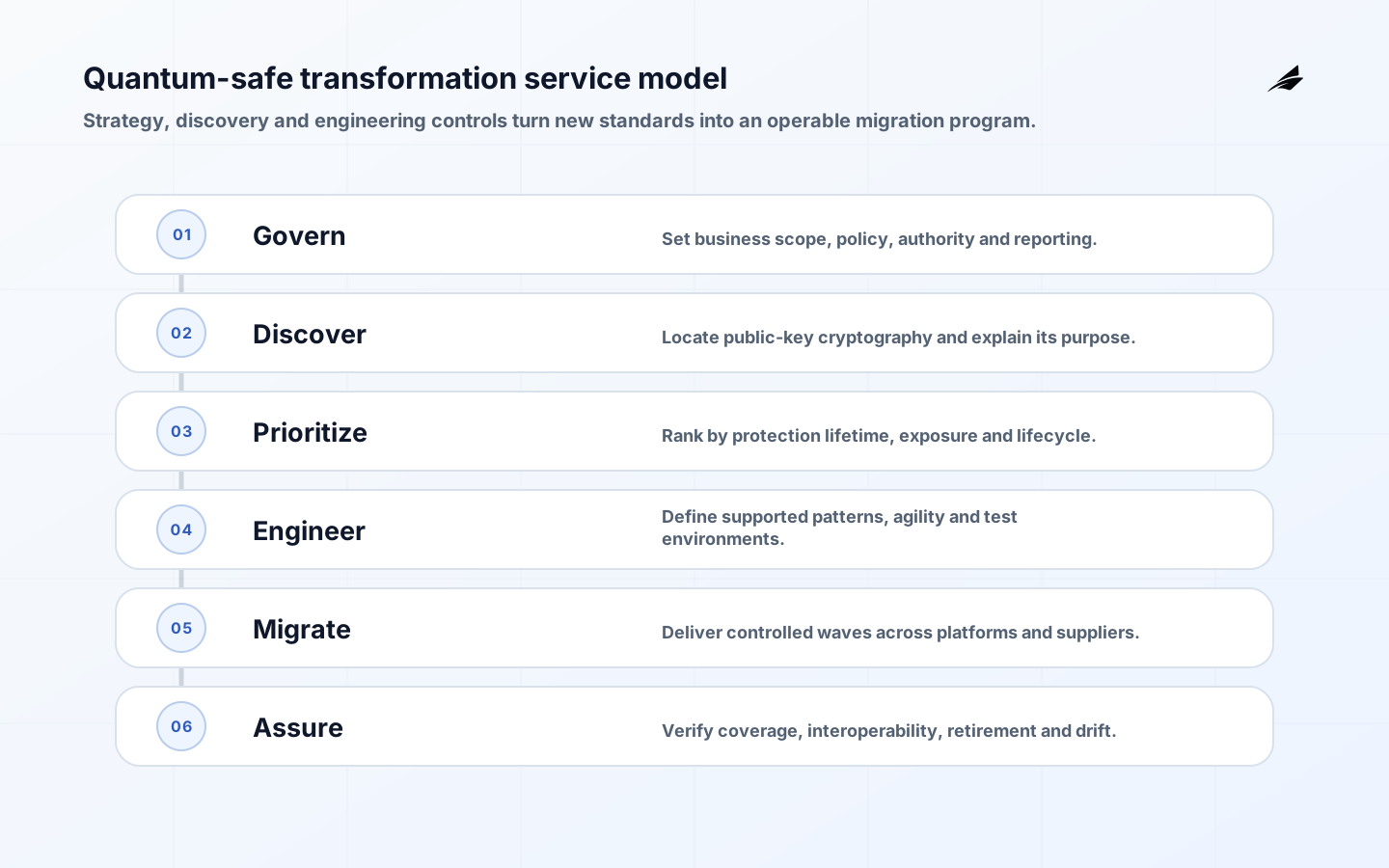
Quantum-safe transformation services help an enterprise prepare systems and data for the transition away from public-key cryptography that could be broken by a future cryptographically relevant quantum computer. The term should describe governed engineering work, not a product label. NIST has standardized ML-KEM for key establishment and ML-DSA and SLH-DSA for digital signatures. Enterprises still need to discover where vulnerable algorithms are used, understand protocol and vendor readiness, prioritize long-lived risk and migrate without disrupting identity, connectivity, signing or recovery.
This FAQ separates practical readiness from speculation. It explains what a transformation provider should deliver, how post-quantum cryptography differs from quantum key distribution, why cryptographic inventory and agility matter, and how buyers can evaluate cost and evidence. The program should improve current security hygiene while preparing for future change. Unsupported algorithms, expired certificates, unmanaged keys and undocumented supplier dependencies are present risks; a quantum-safe initiative that ignores them in favor of a distant threat is poorly governed.
What does quantum-safe mean for an enterprise?
In a practical enterprise context, quantum-safe means that applicable systems use cryptographic mechanisms and operating practices designed to remain secure against both conventional and relevant quantum attacks. For most business systems, the transition centers on standardized post-quantum cryptography implemented in software and hardware products. It does not mean every system must change at once or that a provider can guarantee security against every future development. Applicable standards, protocol profiles, validation requirements and regulatory guidance still determine what is acceptable.

The scope includes confidentiality, integrity, authentication and long-term verifiability. Key establishment protects sessions and stored-key exchange; signatures protect software, documents, identities and transactions. Data with a long secrecy lifetime may face capture-now-decrypt-later risk, while long-lived devices and archives may be hard to update. Define quantum-safe outcomes per business service: which data and artifacts need protection, for how long, on which systems, and which classical dependencies remain temporarily permitted under a governed exception.
Is post-quantum cryptography the same as quantum key distribution?
No. PQC consists of mathematical algorithms intended to run on conventional computing platforms and integrate into protocols and products. QKD uses specialized physical communication systems to distribute key material. It has distinct distance, infrastructure, authentication, availability and implementation constraints. NSA guidance for National Security Systems favors quantum-resistant algorithms over QKD unless significant limitations are overcome. Other organizations should still evaluate their own requirements, but a QKD demonstration does not replace migration of certificates, code signing, identity and internet protocols.
A provider should state which technology is proposed and why. Claims such as “unhackable” or “guaranteed by physics” are not adequate assurance. Ask for standards, threat model, implementation evidence, key lifecycle, authentication, failure modes, integration boundary and operational ownership. Most enterprise programs should begin with cryptographic discovery and supported PQC roadmaps. Specialized quantum communications may be researched separately where a justified use case, infrastructure and assurance model exist.
| Term | Practical meaning | Buyer check |
|---|---|---|
| PQC | Quantum-resistant algorithms on conventional systems | NIST standard, protocol profile and product support |
| QKD | Specialized physical key-distribution technology | Infrastructure, authentication, availability and assurance |
| Crypto agility | Ability to discover and replace cryptography safely | Inventory, abstraction, policy, testing and rollback |
| Hybrid mode | Combined classical and PQC mechanisms | Recognized profile, combination rule and downgrade controls |
What should a transformation service deliver?
The first deliverable is a decision-quality cryptographic inventory linked to services, data, owners, vendors and lifecycle. The second is a risk and dependency map that identifies long-lived confidentiality, signing needs, exposed protocols, shared PKI, libraries, appliances and supplier roadmaps. The third is an architecture pack: approved standards and profiles, implementation patterns, observability, key lifecycle, test plan and exception process. Finally, the provider should deliver pilot evidence, migration waves, cost assumptions, an owned backlog and handover materials.
Reject reports that list algorithms without purpose or recommend immediate replacement without product and protocol analysis. Every finding needs a next action and owner. Every target pattern needs compatibility, performance, security and rollback tests. Every migration wave needs entry and exit criteria. The organization should retain the inventory schema, decision records, test artifacts and supplier correspondence. Transformation is complete only when internal teams can maintain the program and detect new vulnerable dependencies after the consulting engagement ends.
How complete must cryptographic discovery be?
Perfect discovery is unrealistic in a complex estate, so measure and disclose coverage. Combine endpoint and certificate scans, code and dependency analysis, configuration review, cloud key-service records, PKI databases, network observations, device inventory and vendor attestations. Reconcile findings against application and asset inventories. Sample critical systems manually and track opaque products as unknowns. Record algorithm, parameter, protocol, key location, certificate issuer, purpose, data, environment, owner and observation method.
Treat the inventory as sensitive operational data and a maintained capability. Limit access, record changes and never collect private keys. Integrate discovery into CI, procurement and certificate management so new technology does not recreate blind spots. Track coverage by service tier and discovery method, not only finding count. A useful inventory lets leaders ask which externally exposed services still use vulnerable key establishment, which suppliers lack roadmaps and which long-lived signed artifacts need a preservation plan.
What is cryptographic agility, and why is it central?
Cryptographic agility is the ability to replace algorithms, parameters, certificates, keys and protocol configurations through a controlled process. It requires separation between business logic and cryptographic implementation, policy-controlled choices, versioned configuration, automated tests, telemetry and rollback. Simply exposing an algorithm setting can be dangerous if applications negotiate unsupported combinations or permit downgrade. Agility should narrow change risk while keeping security authority centralized and observable.
Evaluate agility by running a change. Rotate a certificate chain, change a library or protocol profile in a test environment, measure affected clients, observe negotiation, roll back and reconcile inventory. Record hard-coded algorithms, fixed-size fields, certificate pinning, firmware constraints and validation dependencies. These constraints often determine schedule more than algorithm performance. Include supplier and partner interfaces; an agile internal service cannot migrate if external clients reject the new handshake or signature.
| Program gate | Required proof | Failure response |
|---|---|---|
| Discovery gate | Coverage reconciled to critical-service inventory | Assign blind spots and additional methods |
| Pattern gate | Supported standard, profile and lifecycle design | Hold production use and resolve interoperability |
| Pilot gate | Security, performance, rollback and support tests | Fix pattern or constrain cohort |
| Wave gate | Owners, change windows, monitoring and exceptions | Delay affected systems without hiding risk |
| Closure gate | Vulnerable route retired and inventory updated | Time-bound exception with accountable risk owner |
What determines cost and business priority?
Costs are driven by estate size, discovery difficulty, unsupported products, PKI and HSM change, device replacement, protocol testing, supplier coordination and release windows. Algorithm licensing is rarely the dominant item. Estimate by archetype and dependency concentration. A centrally managed gateway may upgrade many services efficiently; an embedded fleet with long certification cycles may require capital replacement. Include dual-operation capacity, test laboratories, validation, training and long-term inventory maintenance.
Prioritize with data lifetime, exposure, system life, business consequence and migration lead time. Capture-now-decrypt-later risk increases urgency for long-lived confidential information, while code signing and identity protect integrity and authenticity. Do not divert all funding from current vulnerability management. Use lifecycle events such as platform upgrades and contract renewals to reduce incremental cost. Report ranges and confidence because supplier dates and protocol support evolve. Governance should revisit assumptions on defined triggers rather than pretend the first estimate is final.
How should pilots and success be measured?
Choose pilots that represent diverse constraints: public TLS, internal service identity, software signing, a high-volume path and a supplier-managed component. Test complete protocols and workflows, not primitives alone. Measure key and signature size effects, latency, CPU, memory, bandwidth, certificate handling, client compatibility, monitoring and operational recovery. Exercise expired credentials, rollback and downgrade prevention. Preserve versions and parameter sets so the result can be repeated.
Measure program progress through inventory coverage, high-risk dependencies with owners, approved patterns, suppliers with evidence, successful interoperability tests, migrated services, retired classical-only routes and overdue exceptions. Do not report only trained staff or proof-of-concept counts. Success is a reduced and explainable risk surface plus the ability to keep it from growing again. Independent assurance should sample claims and trace them to configuration, scans, tests and service ownership.
Key takeaways
- Treat quantum-safe work as governed enterprise transformation, not an algorithm purchase.
- Separate PQC from QKD and evaluate each through applicable requirements.
- Maintain a purpose-aware cryptographic inventory with measured coverage.
- Build crypto agility through controlled configuration, tests, telemetry and rollback.
- Judge providers by interoperable migration evidence and retained organizational capability.
Frequently asked questions
When should an enterprise begin?
Begin inventory, prioritization, procurement and pilot planning now. The long lead time and unknown dependencies justify preparation even when production migration dates differ by system and applicable policy.
Can a cloud provider make us quantum-safe automatically?
Cloud providers can upgrade managed components, but customers still own application libraries, data decisions, identities, certificates, integrations and supplier assurance under the relevant service model. Obtain component-specific evidence rather than assuming platform coverage.
Do certifications prove readiness?
They are useful inputs only within their scope and date. Readiness also requires protocol interoperability, deployment configuration, key lifecycle, client compatibility, operational monitoring and migration evidence for the actual service.
Conclusion
Quantum-safe transformation is credible when an enterprise can explain where cryptography is used, why it matters, what supported replacement path applies and how change will be tested and reversed. Use NIST standards and recognized profiles, prioritize enduring business risk, and make suppliers part of the evidence chain. The outcome is more than future protection: it is a durable ability to manage cryptographic change without losing availability, interoperability or accountability.