SCIM deprovisioning is the controlled transition that removes a person's ability to use a SaaS application when employment, contract, role or access policy changes. SSO alone does not delete local accounts, remove direct entitlements, invalidate application sessions or transfer owned records. A dependable design combines an authoritative lifecycle event, precise SCIM semantics, application-side enforcement, retry handling and regular reconciliation. The target is proven access closure, not a successful HTTP status from a connector.
The implementation crosses HR, identity governance, directory, SCIM client and SaaS provider boundaries. Establish ownership before mapping attributes. Edilec's identity governance guide provides the broader joiner-mover-leaver model; this guide focuses on the last mile. For each application, name the event that starts deprovisioning, the maximum closure time, the treatment of sessions and tokens, and the evidence that confirms completion.
Define SCIM deprovisioning semantics per application
RFC 7643 defines the core User schema, including the active attribute, and Group membership. active=false is a common deactivation signal, but a SaaS provider's exact behavior must be documented and tested. Ask whether it blocks interactive login, API access, refresh tokens, mobile sessions, personal access tokens and background jobs. Ask whether it preserves records, ownership and audit history. Do not assume DELETE and deactivation are interchangeable.
Prefer reversible deactivation before deletion when legal retention, investigation, ownership transfer or rapid correction matters. Define a separate deletion policy with waiting period and approval. For movers, remove obsolete group memberships and entitlements without disabling legitimate new access. For contractors, use an authoritative end date and pre-expiry review rather than relying on a manager to remember. Every state transition needs an effective time, source event and accountable owner.
| Lifecycle event | SCIM intent | Application outcome to verify | Common gap |
|---|---|---|---|
| Employment ends | Set active false; remove governed memberships | Login, sessions and integrations blocked | SSO blocked but API token survives |
| Role changes | Patch groups and mapped attributes | Old privileges removed before or with new access | Add succeeds while removal fails |
| Contract expires | Deactivate at authoritative end time | No access after deadline | Timezone or delayed batch mismatch |
| Duplicate account found | Quarantine and link identity | Only governed account remains usable | Wrong account is deactivated |
| Retention period ends | Delete under approved policy | Personal data removed; required evidence retained | Deletion destroys ownership or audit records |
Implement SCIM protocol behavior deliberately
RFC 7644 defines resource discovery, filtering, create, replace, patch, delete and bulk operations. Discover provider schemas and service capabilities instead of coding from a sales checklist. Use stable external identifiers to associate the identity authority's record with the provider resource. Treat provider id as provider-assigned. Before creating a user, query by the supported unique attribute and handle zero, one or multiple matches explicitly.
For updates, choose PUT or PATCH according to supported semantics and test attribute removal. PATCH paths, multi-valued attributes and group changes vary in implementation quality even when syntax is standards-based. Use conditional requests with versions where the provider supports them to avoid overwriting concurrent changes. Parse SCIM error bodies and status values; do not reduce every non-2xx response to a generic retry. Invalid schema, conflict, authorization failure and throttling require different operator action.
Close entitlements, sessions and non-SSO credentials
Create an application closure contract beyond the User resource. Inventory local roles, group-derived roles, direct grants, workspace membership, delegated administration, API keys, OAuth grants, personal access tokens, service credentials and active sessions. Some can be managed through SCIM; others require provider APIs or native lifecycle hooks. If a SaaS product cannot revoke a material credential when a user is deactivated, document the residual risk and compensating process before purchase or renewal.
Preserve access needed by service-owned integrations by assigning them to workload identities rather than departed people. Transfer records, queues and approval responsibilities through an explicit business workflow. Never reactivate a former employee simply to recover ownership. The least-privilege field guide helps teams distinguish necessary operational continuity from standing personal access.
Make lifecycle delivery retry-safe and ordered
Assign each lifecycle change an immutable event ID, subject version and effective time. Persist desired state before calling providers. A worker records attempts and provider resource identifiers, then advances only after a confirmed result. Retries must converge on desired state: repeating active=false should not create another account or reverse a newer decision. Serialize changes per identity and application, or reject stale versions, so a delayed mover event cannot reactivate access after a termination.
Use exponential backoff for transient failures and provider-aware throttling, but set a deadline tied to risk. Once the deadline is threatened, escalate to an operator with a documented native-admin closure path. Protect emergency credentials, record every manual action and reconcile afterward. A dashboard should show desired state, observed state, age, attempts, owner and next action. Queue depth alone cannot reveal which departed user still has privileged access.
| Test case | Expected provider state | Evidence | Escalation trigger |
|---|---|---|---|
| Repeat deactivation event | Same inactive resource; no duplicate | Event and provider ID linked | Non-idempotent behavior |
| Delayed role-add after termination | User remains inactive and role absent | Subject version rejection | Provider applies stale update |
| Provider returns 429 | Desired state remains pending | Retry-after and attempt record | Closure objective at risk |
| SCIM token revoked | No unauthorized fallback | Authentication failure alert | Immediate connector-owner action |
| Native admin reactivates user | Reconciliation detects drift | Observed versus desired diff | Investigate and restore policy |
Reconcile provider reality and retain closure evidence
Run scheduled reconciliation that reads provider users, groups and relevant entitlement sources, normalizes them and compares them with authoritative desired state. Include provider-only accounts, missing accounts, active-state mismatch, stale membership, duplicate external IDs and unmanaged administrators. Prioritize discrepancies by privilege and termination status. The resource-focused decision model in NIST Zero Trust Architecture supports verifying current access rather than trusting that an earlier provisioning event remains correct. Avoid an automatic repair that could delete an unrecognized emergency account before ownership is investigated; quarantine high-impact anomalies with a clear deadline.
Measure median and high-percentile closure time, overdue high-risk removals, retry aging, reconciliation drift, unmanaged accounts and manual exceptions. Store event ID, source, identity, provider, action, policy version, attempt, result and final observed state. Minimize replicated personal data and protect logs. The audit log design guide offers patterns for evidence that remains useful without becoming a shadow directory.
Use the six-stage Edilec SCIM closure cycle
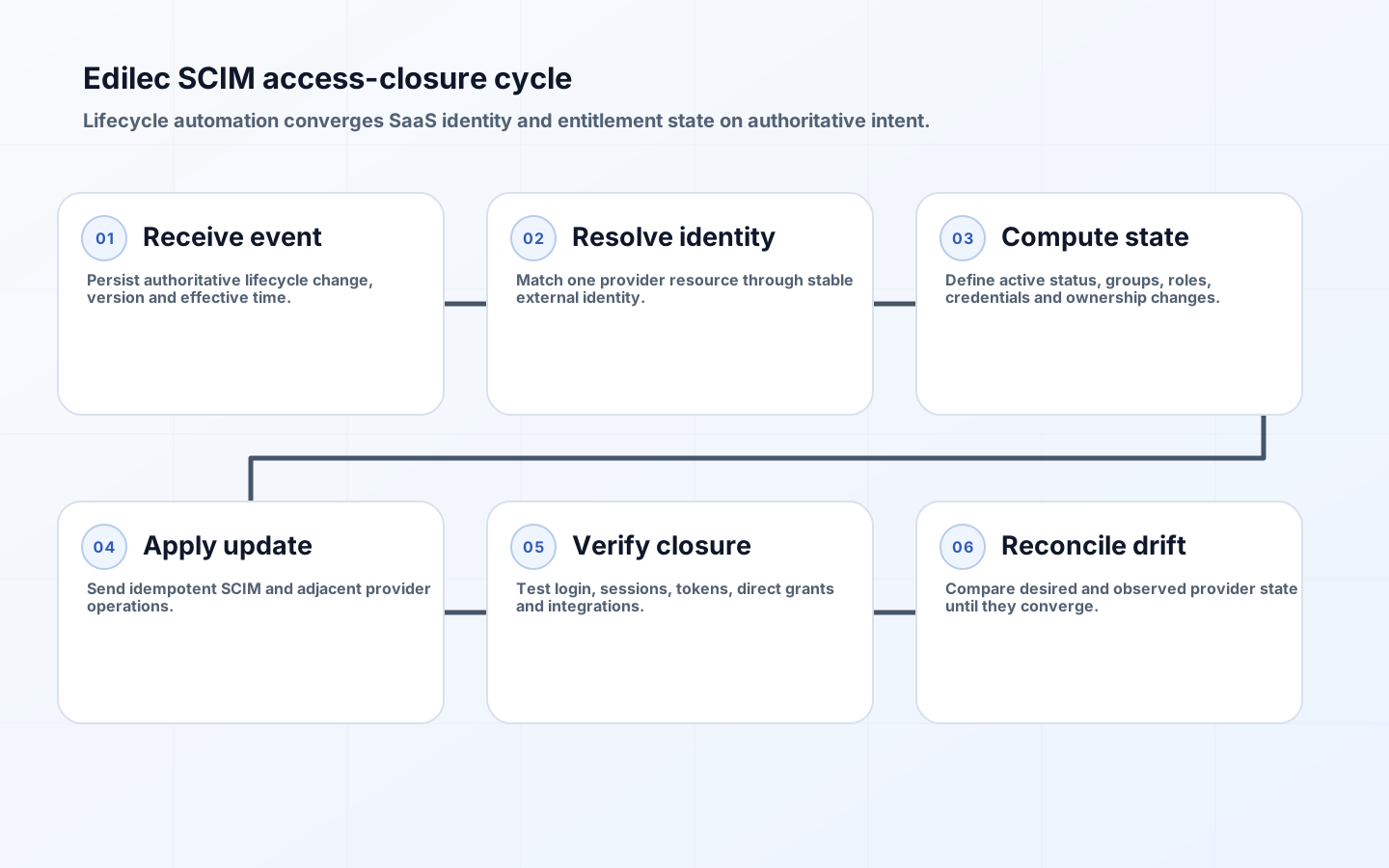
The Edilec cycle begins with an authoritative event, resolves one provider identity, computes desired state, applies a versioned change, verifies all access channels and reconciles observed state. Place the six stages on the runbook and assign an owner to each. The diagram's final verification is deliberately broader than SCIM response success because deprovisioning is complete only when the application no longer honors the person's authority.

Pilot with a test identity that owns records, belongs to groups, holds a direct role, has active browser and mobile sessions, and owns a personal token. Terminate it through the production-like lifecycle path. Verify timing and residual access, restore safely, then test a mover and a mistaken termination. Use the CISA Zero Trust Maturity Model as a cross-team prompt for identity, application and data dependencies, while keeping the application's tested closure contract authoritative. Invite the SaaS owner and service desk to observe; recovery quality is part of the control because bad identity data can otherwise create a business outage.
Qualify a SaaS provider before enabling lifecycle automation
Use a provider onboarding checklist that records base URL, authentication method, supported schemas, filters, PATCH behavior, rate limits, versioning, group semantics, deactivation effects, deletion effects and support escalation. Run conformance scenarios in a non-production tenant, but repeat material closure tests in the purchased edition because security behavior may vary by tier. Verify that the SCIM credential has only lifecycle permissions and can be rotated without recreating every mapping.
Negotiate operational expectations for high-risk applications: endpoint availability, deprovisioning support, throttling guidance, change notice and an emergency manual contact. Provider maintenance should not silently consume the entire termination objective. Capture known limitations in the application catalog and expose them to identity governance reviews. When a limitation prevents timely closure of a privileged account or token, treat it as a product risk and procurement issue rather than permanent connector debt.
Key takeaways
- Define what active false, DELETE and group removal actually do in every SaaS product.
- Track a versioned desired state and make retries converge without letting stale events restore access.
- Close sessions, tokens, direct roles and personal integrations that SCIM may not control.
- Reconcile provider state regularly to find drift, unmanaged users and failed removals.
- Measure final access closure time and retain evidence that joins source event to observed application state.
Frequently asked questions
Should deprovisioning delete the SCIM user?
Usually deactivation should come first because it can block access while preserving ownership and evidence. Delete later under an explicit retention policy after records and responsibilities are transferred. Test provider behavior; some products model these states differently.
Is disabling the identity-provider account enough?
No. It may stop a new federated login but leave application sessions, local passwords, API tokens, direct entitlements or provider accounts intact. Close and verify each supported access channel under the application's lifecycle contract.
What happens if the SaaS SCIM endpoint is unavailable?
Persist desired inactive state, retry safely within a risk-based deadline and escalate to a protected native-admin process before the objective expires. Reconciliation must later confirm the manual and automated views agree; do not mark success simply because a ticket was opened.
Conclusion
SCIM deprovisioning becomes dependable when it is treated as a state-convergence workflow. An authoritative change produces a versioned desired state, the connector applies the provider's tested semantics, adjacent credentials and sessions close, and reconciliation confirms reality. SSO and a 200 response are useful components, not proof of access removal.
Begin with the application whose stale access would matter most. Document its semantics, test a richly entitled identity and measure closure from source event to verified denial. Align exceptions with Edilec's zero trust field guide, where resource access depends on current evidence. That foundation lets the IAM team scale automation without losing the ability to explain and repair each lifecycle outcome.