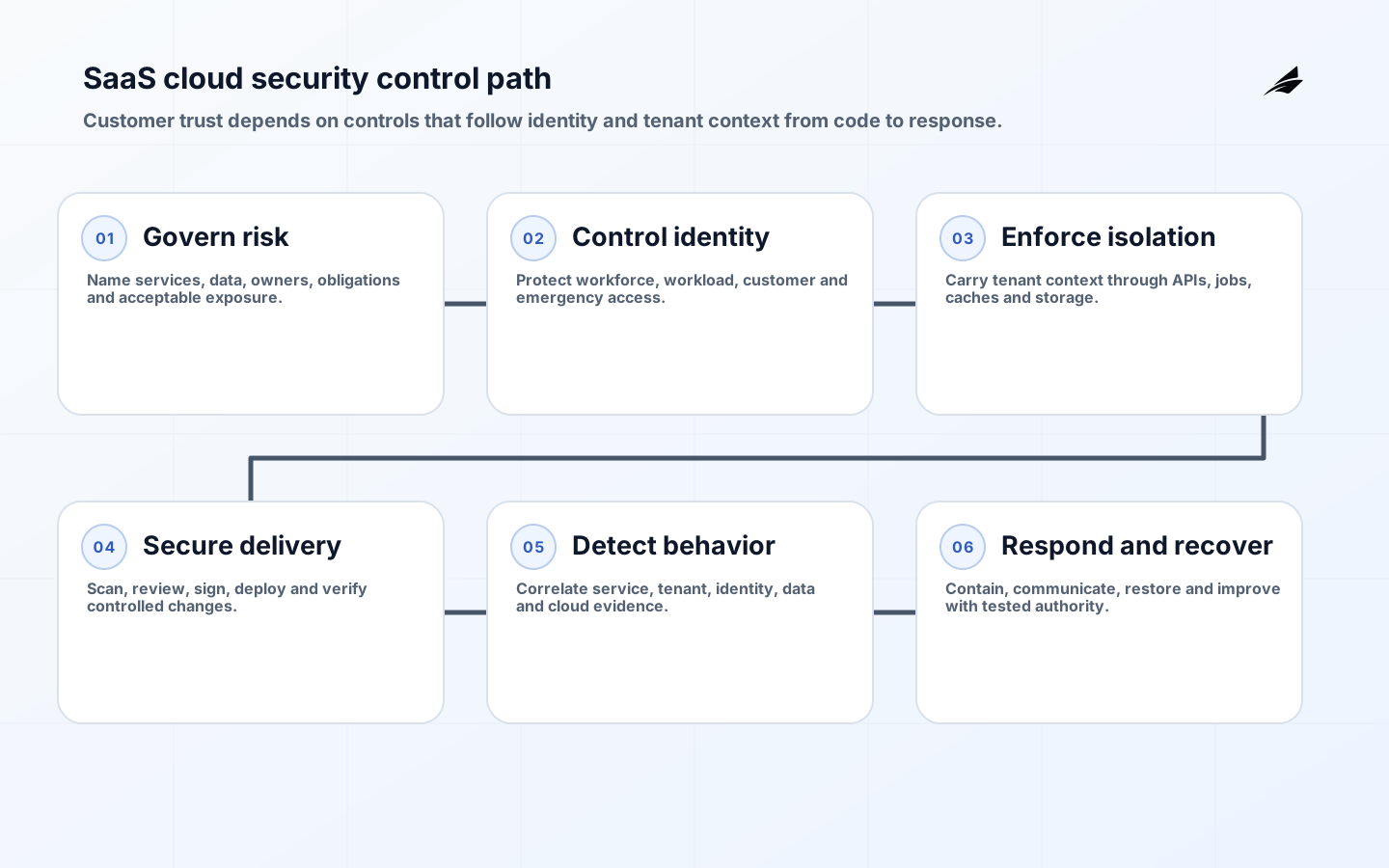
Cloud cybersecurity for a SaaS company must protect a continuously changing product, the cloud control plane and many customers sharing software and infrastructure. The implementation cannot stop at provider configuration. Customer identity, tenant authorization, application code, APIs, pipelines, data, support tooling and supplier integrations all participate in the security boundary. Cloud providers secure defined underlying services, while the SaaS company remains accountable for configuration, application behavior, data use and customer-facing incident response.
This checklist turns broad security goals into evidence a product team can operate. It aligns governance with NIST CSF 2.0, secure development with the NIST SSDF, API risks with OWASP guidance and multitenancy with current cloud architecture practice. Adapt depth to data sensitivity, customer commitments and regulatory scope. Every control needs an owner, implementation location, verification method, exception process and response. A policy statement without deployment and runtime evidence is not an implemented control.
1. Define services, tenants, data and responsibility
Inventory production services, cloud accounts, regions, data stores, APIs, queues, build systems, customer-facing domains and material suppliers. Map data flows and classify customer content, credentials, billing, telemetry and support records. Define the tenant model separately from user identity; one customer organization can have many users and roles. Record provider, SaaS company and customer responsibilities for configuration, access, backup, application security and response. Make exclusions and inherited controls visible.
Assign a business and technical owner to each service and control family. Record security commitments from contracts, privacy notices and assurance reports in implementable language. Establish risk acceptance authority and expiration. Use NIST CSF functions to organize governance, identification, protection, detection, response and recovery without treating the framework as a checklist certification. Define measurable outcomes such as privileged access review, tenant-isolation test coverage, critical-vulnerability remediation and restore evidence.
| Boundary | Primary risk | Required evidence |
|---|---|---|
| Cloud control plane | Account takeover or unsafe configuration | Identity policy, change log and baseline evaluation |
| Application and API | Broken authorization or unsafe business flow | Threat model, tests and runtime detection |
| Tenant data | Cross-tenant disclosure or corruption | Isolation design, access tests and audit trail |
| Delivery pipeline | Malicious or unreviewed release | Protected workflow, provenance and deployment record |
| Supplier integration | Compromise or uncontrolled data use | Inventory, permissions, contract and monitoring |
2. Protect workforce, workload and customer identity
Require phishing-resistant authentication where risk justifies it, centralize workforce lifecycle and use least-privilege roles. Separate routine and privileged accounts, time-bound elevation and monitor emergency access. Avoid static cloud keys; use workload identities and short-lived credentials for services and CI. Restrict federation trust, token audience and redirect configuration. Review service accounts for ownership and use. Customer authentication should include secure recovery, session management, rate limits and notifications appropriate to the product.
Authorization must be enforced server-side on every object and action. Derive tenant context from trusted identity and routing, not a client-supplied field alone. Test object-level and function-level access with multiple tenants and roles. Support tooling and impersonation need explicit approval, reason, duration and audit. API inventory should include obsolete versions and shadow endpoints. Protect tokens in browser and mobile clients according to current OAuth practice, and rotate signing keys with overlap and rollback procedures.
3. Engineer and test tenant isolation
Choose shared, siloed or mixed isolation per component and customer tier. Shared resources can be secure and efficient when application and policy consistently scope access. Dedicated resources improve some isolation properties but increase fleet-management risk. Carry tenant identity through synchronous requests, queues, scheduled jobs, cache keys, object paths, search indexes and analytics exports. Apply database policies or repository constraints where they reduce dependence on individual query discipline. Prevent tenant identifiers from being lost during retries or support operations.
Test negative access continuously. Tenant A should not read, infer, modify or cause side effects in Tenant B through guessed IDs, search, exports, files, webhooks or administrative APIs. Test identical local identifiers, cache collisions, failed jobs and migrations. Load tests should confirm one tenant cannot exhaust shared capacity beyond policy. Monitor authorization denials and unusual cross-tenant lookup patterns without exposing customer data in telemetry. Isolation evidence belongs in release and assurance records.
| Control plane | Preventive control | Detection and recovery |
|---|---|---|
| Code and dependencies | Review, scanning, locked builds and approved sources | Vulnerability ownership and rebuild |
| Infrastructure | Versioned policy and reviewed infrastructure as code | Drift detection and controlled remediation |
| Secrets and keys | Managed storage, workload identity and rotation | Access audit, revocation and replacement |
| Data | Encryption, scoped access and retention rules | Access anomaly, restore and deletion evidence |
| Release | Protected approvals and progressive deployment | Deploy markers, rollback and incident link |
4. Secure software and cloud delivery
Use a documented secure development lifecycle: threat modeling for material changes, peer review, automated testing, dependency and secret scanning, protected branches and reproducible build records. Inventory components and monitor supported versions. Prioritize vulnerabilities with exposure, exploitability, data and business context rather than score alone. Protect build runners, registries and deployment identities. Sign or otherwise establish provenance for release artifacts where applicable, and verify the artifact deployed is the one reviewed.
Manage infrastructure and policy as reviewed code. Separate environments and restrict production changes. Progressive delivery limits blast radius but requires tenant-aware cohorts, objective monitoring and tested rollback. Record feature flags and configuration with the release. Emergency change needs narrow authority and retrospective review. Validate backups and infrastructure recovery after architecture changes. Security controls that block safe deployment encourage bypass; platform teams should provide paved paths that make the approved route the easiest route.
5. Protect data through its lifecycle
Collect and retain only data needed for product and legal purposes. Document storage, processing, transfer, backup, analytics and deletion for each class. Encrypt transport and storage using managed, rotatable key systems. Separate key administration from data administration where risk requires. Restrict production queries and support exports, mask nonproduction data and audit privileged access. Customer-managed keys can meet particular needs but add availability, support and recovery complexity that must be designed explicitly.
Test deletion, export and restoration. A deleted primary record may remain in queues, search, caches, analytics and backups under different rules. Explain those rules accurately. Verify restore by reconstructing a service and reconciling data, not merely observing successful backup jobs. Protect logs from secrets and unnecessary personal data. Define evidence retention for incidents and customer requests. Data protection is a product behavior and operational process, not only an encryption setting.
6. Detect security-relevant behavior with service context
Collect cloud control-plane events, identity changes, privileged actions, application authorization events, data access, deployment markers, network findings and security-tool results. Normalize service, environment, tenant, identity and request context where privacy permits. Alert on high-consequence behavior with an owner and response, such as emergency-role use, disabled logging, new public exposure or impossible cross-tenant access. Tune high-volume detections against normal product behavior and keep raw customer data out of broad analyst access.
Measure telemetry coverage and pipeline health. A missing log source should be detectable. Test alerts and escalation, including provider and supplier contacts. Correlate incidents with releases and configuration. Preserve evidence under controlled access. Avoid treating every anomaly as an incident; combine signals and business context. Detection engineering should learn from penetration tests, support cases and production incidents. Close detections that produce no useful action and invest in those that shorten containment.
7. Rehearse incident response and customer communication
Define severity, command roles, containment authority, evidence preservation, legal and privacy escalation, customer communication and recovery criteria. Build runbooks for account compromise, cross-tenant access, secret exposure, malicious release, data corruption and supplier outage. Rehearse at least one scenario that crosses application, cloud, identity and business teams. Include after-hours deputies and secure communication if normal systems are compromised. Clarify when the cloud provider must be engaged and what logs or identifiers it requires.
Recovery includes technical restoration, customer reconciliation and verified return to normal objectives. Preserve a timeline and decision record. Notify based on facts, obligations and approved authority; avoid speculation. After the incident, assign systemic improvements and verify completion. Track containment and recovery time, repeated causes and overdue actions. A post-incident review should improve architecture, tests, telemetry, access and communication rather than end with individual blame.
8. Maintain assurance and customer evidence
Create an evidence map that links each material control to configuration, tests, runtime records and owner review. Independent audits and penetration tests sample this system but do not replace continuous operation. Review supplier assurance and access. Track exceptions and inherited risks. Provide customers accurate security documentation, shared-responsibility guidance and incident contacts. Avoid claiming that a certificate covers features, regions or periods outside its scope.
Use operational metrics that drive decisions: critical assets without owners, overdue privileged reviews, isolation test failures, unsupported dependencies, restore success, detection coverage, response exercises and unresolved high-risk exceptions. Review them with product and engineering leadership. Security roadmap work should be funded alongside features. The implementation is sustainable when normal delivery updates controls and evidence automatically rather than assembling them only before an audit.
Key takeaways
- Define cloud, application, tenant and supplier responsibility explicitly.
- Use trusted tenant context and test negative authorization continuously.
- Protect workforce, workload and customer identity through separate controls.
- Connect secure delivery, data lifecycle, detection and recovery.
- Maintain control evidence continuously and scope assurance claims accurately.
Frequently asked questions
Is a dedicated database required for every tenant?
No. Isolation can be implemented in shared, pooled, stamped or dedicated models. Choose from customer risk, scale, cost and operational capability, then verify enforcement and failure behavior.
Does a cloud compliance report cover the SaaS application?
No. It covers defined provider controls and scope. The SaaS company remains responsible for configuration, application behavior, identity, data use and its own assurance commitments.
How often should penetration testing occur?
Set cadence by risk, customer commitments and material change. Continuous automated testing and code review complement, but do not replace, independent testing of architecture and business logic.
Conclusion
Cloud cybersecurity for SaaS is strongest when tenant context and accountability survive every layer from identity and code to detection and recovery. Define the shared boundary, enforce least privilege, test cross-tenant failure, secure the delivery system and rehearse response with real evidence. The result is not merely a compliant cloud account; it is a product that can explain and protect customer trust as architecture and usage grow.