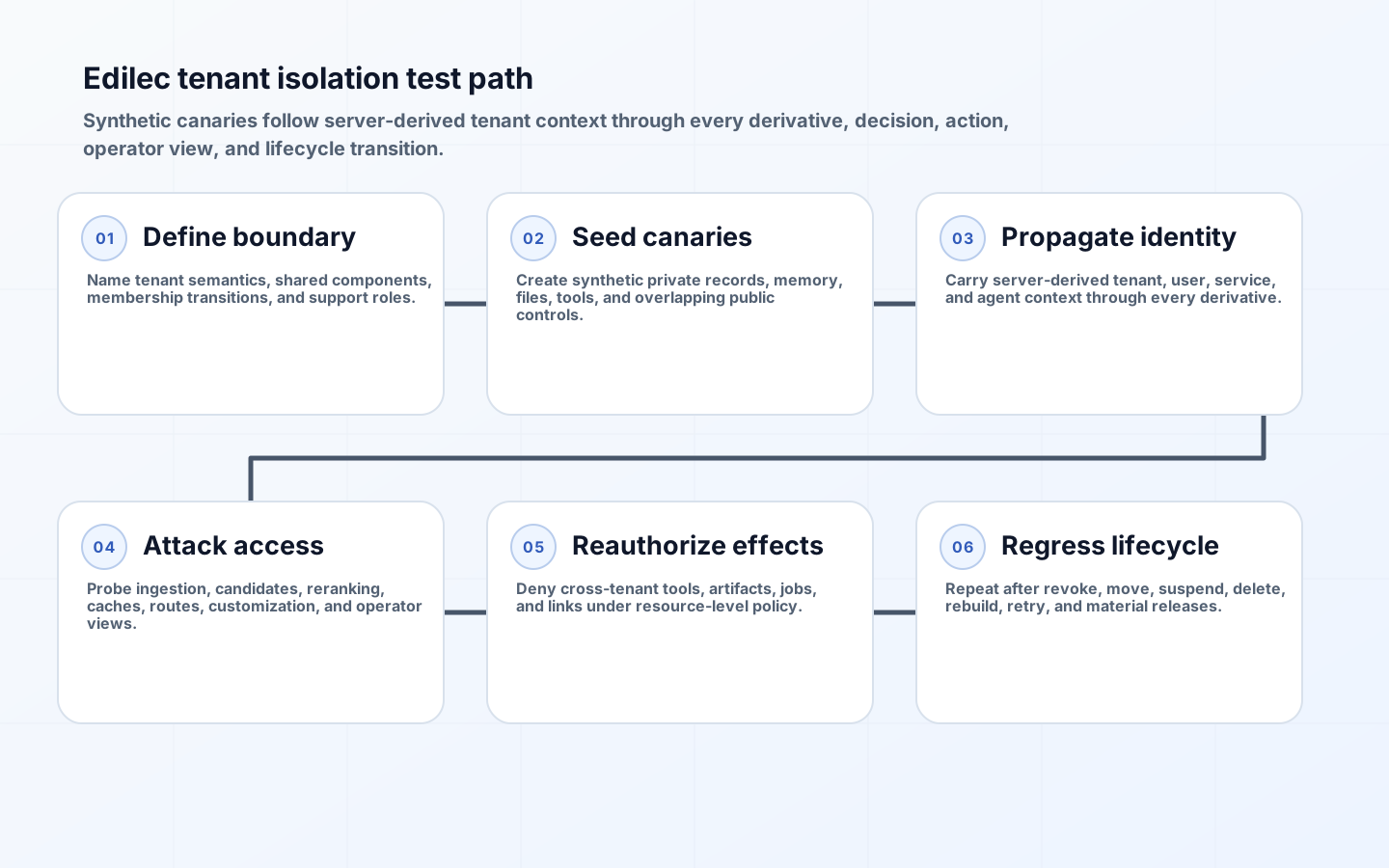
AI cross-tenant data leakage occurs when data, context, behavior or artifacts associated with one customer or organizational boundary become visible to or influence another. Multi-tenant AI introduces paths beyond an ordinary database query: shared retrieval indexes, embedding caches, prompt caches, conversation memory, temporary files, model customization, tool credentials, evaluation datasets, traces and support consoles. A successful authorization check at document ingestion does not prove that every later derivative preserves the tenant boundary.
A useful test program creates synthetic tenants with distinctive canaries, follows those canaries through the complete workflow, and attempts access from different identities, roles, interfaces and lifecycle states. It verifies both confidentiality and non-interference: tenant B should neither read tenant A's record nor receive an answer materially steered by A's private content. Edilec's enterprise RAG guide provides the production architecture; this article supplies the adversarial isolation plan.
Inventory tenant boundaries and shared components
Define tenant in business and technical terms. It may be a customer account, legal entity, workspace, project, region, case or data residency partition. Document whether users can belong to multiple tenants and how administrators impersonate or support them. Then map all components that are dedicated, logically partitioned or globally shared. Include queues, object stores, vector collections, caches, feature stores, model routes, fine-tunes, memory services, tool brokers, analytics and backups.
| Surface | Common isolation mistake | Adversarial test | Expected evidence |
|---|---|---|---|
| Ingestion | Tenant inferred from client-supplied metadata | Upload with another tenant ID and replay a signed import | Server-derived tenant, rejection and audit event |
| Vector retrieval | Filter omitted on one query path | Search canaries through UI, API, reranker and fallback | Tenant predicate at authoritative enforcement point |
| Cache | Key excludes tenant or authorization context | Prime as tenant A, request equivalent input as B | Miss or tenant-scoped entry with no A content |
| Memory | Conversation or user key reused globally | Switch workspace, session and delegated user | Scoped memory reads and explicit reset |
| Tools | Shared service credential bypasses user resource policy | Request A's record through agent while authenticated as B | Denied resource authorization outside the model |
| Observability | Support view exposes raw traces across customers | Use analyst and support roles to search canaries | Tenant-scoped results and logged break-glass decision |
Trace tenant identity through every decision
Tenant context should originate from authenticated server-side membership, not from an untrusted prompt, document field or model output. Propagate a stable tenant identifier through orchestration, retrieval, memory, cache keys, tool authorization, artifact storage and telemetry. Preserve the human user, service or agent identity separately; tenant and actor answer different questions. Reject missing or ambiguous context rather than falling back to a global collection. Background jobs need explicit tenant-scoped workload identity.
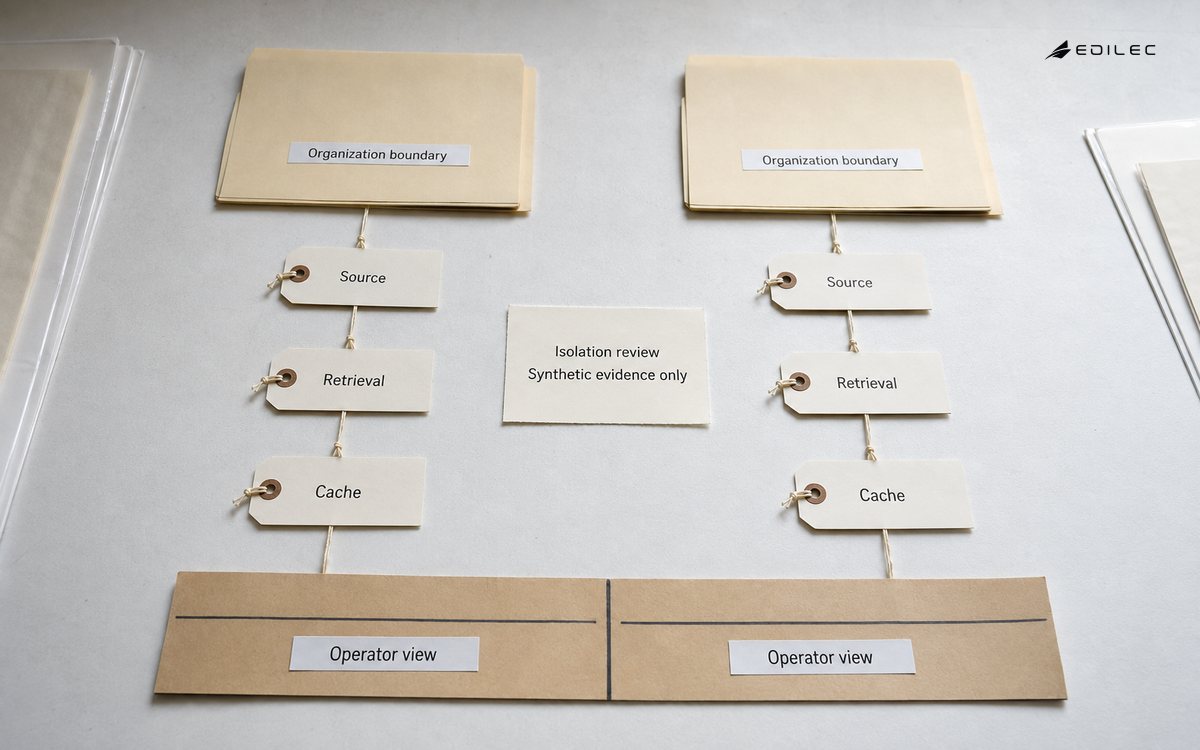
NIST's Zero Trust Architecture rejects implicit trust based on network location and focuses policy on subjects and resources. Apply that model inside the AI stack. The vector service, memory API and tool broker should each authorize access to the requested resource. Edilec's zero-trust guide explains why an upstream login cannot substitute for resource-level checks downstream.
Build synthetic tenants and canary records
Create at least three test tenants: ordinary, privileged or regulated, and an attacker tenant. Populate them with unique canary names, account numbers, phrases, documents, memory facts, tool records and files that do not resemble real customer data. Include overlapping public content so tests distinguish legitimate shared knowledge from private leakage. Maintain expected visibility by role and lifecycle state. Canaries should be searchable enough for testing but never valid credentials or secrets.
Exercise membership changes: invite, suspend, transfer, remove and delete users; move a record if the product permits it; change a document from shared to private; revoke connector access; and close a tenant. Verify propagation to indexes, caches, memory, files, analytics and backups according to policy. A boundary that holds only for newly created records but leaks stale derivatives after revocation is incomplete.
Attack retrieval, ranking, and cache isolation
Query each private canary from the wrong tenant using exact strings, semantic paraphrases, misspellings, multilingual prompts, indirect questions and requests for citations. Test every interface: chat, search, API, batch export, evaluation runner and administrator preview. Inspect the candidate set before generation, because the model may decline to repeat a leaked chunk while unauthorized retrieval has already occurred. Test hybrid search, rerankers and fail-open fallback independently.
Prime semantic, prompt, response and tool-result caches as tenant A, then replay equivalent requests as B with different roles and authorization state. Vary only one key dimension at a time. Inspect key construction and invalidation after access changes. Shared embedding computation may be acceptable for identical public text, but cached references, results and scores must not reveal a private source. Do not rely on low probability of a key collision as an isolation control.
Attack memory, tools, files, and asynchronous work
Ask an agent to remember a tenant-specific canary, then switch tenant, user, channel, browser, session and delegated role. Test summarization and compaction, because a private detail can survive after the original message expires. Verify correction and deletion. For tools, request another tenant's object directly and through ambiguity, references returned by search, guessed IDs and stale links. The permission model in Edilec's agent tool guide should hold regardless of model wording.
Test generated files, code sandboxes, browser downloads, email attachments, temporary URLs and asynchronous job results. Object names and signed links must be tenant-scoped and short-lived. Workers should carry the initiating tenant and user authority, not a global queue credential that permits arbitrary reads. Cancel and retry jobs; verify results cannot be claimed by another tenant and that idempotency keys include the boundary. Inspect cleanup after timeout and failure.
Test shared models and tenant customization
A shared foundation model does not automatically train on enterprise prompts, but the application and provider configuration must prove the intended handling. Verify provider retention and training controls, routing, project boundaries, API keys and administrative access. Use canaries to test whether a previous tenant's context appears in later stateless requests; investigate application state before attributing behavior to model memorization. The NIST adversarial ML taxonomy helps distinguish privacy attack hypotheses from ordinary context leakage.
For fine-tuned models, adapters or tenant-specific prompt bundles, confirm artifact ownership, registry access, route selection, evaluation data and retirement. Attempt to select another tenant's customization through API parameters, model aliases, deployment IDs and support tools. Inspect batch training and evaluation pipelines for mixed exports. NIST SP 800-218A supports secure lifecycle controls for AI development artifacts; extend those controls to tenant-labeled inputs and outputs.
| Test phase | Required assertion | Pass evidence | Escalation trigger |
|---|---|---|---|
| Create | Tenant is derived from authenticated membership | Server decision and tenant-bound record | Client can choose a foreign tenant |
| Transform | Every derivative retains boundary metadata | Manifest links chunks, embeddings, summaries and files | Orphaned or global derivative |
| Retrieve | Policy filters every candidate path | Candidate set contains only permitted source classes | Unauthorized candidate, even if not displayed |
| Act | Tool reauthorizes user and resource | Policy decision and denied cross-tenant object | Shared credential permits the effect |
| Observe | Trace and support access are tenant-scoped | Scoped query plus audited exception path | Canary visible through ordinary analyst role |
| Delete | Boundary data follows retention and deletion policy | Source and derivative disposition records | Canary persists in active service after deadline |
Automate isolation regression and incident response
Run deterministic authorization tests on every build and adversarial end-to-end suites on changes to connectors, schemas, indexes, caches, memory, tools, model routes and support consoles. Assert both absence of the canary and presence of the correct tenant's result, so a broken service does not appear secure by returning nothing. Preserve route, identity, policy, source and version evidence for failures. The OWASP GenAI Security Project provides application threat categories that can broaden cases without replacing local architecture analysis.
Treat any confirmed cross-tenant access as a security incident. Contain the affected query path, cache, collection, credential or support role; preserve canary and real-world scope evidence; identify every derivative; and test whether external actions occurred. Do not use customer data to reproduce the issue after a synthetic canary proves it. Add the path to regression and review sibling services that copied the same library or key pattern. Trace evidence should follow Edilec's observability checklist without exposing more customer content.
Key takeaways
- Define tenant boundaries explicitly and inventory every shared or logically partitioned component.
- Derive tenant context from authenticated membership and authorize each downstream resource.
- Use synthetic canaries to test confidentiality and cross-tenant influence without exposing customer data.
- Attack candidate retrieval, caches, memory, tools, files, model routes, traces and lifecycle transitions.
- Automate isolation regression and treat any unauthorized candidate or artifact as a security failure.
Frequently asked questions
Is a separate vector index required for every tenant?
Not always. Dedicated indexes simplify some boundaries, while shared indexes can be acceptable with consistently enforced tenant predicates, protected metadata, testable fail-closed behavior and lifecycle controls. Choose based on impact, scale and operational evidence.
Does output filtering compensate for unauthorized retrieval?
No. Once a protected chunk enters model context, confidentiality has already failed and the content may influence answers or tools without verbatim disclosure. Enforce authorization before retrieval and retain output controls as defense-in-depth.
Can production customer data be used to test leakage?
Use synthetic tenant fixtures and canaries by default. Real data should not be an expected target. Incident investigation may examine affected records under controlled authority, minimization and evidence-handling rules.
Conclusion
Tenant isolation is an end-to-end property, not a vector-store setting. Identity and boundary context must survive ingestion, transformation, retrieval, caching, memory, action, observability and deletion. Synthetic canaries make that property testable across normal, adversarial and changing lifecycle states.
Begin by tracing one private record from upload to every derivative and operator view. Mark where tenant context is created, propagated, enforced and retired. Any stage that cannot answer those four questions belongs at the top of the isolation backlog.