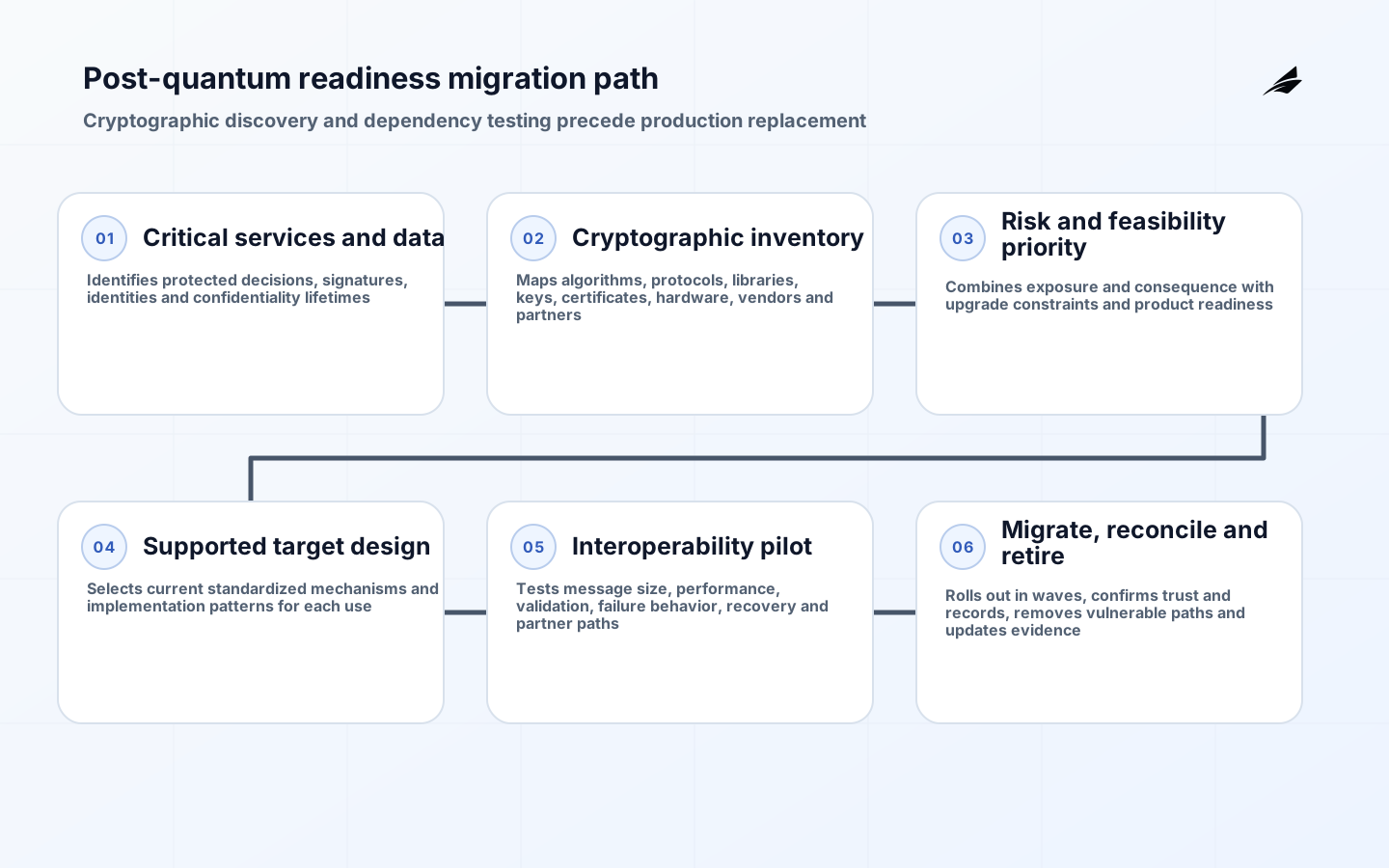
Quantum computing advancements pose an imminent threat to current cryptographic systems, particularly those based on integer factorization and discrete logarithms. This article addresses the practical implementation of post-quantum cryptography (PQC) for critical systems, emphasizing actionable steps that avoid common pitfalls. Unlike theoretical discussions, this guide focuses on concrete migration pathways, risk assessments, and integration strategies that organizations can deploy immediately. The urgency stems from quantum computers potentially breaking widely used encryption standards within the next decade, necessitating proactive preparation rather than reactive measures.
Understanding the Quantum Threat Landscape
The threat from quantum computing is not hypothetical. Current public-key cryptography, such as RSA and ECC, relies on mathematical problems that quantum computers could solve efficiently using Shor's algorithm. While large-scale quantum computers do not yet exist, advances in quantum computing, particularly in error correction and qubit stability, suggest that practical quantum threats could emerge on an uncertain future timeline. Organizations must recognize that their existing cryptographic infrastructure is vulnerable to future quantum attacks, even if no immediate quantum computer is available. This vulnerability is especially critical for systems handling sensitive data, such as financial transactions, government communications, and intellectual property.
NIST's PQC Standardization Process
The National Institute of Standards and Technology (NIST) has been standardizing post-quantum cryptographic algorithms since 2016. The process involves rigorous evaluation of candidate algorithms to ensure they are secure against both classical and quantum attacks. NIST has selected four PQC standards: lattice-based (FIPS 203 and FIPS 204), hash-based (FIPS 205), and code-based systems. Each standard addresses specific use cases, such as key encapsulation mechanisms (KEMs) and digital signatures. Organizations must understand that these standards are not interchangeable; each serves a distinct purpose in cryptographic systems.
- Lattice-based cryptography (FIPS 203 and FIPS 204) provides strong security for key exchange and digital signatures.
- Hash-based signatures (FIPS 205) are suitable for systems with low computational overhead and short-lived signatures.
- Code-based cryptography is not yet standardized but remains a candidate for future use cases.
- NIST's selection process ensures that algorithms are resistant to both classical and quantum attacks.
Critical Systems Migration Strategy
Migrating critical systems to PQC requires a phased approach that balances security, performance, and operational continuity. Organizations should prioritize systems with high sensitivity to quantum threats, such as those handling state secrets or financial transactions. The migration process must avoid disrupting existing services, which means implementing PQC in a way that does not require system downtime. For example, hybrid cryptography—combining classical and PQC algorithms—can provide transitional security while new systems are updated. This approach minimizes risk without sacrificing functionality.

| Use Case | Recommended PQC Standard | Implementation Complexity | Security Level |
|---|---|---|---|
| Secure communication channels | FIPS 203 (Lattice-based KEM) | High | Quantum-resistant |
| Digital signatures for internal systems | FIPS 204 (Lattice-based digital signatures) | Medium | Quantum-resistant |
| Short-term digital signatures for low-latency systems | FIPS 205 (Hash-based signatures) | Low | Quantum-resistant |
| Legacy systems with limited computational resources | FIPS 205 (Hash-based signatures) | Very low | Quantum-resistant |
Risk Assessment for PQC Implementation
Before implementing PQC, organizations must conduct a thorough risk assessment to identify vulnerabilities in their current cryptographic infrastructure. This includes evaluating the cryptographic strength of existing systems, the potential impact of a quantum attack, and the timeline for migration. For instance, systems using RSA with key sizes below 2048 bits are particularly vulnerable, as quantum computers could break them faster than expected. Risk assessments should also consider the regulatory environment, as some industries have specific compliance requirements that may influence the migration strategy.
| Cryptographic use | Why it matters | Readiness action |
|---|---|---|
| Public-key establishment | Quantum-vulnerable algorithms protect sessions and wrapped keys | Inventory protocols, libraries, endpoints and vendor upgrade paths |
| Digital signatures | Signatures protect identity, code, documents and firmware | Map signing and verification dependencies plus trust-anchor lifetimes |
| Long-lived confidential data | Captured ciphertext may remain valuable when future decryption becomes possible | Prioritize by secrecy lifetime and exposure, not a guessed quantum date |
| Constrained or long-lived systems | Hardware, firmware, packet size and maintenance windows may limit options | Benchmark candidate implementations and coordinate product roadmaps |
Hybrid Cryptography as a Transitional Strategy
Hybrid cryptography—using both classical and PQC algorithms—provides a practical bridge between current systems and fully quantum-resistant infrastructure. This approach ensures that systems remain secure during the migration process without requiring complete system overhauls. For example, a system could use RSA for authentication while transitioning to FIPS 204 for digital signatures. Hybrid solutions are particularly valuable for organizations with legacy systems that cannot be easily updated. By maintaining dual-layer security, organizations can mitigate the risk of quantum attacks while gradually phasing out classical cryptography.
Testing and Validation of PQC Implementations
Testing and validation are critical to ensuring that PQC implementations do not introduce new vulnerabilities. Organizations should conduct rigorous testing of their cryptographic systems using tools like NIST's Post-Quantum Cryptography Validation Toolkit. This toolkit helps identify potential weaknesses in PQC implementations, such as incorrect key generation or signature validation. Additionally, organizations must validate that their systems comply with the latest PQC standards, such as FIPS 203 and FIPS 204, to avoid interoperability issues. Testing should be performed in a controlled environment before deployment to minimize disruption.
Interoperability Challenges in PQC Adoption
Interoperability is a major challenge in PQC adoption, as many existing systems are designed for classical cryptography. Organizations must ensure that their PQC implementations can communicate with other systems without requiring extensive reconfiguration. For example, systems using FIPS 204 for digital signatures may not be compatible with legacy systems that rely on RSA. To address this, organizations should adopt standardized interfaces and protocols that support both classical and PQC algorithms. This includes using hybrid approaches and ensuring that all components of the system are updated to the latest standards.
Quantum Threat Mitigation in Practice
Real-world examples highlight the importance of proactive quantum threat mitigation. For instance, financial institutions have started implementing hybrid cryptography to protect transaction data while transitioning to PQC. Government agencies are prioritizing systems handling national security data, such as military communications, for immediate migration. These examples demonstrate that organizations can take meaningful steps without waiting for quantum computers to become operational. The key is to start early and maintain a clear migration roadmap.
Quantum Threats Implementation Requirements
Critical systems must implement quantum threat modeling to identify vulnerabilities in current cryptographic protocols. This involves assessing the risk of quantum attacks on existing public-key infrastructure, particularly focusing on RSA and ECC systems which are susceptible to Shor's algorithm. The analysis should include both short-term threats from quantum computers with 2048-bit security and long-term threats from future quantum capabilities. This step ensures that cryptographic assets are evaluated for quantum resilience before migration begins.
Quantum threat modeling requires specific technical validation of cryptographic assets. For example, systems using RSA-2048 must be validated against quantum attack simulations to determine the minimum key size required for post-quantum security. This validation process should be integrated into the system's operational workflows to ensure continuous assessment of quantum vulnerability. The results of this validation must be documented and maintained as part of the system's security posture.
Quantum Threats and Post-Quantum Cryptography: Practical Implementation Guide
This guide provides actionable steps for critical systems to implement post-quantum cryptography without compromising security or operational continuity.
Post-Quantum Key Rotation Strategy
Implement a rolling key rotation schedule that aligns with the operational lifecycle of cryptographic modules. For FIPS 203 and FIPS 204, this requires defining a rotation interval that balances quantum threat exposure with system stability. A minimum of 90 days between rotations is recommended for lattice-based systems to ensure sufficient time for cryptographic updates without compromising security. This interval must be dynamically adjusted based on the system's quantum threat level, which can be monitored via the quantum threat assessment framework outlined in NIST SP 800-208.
- Rotate FIPS 203 key encapsulation keys every 90 days for lattice-based systems
- Rotate FIPS 204 digital signature keys every 180 days to accommodate longer key lifespans
- Use a key rotation audit log that tracks rotation events with timestamps and cryptographic hashes of the new keys
Quantum threat exposure is calculated using the formula: Threat Exposure = (Current Quantum Threat Level) × (Time Since Last Rotation). When Threat Exposure exceeds 0.5, immediate rotation is required. This metric ensures that systems remain below the critical threshold where quantum attacks could compromise encrypted data. The quantum threat level is derived from NIST SP 800-208 and must be updated quarterly to reflect advancements in quantum computing capabilities.
FIPS 203-204 Implementation Verification
Verification of FIPS 203 and FIPS 204 implementations must include cryptographic module validation against the FIPS 203 and FIPS 204 standards. This involves testing the module's ability to handle key generation, encapsulation, and signature operations under simulated quantum threats. The verification process must confirm that the module adheres to the strict requirements for lattice-based cryptography, including the use of module lattices and the avoidance of side-channel vulnerabilities.
- Conduct a cryptographic module test using the FIPS 203 and FIPS 204 validation tools
- Validate key generation processes to ensure they meet the lattice-based security requirements
- Perform side-channel vulnerability assessments to detect potential leakage of cryptographic parameters
The verification process must also include a post-implementation review to identify any deviations from the FIPS 203 and FIPS 204 specifications. This review should focus on the module's resilience to quantum attacks, including the ability to handle key rotations without compromising system integrity. Any identified issues must be resolved before the module is deployed in production environments.
Quantum Failure-Handling Procedures
Quantum failure-handling procedures must be designed to address scenarios where quantum attacks compromise cryptographic systems. This includes protocols for detecting and mitigating key compromise events, such as when a quantum computer successfully breaks a cryptographic key. The procedures should specify immediate key revocation, system isolation, and the use of fallback mechanisms to ensure continuity of operations during the transition to post-quantum cryptography.
- Implement key revocation protocols that trigger upon detection of quantum key compromise
- Establish system isolation protocols to prevent lateral movement of compromised keys
- Deploy fallback mechanisms using classical cryptographic keys for critical operations until post-quantum keys are restored
Failure-handling procedures must also include a recovery timeline that specifies the steps required to restore system integrity after a quantum attack. This timeline should account for the time needed to generate new keys, update cryptographic modules, and validate the new keys against the FIPS 203 and FIPS 204 standards. The recovery process must be tested regularly to ensure it can handle real-world quantum attack scenarios.
Post-Quantum Governance Requirements
Governance for post-quantum cryptography must include clear accountability for cryptographic key management, including the roles and responsibilities of key managers, auditors, and system administrators. This governance framework should specify the procedures for key rotation, verification, and failure handling, ensuring that all actions align with the FIPS 203 and FIPS 204 standards. The framework must also address the legal and regulatory implications of quantum key compromise, including compliance with relevant laws and standards.
- Define key management roles and responsibilities for FIPS 203 and FIPS 204 implementations
- Establish audit trails for all key rotation and verification activities
- Ensure compliance with legal and regulatory requirements for quantum key compromise
The governance framework must also include a mechanism for continuous monitoring of quantum threat levels and the effectiveness of post-quantum cryptographic measures. This monitoring should be integrated with the system's existing security infrastructure to provide real-time insights into potential quantum threats and the need for immediate action.
Key takeaways
- Quantum computing threatens current cryptographic systems, necessitating immediate action.
- NIST has standardized four PQC algorithms: lattice-based (FIPS 203/204), hash-based (FIPS 205), and code-based systems.
- Critical systems should adopt hybrid cryptography to ensure continuity during migration.
- Risk assessments must prioritize systems with high quantum vulnerability, such as RSA with small key sizes.
- Testing and validation are essential to avoid new vulnerabilities in PQC implementations.
Frequently asked questions
What is the difference between PQC and quantum-resistant cryptography?
Post-quantum cryptography (PQC) refers to cryptographic algorithms designed to be secure against attacks by both classical and quantum computers. Quantum-resistant cryptography is a subset of PQC that specifically addresses resistance to quantum attacks. All PQC algorithms are quantum-resistant, but not all quantum-resistant algorithms are PQC. This distinction is critical for understanding the scope of cryptographic solutions.
How long does it take to migrate from classical to PQC?
Migration timelines vary based on the organization's size and the complexity of their systems. For critical systems, migration can take 12-24 months, with hybrid approaches reducing the timeline. Organizations should start with high-priority systems and gradually phase out classical cryptography. The exact timeline depends on factors like system interoperability and the availability of quantum-resistant alternatives.
Can PQC be implemented without disrupting existing services?
Yes, hybrid cryptography allows organizations to implement PQC without disrupting services. By using both classical and PQC algorithms, systems can maintain functionality while transitioning to quantum-resistant cryptography. This approach minimizes downtime and ensures continuity for critical operations.
Which PQC standards are most suitable for small businesses?
Small businesses should prioritize FIPS 205 (hash-based signatures) due to its low computational overhead and suitability for systems with limited resources. For communication channels, FIPS 203 (lattice-based KEM) can be used with hybrid approaches to balance security and performance. Small businesses should focus on critical systems first and avoid over-engineering the migration process.
Conclusion
Quantum computing presents a significant threat to current cryptographic systems, but organizations can prepare for it through practical, actionable steps. By adopting NIST's PQC standards, implementing hybrid cryptography, and conducting thorough risk assessments, organizations can ensure their systems remain secure against future quantum attacks. The key is to start early and maintain a clear migration roadmap. As quantum computing technology advances, proactive preparation will be essential for maintaining the security of critical infrastructure.