Graceful degradation architecture is often reduced to a cache, a circuit breaker, or a message that says a feature is unavailable. Those are mechanisms. The design problem is deciding which business capabilities must survive, what reduced outcome is still truthful and useful, and how the system protects that outcome when a dependency becomes slow, incorrect, or unreachable.
A product should not spend scarce capacity equally on every feature during failure. A retailer may preserve browse, cart, and checkout while disabling recommendations and high-resolution media. A clinical workflow may preserve access to current medication instructions while postponing analytics. The correct ordering comes from user harm, reversibility, timing, and obligations, not from which microservice is easiest to keep running.
Tier capabilities by outcome and consequence
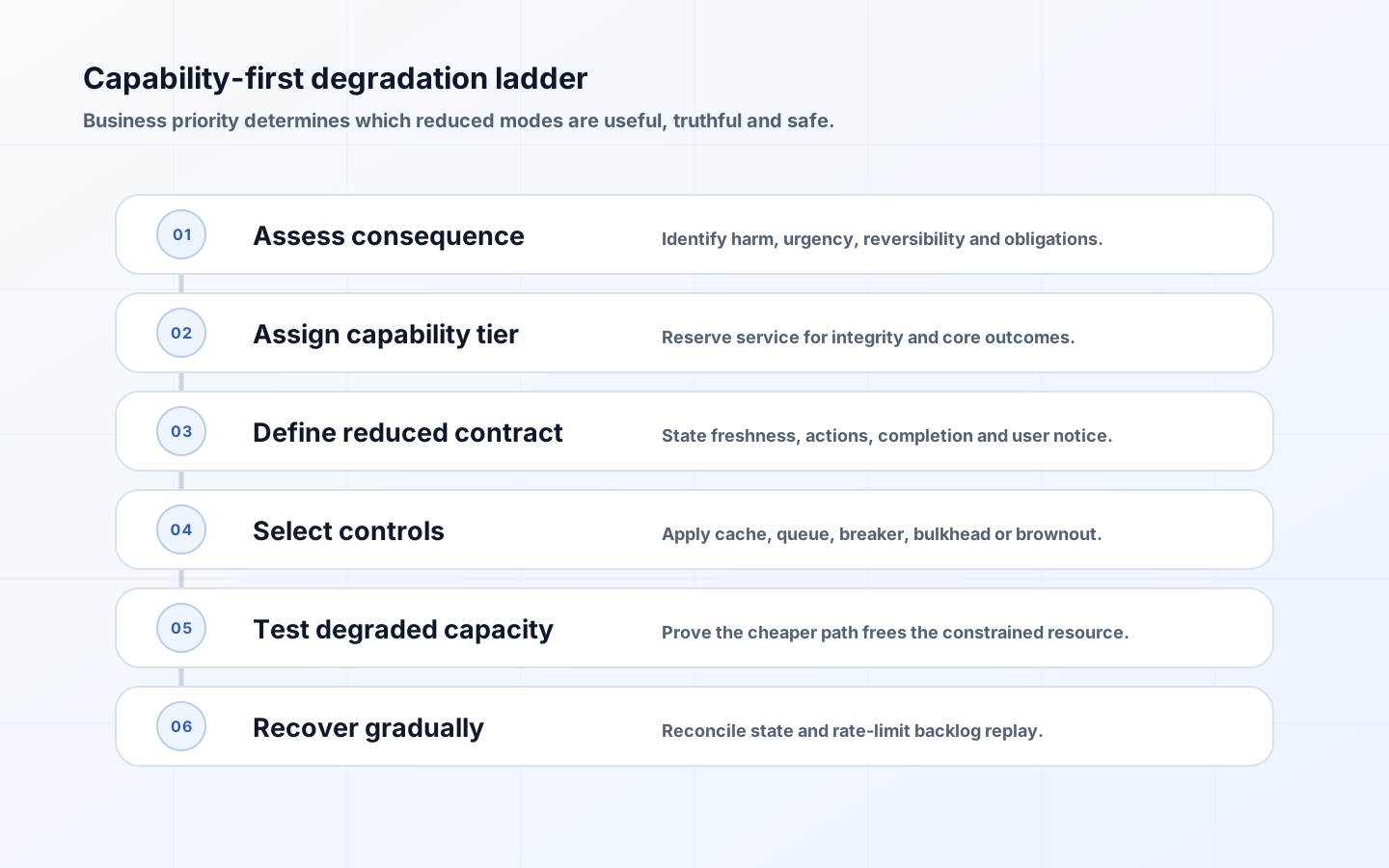
Map end-to-end flows before components. For each flow, identify the user, required result, maximum useful delay, data correctness boundary, and consequence of failure. Then assign a capability tier. Tier 0 may cover safety, legal, or irreversible financial controls that must fail closed. Tier 1 covers core value that should remain available. Tier 2 can operate with reduced freshness or deferred completion. Tier 3 is discretionary and can be removed to protect capacity.
A tier is not a universal priority label. Search can be optional in one product and essential in another. Account history can tolerate stale data for browsing but not for a dispute decision. Define tiers per flow and state, and review them with product, operations, security, legal, and support. Include accessibility and customer communication; a degraded interface that hides important status can be worse than an explicit refusal.
| Capability tier | Expected behavior | Example | Failure posture |
|---|---|---|---|
| Tier 0: integrity or safety | Preserve control or stop safely | Authorization before a funds transfer | Fail closed with a clear recovery path |
| Tier 1: core outcome | Keep the primary journey usable | Submit an order with essential details | Reserve capacity and simplify dependencies |
| Tier 2: delay-tolerant | Accept work durably and complete later | Send a receipt or refresh a report | Queue with status and expiry |
| Tier 3: discretionary | Remove under pressure | Recommendations or decorative media | Brown out early to protect core work |
Define an honest contract for every degraded state
Name each degraded state and specify entry signal, user-visible behavior, data source, freshness, permitted actions, duration, owner, and exit condition. Avoid a vague fallback flag that accumulates unrelated behavior. Useful states might include catalog-read-only, checkout-without-promotions, reports-from-last-successful-snapshot, or notification-delayed. Operators and support teams should be able to tell which state is active and what it promises.
Truthfulness matters more than superficial continuity. A stale balance must show its timestamp. A queued write must not look completed. A default recommendation must not be personalized in a way the user would reasonably rely on. If a fallback cannot preserve authorization, uniqueness, ordering, or data integrity, refuse the action. Graceful degradation is not permission to return plausible but false success.
Connect capability tiers to concrete controls
Select controls from the required degraded contract. Cached or replicated reads can preserve access with explicit freshness. Queues can level load and postpone side effects when durable acceptance is meaningful. Circuit breakers stop repeated calls to a failing dependency and create a deliberate transition to fallback. Bulkheads reserve threads, connections, memory, and quotas for critical work. Feature controls can remove costly optional work, but they need reliable distribution and local defaults.

Place the control near the resource it protects. An edge throttle may reduce global demand but cannot stop one internal caller from exhausting a shared connection pool. A client timeout releases client resources but does not necessarily cancel server work. Use deadline and cancellation propagation, bounded queues, concurrency limits, and admission control at each constrained boundary. Degradation should reduce work, not merely move it into an invisible backlog.
| Degradation mechanism | Best fit | Hidden tradeoff | Required evidence |
|---|---|---|---|
| Stale cache or snapshot | Read paths with bounded freshness | Old data may drive a wrong decision | Age distribution and stale-result acceptance |
| Read-only mode | Preserve inspection while writes are unsafe | Users may repeatedly retry blocked writes | Clear status and retry suppression |
| Durable queue | Work remains valuable after delay | Backlog can exceed recovery capacity | Queue age, expiry, idempotency, replay rate |
| Feature brownout | Optional work consumes shared capacity | Dependencies may still be called indirectly | Measured resource reduction and journey success |
| Alternate provider | Equivalent outcome can be delivered independently | Semantic mismatch and double side effects | Failover tests and reconciliation rules |
Automate entry without creating mode flapping
Entry signals should reflect the user path and protected resource: dependency latency percentiles, timeout rate, available concurrency, queue age, error-budget burn, or correctness checks. Use multiple observations where one noisy metric could trigger unnecessary degradation. Add hysteresis so entry and exit thresholds differ, require a minimum observation period, and allow an authorized manual override. Record why the transition occurred and which configuration version made it.
Prefer a deterministic local fallback when the control plane is unavailable. If every instance must call a remote feature-flag service before it can degrade, the flag service becomes another hard dependency. Cache signed configuration, define a safe startup default, and test stale-control behavior. Keep emergency actions small and reversible; a single global switch that changes several business semantics is difficult to reason about during an incident.
Plan capacity for the degraded system itself
A fallback is a production path with its own load shape. Cache misses can stampede the origin, queue producers can overwhelm storage, and an alternate provider can have a lower quota. Estimate demand after failure, including retries and users refreshing the page. Reserve capacity for Tier 0 and Tier 1 flows and cap lower tiers before saturation. Test whether disabling optional work actually frees the CPU, database connections, network, or downstream quota needed by the core path.
Use a representative scenario: promotion service latency rises from 100 milliseconds to five seconds during peak checkout. The design should stop waiting before the journey deadline, open the circuit after a bounded signal, omit discounts that cannot be verified, explain the temporary limitation, and preserve order integrity. Whether checkout may continue without a promotion is a product policy, not a library default.
Recover without causing a second incident
Exit criteria should be stronger than one successful probe. Require sustained dependency health, spare capacity, and validation that normal-mode data is coherent. Restore traffic gradually. Drain queued work at a rate the recovered system can absorb, prioritize items by expiry and business value, and reconcile ambiguous writes before retrying them. Keep users informed when delayed work completes or expires.
Exercise entry, operation, and exit in tests and controlled fault experiments. Validate state across deployments, not only one process. Observe critical-flow success, degraded-flow correctness, fallback capacity, transition time, and the number of users exposed to misleading state. A tabletop review catches policy gaps; load and fault tests reveal whether the mechanisms hold under pressure.
Operate degraded modes as product behavior
Assign an owner, runbook, dashboard, support message, and review date to every mode. Track activation frequency and duration, users affected, successful critical journeys, stale-data age, queued-work expiry, and manual interventions. Frequent activation may mean a dependency needs investment; a mode that never activates may be untested or unnecessary. Remove obsolete fallbacks when product semantics change so they do not become a hidden legacy system.
Include the behavior in release review. New mandatory calls can invalidate a degraded path even when normal tests pass. Contract tests should prove that optional dependencies are truly optional, clients honor timeout and cancellation, and critical flows retain reserved resources. Product analytics should distinguish normal and degraded outcomes so a partial success does not silently inflate conversion or completion measures. Review the customer-language copy whenever semantics change.
Key takeaways
- Rank business flows by consequence and timing before ranking services.
- Describe each degraded state as a truthful user contract with explicit freshness and completion semantics.
- Use caches, queues, breakers, bulkheads, and brownouts only where they support that contract.
- Capacity-test the fallback and add hysteresis to automated transitions.
- Treat recovery, backlog replay, and reconciliation as part of the original design.
Frequently asked questions
Is graceful degradation the same as failover?
No. Failover attempts to preserve equivalent service on another resource or location. Degradation deliberately provides a smaller or delayed capability. A design can fail over first and degrade if equivalent capacity or dependencies remain unavailable.
Can write workflows degrade safely?
Sometimes. Durable acceptance, idempotency, status visibility, expiry, and reconciliation can make delayed writes safe. Writes that require current authorization, uniqueness, inventory, or irreversible external side effects may need to stop. The business invariant decides.
Should users be told that the system is degraded?
Tell them whenever freshness, completion, available actions, or expected timing changes. Use specific status rather than a generic error banner. Clear communication reduces repeated attempts and lets users decide whether a reduced outcome is acceptable.
Conclusion
Graceful degradation succeeds when a product preserves its most important truths under failure. Define capability tiers, specify bounded degraded contracts, protect their capacity, and prove both transition directions. The result is not a system that pretends nothing failed; it is one that continues to deliver the right outcomes without causing avoidable harm.