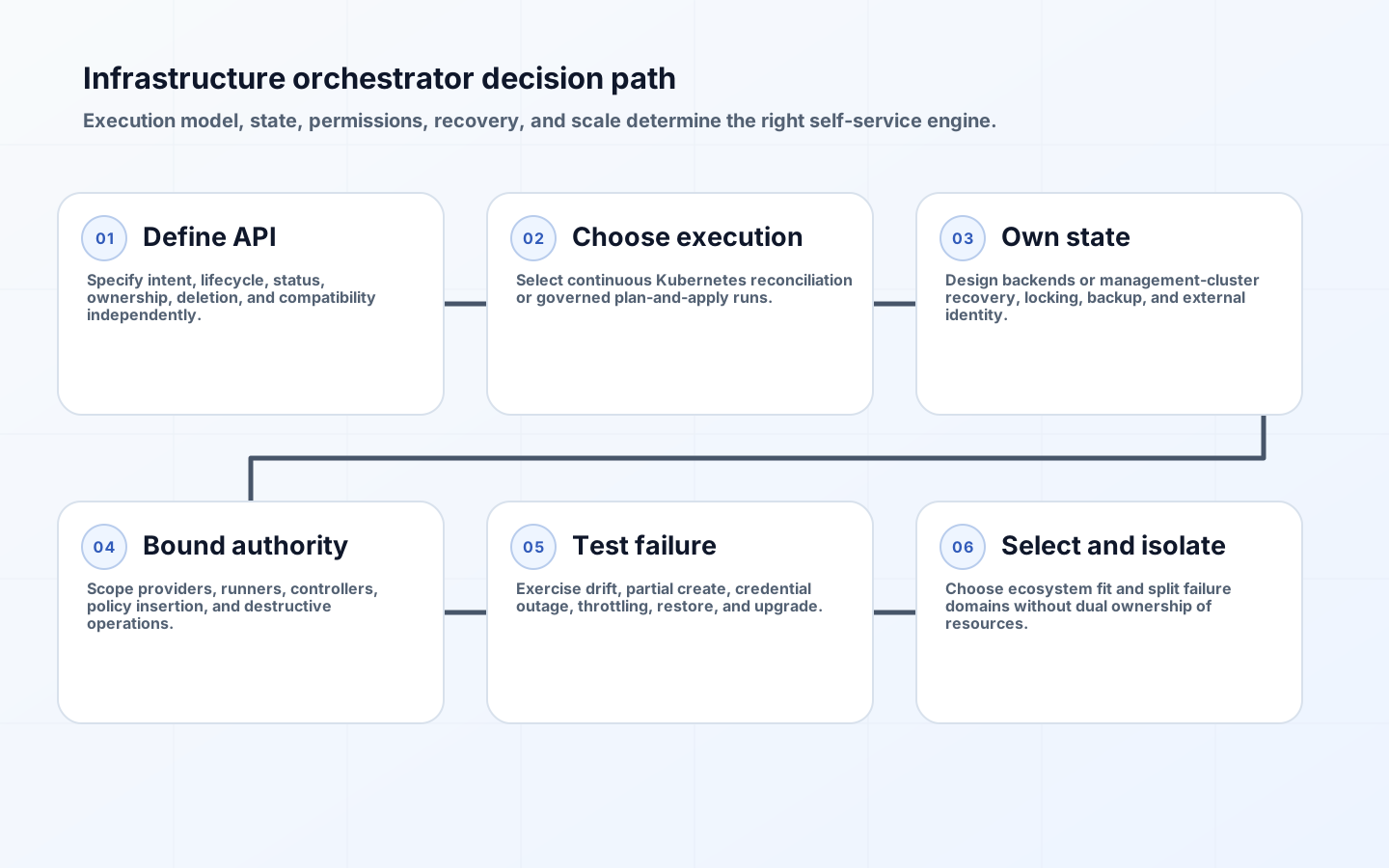
The Crossplane vs Terraform vs OpenTofu choice starts with an operating model, not syntax. Terraform and OpenTofu center a write, plan, and apply workflow backed by state. Crossplane extends Kubernetes with APIs and controllers that continuously reconcile declared resources. All can power platform self-service, but they place intent, execution, credentials, state, drift, and failure recovery in different places.
A fair comparison also separates the developer-facing platform API from the infrastructure engine. Product teams should usually request a database or environment through a stable contract; platform engineers decide whether a pipeline applies modules or a controller reconciles composite resources. Exposing raw tool configuration as the self-service API makes a future engine change everybody's migration. First design the request and lifecycle, then select the implementation that can operate it.
Choose between runs and continuous reconciliation
Terraform's documented core workflow is write, plan, apply. A run reads configuration and state, refreshes relevant remote objects, produces a proposed change, and applies approved actions. OpenTofu documents the same three stages and state-based model. Platform automation wraps that workflow with queues, remote execution, policy, approvals, credentials, and notifications. Between runs, the engine is not inherently a continuously active controller unless another system schedules detection or applies remediation.

Crossplane runs inside a Kubernetes control plane. Composite Resource Definitions define custom API schemas; Compositions and function pipelines determine the resources to create; controllers repeatedly reconcile desired and observed state. Current Crossplane documentation exposes Synced and Ready conditions and composition revision controls. This model suits long-lived APIs and continuous convergence, but it also means the control plane, providers, credentials, and reconciliation behavior become production infrastructure requiring high availability and careful upgrades.
| Decision | Crossplane | Terraform | OpenTofu |
|---|---|---|---|
| Primary execution | Continuous controller reconciliation | Discrete plan and apply runs | Discrete plan and apply runs |
| Desired-state surface | Kubernetes custom resources | HCL configuration and modules | HCL-compatible configuration and modules |
| Operational state | Kubernetes API objects plus provider external state | State snapshots in configured backend | State snapshots in configured backend |
| Human review | API review, policy, and composition rollout | Saved or speculative plan review | Plan review |
| Drift response | Reconcile according to controller behavior | Detect during plan or scheduled run | Detect during plan or scheduled run |
| Control-plane dependency | Required for ongoing reconciliation | Required during runs and state operations | Required during runs and state operations |
Design the self-service API independently
Define intent-oriented fields, defaults, constraints, status, ownership, deletion, and version compatibility. In Crossplane, an XRD can directly implement that API and a Composition maps it to resources. With Terraform or OpenTofu, a portal or service can validate the same request, select a module release, create a workspace or run unit, pass bounded inputs, and translate outputs into stable status. Neither architecture should expose unrestricted provider attributes by default.
Crossplane composition revisions make implementation rollout visible: composite resources can update automatically to the latest revision or use a manual policy and explicit revision. Pipeline tools need an equivalent module-release strategy, workspace inventory, and migration process. Keep engine metadata behind the contract while retaining a diagnostic link. Developers need to know that their database is ready or why it failed, not the internal resource graph unless they are debugging with the platform team.
Decide who owns state and drift
Terraform and OpenTofu state maps configuration addresses to remote objects and can contain sensitive values. Use remote backends with locking or managed run services, scoped access, backup, recovery tests, and separation between environments. OpenTofu additionally documents native state and plan encryption at rest, with a serious operational consequence: lost keys make encrypted state unrecoverable. Encryption does not replace integrity, backup, access control, or replay protection.
Crossplane stores desired and observed API state in Kubernetes and external systems remain authoritative for their resources. Protect etcd, back up cluster state, scope provider credentials, and understand provider deletion and late-initialization behavior. Decide whether manual external changes should be reverted, adopted, ignored, or alerted. Continuous reconciliation is not automatically safer; a bad desired state, broad credential, or faulty provider can continuously repeat a harmful action.
| Failure | Run-based response | Reconciler response | Required design |
|---|---|---|---|
| Partial create | Next plan identifies recorded and discovered state | Controller retries and updates conditions | Idempotency and import/adoption rules |
| Manual drift | Scheduled plan reports difference | Controller may restore declared state | Drift authority and ignore policy |
| Credential outage | Run fails; existing resources continue | Reconciliation fails and may retry | Bounded retry, alerts, rotation |
| Engine upgrade defect | Pause queues and pin executable/provider | Pause or roll back controllers and revisions | Canary, compatibility tests, rollback |
| Lost state | Restore backend and reconcile carefully | Restore Kubernetes state and verify external references | Backups plus recovery exercises |
| Destructive request | Plan and approval can expose action | Admission and API policy must stop unsafe intent | Deletion protection and explicit confirmation |
Compare extensibility and policy insertion
Terraform and OpenTofu use providers for APIs and modules for reusable configurations. Their broad ecosystem and plan representation support many established infrastructure workflows. Assess provider provenance, version constraints, schema changes, module testing, and whether the selected automation layer can enforce policy before apply. OpenTofu and Terraform share substantial workflow concepts, but licensing, release features, registry behavior, and compatibility are product-specific; validate the exact versions and surrounding services you intend to operate.
Crossplane providers add managed resource APIs, while Composition functions can template and transform desired resources. Crossplane documentation notes that composed resources can be Kubernetes resources and that additional RBAC may be required. This is powerful and privileged. Constrain which XRs users may create, validate fields at admission, limit Crossplane's aggregate permissions, review function images, and separate platform definitions from tenant requests.
Model scale, tenancy, and blast radius
For run-based systems, model arrival rate, plan duration, provider throttling, concurrency, state-lock contention, queue isolation, and workspace count. Small state units reduce lock contention and blast radius but increase inventory and cross-stack dependency work. Large units simplify some references but make plans slower and failures broader. Segment credentials, runners, and queues by environment and risk.
For Crossplane, model reconciliation volume, provider API rate limits, controller memory, Kubernetes API pressure, event noise, and dependency on one management cluster. Use separate control planes or bounded provider configurations where failure domains require them. Namespaces help scope namespaced composite resources, but cluster-scoped definitions, controllers, and credentials remain shared concerns. Test API-server loss, provider slowdown, and composition errors at representative scale.
Select from constraints, not ideology
Crossplane is a strong candidate when Kubernetes is an accepted control-plane substrate, teams need a declarative API with continuous reconciliation, and the platform can operate controllers and provider permissions. Terraform is a strong candidate where the organization values its ecosystem and supported commercial automation or already has mature state, module, and plan governance. OpenTofu is a strong candidate where an open source, community-governed HCL workflow and its feature set align with requirements, and the team can validate provider and automation compatibility.
Hybrid designs are legitimate. A platform API may use Crossplane for long-lived managed resources and invoke run-based automation for legacy systems, or use pipelines everywhere while Kubernetes operates only workloads. Keep one owner per resource and avoid two engines reconciling the same external object. Normalize status and audit evidence at the platform boundary so hybrid implementation does not become a fragmented user experience.
Run a production-shaped proof
- Define one intent API with create, update, observe, import, and delete behavior.
- Implement it with realistic policy, identity, network, and secret constraints.
- Exercise partial failure, manual drift, credential outage, concurrency, and engine upgrade.
- Measure time to outcome, recovery effort, control-plane load, and diagnostic quality.
- Restore state or management-cluster data and verify every external object.
- Document staffing, support, migration, and exit before choosing the engine.
Key takeaways
- Choose continuous reconciliation or governed runs deliberately.
- Keep the developer contract independent from the orchestration engine.
- Treat state, provider credentials, upgrades, and recovery as first-class operations.
- Use plan review or admission policy according to where destructive intent appears.
- Prevent multiple engines from owning the same resource.
Frequently asked questions
Does Crossplane replace Terraform or OpenTofu?
It can manage many of the same external APIs, but its controller model and Kubernetes API surface are different. Replacement depends on provider coverage, import, state migration, policy, operating skills, and required lifecycle behavior, not resource overlap alone.
Are Terraform and OpenTofu interchangeable?
They share language and workflow ancestry, but current features, licensing, releases, registries, providers, state capabilities, and automation integrations can differ. Test the exact configuration, state, providers, and surrounding platform before planning migration or dual support.
Which option handles drift best?
The one whose operating policy matches your authority. Continuous reconciliation can remediate quickly but can repeat bad intent. Scheduled plans make review explicit but leave drift between runs. Define who may change resources, when remediation is automatic, and how exceptions are recorded.
Conclusion
Crossplane, Terraform, and OpenTofu can all underpin self-service when the platform owns a stable request and status contract. The decisive differences are continuous control versus runs, state and failure semantics, permission boundaries, ecosystem fit, and operational skill. Prove those characteristics with failures, tested disaster recovery, representative production scale, and a controlled upgrade rehearsal, then choose the engine whose burden your team can sustain over the full resource lifecycle.