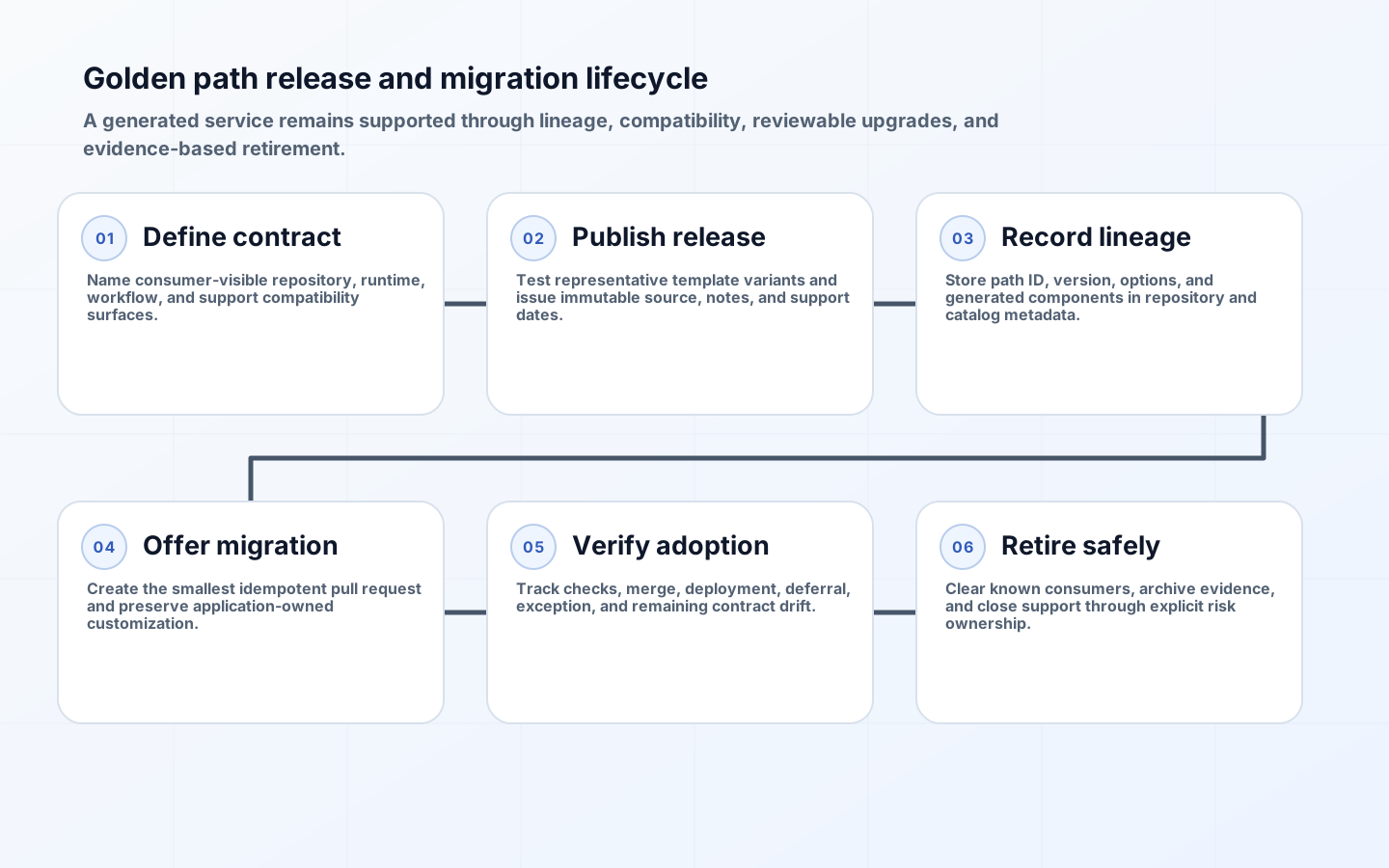
A golden path stops being a one-time template as soon as a generated service reaches production. The repository now has owners, releases, local decisions, dependencies, and uptime obligations. Meanwhile, the platform team will change its runtime baseline, CI workflow, security controls, observability conventions, and deployment model. Golden path versioning is the discipline that connects those two timelines without pretending the platform can overwrite application code safely.
The central design decision is to separate creation from continuing support. Backstage Software Templates can load a skeleton, collect inputs, execute steps, publish a repository, and register a component. That execution creates a consumer at a known starting point; it does not create an automatic update channel. Platform teams therefore need lineage, compatibility policy, change delivery, and adoption evidence around the template engine. A paved road is credible only when teams can tell which release they use, what remains supported, and how to move.
Record lineage at generation time
Give every path a stable product identifier and every released template an immutable version. When a generator runs, write a small machine-readable receipt into the new repository: path ID, template version or commit digest, creation timestamp, selected options, generated components, and any intentionally excluded modules. Also attach the path and version to catalog metadata. The receipt is not a claim that the repository still equals the template. It is the baseline from which later scanners can identify applicable changes and explain why an upgrade was offered.

Keep template source, documentation, tests, release notes, and migration transforms in version control. Backstage stores templates as catalog entities and requires a refresh before some modifications become visible, so the release process should verify both the source revision and what the production catalog serves. Publish a release only after generating representative variants into disposable repositories and running their build, policy, deployment, and smoke tests. A successful render alone misses failures in custom actions, permissions, registry access, or downstream tooling.
| Artifact | Purpose | Owner | Retention |
|---|---|---|---|
| Template release | Immutable generation input and action set | Platform product team | For every supported and traceable release |
| Generation receipt | Links a consumer to its starting release and options | Generated repository owner | Life of the repository |
| Compatibility statement | Defines supported runtime, language, and platform ranges | Platform and capability owners | Current plus archived releases |
| Migration transform | Produces a reviewable change from one release family to another | Platform maintainer | Until source release support ends |
| Adoption record | Shows offered, accepted, deferred, failed, or superseded upgrades | Platform operations | According to engineering evidence policy |
Define compatibility around consumer-visible behavior
Do not borrow semantic version numbers without defining what a breaking change means. For a golden path, the public contract may include repository layout, build commands, deployment inputs, runtime versions, health endpoints, ownership metadata, policy annotations, dashboards, and support automation. A change can be breaking even when generation succeeds: renaming a CI secret, changing an image entry point, or requiring a new network capability can invalidate established consumers. Write compatibility in terms a service owner can test, not in terms of internal template refactoring.
Use release channels to express maturity separately from compatibility. An experimental path can move rapidly with limited support; a stable path needs a migration window and tested upgrade route; a legacy path may receive only critical fixes. Backstage itself illustrates why labels matter: its umbrella releases and individual package versions have different policies and are not interchangeable. Your path may similarly contain a template release, action package versions, and runtime component versions. Expose each identity rather than compressing them into one misleading number.
Classify changes before choosing a delivery mechanism
Not every improvement belongs in generated code. Central policy, managed runtime defaults, shared actions, and platform-side controllers can often improve existing consumers without repository edits, provided their contracts permit the change. Repository-owned workflow files, dependencies, application configuration, and service code usually require a pull request. First classify who owns the affected surface and whether behavior changes. This avoids sending noisy migrations for a platform-side update, while preventing a silent central change from crossing a consumer-owned boundary.
| Change class | Typical example | Delivery | Main tradeoff |
|---|---|---|---|
| Platform-side compatible | Patch a managed build worker | Update service with staged rollout | Fast coverage, but shared blast radius |
| Repository mechanical | Rename a workflow action input | Automated pull request | Scalable, but merge conflicts need handling |
| Repository semantic | Adopt a different deployment topology | Guided migration with owner decisions | Safer intent review, slower adoption |
| Security emergency | Replace a compromised action or runtime | Expedited update plus bounded exception process | Risk reduction competes with service stability |
| Retirement | Remove an unsupported runtime line | Deadline, escalation, and residual-risk acceptance | Clear closure may expose unfunded work |
Make upgrades reviewable and idempotent
Prefer a pull request that explains intent, source and target path releases, affected contract surfaces, required owner choices, test evidence, and rollback. A transform should detect whether it applies, make the smallest deterministic change, and produce the same result when rerun. Use structured parsers for YAML, JSON, and manifests rather than replacing strings. Never regenerate the entire repository over local work. If a migration cannot distinguish generated structure from application-owned customization, stop and ask for a guided decision.
Test transforms against a corpus of real, sanitized repository shapes: untouched outputs, common approved variants, old versions, partially applied migrations, and known conflicts. Run the consumer's own checks after transformation. For high-risk changes, canary the updater with volunteer teams and compare failure reasons before broad rollout. Keep the previous path release available long enough to diagnose regressions, but do not imply that reverting a pull request will reverse external state already changed by a deployment or data migration.
Measure drift without punishing legitimate ownership
A byte-for-byte comparison with the latest template produces a useless score because consumers are expected to evolve. Measure contract-relevant conformance instead: supported runtime range, required build controls, deploy interface, ownership metadata, telemetry, and policy status. Preserve an explicit extension model so teams can customize approved locations without appearing broken. Drift findings should say which capability is affected, why it matters, the observed evidence, and the available remediation. They should not rank individual developers or become a proxy for code quality.
Track population state as a product cohort: release installed, applicable target, upgrade offered, pull request opened, checks passed, merged, deployed, deferred with reason, exception expiry, or repository retired. This distinguishes discoverability failure from migration failure. A low merge rate may mean the value is unclear, the change conflicts often, owners lack capacity, or the target release is unsafe. Each cause needs a different response; a single adoption percentage hides all of them.
Retire versions with an explicit support clock
Publish support dates when a release becomes available, not when the platform team wants it gone. Name what support includes: security fixes, compatibility testing, migration help, incident response, or best-effort documentation. Before end of support, identify every known consumer, verify ownership, offer an upgrade, and escalate unresolved critical workloads through engineering governance. A retirement date should change operational behavior, such as stopping routine fixes, but should not trigger an unreviewed destructive migration.
Provide a bounded exception for services that cannot migrate on time. Record the reason, accountable owner, compensating controls, target date, and risk approver. Report exceptions separately from supported adoption so leadership sees the residual obligation. The platform team also needs an archive strategy: old template source, migration tools, release notes, and receipts may be required to investigate incidents even after the creation option disappears from the portal.
Operate golden paths as a release portfolio
- Assign a product owner, technical owner, and support channel to every path.
- Publish immutable releases with compatibility, security, and support statements.
- Capture generation lineage and expose it in repository and catalog metadata.
- Separate platform-side changes from repository migrations and owner decisions.
- Test migration transforms against real variants and preserve pull-request evidence.
- Measure contract conformance, migration funnel state, exceptions, and retirement progress.
Key takeaways
- Generation is the beginning of a consumer relationship, not the end of template work.
- Version the consumer-visible contract and record exact lineage at creation.
- Deliver repository changes as narrow, tested, idempotent pull requests.
- Treat valid customization differently from unsafe contract drift.
- Give every supported release a published migration route and retirement clock.
Frequently asked questions
Should a template update every repository automatically?
Usually no. A template engine can create source, but generated repositories acquire local ownership and changes. Automate a narrow pull request when a transform can preserve those decisions. Keep centrally owned behavior on the platform side where a staged service rollout is the honest delivery mechanism.
Is semantic versioning enough for a golden path?
Only after you define the public contract. Teams need to know whether repository shape, workflow inputs, runtime support, deployment behavior, or generated APIs count as compatibility surfaces. Release channels and support dates carry information that a major, minor, or patch number cannot.
What if a team has heavily customized the generated service?
Evaluate current contract conformance rather than template similarity. Offer component-level migrations where possible. When automation cannot identify intent safely, provide a guided checklist and test suite. The team may keep its design while still adopting required runtime, policy, ownership, and observability contracts.
Conclusion
A durable golden path has lineage, a defined contract, tested releases, upgrade mechanisms, adoption evidence, and a fair retirement policy. Those practices let the platform evolve without seizing ownership of generated services or abandoning them on old assumptions. Version the promise teams depend on, automate only changes whose intent can be preserved, and make every migration a product experience that earns continued use.