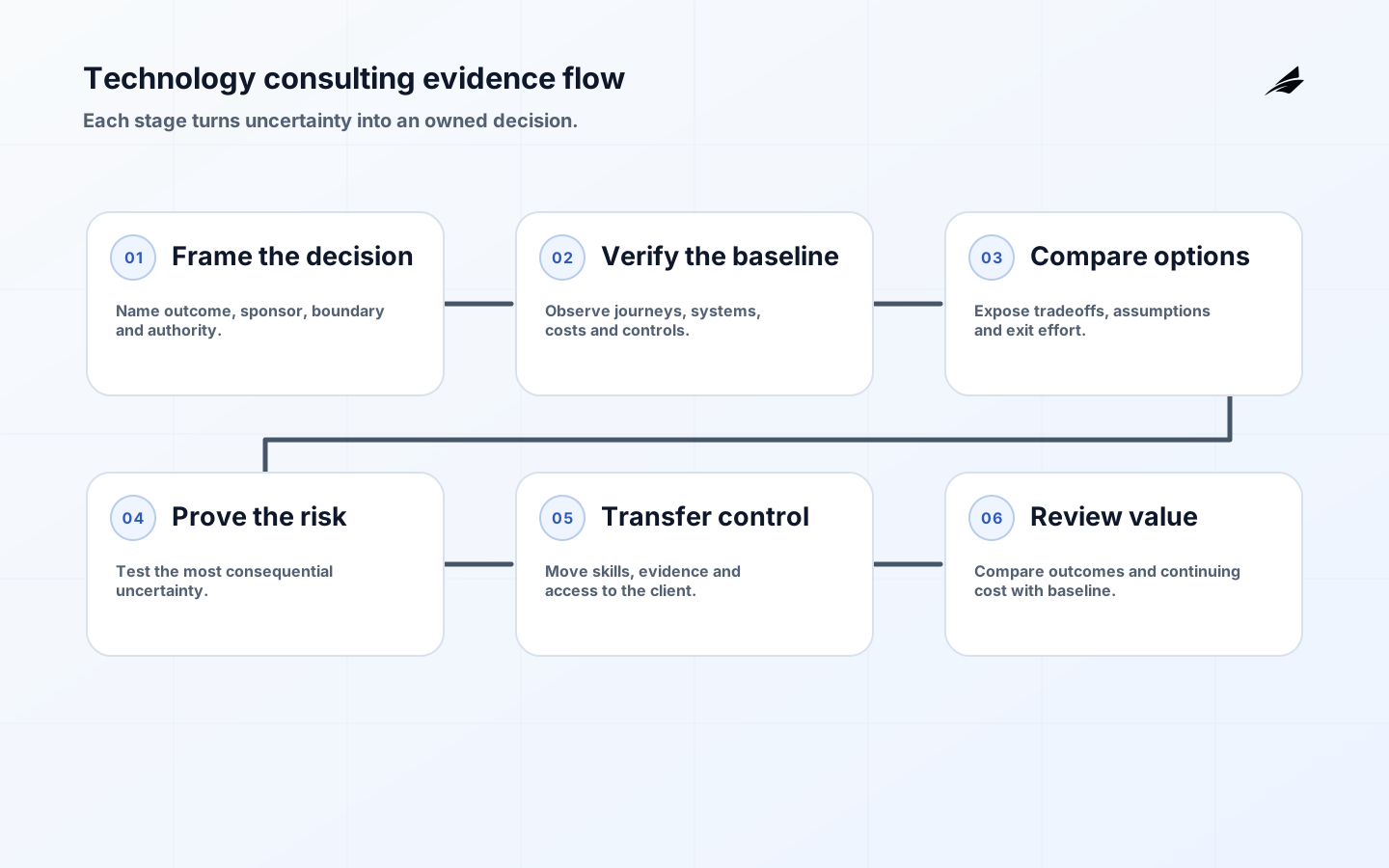
Technology consulting services are most valuable when an organization faces a decision it cannot responsibly settle with its current time, evidence or specialist capacity. That decision might be whether to modernize a core platform, how to govern an AI workflow, which cloud operating model to adopt, or how to recover a delayed program. A useful engagement does more than recommend a destination. It establishes the baseline, exposes assumptions, tests the riskiest claims, supports implementation and leaves accountable people able to operate what changed.
The buying question is therefore not simply, 'Which consultant has the broadest capability deck?' It is, 'What decision or capability must be measurably better when this engagement ends?' The technology consulting implementation checklist is useful once delivery begins, while the technology consulting FAQ helps procurement teams compare engagement models. This guide covers scope, cost, risk and the delivery plan that connects both.
1. Define the decision before the work package
Write a short decision brief before requesting proposals. Name the business outcome, sponsor, affected users, deadline, constraints, current evidence and decision rights. Distinguish an advisory engagement, which produces options and a recommendation, from a delivery engagement, which changes systems and operating practices. If both are required, state the gate between them. The advisor should not automatically win implementation merely because it wrote the recommendation; the client should explicitly accept the option, commercial basis and delivery accountability.
Bound the estate and the journeys in scope. An application-modernization brief should identify applications, interfaces, data classes, environments, suppliers and operating hours. A security brief should identify protected outcomes and risk tolerance. The NIST Cybersecurity Framework 2.0 is deliberately outcome based and adds Govern alongside Identify, Protect, Detect, Respond and Recover. That structure helps a sponsor describe intended outcomes without pretending that a framework selects the architecture or supplier.
| Scope element | Question to settle | Acceptance evidence |
|---|---|---|
| Outcome | Which business decision, journey or risk must improve? | Baseline, target and accountable owner |
| Boundary | Which systems, data, roles, sites and suppliers are included? | Current-state map and explicit exclusions |
| Authority | Who recommends, approves, builds and operates? | Decision-rights and responsibility matrix |
| Constraints | What legal, technical, timing and budget limits apply? | Constraint register with owners |
| Transition | What must the client perform without the consultant? | Observed handover and operating exercise |
| Value | How will benefit and continuing cost be reviewed? | Measurement plan tied to the baseline |
2. Turn discovery into comparable options
Discovery should observe real work, not only collect stakeholder wishes. Follow representative user and operator journeys; inspect architecture, contracts, incidents, delivery data, costs and controls; and reconcile disagreements against evidence. Separate facts from assumptions and unknowns. A consultant should be able to explain how each finding changes a decision. A large inventory with no decision consequence is expensive documentation, while a polished target state built on untested assumptions is false precision.

Present at least two viable options when a real choice exists, including the option to improve the current system. Compare capability, transition effort, operating cost, security, resilience, skills, supplier dependence, reversibility and time to evidence. Describe conditions under which each option stops being preferable. This makes the recommendation auditable and lets the sponsor choose according to risk tolerance rather than treating an architecture diagram as an objective answer.
3. Build an evidence-led delivery plan
Plan delivery as small, accepted slices. The GAO Agile Assessment Guide describes incremental development, continuous evaluation and disciplined program monitoring rather than equating agility with the absence of planning. A practical consulting plan might move from a two-week baseline to an architecture decision, a representative technical proof, one end-to-end pilot and then controlled expansion. Every stage needs a decision, evidence owner, exit criteria and route for unresolved findings.
Choose the representative slice for learning value, not convenience. It should cross enough of the real system to reveal identity, data, integration, release, support and ownership constraints, yet remain recoverable. Run it with production-like roles and realistic awkward cases. A cloud migration proof that ignores identity federation and restore behavior, or an AI pilot using hand-curated documents and administrator permissions, cannot support a broad investment decision.
For software delivery, include security in the engagement definition. NIST's Secure Software Development Framework groups practices around preparing the organization, protecting software, producing well-secured software and responding to vulnerabilities. Ask how source, dependencies, builds, artifacts, environments and vulnerability response will be controlled. Security review performed only before launch tends to discover architectural obligations after the cost of change has risen.
4. Estimate cost without pretending uncertainty is fixed
Separate discovery, delivery and continuing operation. Discovery can often be time boxed because its output is a decision and evidence pack. Delivery estimates should show labor by role, third-party products, cloud consumption, migration, testing, training, data work, change support and contingency. Continuing costs include platform operations, licenses, support, security, data retention, supplier management and future change. A low build quote can be the expensive option if it creates a proprietary operating dependency.
The GAO Cost Estimating and Assessment Guide emphasizes defining purpose, technical baseline, work breakdown, assumptions, risk analysis and updates with actual costs. Those principles are useful outside government acquisition. Ask for ranges linked to assumptions, identify the variables with the largest effect, and fund uncertainty retirement before committing the full program. Update the estimate when evidence changes rather than preserving an obsolete number for contractual appearance.
| Commercial model | Good fit | Buyer control to retain | Common risk |
|---|---|---|---|
| Fixed price | Bounded output with stable interfaces and acceptance tests | Change and acceptance definitions | Supplier prices hidden uncertainty into scope gaps |
| Time and materials | Discovery or evolving delivery with active product ownership | Budget cadence, priorities and evidence reviews | Activity grows without outcome decisions |
| Capped stage | Uncertain work needing a firm decision point | Stage outcome and stop rule | Cap is treated as a promise for later stages |
| Retainer | Specialist advice or operational support with variable demand | Response terms and usable capacity reporting | Unused access replaces planned capability transfer |
| Outcome linked | Measurable outcome with attributable supplier influence | Baseline and anti-gaming measures | Payment depends on factors neither party controls |
5. Govern conflicts, dependencies and delivery risk
Maintain a decision log, risk register and assumption register as working controls. Each material item needs an owner, next evidence, review date and consequence. Record vendor affiliations, reseller revenue, implementation interests and platform incentives. Product expertise is valuable, but the sponsor must know when a recommendation creates commercial benefit for the advisor. Require options and exit implications to be visible before committing to a platform or managed service.
Protect client control of accounts, source, repositories, architecture decisions, credentials, data, models, build definitions and operational evidence. Contract for confidentiality, data handling, subcontractors, incident notification, intellectual property, open-source obligations, deletion and assistance at exit. Access should be role based, attributable and removed when work ends. These controls should be exercised during delivery rather than discovered in a hurried final handover.
Use metrics to improve the system rather than score individuals. DORA's January 2026 software delivery metrics guidance uses five measures across throughput and instability and recommends applying them to one application or service in context. A consulting engagement can use delivery evidence alongside customer outcomes, reliability, security and cost, but a single deployment number cannot prove value. Establish the baseline before the intervention and explain other changes that could affect the result.
6. Accept capability, not presentation volume
Define acceptance around observed performance. The client team should make a change, operate a critical journey, investigate a failure, restore a representative service or dataset, review cost and security evidence, and make the next priority decision. Documentation supports this exercise but does not replace it. Record unresolved risks, temporary access, supplier actions and workarounds with owners and dates before commercial closure.
Handover should begin during the first stage. Pair client staff with consultants, keep artifacts in client-controlled systems, and rotate responsibility for meetings, deployments and incidents. The infrastructure services scope guide offers deeper questions for platform ownership, while the infrastructure implementation checklist helps test operating readiness. The end state is not independence from every specialist; it is informed control of decisions and dependencies.
Key takeaways
- Define a consequential decision, a baseline and decision rights before buying activity.
- Compare viable options through transition effort, operating cost, risk and reversibility.
- Use staged proofs to retire the most expensive uncertainty before broad commitment.
- Estimate discovery, implementation and continuing operation separately.
- Keep client control of systems, evidence, credentials and architecture decisions.
- Accept the work when accountable staff can operate and improve the changed capability.
Technology consulting services FAQ
How long should a technology consulting engagement last? Duration follows the decision and evidence required. A bounded assessment may take weeks; implementation can take months or longer. Use stages with acceptance decisions instead of one undifferentiated end date.
Should consultants recommend specific vendors? They can when the recommendation follows declared requirements and comparison criteria. Require disclosure of commercial relationships, viable alternatives, total operating implications and an exit route.
Is a fixed-price engagement safer? It improves price certainty only when scope, interfaces and acceptance are stable. For uncertain work, a capped discovery stage can protect the budget while producing evidence for a better delivery estimate.
What is the most important handover artifact? No single document is enough. The strongest evidence is a client team successfully operating the capability with its own permissions, supported by source, decisions, runbooks, controls and known-risk records.
Conclusion: buy an owned decision and operating capability
Professional technology consulting services convert uncertainty into owned, testable decisions. Start with the outcome and boundary, demand comparable options, fund representative evidence, make cost and conflicts transparent, and transfer responsibility throughout delivery. The engagement has succeeded when the organization can explain what changed, operate it under pressure and decide what to improve next.