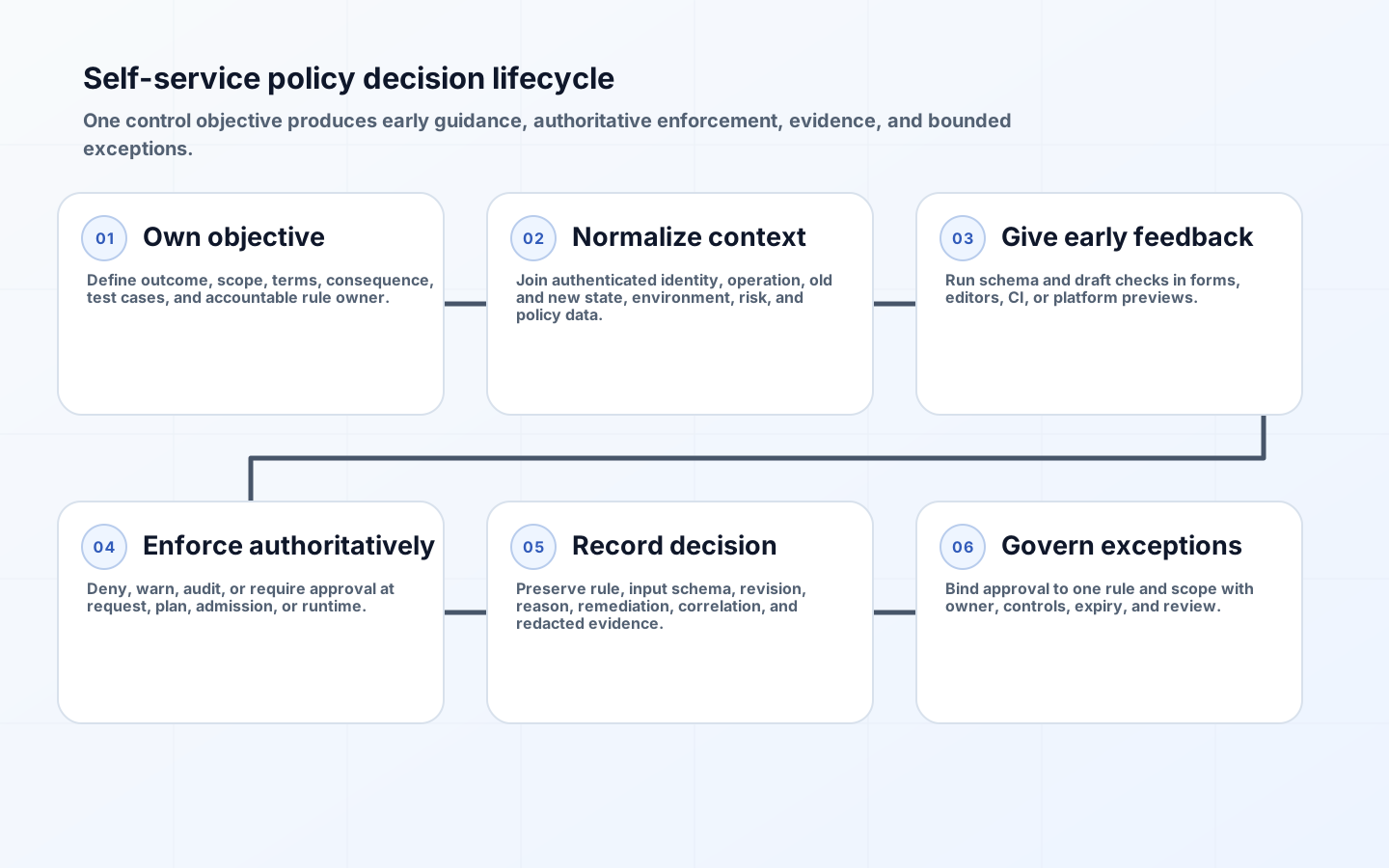
Self-service changes where governance happens. A central reviewer no longer inspects every database, deployment, or cloud request before work begins, so controls must move into the interfaces where intent is declared and realized. Good platform engineering policy guardrails return fast, specific feedback, prevent material harm, preserve evidence, and provide a bounded path for exceptional cases. They do not turn the platform into an unexplained wall of denials.
No single enforcement point is sufficient. A portal can validate friendly inputs but may be bypassed by API. An infrastructure plan sees provider changes but not every runtime mutation. Kubernetes admission intercepts modifying API requests after authentication and authorization but before persistence; it does not inspect reads and cannot prove that running state remains compliant forever. Build a layered decision path around one policy intent and identify which layer is authoritative.
Write control objectives before policy code
Express the outcome, scope, owner, evidence, and failure consequence. 'Production data stores must not accept public network traffic' is clearer than 'deny public equals true' because the objective can be implemented across cloud providers and tested against architecture. Define production, data store, public reachability, approved ingress, and exceptions. Link the rule to an accountable security or operations owner who can answer questions and approve changes.
Classify rules by consequence. Safety invariants and legal constraints usually deny. Recommended defaults may warn while teams migrate. Organizational conventions may be lint findings. Some decisions need approval because context cannot be reduced to request attributes. Do not label every preference critical; users will route around an interface that blocks delivery for low-value consistency. Equally, do not offer warnings where one accepted request could create an unacceptable exposure.
| Class | Example | Default action | Required governance |
|---|---|---|---|
| Invariant | No unauthenticated public production database | Deny | Named owner, tests, emergency scope |
| Risk threshold | Resource exceeds team quota or approved region | Deny or approval | Parameters and delegated authority |
| Migration rule | Legacy encryption setting remains | Warn, then deny by date | Affected inventory and remediation |
| Quality guidance | Missing recommended cost label | Warn | Actionable fix and value explanation |
| Detective control | Runtime drift after admission | Alert and reconcile by policy | Response owner and severity |
Map policy to the earliest reliable boundary
Evaluate as early as possible for feedback, then enforce at the boundary that has authoritative data and cannot be casually bypassed. Schema validation belongs in editors and CI. Eligibility and quota may belong in the platform API. Provider-specific restrictions may evaluate a plan. Kubernetes object policy belongs at admission. Network or identity facts that emerge later need runtime detection. Reuse the control objective and test cases even when implementation languages differ.
Inventory every path that can create or change the governed resource: portal, CLI, API, GitOps controller, CI credential, cloud console, break-glass account, operator, and direct cluster request. Either route each through equivalent enforcement or document a narrower assurance claim. UI-only validation is convenience, not a preventive control. Conversely, a deep admission denial without earlier feedback wastes time and makes policy feel arbitrary.
Build a normalized policy input contract
Policy needs more than the submitted object. Normalize authenticated principal and team, operation, resource type, old and proposed state, environment, data class, region, cost center, exception references, and trusted directory or inventory facts. Identify the authority and freshness of each attribute. Never let the request self-assert that it is nonproduction, low risk, or preapproved without verification.
Version the input schema separately from policy bundles. Provide stable decision outputs: allow, deny, warn, or approval-required; rule ID; human message; machine reason; remediation; documentation; decision ID; policy revision; and relevant field path. OPA is designed to evaluate structured data with declarative policy and exposes APIs for decisions. That makes it suitable as one engine, but the platform still owns input integrity and user-facing semantics.
| Layer | Available context | Best use | Blind spot |
|---|---|---|---|
| Editor or form | Draft fields and user selections | Schema, defaults, immediate guidance | Can be bypassed and lacks final identity |
| Platform API | Authenticated requester, intent, catalog context | Eligibility, ownership, quota, approvals | May not know provider-computed changes |
| Plan | Proposed concrete infrastructure delta | Destructive actions and provider attributes | Plan can age before apply |
| Admission | Final API request and cluster context | Non-bypassable object validation | No read control and limited external context |
| Runtime | Observed resources, traffic, and configuration | Drift and emergent conditions | Detects after change unless reconciled |
Use Kubernetes admission with explicit failure semantics
Kubernetes processes mutating admission before validating admission. ValidatingAdmissionPolicy is a stable, in-process option using CEL and consists of policy logic plus a binding, with optional parameter resources. Bindings can Deny, Warn, or Audit; Deny and Warn cannot be combined in one binding. Use match constraints and namespace or object selectors carefully, test updates as well as creates, and provide messages that identify the failing field.
Webhooks support external logic but add network and service dependencies. Set timeouts, failure policy, side-effect declarations, version matching, and high availability deliberately. A fail-closed webhook protects the invariant during outage but can block the API; fail-open preserves availability while admitting unchecked changes. Reduce this tradeoff with in-process rules for suitable checks, local data, redundant webhooks, narrow matching, and a tested emergency route rather than a global bypass.
Make denials and warnings actionable
Return what failed, why it matters, where it was observed, how to fix it, and who owns the rule. Prefer 'Production database orders requests public ingress; select private connectivity or attach approved exception EX-123' over 'policy violation.' Preserve a stable rule ID for search and support. Offer a dry-run or local test using the same input contract so users can resolve issues before waiting for provisioning.
Measure denial rate by rule, valid remediation, repeated failure, exception request, decision latency, and support escalation. A high denial count may mean the control is catching risk, the default is wrong, documentation is poor, or the input mapping is broken. Sample decisions with platform users and policy owners. Do not weaken an invariant merely to improve throughput; fix the experience or underlying paved path first.
Design exceptions as policy objects
An exception should bind one rule to a precise resource or request scope, owner, business reason, risk approver, compensating controls, start, expiry, and review trigger. Validate the reference and scope during every decision. Never accept an unstructured ticket number as proof of approval. Broad exemptions by namespace, team, or cloud account accumulate invisible risk and are difficult to retire.
Expiry should prevent new or changed noncompliant state and create remediation work; automatic destruction is appropriate only where explicitly designed and safe. Alert before expiry, record use, and report active exception exposure. Emergency access needs a faster authorization route but the same bounded scope and retrospective review. Predefine which authority can approve which rule so an incident does not improvise governance.
Operate policy versions and decision evidence
Store policy code, tests, data, and release metadata in version control. Sign or integrity-protect bundles, separate authorship from production promotion for high-impact controls, and canary changes in audit or warning mode. OPA bundles can update policy and data without restart and support signatures; test activation failure and retain the prior known-good bundle. Pin decisions to a bundle revision rather than recording only the latest rule text.
OPA decision logs can include policy path, input, result, decision ID, bundle revision, and trace identifiers. They can also contain sensitive request data, so use masking, access control, retention, and minimization. Preserve enough evidence to reproduce a material decision without creating a second uncontrolled store of credentials or personal data. Link plan, admission, runtime, and exception events through a correlation ID where possible.
Test and roll out guardrails safely
- Write allowed, denied, boundary, missing-data, and malicious-input examples for each objective.
- Test schema and policy versions together, including old objects on update.
- Replay representative decisions and compare old and candidate results.
- Deploy in audit or warning mode and classify unexpected outcomes.
- Canary enforcement on a bounded resource cohort with rollback ready.
- Exercise engine outage, stale data, exception expiry, and emergency authorization.
Key takeaways
- Anchor rules in owned control objectives and proportional consequences.
- Give early feedback and enforce at the earliest authoritative non-bypassable boundary.
- Normalize trusted context and return stable, explainable decisions.
- Model exceptions as scoped, expiring, auditable policy data.
- Version, test, canary, and preserve evidence for every policy release.
Frequently asked questions
Should every failed policy deny the request?
No. Deny invariants and material thresholds. Warn for recommendations and staged migrations, and use approvals where contextual judgment is legitimate. The action should follow a documented consequence model, not the convenience of the policy engine.
Can admission control replace runtime compliance?
No. Admission evaluates matched modifying requests at a point in time. External systems, bypass paths, controller behavior, and changing facts can produce drift later. Pair prevention with observation and a deliberate remediation policy.
Should policy fail open during an outage?
It depends on the control objective and availability impact. Engineer highly available local evaluation for critical invariants, and define a narrow audited emergency path. A silent global fail-open setting converts a policy-service outage into uncontrolled change.
Conclusion
Policy guardrails make self-service scalable when they combine trustworthy context, early guidance, authoritative enforcement, humane explanations, controlled exceptions, and reproducible evidence. Layer the same objective across request, plan, admission, and runtime where needed. The result is governance that speeds safe decisions because developers know the rules before infrastructure is created.