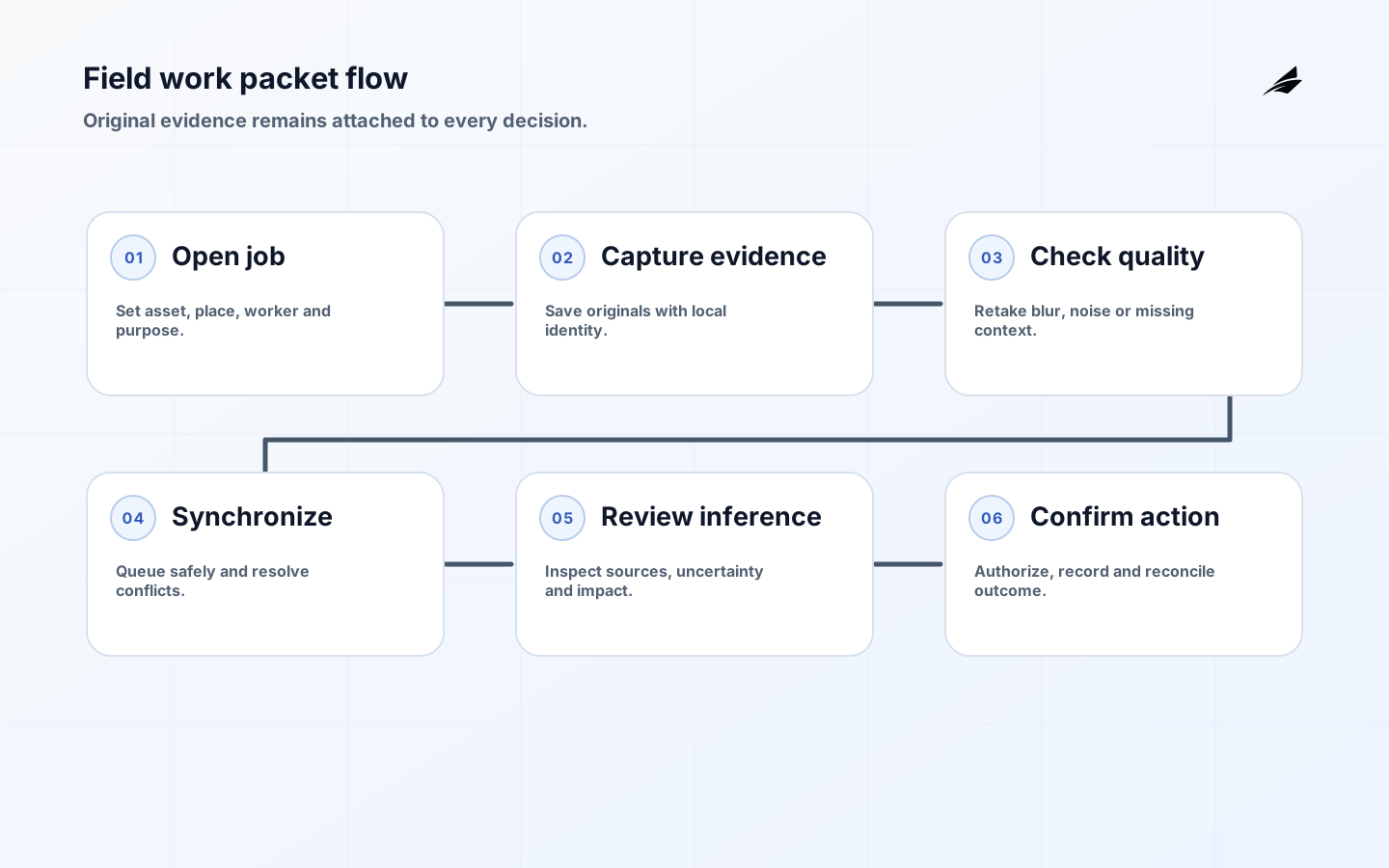
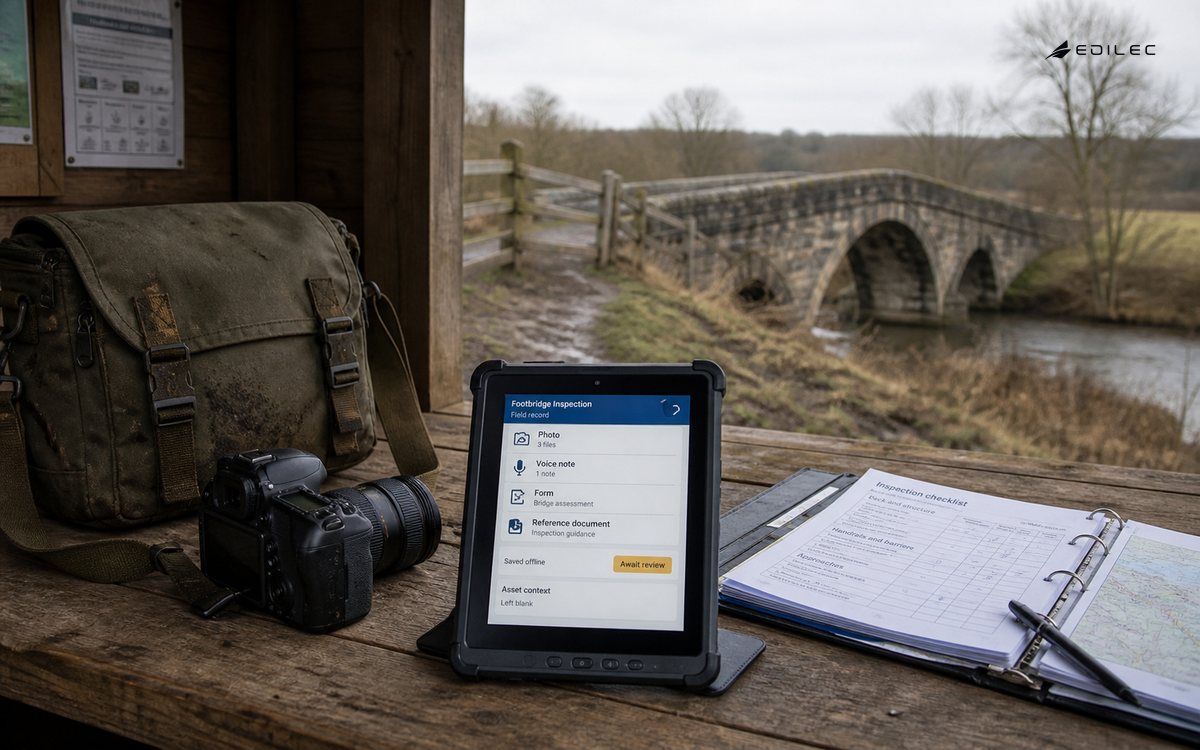
Multimodal AI workflows for field teams combine photos, voice notes, forms, sensor readings and reference documents into a reviewable work record. The value is not that a model can “see” an image or transcribe speech. It is that a technician, inspector, nurse, surveyor or maintenance lead can capture evidence once, keep it attached to the right asset and turn it into a controlled next action. Field conditions make this difficult: connectivity is intermittent, devices are shared, lighting and noise vary, terminology is local and the consequence of a mistaken recommendation may be physical. The architecture must therefore preserve original evidence, uncertainty, identity and offline state before it optimizes model output.
Design one field work packet
Use a work packet as the boundary for every capture. It should identify the job, asset or location; capture who collected each item and when; retain original media; record device and synchronization state; and connect derived text or classifications back to their source. Do not flatten a photo, transcription and operator correction into one untraceable note. The packet should show what the model observed, what it inferred and what a person confirmed. The AI document intake guide provides a complementary pattern for forms and documents that enter from outside the field app.
| Input | Preserve with it | Typical quality check |
|---|---|---|
| Photo or video | Original file, timestamp, orientation and asset reference | Blur, crop, lighting and required viewpoint |
| Voice note | Original audio, language and speaker context | Noise, missing terms and transcription confidence |
| Structured form | Schema version, field edits and validation result | Required values, units and allowed state |
| Reference document | Version, source and effective date | Current procedure and access permission |
| Model output | Model, prompt, sources and confidence signal | Unsupported claim, unsafe action or missing evidence |
Make offline behavior explicit
Field software should remain useful when the network disappears. Android’s offline-first guidance recommends a local source of truth and describes queued or lazy writes that synchronize later. Apply that principle to the entire packet: assign a durable local identifier, save media before processing, show pending upload state and make retry idempotent. Decide conflict rules for two workers updating the same job, and never imply that a server action completed while it is only queued. Business-critical uploads should survive process death as durable work, a concern also covered in the official Android data-layer architecture.
Process each modality on its own terms
Compression, transcription, optical character recognition and image analysis fail differently. Run capture-quality checks close to the device so the worker can retake evidence while still on site. Preserve units and domain vocabulary during transcription; store page and region references for extracted document text; and avoid asking one general model to silently reconcile conflicting signals. Build a normalized evidence object only after modality-specific processing. When a photo suggests corrosion but the form reports “no defect,” route the disagreement rather than averaging it away. A good interface lets the reviewer open the exact image region, audio segment or document page behind a claim.
| Failure condition | Safe system behavior | Operator message |
|---|---|---|
| No connectivity | Save locally and queue an idempotent upload | Captured on device; not yet synchronized |
| Poor media quality | Request a retake before leaving the task | Photo is too blurred to verify the label |
| Conflicting evidence | Hold automation and request review | Form and image describe different states |
| Untrusted instruction in a document | Treat content as data, not a command | Document requires security review |
| Downstream tool timeout | Do not repeat a consequential write blindly | Action not confirmed; check status before retry |
Separate evidence from instructions
Every field photo, note and document is untrusted input. A sign, label or PDF can contain text that attempts to redirect an AI workflow. OWASP identifies prompt injection as a central LLM application risk, including indirect instructions embedded in external content. Isolate extraction from tool execution, constrain tools by user and task, validate structured arguments and require human approval for safety, finance, identity or compliance actions. The model may recommend a part replacement; the inventory reservation, work-order closure or customer notice should still pass deterministic authorization.
Place human review at consequential boundaries
Review should focus on uncertainty and consequence, not force a person to reread every easy case. Route low-confidence captures, conflicting modalities, unfamiliar assets and high-impact recommendations to qualified reviewers. Present source evidence and the proposed action together, allow correction with a reason and preserve both versions. The human-in-the-loop design guide explains how approval gates should change authority rather than decorate the interface. NIST’s Generative AI Profile supports ongoing testing and monitoring as context and behavior evolve.
- Capture consent and safety notices before recording people or private spaces.
- Minimize location and device metadata to what the task actually requires.
- Encrypt local storage and remove completed packets according to policy.
- Allow a worker to correct transcription without destroying the original audio.
- Test gloves, glare, background noise, shared devices and low battery in the real environment.
Operate the workflow as a field service
Measure the full path from capture to resolved work. Useful signals include retake rate, synchronization age, transcription correction, review burden, false escalation, unresolved packet age, model cost per completed job and safety incidents. Segment by device, site, language, asset type and connectivity because a global average can hide a failing cohort. Connect incident review to the intake-to-action workflow series so recurring capture and handoff failures become product changes. Keep an offline manual route and test how already-captured packets are reconciled after service restoration.
Design the interface for field reality
Field users cannot inspect a dense AI explanation while balancing equipment, wearing gloves or speaking over machinery. Use one primary task per screen, large targets, clear capture requirements and visible offline state. Let the worker preview and retake media, mark an item unavailable and defer noncritical details. Show which evidence is still on the device and which has synchronized. Avoid automatic submission immediately after capture; a brief confirmation catches the wrong asset or accidental recording. Support local language and domain terms without silently translating codes that carry operational meaning. Accessibility includes sunlight contrast, hearing alternatives, motor constraints and cognitive load as well as formal conformance.
Evaluate across environments and cohorts
Build a field evaluation set from authorized examples spanning devices, seasons, lighting, noise, accents, handwriting, asset age and rare failure modes. Preserve subgroup labels needed to detect uneven performance without retaining unnecessary identity data. Test each modality alone and in combination, because a strong transcription result can still be attached to the wrong photo. Review false reassurance separately from false escalation; their costs differ. Re-run the set after capture, model, prompt or preprocessing changes and sample live packets with reviewer agreement. A laboratory score should never substitute for trials in the places where the workflow will operate.
Operate devices, versions and synchronization
Treat the mobile application, on-device models, remote services and packet schema as one versioned service. Define supported operating systems, storage limits, encryption, remote revocation and update windows. Prevent a schema upgrade from orphaning queued packets; migrate local records or keep backward-compatible ingestion. Monitor failed uploads by app version and site, and provide a recovery export under controlled support when synchronization cannot be repaired. Shared devices need explicit sign-out, local data separation and reassignment handling. Before retiring a version, confirm that no unsynchronized business-critical packets remain and communicate the last supported date to supervisors.
Worked scenario: inspect a damaged asset
Consider a technician inspecting a pump after abnormal vibration. The app opens the assigned asset, downloads the current procedure and works offline. The technician records audio, photographs the nameplate and damaged coupling, enters a vibration value with units and marks the machine isolated. Local checks reject one blurred photo before the worker leaves. On synchronization, transcription preserves equipment terms, image analysis suggests damage classes and the workflow links every derived statement to its source. A reviewer sees a conflict between the entered unit and the expected sensor range, corrects it and approves an inspection recommendation rather than an automatic repair order.
The downstream system creates a work order once, returns its identifier and records the model, evidence, reviewer and policy versions. If the integration times out, the packet checks whether the order exists before retrying. The supervisor can see which evidence is local, synchronized, reviewed and acted upon. Later evaluation uses the correction as a difficult case without exposing unrelated site data. This example shows why the architecture is a packet and state machine, not a single prompt: capture quality, offline truth, authorization, idempotency and business reconciliation determine whether multimodal assistance is safe.
Key takeaways
- Use a durable work packet to bind every modality to one job and identity.
- Design offline state, synchronization and conflict handling before model features.
- Process photos, audio, forms and documents with modality-specific quality checks.
- Treat captured content as untrusted evidence and constrain downstream tools.
- Route consequence and uncertainty to a qualified reviewer with source context.
Frequently asked questions
Must inference run on the device?
No. On-device checks are valuable for immediate quality, privacy or latency, while heavier analysis can run after synchronization. Choose per step and preserve a usable capture path when remote inference is unavailable.
Should a confidence score be shown to field workers?
Only when it is calibrated, explained for the task and connected to an action. A vague percentage can create false trust. Clear states such as “retake required,” “review needed” and “verified” are often more operationally useful.
How long should original media be retained?
Retention follows the business, legal and safety purpose. Keep originals long enough to support review, correction and required evidence, then delete them through a documented schedule. Do not retain rich location or audio data merely because storage is cheap.
Conclusion
A dependable multimodal field workflow protects the chain from real-world evidence to accountable action. Offline-first capture, visible provenance, bounded tools and focused human review make AI assistance useful where conditions are least predictable.