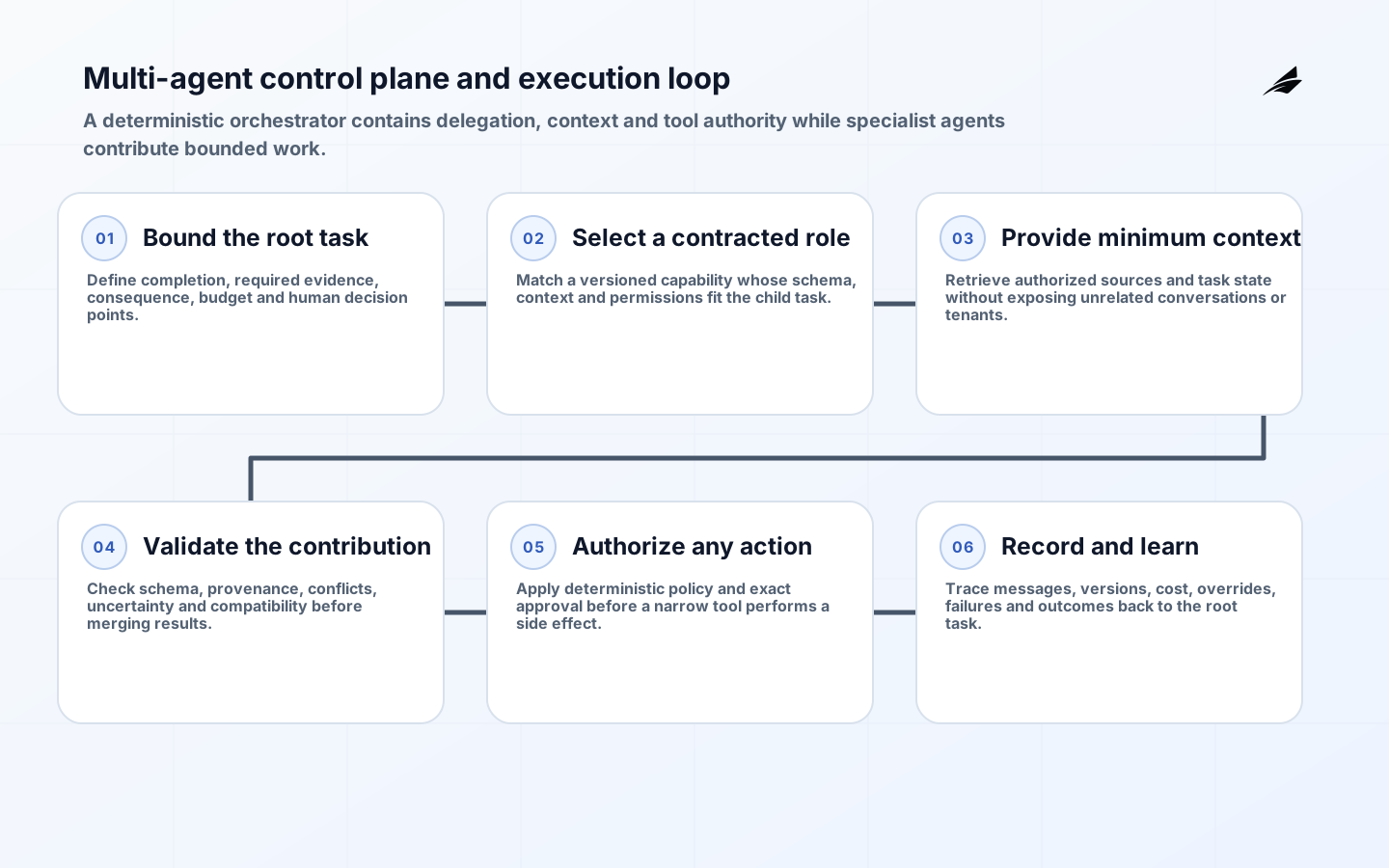
A multi-agent services suite implementation checklist must answer a harder question than how several models can exchange messages: how does the overall service remain correct, authorized and recoverable when responsibility is distributed? Specialized agents can separate planning, retrieval, domain analysis and execution, but each additional participant creates another identity, context boundary, failure mode and source of latency. The implementation should therefore begin with one business workflow and explicit authority, not a diagram filled with agent personas.
This guide treats a multi-agent system as a production distributed application. It covers role contracts, orchestration, Agent2Agent communication, Model Context Protocol connections, tool execution, memory, evaluation and human control. Teams comparing architecture and commercial options can first read the multi-agent services suite scope and delivery plan; operational questions are addressed in the multi-agent services suite FAQ.
Select a workflow that genuinely needs multiple agents
Choose a workflow where decomposition creates a measurable advantage: different domains require separate policies, work spans independently owned systems, or tasks can run concurrently with clear merge rules. Do not add agents merely to imitate an organization chart. A single orchestrator with deterministic tools is usually easier to evaluate than a conversation among loosely described roles. Write the trigger, desired result, maximum acceptable consequence, required evidence and human decision points before designing messages.
Define the unit of work and its completion rule. For a supplier review, completion might require verified company data, sanctions screening, contract analysis and an accountable approval. For an incident investigation, it might require a correlated timeline and proposed containment plan, never autonomous containment. Record where probabilistic assistance is appropriate and where conventional policy code must decide. This boundary becomes the basis for architecture, tests and operational metrics.
| Candidate pattern | Use it when | Avoid it when |
|---|---|---|
| Coordinator with specialists | One service owns the workflow and delegates bounded analyses. | Specialists can make conflicting irreversible changes. |
| Parallel analysis | Independent evidence can be gathered concurrently and merged deterministically. | Tasks depend on an evolving shared state that cannot be versioned. |
| Reviewer agent | A separate model can challenge evidence or policy interpretation. | The reviewer shares the same blind spots and evaluation data as the producer. |
| Agent-to-agent delegation | Remote capabilities have explicit contracts and independent ownership. | Discovery, identity or liability for the remote agent is unclear. |
| Human approval gateway | Consequences require accountable judgment or additional context. | The interface merely encourages rubber-stamping. |
Specify agent roles as enforceable contracts
For each agent, define accepted task types, input schema, output schema, allowed context, prohibited data, tool permissions, latency budget and failure response. A role name such as “research agent” is not a contract. A useful definition states which repositories it may query, how sources are represented, whether it may ask for clarification and what confidence or missing-evidence fields accompany its result. Version role contracts so the orchestrator can reject incompatible participants rather than improvise.
Give every participant a workload identity independent of the model prompt. Authorization should be checked by the host, gateway or tool service, not inferred from a natural-language claim. Propagate the end-user identity and delegated purpose where downstream policy depends on them, but do not expose the entire conversation to every service. Model Context Protocol’s host-client-server separation is useful precisely because the host can enforce connection permissions and isolate servers from one another.
Keep orchestration and workflow state deterministic
Use a durable orchestrator to own task state, deadlines, retries, cancellation and compensation. Agents may propose the next step, but the state machine should decide whether that transition is valid. Store an immutable event history containing task version, participant identity, request and response hashes, policy result and tool outcome. This prevents a resumed workflow from depending on an unrecoverable chat transcript and lets operators answer which component changed the case.

Set explicit fan-out and recursion limits. Unbounded delegation can multiply token use, latency and external calls without improving the result. Attach a budget to the root task and decrement it across child work. Require a reason and expected output for each delegation. When parallel results return, use a typed merge operation that can represent disagreement instead of asking another model to silently blend incompatible answers. Timeouts should yield a controlled partial result or escalation, not an invented completion.
Govern protocol discovery and compatibility
Agent2Agent protocols can support capability discovery and remote task exchange, while MCP can connect a host to tools and context. These protocols solve interoperability mechanics; they do not establish trust by themselves. Pin trusted endpoints, validate advertised capability metadata, authenticate both parties and maintain an allowlist of accepted protocol versions. Treat an agent card or tool description as untrusted input because it can influence planning and may change independently of your release.
Define compatibility tests for schemas, streaming events, cancellation, error codes and artifact retrieval. A remote participant should be replaceable without changing the business completion rule. Capture the actual capability version used for each task. If discovery is dynamic, verify ownership and signatures before use, and decide what happens when a previously available specialist disappears. Cross-organization delegation also needs contractual boundaries for data processing, retention, incident notification and service levels.
Separate task context, memory and authoritative records
Provide each agent with the minimum context needed for its assigned decision. Use permission-filtered retrieval and return source identifiers, effective times and provenance. Shared memory should not become an ungoverned database of summaries. Distinguish short-lived task state, user-approved preferences, operational logs and authoritative business records; apply separate retention and correction rules. A model-generated summary can accelerate work, but it must not overwrite the source record from which a future decision is made.
Defend retrieval and messages against instruction injection. Content from documents, websites and remote agents is data, not trusted control text. Keep system policy outside retrieved material, label origins and restrict which outputs can affect tool arguments. Sensitive values should be referenced through handles when possible rather than copied into every message. Redact logs without removing the identifiers required to investigate an incident. Test cross-tenant and cross-task isolation explicitly.
| Control surface | Required guardrail | Evidence to retain |
|---|---|---|
| Agent identity | Authenticated workload identity and least-privilege role. | Identity, delegated user, purpose and authorization decision. |
| Message | Schema validation, size limit and provenance label. | Sender, recipient, protocol version and content hash. |
| Memory | Purpose-bound storage, retention and correction workflow. | Record source, effective time, access and deletion event. |
| Tool call | Argument validation, policy check and idempotency. | Proposed call, approved call, result and side effect identifier. |
| Delegation | Allowlisted capability, depth and budget limit. | Parent task, reason, child status and cost. |
| Human decision | Consequences, evidence and alternatives displayed. | Reviewer identity, decision, rationale and policy version. |
Constrain tools and consequential actions
Expose narrow task-specific tools rather than generic shell, database or browser control. A refund tool should accept a validated order, amount, reason and idempotency key; it should not permit arbitrary API calls. Validate every argument outside the model, re-read current state before execution and enforce business policy with deterministic code. Use separate credentials for reading and changing data. High-consequence tools should require a signed approval object tied to the exact proposed action.
Design approval for judgment, not ceremony. The reviewer needs the original request, material evidence, model recommendation, uncertainty, policy result and consequences of approval or rejection. If the proposal changes after review, invalidate the approval. Record abstention and requests for more information as first-class outcomes. Emergency override requires stronger authentication, a narrow duration and retrospective review. A kill switch should stop new consequential actions while allowing evidence preservation and safe completion of in-flight work.
Evaluate the system, not only each model
Create scenario suites from real workflow families, edge cases and past incidents. Score task completion, evidence quality, policy compliance, unsafe tool attempts, escalation quality, latency and cost. Component accuracy can look strong while orchestration fails through duplicated work, lost state or incompatible assumptions. Test message delays, malformed responses, unavailable specialists, stale memory, conflicting findings and prompt injection. Include domain experts and operators who did not build the system.
Compare the suite with a simpler baseline. If one model plus deterministic tools produces equivalent outcomes with lower risk and cost, the multi-agent design has not justified itself. Version models, prompts, role contracts, protocol adapters, retrieval indexes and policies as one evaluated release set. Promotion should require performance by risk tier, not a single average score. Retain failed and abstained cases because they reveal the boundaries future users need to understand.
Operate agents with distributed-system discipline
Trace one root task across all messages, retrievals, policy decisions and tool calls. Monitor completion by workflow family, delegation depth, stalled child tasks, retries, human overrides, unsafe proposals, token use and external dependency errors. Do not log private chain-of-thought; capture structured decisions, cited evidence and observable actions. Alerts should point to customer or business impact, such as unapproved actions or a backlog of tasks awaiting review, rather than raw model latency alone.
Prepare runbooks for compromised credentials, malicious remote capability metadata, runaway delegation, tool outage, model regression and corrupted memory. Operators need the ability to pause a participant, route work to a fallback, invalidate cached discovery and replay from a known event without repeating side effects. Post-incident review should distinguish model behavior, orchestration logic, authorization, data quality and operator interface defects so corrective work reaches the owning component.
Multi-agent implementation takeaways
- Use multiple agents only when domain separation, parallel work or independent ownership creates a measurable benefit.
- Define each role through schemas, permissions, failure behavior and versioned compatibility rather than personality prompts.
- Keep workflow state, budgets and valid transitions in deterministic orchestration.
- Treat remote descriptions and retrieved instructions as untrusted data.
- Authorize and validate tool actions outside models, with exact human approval for consequential changes.
- Evaluate and observe the complete distributed service under realistic failure and attack conditions.
Frequently asked questions
How many agents should a suite contain? Start with the smallest architecture that represents distinct responsibilities. Add a participant only when its boundary improves evaluation, ownership, isolation or parallelism. More roles increase coordination cost and can make failures harder to attribute.
Do A2A or MCP make an agent integration secure? No. They provide communication and capability patterns. The host organization still has to authenticate endpoints, authorize data and tools, validate schemas, constrain context, monitor behavior and handle protocol or participant failure.
Can one agent approve another agent’s consequential action? A reviewer agent can surface inconsistencies, but it does not replace accountable approval where policy or impact requires a person. Independent automated checks should be deterministic where possible, and human review must be tied to the exact action and evidence.
Conclusion
A multi-agent services suite is reliable when it behaves like a governed distributed system rather than an open-ended conversation. Explicit role contracts, durable orchestration, isolated context, authenticated protocols, narrow tools, meaningful human authority and system-level evaluation make delegation useful without losing control. The implementation checklist is complete only when the team can explain and recover every task from trigger through final side effect.