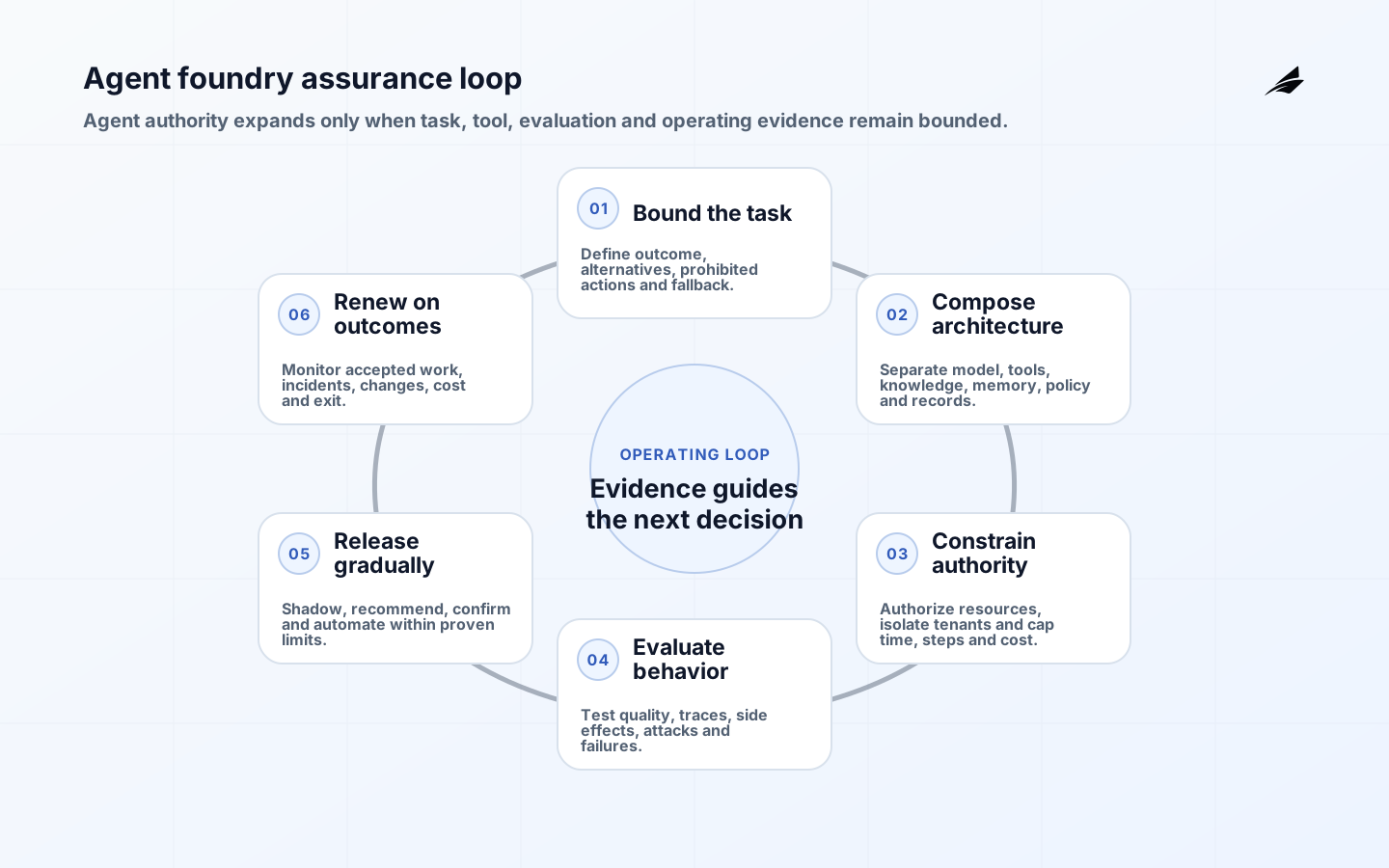
This agent foundry solution FAQ treats a foundry as a governed environment for creating, evaluating, deploying and operating AI agents, not as one universal vendor product. A useful foundry combines model access, prompts or instructions, tools, retrieval, memory, orchestration, identity, policy, evaluation, observability and release controls. The architecture should make authority explicit: a model may propose a step, while deterministic controls decide whether the step is permitted and committed.
Use the agent foundry scope guide to compare options and the production implementation checklist for release gates. The agent governance checklist gives workflow controls. Because agent products and names change quickly, evaluate capabilities against a versioned scenario and contract rather than assuming that the label foundry implies security or enterprise readiness.
What is an agent foundry solution?
An agent foundry provides reusable infrastructure and governance for agent applications. It may include model gateways, agent definitions, tool registries, retrieval, state stores, evaluation sets, deployment, tracing and policy. The foundry is distinct from an individual agent and from the business application that invokes it. This separation lets platform teams standardize controls while product teams own a bounded workflow, user experience and outcome. Avoid a central platform that becomes the owner of every business decision.
Start with one task that benefits from flexible reasoning or language and has observable success. Examples include gathering approved evidence for a service case, drafting a change plan or classifying a document for review. Compare the agent with search, rules, templates and normal software. Do not use an agent where exact deterministic behavior is available and sufficient. Define prohibited actions, affected people, fallback and the human authority that owns the result.
| Foundry layer | Responsibility | Required evidence |
|---|---|---|
| Model gateway | Approved models, routing and limits | Version, region, data terms and failover |
| Agent runtime | State, orchestration and isolation | Trace, timeout, recursion and tenant tests |
| Tools | Typed actions and scoped credentials | Authorization, idempotency and audit |
| Knowledge | Approved retrieval and access filtering | Source, version, permission and citation test |
| Evaluation | Quality, safety and operations gates | Versioned cases, thresholds and adjudication |
How should tools, memory and retrieval be designed?
Define tools with narrow typed schemas, validated inputs, bounded outputs and least-privilege identities. Authorize each action in application code using the user, agent, resource and transaction context. Separate read, propose and commit. Require confirmation for material external effects and use idempotency keys for retries. Set time, step, cost and recursion limits. A tool description is untrusted guidance to a probabilistic planner; it is not an access-control policy.
Use memory only when a workflow needs durable state. Classify what can be stored, who may retrieve it, retention, correction and deletion. Separate per-task scratch state, user preferences, shared knowledge and audited business records. Do not let generated summaries overwrite authoritative facts. Retrieval must enforce source permissions at query time, retain document identity and effective date, and test that cited passages support the answer. Treat retrieved content as potentially hostile instructions.
What risks are specific to agentic systems?
Agents add action and multi-step state to familiar generative risks. The OWASP Agentic Top 10 identifies issues such as goal hijacking, tool misuse, identity and privilege abuse, supply-chain vulnerabilities, unexpected code execution and cascading failures. Threat-model the whole system: user, model, prompts, tools, memory, retrieval, agents, protocols and external systems. Never evaluate only the final natural-language answer.
Use MITRE ATLAS as a living knowledge base of adversary tactics and techniques against AI systems. Test indirect prompt injection in documents, poisoned tool results, secret extraction, cross-tenant state, unauthorized actions, excessive delegation, denial of service and audit evasion. Assume an attacker can influence some inputs. Contain blast radius with isolation, scoped credentials, egress policy, allowlists, rate limits and transaction limits rather than relying on the model to refuse.
| Failure mode | Test case | Control |
|---|---|---|
| Goal hijack | Retrieved document instructs data export | Instruction hierarchy, content isolation and action policy |
| Tool abuse | Model supplies another user's record ID | Resource authorization outside the model |
| Memory leak | New session asks for prior tenant state | Tenant isolation and retrieval tests |
| Runaway loop | Tool returns an ambiguous retry response | Step, time and cost limits |
| False completion | Agent claims an action succeeded after timeout | External status verification and reconciliation |
How are agents evaluated before production?
Build cases from representative tasks, edge conditions, abuse, dependency failures and affected groups. Score task completion, factual support, tool choice, argument accuracy, policy compliance, side effects, latency and cost. Preserve full traces and external outcomes. Use deterministic checks where possible and qualified human adjudication for ambiguous quality. Report sample size and variation across repeated runs, models and versions. One successful demonstration is not a reliability estimate.
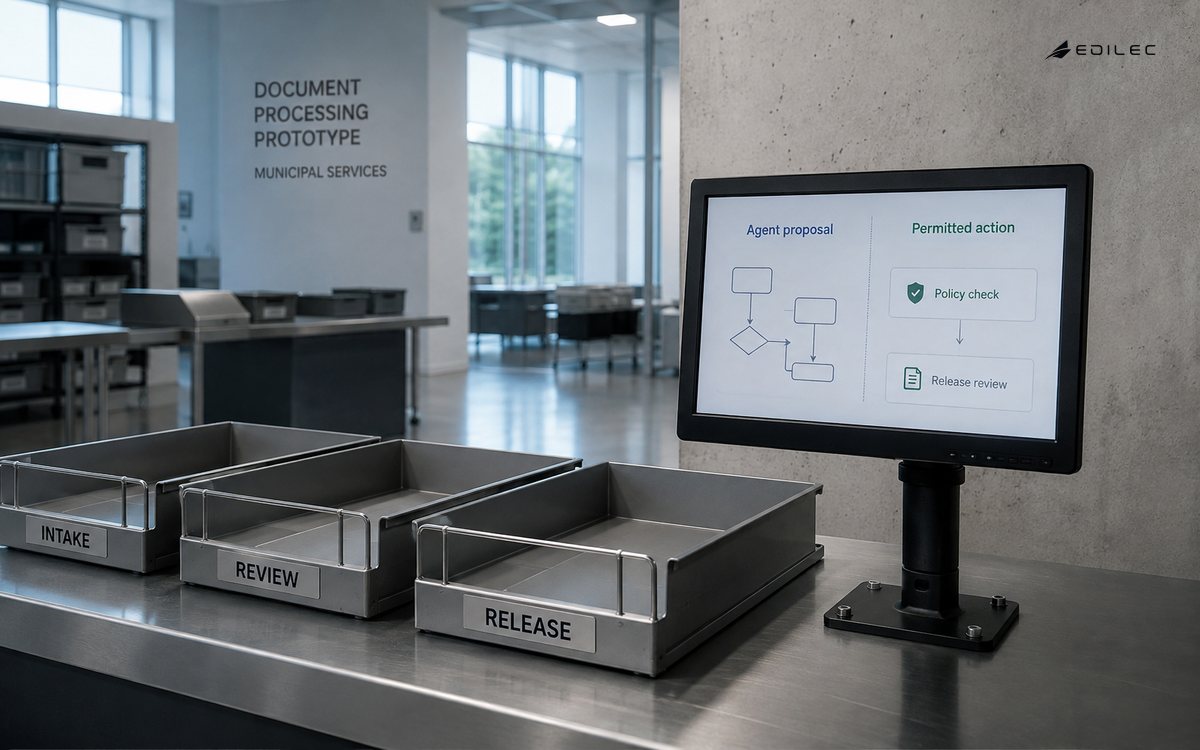
The NIST AI RMF organizes work around Govern, Map, Measure and Manage. Its Generative AI Profile adds risk considerations including confabulation, information integrity, privacy and security. Translate relevant outcomes into release thresholds and stop conditions. Compare with a non-agent baseline and require evidence that added autonomy improves the workflow enough to justify added risk and cost.
Where should human control sit?
Place review before consequential, irreversible, high-value or low-confidence actions. Give reviewers source evidence, proposed action, affected resources, uncertainty and alternatives. They need time and authority to reject, edit, defer or escalate. Measure review burden, correction quality and automation bias. Confirmation prompts that repeat an opaque action are not meaningful control. For low-risk reversible tasks, sampling and post-action reconciliation may be more effective than approving every step.
Tell users when they interact with an agent and describe relevant limitations. Provide a challenge and correction route where outputs affect people. Keep accountability with named business and system owners. The NIST Privacy Framework helps evaluate consequences of data processing, including agent memory, model-provider handling and generated inferences. Human oversight complements technical limits; it does not excuse excessive collection, insecure tools or a use that should not exist.
How should agents be deployed and monitored?
Release in shadow or recommendation mode, then grant narrowly bounded actions after evidence. Pin model and component versions where available, record prompts, tool schemas, policies, knowledge snapshots and deployment manifests. Use canaries and rollback. Monitor task success, policy blocks, tool errors, unauthorized attempts, retrieval quality, latency, token and tool cost, human overrides and downstream outcomes. Alert owners with a playbook; traces without action responsibility are retained uncertainty.
Reconcile intended and actual external effects. An agent may time out after a system committed a change or report success before an asynchronous job fails. Query authoritative status and use compensation procedures. Treat model, prompt, tool, memory, knowledge, policy and user-population changes as distinct release classes with proportionate reevaluation. Capture valid incidents into test sets after adjudication. Disable capabilities when evidence, provider terms or operating conditions invalidate the risk case.
How should cost and vendors be compared?
Model inference, embeddings, retrieval, tool calls, storage, observability, evaluation, security, network, support and human review. Measure cost per accepted task, not per model call. Include failed runs and rework. Smaller models, caching or deterministic routing may reduce cost, but cache keys and model routing must preserve privacy and quality. Set per-run and aggregate budgets with graceful failure. Cost controls are also safety controls against runaway execution.
Evaluate vendors through a buyer-run scenario. Inspect model choice, data use, region, retention, isolation, identity, logs, evaluation, security response, availability, change notice, export and deletion. Require tool and trace portability where feasible. Contract for material model or policy changes and incident cooperation. Do not accept a proprietary benchmark as the sole quality proof. Preserve an alternative model or non-agent fallback for critical workflows and test it periodically.
Practical example: an agent for change preparation
A software organization pilots an agent that prepares a change request from an approved work item, repository metadata, test results and service catalog. The agent may retrieve evidence and draft risk, validation and rollback sections; it cannot merge code, approve change or deploy. A typed tool fetches only repositories and services the requesting engineer may access. Task memory expires after the request, while the accepted change record remains in the authoritative system.
Evaluation includes routine changes, incomplete evidence, conflicting service ownership, malicious instructions in repository files, another team's identifier, tool timeout and repeated execution. Deterministic checks verify cited commits, test status, owner and required fields. Reviewers score whether the draft identifies relevant risk and avoids unsupported claims. Security tests confirm that retrieved text cannot cause export or deployment and that the agent cannot discover cross-team data through error messages.
The pilot runs in draft-only mode. Measures include accepted sections, reviewer correction, missed risks, unsupported citations, latency, cost and user bypass. A frequent false completion occurs when the catalog API times out, so the runtime verifies tool status and marks the draft incomplete. Only after repeated evidence does the team allow the agent to submit a draft into the change queue, still requiring human approval. Authority expands one reversible step at a time, grounded in workflow outcomes.
Key takeaways
- Define a bounded task and compare agents with simpler software.
- Authorize every tool action outside the model and constrain runtime resources.
- Separate memory, knowledge and business records with lifecycle controls.
- Evaluate complete traces, external effects and adversarial scenarios.
- Place meaningful human control at consequential decision points.
- Monitor accepted outcomes and retain model, tool, policy and cost evidence.
Frequently asked questions
Is an agent framework the same as an agent foundry?
Usually not. A framework supplies development abstractions, while a foundry adds shared model, identity, evaluation, deployment, governance and operating capabilities. Products use these labels inconsistently, so assess actual functions and responsibilities.
Should enterprise agents be fully autonomous?
Autonomy should be scoped by consequence and evidence. Many valuable systems operate in recommendation mode or automate reversible low-risk steps. Increase authority only after realistic tests and production outcomes show controls work.
Conclusion
An agent foundry solution is useful when it makes safe, repeatable agent delivery easier than one-off experimentation. Bound the task, control tools and state, test adversarial behavior and observe real effects. A platform earns expansion through accepted outcomes, constrained authority and recoverable operation, not through the number of agents it can generate.