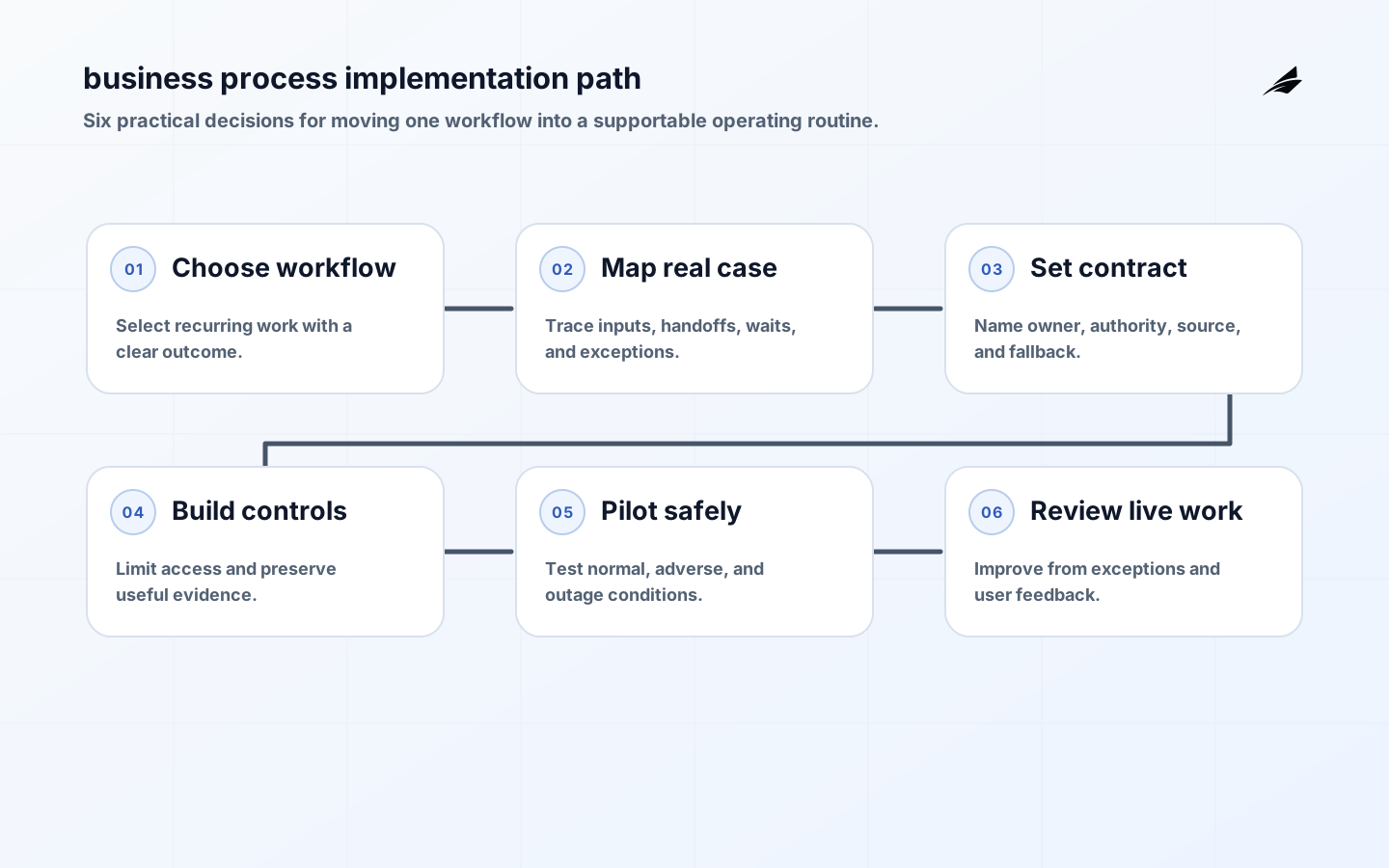
Business Process Solutions Implementation Checklist
A business process solution earns its place when it makes a particular piece of work easier to complete, inspect, and recover. That sounds modest, but it rules out the most expensive mistake: starting with a platform and searching for a problem to feed it. Use this business process solutions implementation checklist to choose one recurring workflow, define what a good handoff looks like, and release only the smallest change that can be supported. Whether the solution includes software, automation, AI, or a clearer operating procedure, people still need to know who owns an exception and what happens when the system is unavailable. The NIST AI Risk Management Framework is a useful reminder that governance is a continuing activity, not a sign-off at procurement.
Choose the first workflow
Start where work is frequent enough to observe, bounded enough to map, and consequential enough that improvement matters. A good candidate may be a request intake queue, a customer onboarding handoff, or a monthly reconciliation. Avoid a workflow whose outcomes depend on unwritten judgment from many teams until that judgment is visible. Sit with the people who do the work and trace a recent real case from trigger to closure. Record the inputs, decisions, waiting points, systems of record, rework, and escalation routes. Ask which step would cause harm if it were late, wrong, or skipped. That question gives the implementation a safety boundary instead of a vague mandate to make a process faster.

| Candidate signal | What it suggests | First check |
|---|---|---|
| Repeated manual transfer | A handoff may be standardised. | Confirm the source and destination owners. |
| Long waiting time | A queue, approval, or missing-information issue may exist. | Separate active work from time spent waiting. |
| Frequent correction | Rules or data definitions may be unclear. | Sample completed cases and classify the corrections. |
| High consequence | Automation needs stronger controls. | Name the person who can stop or override it. |
Write the operating contract
Before building, write a one-page operating contract in ordinary language. It should state the trigger, intended user outcome, authoritative data source, decision rule, owner, service expectation, and safe fallback. Include what the solution must not do. For example, an intake assistant may prepare a case but not commit a payment or make an eligibility decision. This contract is more valuable than a long feature list because it exposes disagreements early. It also makes testing realistic: a team can use representative cases and compare the observed result with the promised behaviour. Where personal information is involved, use the NIST Privacy Framework to prompt questions about data processing, consent, retention, and downstream disclosure rather than assuming that a familiar internal system removes the risk.
- Name one accountable business owner and one technical owner.
- Describe the decision or handoff in a sentence a new operator can test.
- Mark each input as authoritative, optional, derived, or untrusted.
- Set an escalation route for a stalled, disputed, or unsafe case.
- Choose a recovery method that does not require improvised privileged access.
Design controls before convenience
The useful design question is not simply whether the tool can connect to a system. It is whether the connection permits only the action needed for this workflow and leaves enough evidence to investigate a result later. Limit access by role, keep credentials out of prompts and shared documents, and make consequential actions explicit. Build a review queue when confidence is low, required information is missing, or a case falls outside the rule. The control catalog in NIST SP 800-53 Rev. 5 can help teams translate broad intentions such as accountability and resilience into concrete questions about access, audit records, change control, and contingency planning. The exact control set should still reflect the workflow's real consequence.
| Control | Implementation choice | Evidence to retain |
|---|---|---|
| Access | Grant the narrowest role needed to perform the step. | Role approval and periodic review. |
| Decision review | Route exceptions to a named person. | Reason, reviewer, timestamp, and outcome. |
| Change | Version rules and integrations before release. | Approval, test result, and rollback owner. |
| Continuity | Provide a documented manual fallback. | A rehearsal using an actual case type. |
Test real conditions
A demonstration proves that a happy path exists; it does not prove the workflow is ready. Test clean cases, incomplete cases, duplicate requests, stale data, conflicting approvals, a dependent-system outage, and a user who needs to correct the result. Include people from the operational team, because they can notice when a technically valid output does not fit the job that follows it. Define acceptance criteria in advance: accuracy may matter, but so may queue age, time to resolve an exception, percentage of cases needing correction, and the quality of the audit trail. Do not publish a single performance number without its population, period, threshold, and trade-off. A narrow pilot is successful when it teaches the team what to change safely.
Release in stages
Release to a limited group, location, request type, or time window first. Give users a visible way to flag a bad result and make the escalation team available while the change is new. Monitor the workflow rather than only the application: compare backlog, rework, handoff time, overrides, and complaints with the pre-release baseline. A rise in overrides may be a useful signal that the rule is too broad, not a user failure. Freeze nonessential changes during the first operating window so that an incident can be traced to a manageable set of causes. Decide in advance what would pause the rollout, who can make that call, and how affected work will continue while the team investigates.
Operate and improve
Once the workflow is live, move from project language to operating discipline. Review exceptions on a predictable cadence, remove temporary access, and retire workarounds that have become invisible dependencies. Keep a short change record that explains what changed, why, what cases were tested, and who accepted the residual risk. Management-system guidance such as ISO/IEC 42001 is useful here because it treats responsibility, monitoring, and improvement as connected work. It is not a substitute for understanding the process. The people receiving the handoff should be able to explain when they trust it, when they check it, and how they recover from an error.
Key takeaways
- Begin with one observable workflow, not an enterprise-wide tool rollout.
- Treat ownership, data authority, and fallback as design requirements.
- Test exceptions and outages before expanding the pilot.
- Measure operational effects alongside technical reliability.
- Keep evidence that lets a future operator reconstruct an important case.
Frequently asked questions
How long should the first implementation take? There is no reliable universal duration. A bounded workflow should be explored until the team can map it, test representative cases, and support a fallback; expanding scope before those conditions are met usually makes planning less reliable. What if the process itself is messy? Preserve necessary judgment, but make the recurring decisions, data definitions, and escalation rules visible before automating them. The goal is not to force every case into one path.
- Should every improvement use AI? No. A clearer form, queue rule, integration, or ownership change may be the better solution.
- Who approves exceptions? The accountable business owner should define the authority, while subject-matter staff handle cases within that boundary.
- What evidence matters after launch? Retain the input context allowed by policy, decision version, reviewer actions, outcome, and corrective action.
Decide before expansion
Before extending the solution to a new team or adjacent workflow, repeat the original questions instead of assuming success transfers automatically. The new group may use different records, have a different approval authority, or encounter exceptions that were rare in the pilot. Review a sample of completed and escalated cases with local users. Check whether the stated source of truth is still available, whether the fallback is understood, and whether any temporary access or manual workaround has become permanent. Compare the proposed expansion against the evidence from the first release: which outcome improved, which burden moved, and what new risk is being accepted? Make an explicit go, revise, pause, or decline decision. That small discipline is how a useful local improvement avoids becoming an opaque organization-wide dependency.
A useful handover package makes the operating model survivable. It includes the process map, owner contacts, current rule or configuration version, approved access path, test examples, known limitations, and the exact manual steps for a disruption. Give the package a review date and attach it to the change record rather than leaving it with the original delivery team. During the handover, let an operator run a difficult case and let a support colleague trace the outcome. Those exercises expose details that a presentation misses, such as where a reference number is generated or which team can correct a source record. Address those details before calling the work complete. The resulting package is not paperwork for its own sake; it is the working memory that lets a process continue when staff, systems, or priorities change.
Conclusion
A sound business process solution makes a real workflow more dependable without making it mysterious. Choose a small starting point, write the operating contract, test uncomfortable cases, and retain a workable manual route. That sequence gives a team evidence for the next decision instead of a polished prototype with nowhere safe to go.