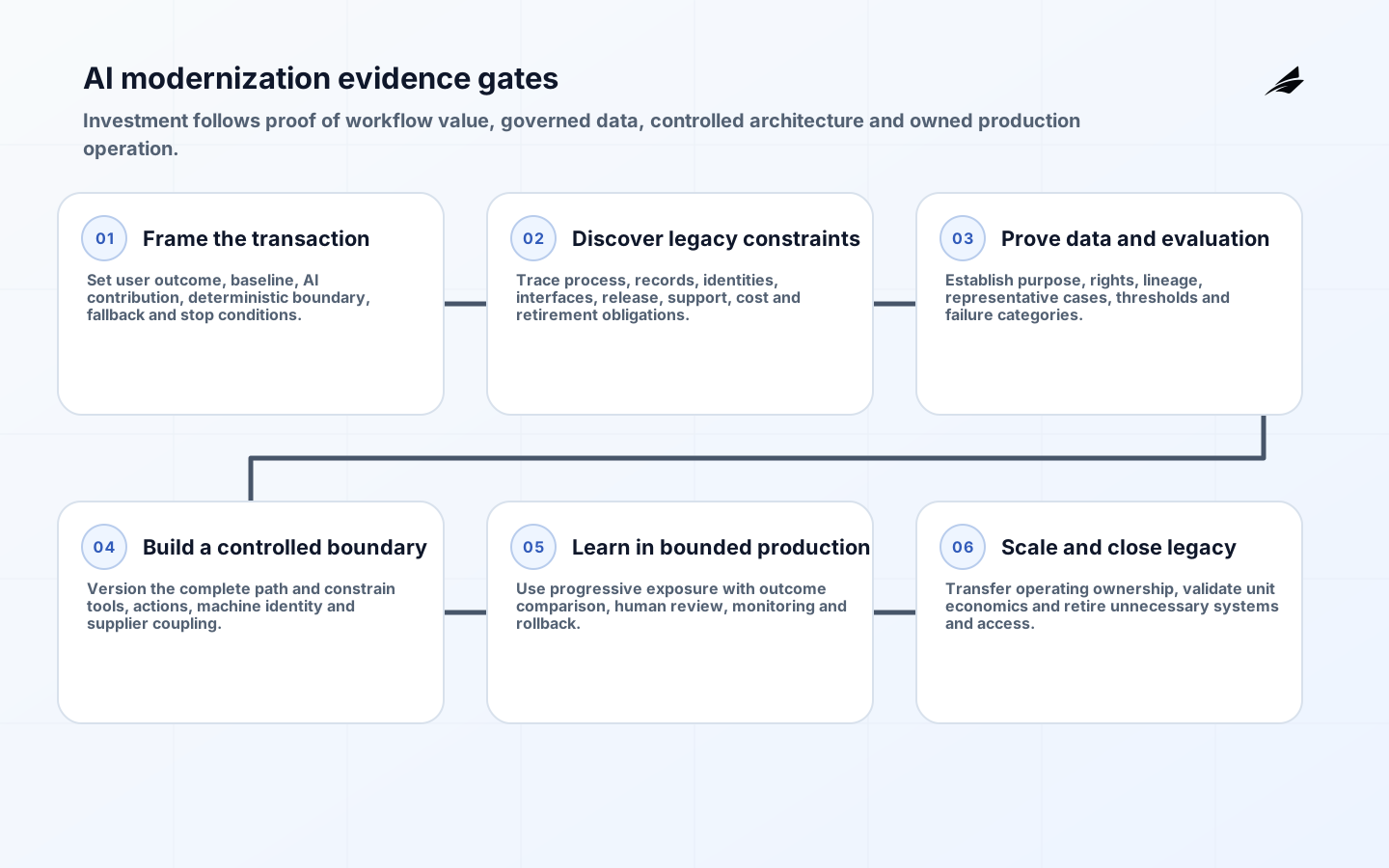
AI modernization services should change the smallest coherent set of process, data, software and operating capabilities needed to deliver a valuable AI-enabled service. The goal is not to make every legacy application cloud native or attach a model to every workflow. A decision-ready plan identifies the business outcome, current constraints, safe target state, investment range, risks, delivery gates and internal owners. It also preserves the option to choose rules, search or conventional analytics when they fit better than AI.
This article establishes scope and sequencing. Delivery teams can use the AI modernization implementation checklist for evidence and the AI modernization FAQ for architecture and operating questions. Begin with a product owner and a representative transaction. Technology leaders, domain experts, data owners, security, privacy, legal, finance and operators should join according to the use case's impact.
Frame the modernization outcome and decision
Define the user, decision or task, current baseline and target. Useful measures include cycle time, first-time-right rate, capacity, customer outcome, release lead time, recovery performance or cost per completed case. State how AI contributes: extracting fields, finding evidence, forecasting demand, recommending an option or drafting content. Name what remains a human or deterministic decision. An outcome such as reducing claim review delay while preserving appeal and accuracy is more actionable than becoming AI ready.
Set scope boundaries around workflows, applications, data, regions, roles and actions. Document assumptions and stop conditions. Decide the acceptable consequence of a wrong output, necessary human oversight and fallback when AI is unavailable. Establish a bounded learning budget for discovery and pilot. The sponsor should know which evidence will authorize the next investment and which result will narrow or end the initiative.
Discover the legacy transaction and modernization constraints
Trace real cases through user interfaces, APIs, batch jobs, spreadsheets, message queues, databases, document stores and manual reconciliation. Identify source-of-truth records, data semantics, identities, integration ownership, release process, support model, service levels, licensing and retirement plans. Inspect incident, change and cost history. Static inventory tools help, but operational staff often know hidden dependencies and end-of-period controls that scans cannot reveal.
Classify each constraint by outcome impact. Unsupported runtime, tightly coupled release, missing API, inconsistent identifiers, inaccessible documents, weak audit evidence and shared administrator accounts require different remedies. Microsoft's cloud-modernization planning guidance warns against over-modernizing and presents strategies with different value and complexity. Choose retain, replace, rehost, replatform, refactor or rearchitect at component level where practical.
| Constraint | Evidence | Proportionate response |
|---|---|---|
| Unclear process | Conflicting rules and manual workarounds | Redesign and approve the workflow first |
| Poor data authority | Unknown provenance, rights or outcome labels | Build a governed use-case data product |
| Tight coupling | Small changes require broad coordinated release | Create a tested boundary around the target capability |
| Unsupported platform | Security, skills or vendor support risk | Replatform, replace or retire by impact |
| Weak delivery | Manual builds and unrepeatable environments | Automate source-to-production evidence |
| No operating owner | Alerts, costs and incidents lack decisions | Establish product and service ownership |
Build a governed data and evaluation plan
Create a data map for inputs, retrieved context, output, feedback and authoritative outcome. Record purpose, authority, sensitivity, rights, residency, retention, deletion, lineage and quality expectations. Separate production, evaluation and development handling. Do not export a broad historical dataset merely because it is available. Minimize to the use case and preserve entitlement when retrieval results depend on the user's access.
Design evaluation before selecting a model. Build representative cases across normal, rare, adversarial and subgroup conditions. Define metrics, baseline, uncertainty behavior, review and acceptance threshold. Generative systems need fact grounding, citation or provenance checks, unsafe-content tests and human-use evaluation where relevant. NIST's Generative AI Profile identifies risks including confabulation, privacy, harmful bias, information integrity and value-chain dependencies that teams can map to their context.
Design the target architecture and control boundary
Map the request from user to model or analytical component and back to the system of record. Define identity, authorization, data movement, retrieval, prompt or feature construction, model endpoint, policy checks, human review, action execution, logs and fallback. Separate suggestions from consequential transactions. Use transaction limits, narrowly scoped tools and deterministic validation so an incorrect generation cannot directly make an unlimited payment, delete records or change access.
Version model, prompt, configuration, retrieval index, schema and evaluation suite. Record which combination affected a material output. Decide accepted supplier coupling and exit needs. A provider abstraction is useful when change is likely and the common contract preserves required capability; otherwise it can add complexity without portability. Validate latency, throughput, availability, data terms, regional support, model-change notice and export with current supplier evidence.
Integrate AI, security and human risk controls
Use the NIST AI Risk Management Framework to govern roles, map context, measure behavior and manage prioritized risks throughout the lifecycle. Identify affected people, foreseeable misuse, legal duties, transparency, recourse, harmful bias, safety and privacy. Controls may include use restrictions, data minimization, representative evaluation, uncertainty display, human approval, logging, monitoring, rate limits and an emergency stop. Verify that human reviewers have context, time and authority.
Secure the complete software path. The NIST Secure Software Development Framework can guide repository, dependency, build, artifact and vulnerability practices. Threat-model prompt injection, tool abuse, poisoned data, unsafe output processing, secret exposure, model extraction and supplier compromise as relevant. Protect machine identities, separate environments, review elevated access and test incident handling. AI-specific controls supplement rather than replace application, cloud and data security.
Execute a six-stage AI modernization delivery roadmap
Sequence delivery through outcome framing, transaction discovery, governed data proof, architecture isolation, bounded production pilot and scaled ownership. Each stage closes named uncertainty. The architecture stage should prove interfaces, access and evaluation in a production-like path. The pilot should expose representative users and demand with limited consequences, using shadow, assistive or progressively enabled modes where possible. Scale only after the target outcome and controls pass.

Build continuous delivery into modernization. DORA guidance emphasizes version control, automated tests, deployment automation and fast feedback for low-risk release. Add model and data version capture, repeatable evaluation, policy checks, canary comparison and rollback. Database and record changes need compatible migration and reconciliation. A modern architecture that still requires an exceptional weekend release has not removed a central operating constraint.
Estimate cost, benefit and migration overlap
Estimate discovery, process redesign, legacy remediation, data work, integration, platform, model use, evaluation, security, privacy, environments, delivery tooling, observability, human review, support, training, supplier commitments and retirement. Model usage by successful transaction, including context, retries, evaluation traffic and escalation. Include growth and failure scenarios. Parallel operation, duplicate licenses and specialist support often dominate transition cost if closure dates drift.
Quantify benefit conservatively against the baseline. Time saved becomes realized capacity only when teams can redirect it or demand increases. Quality improvement should account for detection and correction cost. Risk reduction needs an explicit exposure and control, not a generic percentage. Present ranges and assumptions rather than a single precise return. Release further funding when production evidence validates value and operating cost.
| Economic area | Planning input | Decision measure |
|---|---|---|
| Build | Architecture, data, integration and remediation ranges | Cost to reach each evidence gate |
| AI operation | Requests, context, model mix and evaluation | AI cost per accepted outcome |
| Human assurance | Review, escalation, domain and risk effort | Minutes and rework per completed case |
| Legacy overlap | Systems, licenses, data and specialist support | Burn rate and closure date |
| Quality benefit | Baseline errors, delay and impact | Net corrected outcome improvement |
| Option and exit | Supplier change, export and fallback | Tested transition effort and residual risk |
Accept operations, monitoring and retirement
Production acceptance should require architecture and data records, source-controlled artifacts, access review, threat and risk findings, evaluation results, release identity, SLOs, dashboards, alert ownership, incident procedures, fallback, recovery evidence, cost allocation and known limitations. Have internal teams deploy a change, investigate a degraded output, trace its version and data, disable the AI path, revoke a machine identity and explain the unit cost.
Monitor user outcome, quality, subgroup or edge-case behavior, abstention, override, latency, availability, drift, security events, supplier changes and cost. Define events that force re-evaluation. Maintain a retirement path for models, prompts, indexes, endpoints, data copies and legacy systems. Reconcile records before cutover, preserve required evidence and remove obsolete access. Modernization value is realized only when unnecessary old cost and risk close.
AI modernization plan takeaways
- Start with a measurable transaction and the minimum enabling change.
- Choose component strategies from evidence rather than rebuilding by default.
- Design data governance and evaluation before model selection.
- Constrain consequential actions with identity, policy and human authority.
- Fund stages through value, risk and operability evidence.
- Close legacy dependencies and retain internal ownership after scale.
Frequently asked questions
Must the core application be replaced? No. A stable interface or isolated component may be enough, while unsupported or unsafe platforms can justify replacement. Should the data platform be complete first? No. Prove a governed path for the use case and expand reusable capabilities from it. Is a model benchmark sufficient? No. Evaluation must represent the workflow, users, failure costs and human interaction. Can a supplier own AI risk? A supplier owns contracted duties; the deploying organization retains accountability for its use and decisions.
How long should a pilot run? Long enough to observe representative demand, outcomes and exceptions, with a pre-agreed limit. What is the strongest modernization metric? Use a balanced view of business outcome, quality, delivery, reliability, risk and unit cost. When should scope narrow? When evidence shows value only for specific roles, cases or actions. What makes the work complete? The organization can release, monitor, challenge, recover and retire the service, and unnecessary legacy obligations are closed.
Conclusion
An AI modernization plan should improve a real service, not pursue architectural novelty. Trace the legacy transaction, govern the required data, isolate a safe capability and learn under bounded exposure. Combine AI risk, secure delivery, human authority and full economics at every gate. Scale only when internal teams can operate the service and finish by closing the old dependencies. That creates an AI-ready capability with evidence, ownership and a credible exit.