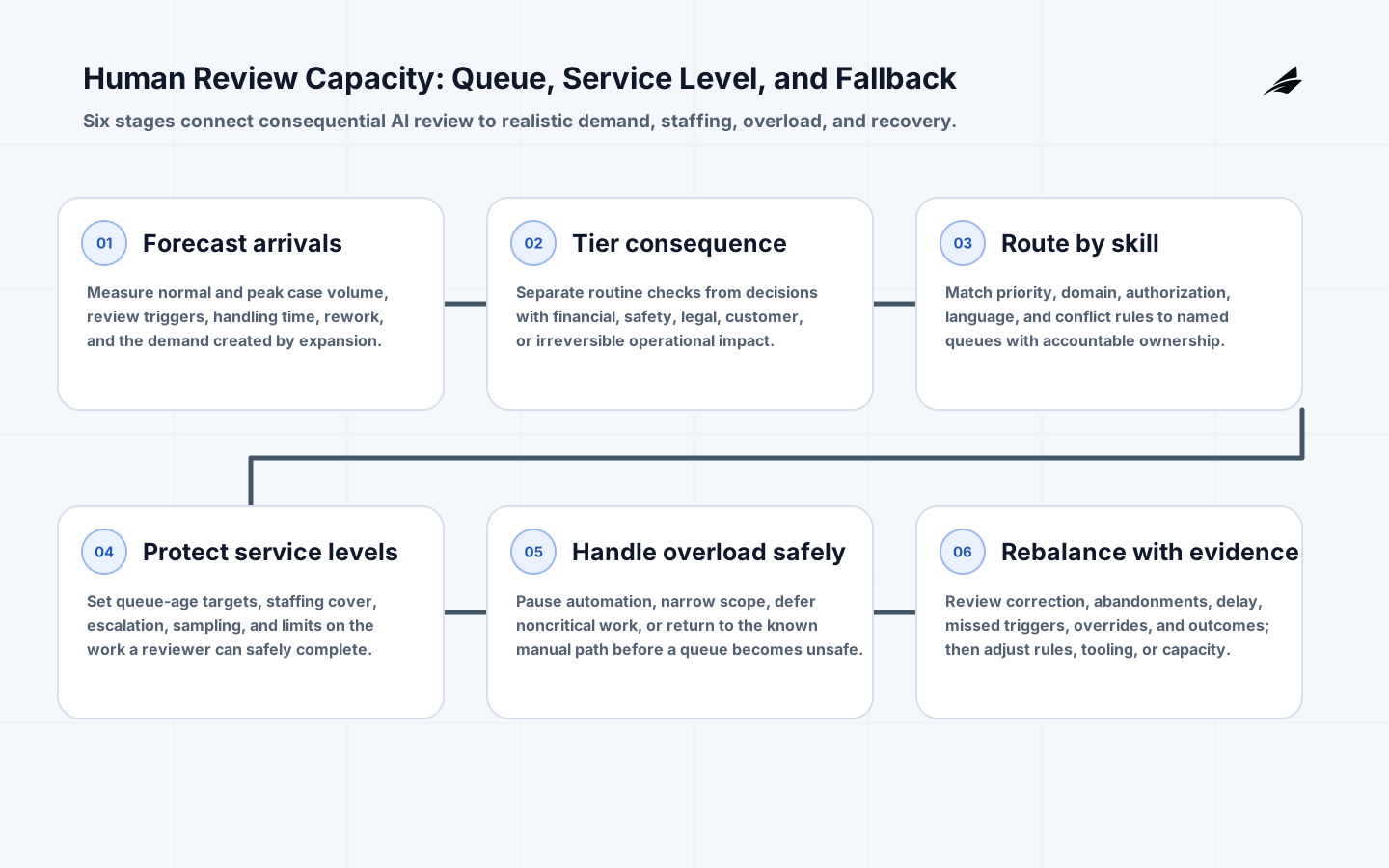
Human-in-the-loop automation is a workflow design discipline, not a button that adds a person after a model has finished. The team must decide what the system may recommend, what a reviewer must verify, which actions remain prohibited, and how an unresolved case returns to ordinary operations. A useful first release makes one decision easier to inspect without making authority ambiguous.
This guide focuses on review capacity: the queue, evidence, roles, measures, and recovery paths that determine whether assistance remains dependable as volume grows. The NIST Generative AI Profile treats governance, provenance, testing, and incident disclosure as connected lifecycle responsibilities. Apply the same idea to the review desk: every recommendation should have an owner, a reason to trust its inputs, and a visible next step when the evidence is weak.
Start With a Decision Contract
Choose a task with a stable trigger and a bounded outcome. Examples include classifying an incoming service request, proposing a response for a support agent, or identifying missing fields in an onboarding packet. Write down the request that starts the flow, the records the system may read, the output it may produce, and the system of record that remains authoritative. If the task cannot be stated in those terms, it is not ready for automation.
Name the Work and the Authority
A recommendation and an approval are different events. The model can suggest a category, summarize evidence, or identify a likely next step; a policy service or authorized person must decide whether the business action is allowed. Record the role that may approve, the facts that role must inspect, and the conditions that force escalation. This prevents a reviewer from treating fluent wording as permission.
| Decision-contract question | Working rule | Evidence to retain |
|---|---|---|
| What starts the case? | Use a named event, such as a submitted form or a new message in a monitored queue, with a deduplication rule. | Event identifier, received time, initiating actor, and the version of the intake schema. |
| What may the system read? | List approved fields and repositories. Exclude unrelated records even when the connected account can technically access them. | Source identifiers, access decision, retrieval timestamp, and any redaction applied before inference. |
| What may it produce? | Constrain the output to a typed recommendation, draft, or queue assignment; do not let free text stand in for an authorization. | Model and prompt versions, structured result, validation outcome, and confidence limitations. |
| Who can decide? | Assign approval to a role with the required business authority and give that role a named fallback when unavailable. | Reviewer identity, role at decision time, decision timestamp, and escalation reason. |
| What happens when evidence fails? | Pause the automated path, preserve the case, and route it to a queue that can resolve the missing or conflicting fact. | Failure code, queue transition, customer or requester status, and final recovery action. |
Design the Review Queue
The queue is part of the control plane. It should make work visible, assign responsibility, and show why a case is waiting. Avoid one undifferentiated list: separate routine verification, specialist judgement, security-sensitive exceptions, and cases blocked by an upstream system. Each lane can then have its own service expectation, required role, and escalation timer.
Route by Risk and Effort
Routing should use observable attributes rather than a model's self-reported confidence alone. Consider the consequence of an incorrect decision, the reversibility of the action, the sensitivity of the records, the number of conflicting sources, and the amount of judgement required. A low-risk, evidence-complete request can go to a trained generalist. A request that changes access, money, eligibility, or a legal commitment should reach a role with explicit authority, even when the recommendation appears clear.
Keep the reason for routing visible to the reviewer. Labels such as missing source, conflicting policy, sensitive record, or out-of-scope request are more useful than a single opaque score. The human approval design guide is a useful companion when the workflow needs a sharper boundary between recommendation, approval, and fulfilment.
Size Capacity With Workload Evidence
Capacity planning begins with observed work, not an assumed automation percentage. Measure arrivals by case type, active handling time, elapsed wait, reassignment, escalation, rework, and the age of the oldest open case. A queue can look efficient on average while a small class of urgent or specialist cases quietly accumulates. Segment the data before deciding whether to add automation, training, a new role, or a different service target.
A simple planning estimate is required review hours = incoming cases x median handling minutes / 60. Add time for calibration, handoffs, interruptions, and quality sampling, then compare the result with the staffed hours available in the same period. Use a range for arrivals and handling time rather than a single promise. The estimate is a planning instrument; the queue and outcome records remain the evidence for changing the design.
| Signal | What it reveals | Design response |
|---|---|---|
| Arrival mix | Whether volume is concentrated in routine work or volatile exception classes. | Create separate lanes and staffing rules for materially different work. |
| Active handling time | How much effort a decision consumes after waiting and handoff time are removed. | Improve evidence presentation or simplify the decision before assuming more reviewers are needed. |
| Correction and rework | Where recommendations create downstream cleanup or repeated review. | Add a structured correction reason and turn recurring causes into evaluation cases. |
| Queue age by priority | Whether urgent cases are being displaced by easy work or specialist scarcity. | Reserve capacity, add escalation rules, and make priority changes auditable. |
| Reviewer agreement | Whether the policy and evidence support a consistent decision across trained people. | Clarify the policy, improve examples, or route the decision to a more qualified role. |
Build an Actionable Review Surface
A reviewer should not have to reconstruct a case from scattered tabs. Present the request, relevant source excerpts, timestamps, policy conditions, the recommendation, known limitations, and the proposed downstream action in one attributable view. Show what is missing as clearly as what is present. The interface should support accept, edit, reject, request-more-information, and escalate outcomes with a reason appropriate to each choice.
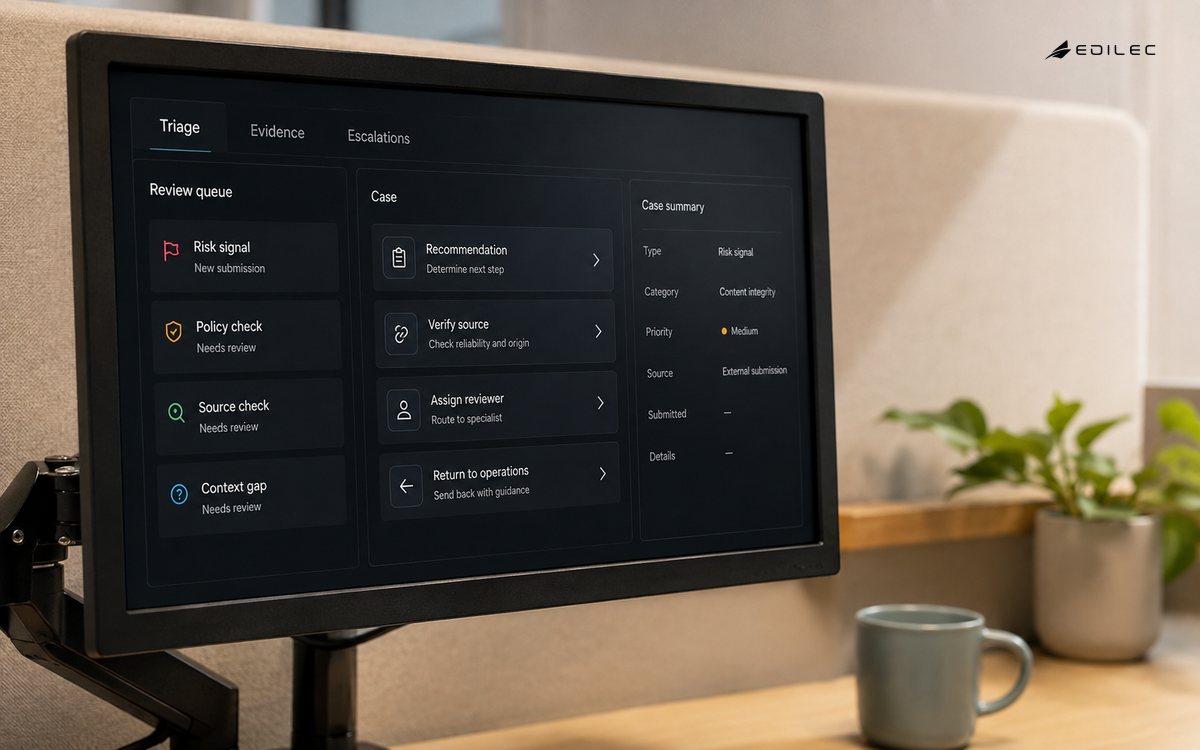
Do not hide the model's uncertainty behind a decorative score. Explain which required fields were found, which source was preferred, whether the policy matched exactly, and whether a human check is mandatory. When a reviewer edits a draft, preserve the original recommendation and the final approved value so later analysis can distinguish a harmless wording change from a substantive correction.
- Show the authoritative record beside the generated summary, with a direct link and a retrieval time.
- Make protected fields and access decisions explicit before exposing sensitive content to a reviewer.
- Use typed controls for classifications, amounts, dates, and status transitions so free text cannot bypass validation.
- Require a structured reason for overrides, rejections, escalations, and requests for more information.
- Give the reviewer a safe defer option when the case needs another team or an unavailable source system.
- Keep the final decision and fulfilment result separate so a successful approval cannot conceal a failed downstream action.
Evaluate Judgment, Not Just Text
Evaluation should ask whether the workflow reaches the correct operational state, not whether a generated explanation sounds convincing. Build a fixture set from ordinary cases, incomplete submissions, conflicting records, unauthorized requests, adversarial inputs, and unavailable dependencies. Use the LLM observability implementation checklist to connect those fixtures to production traces and review signals. NIST recommends comparing output quality with known ground truth and using multiple evaluation methods, including human oversight. OWASP's Top 10 for LLM Applications is a practical checklist for prompt injection, insecure output handling, excessive agency, and overreliance.
| Fixture | Expected system behavior | Pass evidence |
|---|---|---|
| Complete and ordinary request | Produce a bounded recommendation with the required source references and route it to the intended role. | Correct classification, complete evidence panel, valid queue assignment, and no unauthorized action. |
| Two records disagree | Stop automatic fulfilment and identify the conflict rather than choosing the newest-looking sentence. | Conflict code, both source identifiers, escalation destination, and reviewer resolution. |
| Requester lacks authority | Refuse or route the request without revealing protected details from the underlying record. | Access decision, safe user message, security event, and absence of a downstream write. |
| Required system is unavailable | Keep the case pending or switch to a documented manual path; do not fabricate a value to complete the form. | Dependency status, retry or handoff record, customer impact, and eventual reconciliation. |
| Reviewer disputes the recommendation | Allow a correction with a reason and retain the original output for analysis. | Original result, final decision, override category, reviewer identity, and follow-up test candidate. |
Work Through a Concrete Scenario
Consider an account-change request that asks to update a billing contact and alter payout details. The automation may extract the requested fields, compare them with the account record, and highlight whether the requester has completed the required verification. It must not treat a persuasive message or a matching name as proof of authority. A verified low-risk contact correction could go to a trained operations reviewer; a payout change should pause for the stronger control required by the organisation's policy.
The review view should show the request, the account's current values, the proposed before-and-after change, verification events, and the exact policy rule that determines the route. If the verification service is unavailable, the case remains pending with a clear status. If the reviewer approves, a separate fulfilment step writes to the authoritative account service and returns a result. A failed write creates a recoverable exception, not a misleading completed case.
Operate Exceptions and Feedback Loops
Treat exceptions as product evidence. Review the reason codes weekly, but distinguish defects in source data from defects in policy, routing, prompt design, model behavior, and reviewer training. A recurring missing document may call for a better intake form. A recurring false escalation may call for clearer policy examples. A recurring unsafe approval should pause the affected path while the owner investigates.
Version the components that can change a decision: source extracts, policy rules, prompt or template, model, tool permissions, reviewer guidance, and queue configuration. When an outcome is challenged, an operator should be able to reconstruct the decision without relying on a screenshot. The AI agent control plan extends the permission, approval, and audit design for workflows that can act through tools. The UK NCSC secure AI system development guidance places logging, monitoring, update management, and information sharing inside secure operation and maintenance; apply that same discipline to review records.
Sample accepted cases as well as overrides. A reviewer who always accepts may be following a good recommendation or may be missing a subtle failure. Compare decisions across roles, case types, and time periods, and protect personal information in the sample set. Feed confirmed defects back into regression tests before changing the live workflow.
Key Takeaways
- Define one decision, its authority boundary, and its recovery route before selecting a model.
- Route work by consequence, sensitivity, reversibility, and evidence quality rather than by an opaque confidence score.
- Plan reviewer capacity from arrivals, handling time, queue age, rework, and specialist demand.
- Give reviewers source evidence, policy context, typed actions, and structured reasons for exceptions.
- Test the full workflow with incomplete, conflicting, unauthorized, adversarial, and unavailable cases.
- Version decision inputs and use overrides, incidents, and fulfilment failures to improve the next release.
Frequently Asked Questions
What should be automated first?
Start with a frequent, bounded task where the source records are understandable and the result can be checked without specialist investigation every time. Keep consequential writes, access changes, financial commitments, and decisions affecting rights behind the authority boundary until the workflow has earned broader trust.
Does a human reviewer make the system safe?
No. A reviewer can catch errors only when the interface presents the relevant evidence, the role has authority, the queue allows enough time, and the system records the decision. Human involvement without those conditions can become a rubber stamp or an unmeasured source of inconsistency.
Which measures matter most?
Track outcome correctness, correction rate, exception mix, queue age, active handling time, escalation, fulfilment success, and the distribution of work across reviewer roles. Read them together: a faster queue with more downstream reversals is not an improvement.
Conclusion: Make Review Capacity Operable
Human-in-the-loop automation scales when review is designed as accountable operational work. Define the decision contract, expose evidence, preserve authority, size the queue from real demand, and turn exceptions into tests. That gives the team a practical way to expand assistance while keeping correction and recovery available when the system meets a case it cannot safely resolve.