A search for the Chinese Services Group chairman often combines three different questions: who holds or held a published leadership title, what a Chinese Services Group does, and whether that title provides authority over a particular client engagement. Those questions require separate evidence. A current official biography can support a role claim; a service page can describe the network; only an engagement letter and named member-firm leaders can establish responsibility for specific work.
This FAQ complements the Chinese Services Group planning guide and cross-border implementation checklist. It does not infer private reporting lines or promise access to an executive. It shows buyers, partners and researchers how to verify public information and turn a broad global title into a precise, governed service conversation.
Who is identified as Chinese Services Group chairman?
Deloitte’s public global biography for John Hung states that he has served as chairman of Deloitte’s Global Chinese Services Group from July 2019 and describes other Deloitte China and Asia Pacific responsibilities. That is the strongest primary source for the exact phrase in this article. However, leadership pages are living corporate records. They should be checked on the date of reliance, saved in the procurement file and confirmed directly when the role affects an engagement decision.
A second current Deloitte China profile identifies Lawrence Jin as managing partner of the Global Chinese Services Group, while the current service page presents him as the contact for the China-to-Global program. Chair, managing partner, program leader, regional leader and engagement partner are not interchangeable labels. The coexistence of those public descriptions is a reason to ask which responsibilities each role carries, not a reason to guess at an internal hierarchy.
| Public description | What it can establish | What still needs confirmation |
|---|---|---|
| Official individual biography | Published title, career summary and stated experience | Whether the role remains current on the decision date |
| Current service page | Network purpose, service positioning and named contact | Which member firm will contract and deliver |
| Proposal or pitch team | People presented for the opportunity | Availability, allocation and authority after award |
| Engagement letter | Contracting entity, scope, fees and formal responsibilities | Day-to-day execution and change decisions |
| Client reference | Evidence about another completed engagement | Fit for this jurisdiction, team and problem |
What does a Chinese Services Group do?
Deloitte’s service page says its Global Chinese Services Group supports Chinese companies expanding internationally and multinational companies operating in China, using Chinese-speaking professionals and local experts across jurisdictions. In practical terms, such a network can coordinate language, business context and access to audit, tax, consulting, risk or transaction specialists. The network description does not mean every service is delivered by one worldwide legal entity or under one regulatory license.
A buyer should begin with the direction of travel and the actual decision: entering a country, acquiring a business, restructuring operations, meeting local reporting obligations or investigating a risk. Then identify the regulated or specialist work involved. Corporate formation, tax advice, statutory audit, legal advice, cybersecurity testing and investment approval may require different entities, permissions, independence safeguards and local professionals. A broad relationship sponsor cannot replace those requirements.
What should a chairman or global leader contribute?
At a useful level, a global chair or leader can sponsor coordination, connect country teams, surface senior issues and help maintain a consistent client view. Buyers can ask how escalation works, who owns cross-border dependencies and how conflicting country advice is reconciled. They should not assume that a title makes the person the technical reviewer, contracting partner or final authority for every location. Those responsibilities must be named.
Request a one-page responsibility map. It should identify the executive sponsor, global coordinating partner, local engagement partners, subject-matter leads, quality or independence reviewers, project manager and client decision owners. For each, state decisions they make, information they receive and backup coverage. This turns leadership visibility into an operating design and prevents urgent questions from circulating through ceremonial contacts.
How should a cross-border service team be evaluated?
| Evaluation area | Evidence to request | Warning sign |
|---|---|---|
| Legal and geographic coverage | Contracting entities, work locations, licenses and local partners | One brand name offered as the answer to every jurisdiction |
| Named team | CVs, allocation, language capability and replacement rules | Senior names appear only in the pitch |
| Independence and conflicts | Completed checks, restricted services and escalation owner | Checks deferred until after sensitive information is shared |
| Data handling | Approved systems, transfer map, access, retention and deletion | Unspecified global collaboration tools |
| Quality and decisions | Review gates, assumptions log, sign-off and issue path | Advice delivered without attributable reviewer |
| Commercial control | Deliverables, rates, expenses, tax, change and exit terms | Open-ended coordination fees without outputs |
Which due-diligence controls matter?
Cross-border engagements can touch beneficial ownership, sanctions, anti-bribery, conflicts, human rights, data transfer, tax, employment and sector restrictions. The correct checks depend on countries, parties and work. FATF’s beneficial-ownership guidance supports obtaining adequate, accurate and current information about the natural persons who ultimately own or control relevant legal persons. The OECD Guidelines address responsible business conduct across human rights, environment, disclosure, bribery, technology, competition and taxation.
Use specialist legal and compliance advice where obligations are material. Operationally, maintain a party register, ownership evidence, conflict status, approval record and refresh date. Define who can accept a new intermediary, subcontractor, data location or public-sector contact. The U.S. Department of Justice’s compliance guidance is also a useful reminder to test whether controls are designed for the actual risk, resourced and working in practice rather than existing only in policy documents.
Follow a six-step leadership verification procedure
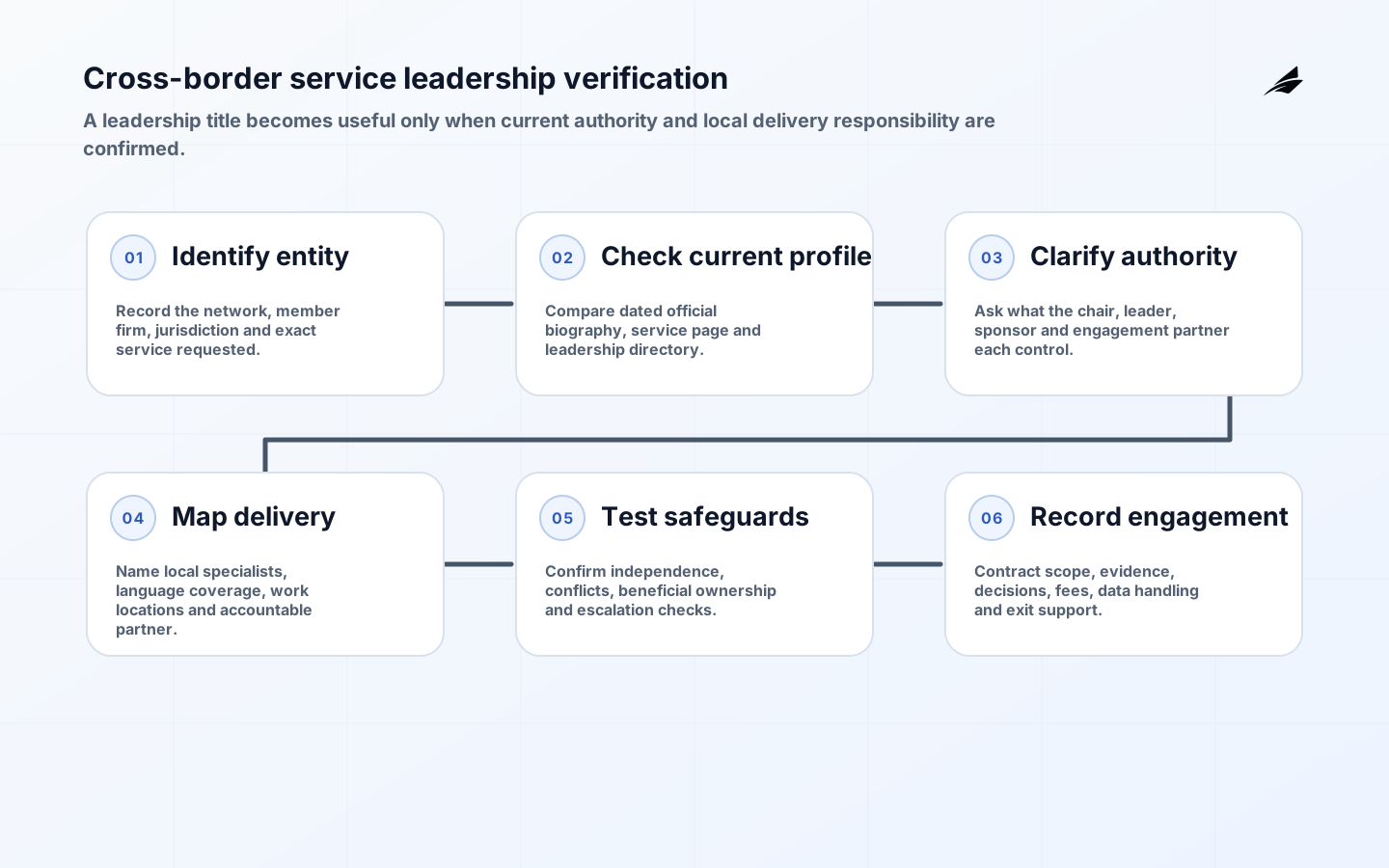
First identify the exact network and legal entities; similar service-group labels can exist across firms or regions. Second, compare current official biographies, service pages and leadership directories, recording access dates. Third, ask the organization to confirm the role and its scope in writing. Fourth, map the proposed local delivery chain. Fifth, complete conflicts, independence, ownership and risk checks before sharing restricted information. Sixth, incorporate the confirmed responsibilities into the engagement and governance schedule.

- Save the official page and access date that support each material title claim.
- Ask whether the title is current, former, global, regional, program-specific or engagement-specific.
- Name the member firm or legal entity responsible in every delivery country.
- Confirm which leaders will attend gates, make decisions, review advice and handle escalation.
- Bind team substitutions, subcontractors and new data locations to documented approval.
- Refresh leadership and risk information when the scope, country mix or transaction changes.
For example, a manufacturer entering two markets may receive a proposal featuring a global chair, a China-to-global leader and local tax teams. The buyer should not ask only, “Who is senior?” It should ask who signs the contract, who owns the market-entry recommendation, who reviews independence, where company and employee data will be processed, and who resolves inconsistent advice. The global sponsor can be valuable, but the delivery map is what makes that value dependable.
How should fees and governance be structured?
Separate coordination from local delivery. A transparent estimate shows assumptions, country work packages, senior oversight, travel, translation, taxes, expenses and contingency. Decide whether coordination is a fixed deliverable, capped time, or included in local fees. Use a change process for new countries, transaction structures or diligence findings. Avoid a single blended rate that hides where senior time, specialist review or local execution is actually occurring.
Run a governance rhythm proportionate to risk: weekly workstream decisions, a concise cross-border dependency review and milestone gates for advice that triggers investment or filing. Keep an assumptions and jurisdiction register. Record advice owner, applicable date, source material, reviewer, decision and expiry or refresh condition. Measure unresolved cross-border dependencies, decision turnaround, rework caused by inconsistent advice, team continuity, budget variance and closure of risk actions.
When public biographies disagree or appear stale, do not publish a definitive correction based on inference. Ask the organization, record the response and narrow the claim to what the sources support.
Key takeaways
- Use a current official biography for a title claim and confirm it directly when the role affects a decision.
- Distinguish chair, managing partner, program leader, local partner and engagement partner responsibilities.
- Treat a global network as a coordination capability, not proof that one entity can deliver every regulated service.
- Verify legal entities, local authority, named staff, conflicts, data paths and beneficial ownership before work begins.
- Contract governance and evidence so leadership sponsorship results in accountable delivery rather than an impressive organization chart.
Frequently asked questions
Is John Hung currently the Global Chinese Services Group chairman?
Deloitte’s live global biography states that John Hung has served in that role from July 2019. Because corporate roles can change and another current page names Lawrence Jin as managing partner and program leader, confirm the current position and scope directly for any consequential reliance.
Does the global group operate as one legal firm?
Do not infer that from a shared brand or network description. Ask which legal entity contracts, which entity performs each service and how responsibility, confidentiality, insurance and dispute terms apply across participating firms.
Does hiring the group guarantee access to the chairman?
No. Access should be defined in the proposal or governance schedule. Specify the sponsor’s planned role, milestone attendance, escalation availability and substitute. Day-to-day quality should not depend on an unwritten expectation of executive access.
Can technology replace local cross-border specialists?
Technology can organize documents, translate drafts, track obligations and surface inconsistencies. It should not be treated as a substitute for licensed, accountable and context-aware review where law, audit, tax, safety or rights are at stake. Preserve sources and human sign-off for consequential advice.
Conclusion
A Chinese Services Group chairman title is a starting point for verification, not an engagement control. Check the live primary source, distinguish leadership roles, identify every responsible entity and professional, and turn coordination promises into an evidence-backed operating map. Cross-border service quality comes from current authority, competent local delivery and recorded decisions working together.