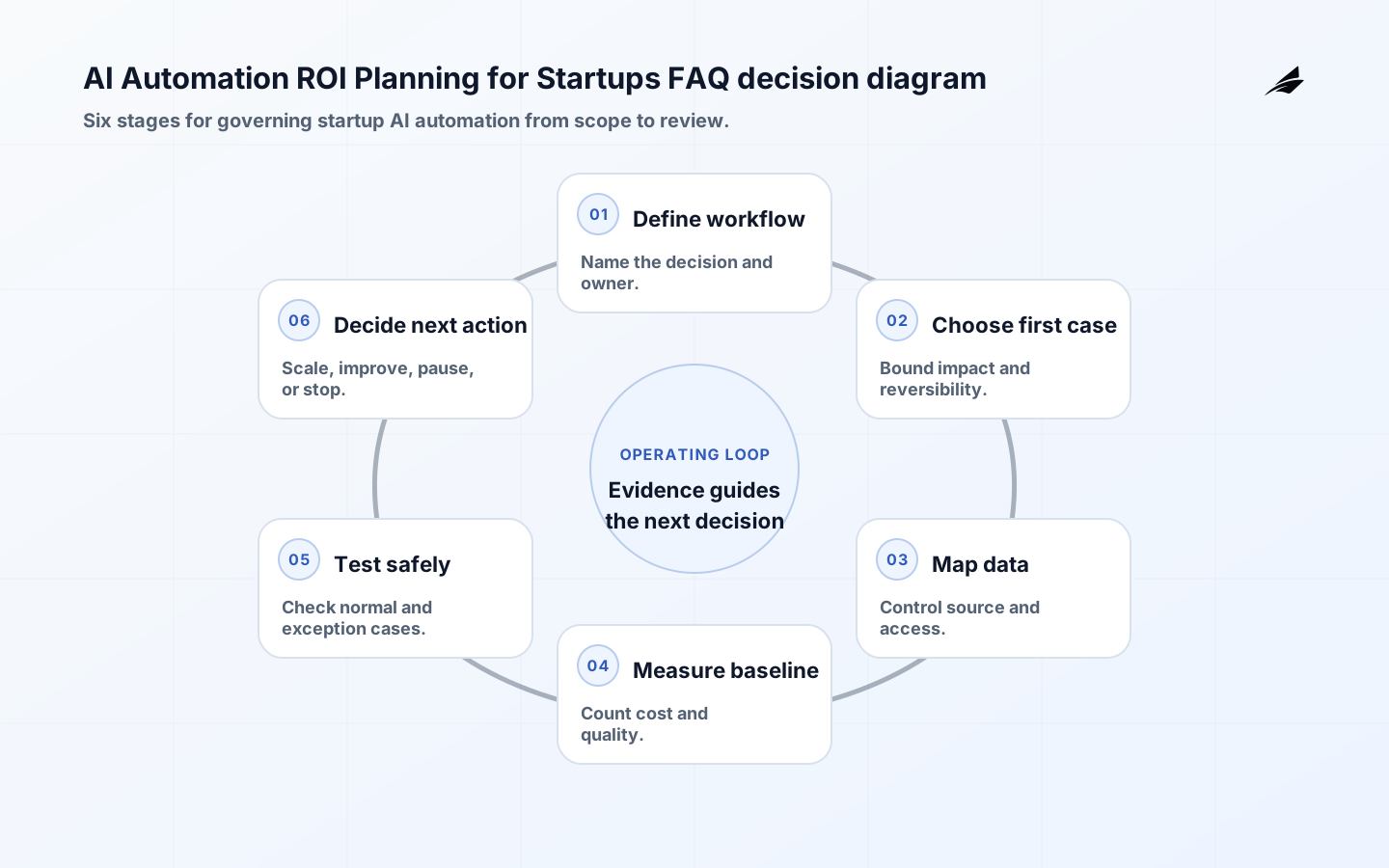
Startup teams should ground AI automation ROI questions in a real operating decision, not a technology purchase. They should name the repeated task, the people affected, the source records, the decision that follows, and the cost of being wrong. For startup AI automation, the useful question is not whether a model can produce an impressive response. It is whether the workflow can produce a smaller, evidence-led automation decision under ordinary pressure, incomplete inputs, and exceptions. NIST's AI Risk Management Framework is a helpful discipline here: govern the use, map its context, measure the outcome, and manage the residual risk. A short, bounded first release makes those activities possible.
Start with a workflow boundary
Define where startup AI automation starts and ends. Write the triggering event, allowed inputs, system actions, human decision points, outputs, and the place where a person takes responsibility. This prevents a vague goal such as “automate support” or “improve finance” from becoming an untestable promise. The boundary should also identify what stays outside the first release. A workflow that includes changing a contractual, payment, access, or customer-facing state usually deserves a smaller initial scope and an explicit review gate. Answering common ROI, quality, and governance questions before committing budget is a reasonable aim only when the team can explain the evidence behind each result and the recovery path when that evidence is insufficient.

| Question | Evidence to collect | Decision it supports |
|---|---|---|
| What repeats? | A sample of real cases, volumes, and handoffs | Whether there is enough recurring work to improve. |
| What can go wrong? | Examples of harmful or costly outcomes | Where review, restrictions, or escalation belong. |
| Who owns the result? | Named business and technical owners | Who may approve change and investigate failure. |
| What proves value? | Baseline time, quality, cost, and exception data | Whether to continue after the pilot. |
Choose a safe first case
For delivery teams working on AI automation ROI planning for startups FAQ, this operating decision should connect governed inputs, model behavior, permitted tools, human judgment, and recorded outcomes to evidence an accountable owner can inspect. The strongest first case for startup AI automation is frequent, bounded, and reversible. It has a known source of truth, a measurable delay or error burden, and a human who can review uncertain results without creating a second hidden queue. Avoid using the first release to make irreversible commitments or to absorb poorly defined work. Break a large ambition into one step that prepares, classifies, summarizes, retrieves, or routes information. That step can still save meaningful effort, but it gives the team a way to compare the assisted result with current practice. NIST's generative AI profile emphasizes lifecycle risk management; the scope of the system, its users, and its operating context should be visible before the system is trusted. In this question-and-answer review, move beyond the operating decision only after the owner can show the accepted result, the exception path, and the signal for another review.
Map data and permissions
In AI automation ROI planning for startups FAQ, delivery teams should make the relationship between governed inputs, model behavior, permitted tools, human judgment, and recorded outcomes explicit and reviewable. List every source record, connector, identity, prompt input, generated output, and log needed by startup AI automation. For each, decide who may read it, who may change it, how long it is retained, and what must be removed or masked before processing. Do not rely on a generic “internal data” label: customer records, employee information, security material, and financial evidence can require different treatment. The NIST Privacy Framework offers a practical way to make privacy risk part of the operating design rather than a late legal review. Keep authorization checks close to the source system and give the automation only the minimum access required for its bounded task. This question-and-answer review should close the information boundary only when the result, unresolved exception, and next review condition are recorded.
| Control area | Practical check | Signal of trouble |
|---|---|---|
| Source quality | Record freshness, owner, and version are known | The system cannot explain which record supported a result. |
| Access | Role and tenant restrictions are enforced | A test account sees data outside its approved scope. |
| Output handling | Drafts, citations, and review state are stored appropriately | A generated answer is mistaken for a final record. |
| Recovery | A case can be corrected, retried, or escalated | An exception disappears between systems. |
Measure the full economics
A dependable AI automation ROI planning for startups FAQ design makes governed inputs, model behavior, permitted tools, human judgment, and recorded outcomes visible to the owner responsible for this operating signal. A credible ROI model for startup AI automation starts with a baseline: case volume, active handling time, elapsed time, quality defects, rework, service-level misses, and the cost of the people or systems involved. Then add the less glamorous costs: integration, content preparation, evaluation, monitoring, training, access review, vendor usage, and human review. Estimate ranges rather than a single heroic number. Separate capacity released from cash actually avoided; saving five minutes from a task only creates financial value when the organization can use that capacity elsewhere. Report benefits and risks by workflow segment so an improved average does not hide a damaging exception pattern. The next step in this question-and-answer review is justified when the team can trace the accepted outcome, the fallback route, and the owner of follow-up.
Test before you scale
This acceptance decision for AI automation ROI planning for startups FAQ is strongest when governed inputs, model behavior, permitted tools, human judgment, and recorded outcomes can be reviewed as one operating record. Create a representative evaluation set from permitted historical or synthetic cases, including common cases, difficult cases, missing information, adversarial instructions, and expected escalations. Define acceptance criteria before looking at results: for example, supported answers, correct routing, proper abstention, reviewer agreement, and no unauthorized disclosure. OWASP's LLM application guidance is particularly relevant when instructions and external content can influence a model; treat untrusted text as data, constrain tool access, and test the routes through which a system could be misled. Run the pilot alongside the current process until the differences are understood. The point is evidence, not a perfect demo. Acceptance in this question-and-answer review requires a visible outcome, a bounded exception path, and a measurable reason to revisit the decision.
Operate with visible ownership
Delivery teams can keep AI automation ROI planning for startups FAQ accountable by recording how governed inputs, model behavior, permitted tools, human judgment, and recorded outcomes shape this ownership decision. Once startup AI automation is live, use an operating cadence that reviews both performance and impact. A business owner should own workflow outcomes, a technical owner should own reliability and change control, and a control or security owner should have a route to challenge unsafe use. Log the input context needed for investigation, the system version, the output, the reviewer action, and the final downstream outcome, while respecting the data-retention boundary. Watch for input drift, changes in source content, access changes, unusual exception rates, rising manual correction, and users working around the intended review step. A monitored small system is more valuable than a broad unattended one. For this question-and-answer review, the responsible owner should be able to explain what passed, what remains exceptional, and which signal reopens review.
Decide what to scale
For AI automation ROI planning for startups FAQ, the evidence behind this operating decision should cover governed inputs, model behavior, permitted tools, human judgment, and recorded outcomes. At the end of a defined pilot period, compare the assisted workflow with the baseline rather than with an idealized future. Ask whether quality held for the cases that matter, whether reviewers could explain and correct outcomes, whether costs stayed within the operating model, and whether the result changed a business metric worth protecting. Promotion can mean broader volume, another well-matched workflow, or better source coverage; it does not have to mean more autonomy. A hold decision is useful when evidence is thin. Document the reason, the unresolved risk, and the condition that would make a later trial responsible. This is how FAQ guide turns experimentation into a repeatable management practice. Do not widen the scope from this question-and-answer review until the evidence supports the result, the recovery route, and the next operating check.
Key takeaways
- Start startup AI automation with a bounded workflow and a named owner.
- Measure exceptions, review effort, and correction cost alongside time saved.
- Give the system only the data and permissions it needs for the agreed task.
- Test supported outcomes, abstentions, and unsafe paths before expanding use.
- Scale only when the pilot shows durable value and manageable residual risk.
Frequently asked questions
The team responsible for AI automation ROI planning for startups FAQ should examine governed inputs, model behavior, permitted tools, human judgment, and recorded outcomes together before accepting this operating decision. How quickly should startup AI automation show ROI? Set a review window that fits the workflow volume and implementation effort, but do not declare success from a few favorable examples. What if the model gives a fluent wrong answer? Keep the source evidence visible, require review for consequential actions, and make escalation easy. Is a human reviewer always necessary? The required oversight depends on the harm, reversibility, and quality of the evidence; lower-risk preparation work may need a lighter check than an action that changes a customer, financial, or access state. Can a pilot use live data? Only when access, privacy, retention, and supplier terms have been deliberately reviewed for that scope. A reviewer using this question-and-answer review should be able to reconstruct the decision, route an exception, and identify the next trigger without relying on private context.
A reviewable AI automation ROI planning for startups FAQ workflow ties this operating decision to governed inputs, model behavior, permitted tools, human judgment, and recorded outcomes. Which metric matters most? Choose the measure nearest the promised outcome: supported resolution, accurate routing, cycle time, reduction in rework, or a controlled-risk measure. Usage alone is not proof of value. What should stop a rollout? Pre-agree thresholds for material errors, unsafe disclosure, unexplained access, customer impact, or an exception backlog that reviewers cannot sustain. How often should the team re-evaluate? Recheck after material changes to the model, instructions, sources, integrations, or workflow policy, and review trend data on a regular operational cadence. Completion in this question-and-answer review means the accepted state, correction route, and future review signal are all visible to the operating team.
Conclusion
AI automation ROI planning for startups FAQ is worthwhile when it makes a specific workflow more dependable for the people who rely on it. Begin with clear boundaries, trustworthy evidence, minimum necessary access, honest measurement, and a recovery path. That combination gives startup teams evaluating their first automation a practical basis for deciding whether to improve, expand, pause, or retire the automation without mistaking novelty for progress.