A cross-border advisory engagement for China-related business is a defined piece of advisory work that helps a company enter China, expand from China into other markets, or run operations that span both. It usually brings client priorities, country teams, sector expertise and governance together under one senior coordinating lead. Titles, structures and authority differ from one adviser to another, so this guide plans the engagement itself rather than describing any particular provider. It is general guidance and not legal advice.
Use this plan alongside the cross-border governance implementation checklist and cross-border advisory engagement FAQ. Where the engagement includes technology programs, the AI services delivery plan provides a project-level framework. The coordinating lead should add accountable coordination without displacing the responsibilities of local entities, country teams, engagement partners or legal advisers.
Define the engagement mandate and boundaries
Write an engagement charter that names the sponsoring executive, term, countries, business segments and decisions within scope. Typical outcomes may include a coherent market strategy, qualified cross-border opportunities, coordinated proposals, executive introductions, issue escalation and capability transfer to the client team. State what remains outside the engagement: client acceptance, legal opinions, audit independence decisions, sanctions determinations, engagement quality approval and local employment management usually belong to established functions at the adviser and at the client.
Clarify whether the coordinating lead is an executive with decision rights, an adviser who recommends, or a convener who connects others. A title without authority creates delay; broad authority without local checks creates risk. Map the client sponsor, the adviser's coordinating lead, country leads, sector specialists, account partners, and the risk, legal, finance and operations functions in a decision matrix. Define delegation and a deputy for travel or conflicts. Publish a route for local teams to challenge or decline a direction that conflicts with law, professional obligations or the client's interest.
| Decision | Coordinating lead contribution | Final authority |
|---|---|---|
| Market priorities | Propose a portfolio and convene country input | Client sponsor and steering group |
| Work opportunity | Sponsor coordination and resolve ownership | Authorized engagement leader |
| Risk acceptance | Provide context; never override control functions | Legal, risk and local-entity authority |
| Resource conflict | Broker a documented allocation | Resource-owning leaders |
| Public position | Align the cross-border message | Communications and authorized leadership |
Scope the portfolio and deliverables
Segment work into inbound (entering China), outbound (leaving China for other markets) and partner-ecosystem portfolios. For each, identify priority sectors, countries, business needs, service capabilities, language coverage and relationship owners. Maintain an opportunity record with purpose, entities, jurisdictions, likely services, referral path, conflicts status, risk tier and next decision. Do not treat introductions or meeting counts as delivery. A qualified outcome has an accountable team, permitted scope and evidence that the business need can be served.
Set a quarterly plan with a small number of named initiatives, such as an investment corridor study, a sector briefing series, a partner search or a coordinated account plan. Each initiative needs a sponsor, audience, budget, compliance review, deliverable and outcome measure. Retire activity that repeatedly produces no qualified result or creates a disproportionate review burden. Preserve institutional knowledge in approved engagement systems rather than private messaging histories.
Design risk-based compliance and due diligence
Cross-border work can engage anti-bribery, sanctions, export controls, data transfer, state-secrets, competition, professional independence, tax, lobbying and sector rules. Requirements depend on entities, people, services and jurisdictions, so qualified counsel and control owners must assess the actual matter. The DOJ and SEC FCPA guide and UK Bribery Act guidance are primary explanations of their respective regimes, not interchangeable global checklists.
Screen clients, counterparties, beneficial ownership, relevant intermediaries and transaction parties through approved processes. The U.S. Consolidated Screening List is an aid and explicitly directs users to the underlying official restrictions where a potential match appears. Automate screening where appropriate but retain trained review for transliteration, aliases, ownership and end-use. Record decisions and rescreen on material changes. Never infer clearance because one list returns no match.
Use the OECD responsible-business due diligence guidance to examine adverse impacts across operations and relationships. Give teams confidential advice and reporting routes, prohibit retaliation and define escalation to independent control functions. The client sponsor and the adviser's coordinating lead should both reinforce a culture in which pausing an attractive opportunity for evidence is expected behavior, not a failure of commercial leadership.
Build the cost and resource model
Separate coordination cost from initiative and engagement delivery cost, and ask the adviser to price them separately. Coordination cost may include leadership allocation, program office, analysts, relationship systems, translation, travel, events, market research, risk support and communications. Initiative cost belongs to a named sponsor; delivery cost belongs to the relevant commercial agreement. Allocate shared cost using a stable method and disclose what country teams are expected to contribute. Hidden reliance on uncompensated local work weakens participation and distorts return.
Plan a base case and a travel- or event-intensive case. Include currency, tax, duty of care, security and cancellation assumptions. Apply approval thresholds for hospitality, sponsorship, gifts, intermediaries and public-sector interaction. Measure value through qualified pipeline, realized engagements, cross-border client retention, cycle time and capability reuse, but do not pay incentives that reward bypassing acceptance or compliance. Where relationship benefits are long-term, use a documented multi-period review rather than inventing precise attribution.
| Cost pool | Planning unit | Control |
|---|---|---|
| Leadership and program office | Annual capacity by role | Charter and time allocation |
| Country coordination | Initiative or account support hours | Named sponsor and budget |
| Travel and convening | Approved event or journey | Purpose, attendee and hospitality review |
| Risk and diligence | Case volume and complexity tier | Independent control ownership |
| Technology and data | Licensed users and integrations | Access, residency and retention review |
Run a transparent delivery cadence
Operate weekly opportunity triage, monthly country and sector reviews and quarterly sponsor decisions. Triage should confirm ownership, next action, conflicts or acceptance stage and blockers. Monthly reviews should compare portfolio movement, stalled approvals, capacity and emerging risk. Quarterly reviews should authorize priorities and close initiatives. Keep minutes focused on decisions and avoid distributing sensitive client or personal information beyond need-to-know groups.

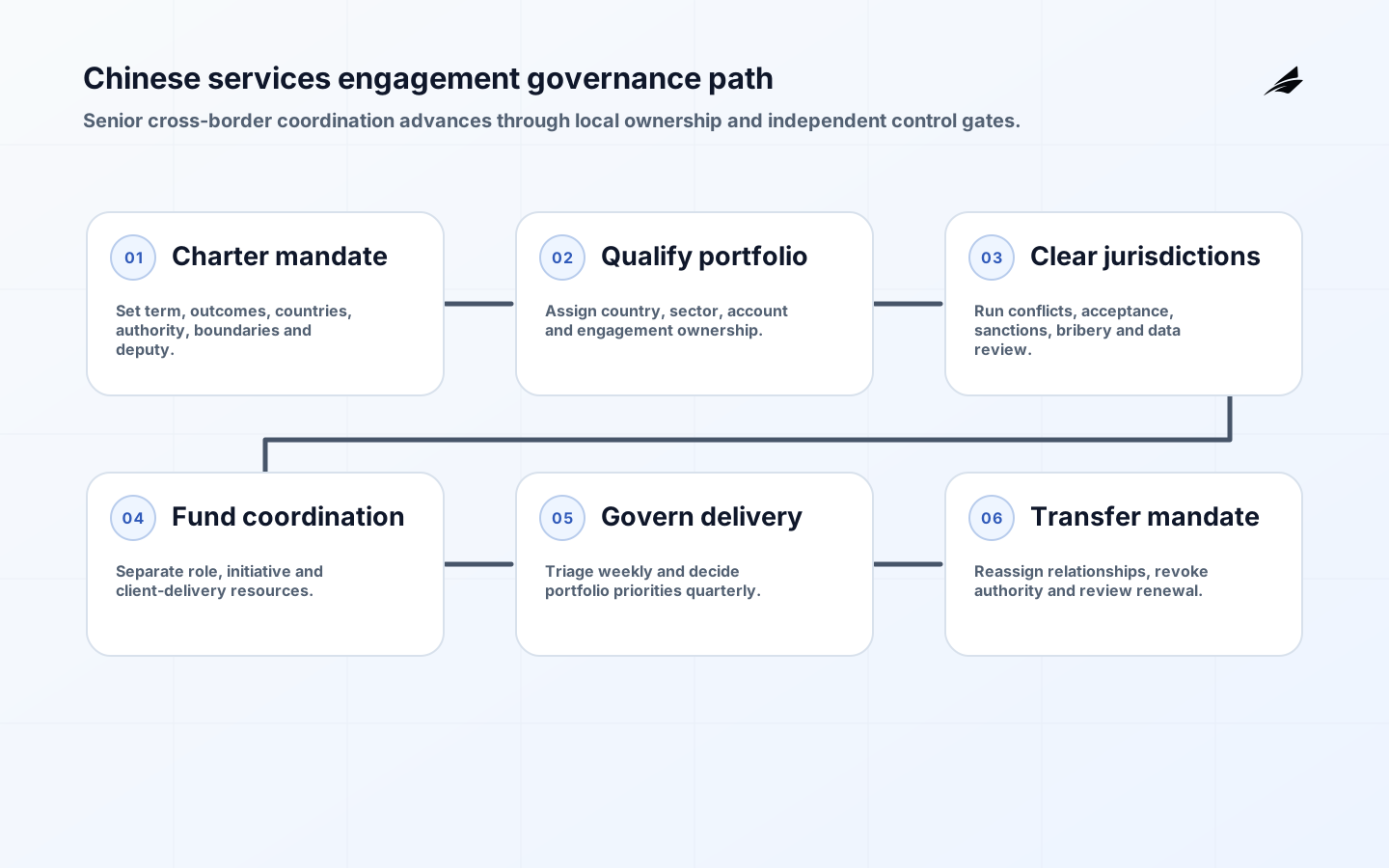
- Approve the charter, authority matrix, term and deputy.
- Map country, sector, account and control-function owners.
- Create prioritized inbound, outbound and partner-ecosystem portfolios.
- Route every opportunity through conflicts, acceptance and risk gates.
- Fund initiatives with explicit deliverables, budgets and close criteria.
- Review outcomes, conduct and capability; renew or reshape the mandate.
Monitor risks and outcome evidence
Maintain a risk register for concentration around one leader, unclear opportunity ownership, relationship data leakage, inconsistent screening, local-team overload, political exposure, independence conflicts and key-person succession. Each needs an indicator, owner, response and escalation threshold. Rehearse a sanctions change, public allegation, data incident and sudden leadership absence. A multi-country engagement must continue safely when the coordinating lead cannot personally coordinate it.
Use a balanced scorecard. Commercial measures show qualified and realized work; service measures show coordination speed and client outcomes; conduct measures show diligence timeliness, exceptions and substantiated concerns; capability measures show trained leaders, reusable insight and succession depth. Do not rank countries only by revenue because market maturity, regulatory limits and strategic purpose differ. Pair numbers with reviewed case evidence.
Plan transition, succession and engagement closure
The coordination role should be transferable from its first day. Maintain current country and account ownership, stakeholder maps, decision logs, approved strategy, initiative status, budget, risk themes and upcoming obligations in governed systems. Develop a deputy and regional leaders who can chair reviews and represent the engagement. Avoid routing every senior relationship through one person's private contacts; obtain consent and follow relationship-management rules when institutionalizing contact information.
Begin formal transition before the end of a term. Review open opportunities for conflicts, acceptance stage, owner and next decision. Reassign sponsorship explicitly, brief control functions and notify stakeholders at the appropriate time. Revoke delegated authorities and system access on the effective date. Preserve required records while removing duplicate personal copies. If a successor changes strategy, close or reauthorize initiatives instead of allowing them to continue on assumed approval.
Evaluate the mandate separately from the individual. Ask whether the cross-border need remains, whether authority and country participation were sufficient, whether conduct controls operated, and whether outcomes justified cost. Options include renewal, rotation, narrower regional coverage, a permanent program office or closure. Record lessons and unresolved risks for the sponsoring body. A successful transition is evidence that the coordination became an institutional capability rather than a personal dependency.
Use an independent review for any allegation involving leadership, a major intermediary or pressure on a control function. Preserve records, protect confidentiality and avoid prejudging facts in portfolio forums. The response owner should be outside the affected reporting line. After resolution, update controls and training with anonymized lessons where lawful. Seniority should increase scrutiny and accountability, not create a faster exception route.
Key takeaways
- Give the coordinating lead a written cross-border mandate and explicit limits.
- Qualify portfolio outcomes through accountable country and engagement owners.
- Keep legal, risk, acceptance and independence decisions with authorized functions.
- Budget coordination, initiative and delivery costs separately.
- Measure durable relationships, compliant delivery and capability, not meeting volume.
Frequently asked questions
Is a global lead title the same at every adviser?
No. Advisers name cross-border and China-related coordination roles in different ways, and the same title can carry different authority. Confirm the actual organization, mandate and title in writing before relying on a generic role description.
Can the coordinating lead approve sanctions or anti-bribery risk?
Not merely by virtue of the title. Legal and risk decisions must follow the organization's authorized governance and applicable law. The coordinating lead can ensure early escalation and adequate context but should not override independent control owners.
How soon should the engagement show value?
Coordination and diligence improvements may appear within a quarter, while relationship and market outcomes can take longer. Set leading indicators and annual outcome reviews. Avoid claiming revenue attribution where the connection to the engagement is not supportable.
Conclusion
A cross-border advisory engagement for China-related business works when senior relationships are joined to institutional governance. Define authority, prioritize a bounded portfolio, protect local and control-function ownership, fund the work transparently and review conduct alongside commercial outcomes. That operating model makes cross-border coordination repeatable and resilient without turning a leadership title into an uncontrolled exception.