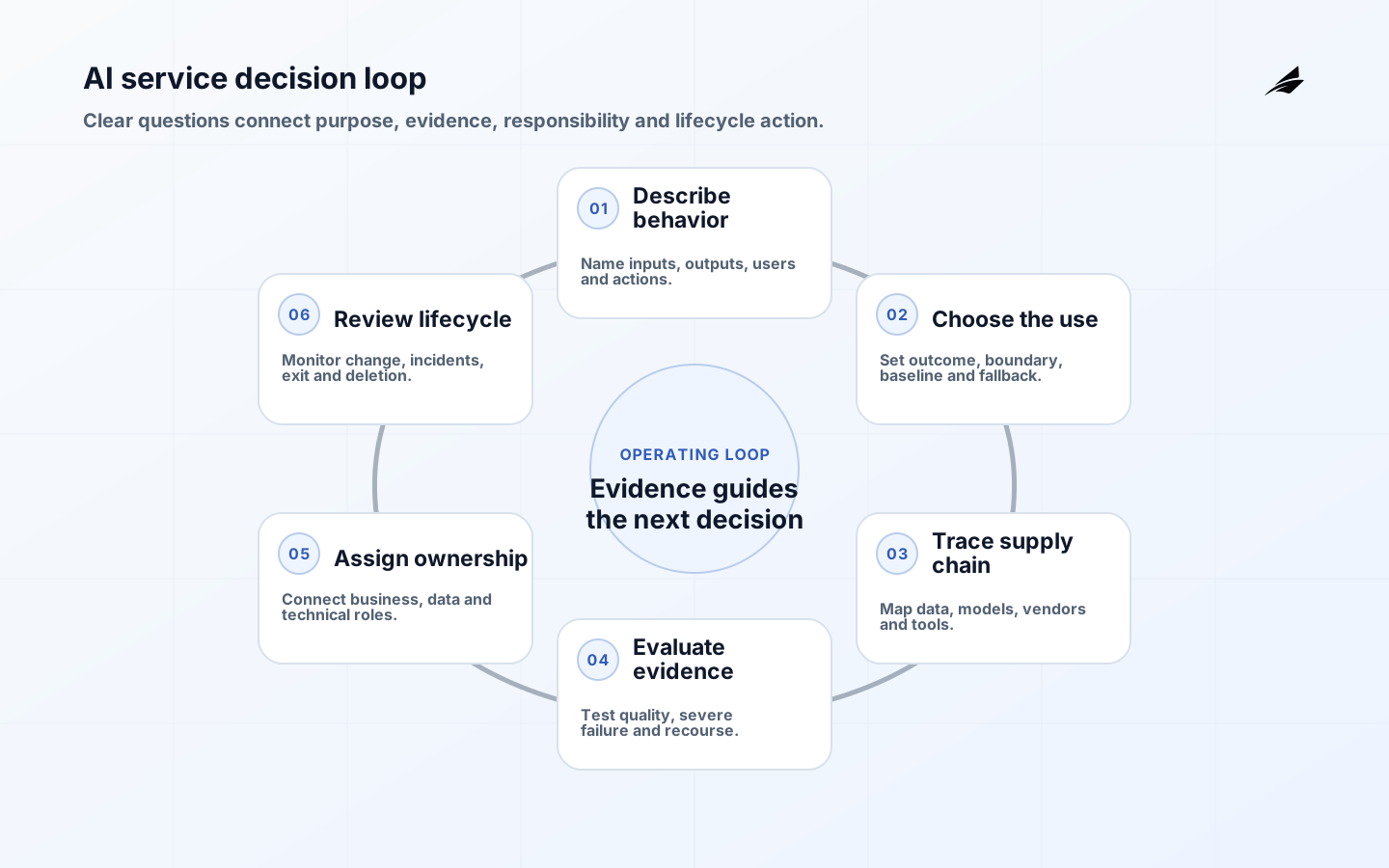
This AI services FAQ answers the questions buyers, product leaders and delivery teams should resolve before and after launch. An AI service can retrieve, classify, predict, generate, recommend or act. Those behaviors create different risks, evidence needs and operating costs. The useful question is not whether a supplier uses AI, but what the deployed service does in a particular workflow, for whom, with which data and authority, and how errors are detected and corrected.
For planning detail, see Edilec’s AI services scope and cost guide, AI services implementation checklist and AI services delivery plan.
Key takeaways
- Describe service behavior and downstream consequence instead of relying on labels.
- Choose a bounded use with observable outcomes, affected-person review and fallback.
- Treat vendor, model, data, retrieval and tools as one deployed system.
- Require representative evaluation and evidence for severe failure controls.
- Retain organizational responsibility even when suppliers provide components.
- Review material changes, incidents and live cases throughout the lifecycle.
What counts as an AI service?
Practically, it is a service that uses AI techniques to produce or influence an operational output. A search assistant, fraud score, document extractor and autonomous agent all qualify for this discussion, but their consequences differ. Document inputs, outputs, users, affected people, dependencies and actions. A simple classifier that routes urgent cases can have greater impact than a sophisticated drafting tool.
Assess the complete system, not the model alone. Prompts, retrieval, source quality, identity, tool permissions, user interface and human review determine behavior. The NIST AI RMF is voluntary guidance for incorporating trustworthiness into design, development, use and evaluation. Apply it to the deployed context and organizational risk tolerance.
| Behavior | Typical use | Central question |
|---|---|---|
| Retrieve | Find approved knowledge | Are sources current and permission-aware? |
| Classify | Route a request | What happens to false positives and negatives? |
| Generate | Draft content | How are claims grounded and reviewed? |
| Predict | Estimate an outcome | Is data fit for this population and decision? |
| Act | Change a record | Is authority bounded and recovery tested? |
How should we choose a first use case?
Choose repeated work with a clear outcome, representative records and an accountable owner. Prefer assistance that reduces search, preparation or comparison while preserving meaningful review. Avoid a first use where failure is hard to detect or recourse is weak. Map the current baseline, including rework and waiting, then define eligible cases, prohibited outputs, success, severe failure and fallback.
Include people who perform the work and people affected by its results. They reveal exceptions, accessibility needs and informal corrections. A use case is not ready when the team cannot say who receives an escalation or how normal work continues during failure. A narrow, reversible pilot produces stronger evidence than a broad launch whose inputs and outcomes cannot be compared.
What should we ask about data and vendors?
Trace prompts, files, records, outputs, feedback, embeddings and logs across organizations and regions. Ask purpose, source rights, model-training use, retention, administrators, subprocessors, export, deletion and incident notification. The NIST Privacy Framework helps manage privacy risk created by data processing. Minimize data rather than sending an entire record because the interface permits it.
Contract terms should match technical behavior. Verify tenant isolation, access, encryption, model and service changes, availability, audit evidence and exit. The UK NCSC's secure AI guidance treats security across the lifecycle and supply chain. Suppliers should explain limitations and controls, but the deploying organization still owns how the service affects its workflow.
| Due-diligence area | Evidence | Decision trigger |
|---|---|---|
| Data purpose | Contract and architecture flow | Use exceeds approved purpose |
| Model change | Version notice and test window | No regression opportunity |
| Security | Threat model, testing and incident process | Critical control remains prompt-only |
| Quality | Task-relevant evaluation and limitations | Only generic benchmark claims |
| Exit | Export, deletion and fallback | Operational records cannot be recovered |
How do we evaluate quality and risk?
Use a versioned set of ordinary, difficult, adverse and out-of-scope cases from the real workflow. Define expected outcomes with domain experts and score sources, correctness, unsupported content, harmful bias, privacy, security, abstention, escalation and downstream validity. The NIST Generative AI Profile adds risk-management actions tailored to generative AI.
Separate average quality from severe failures. One unauthorized disclosure should not disappear inside a high aggregate score. Compare with the current process, including human error and cost, but do not use existing weaknesses to excuse new harm. Evaluate the complete configured service and rerun gates after material changes. Sample live cases because test sets cannot represent every shift in users, data or adversarial behavior.
Who is responsible and how should governance work?
The business owner defines purpose, outcome and authority. Data owners govern sources. Technical owners manage integration, versions and reliability. Domain reviewers set quality criteria. Security, privacy, legal, procurement and risk contribute based on consequence. Users need a visible escalation route. Responsibility can be distributed, but no consequential decision should be attributed vaguely to the model or vendor.
Requirements vary by jurisdiction, sector and use, so seek qualified advice for regulated or high-consequence deployments. The European Commission's current AI Act overview describes the EU framework and application timeline, which has changed through implementation and simplification measures. Maintain an inventory and assess applicability using current official material rather than relying on an old summary.
What changes after launch?
Monitor outcome quality, exceptions, severe incidents, appeals, latency, cost, source freshness, input drift and reviewer effort. Define owners and action thresholds. Review a sample of accepted, corrected, rejected and escalated cases. Users should know when AI materially assists the interaction, what they must verify and how to reach a person. A service that moves repair into hidden manual work is not delivering its stated value.

Control model, prompt, retrieval, data, policy and tool changes. Preserve evaluation results and approval for each deployed version. Rehearse provider outage, compromised source, harmful output and unauthorized action. Be able to isolate a capability, reconcile effects and use a manual or alternate path. Retirement also needs export, record retention, permission removal, deletion and communication.
Turn due diligence into operating terms
Convert supplier answers into testable obligations. If the service promises regional processing, identify which stores, support paths and subprocessors are included. If customer data is excluded from training, cover prompts, uploaded files, outputs and feedback explicitly. Define notice and evaluation time for material model or feature changes, evidence available after an incident, deletion coverage and the format of exported operational records. A questionnaire answer that never reaches architecture, configuration or contract language will not govern production behavior.
Set service levels around the business workflow where possible. Model endpoint availability may not describe retrieval freshness, tool success or reviewer capacity. Define what the organization does when the service is degraded: queue eligible work, switch to manual processing, use a read-only capability or stop intake. Include recovery priorities and communication contacts. Test the fallback with realistic volume before relying on it during a provider outage.
Keep evidence proportional to consequence. A low-risk drafting assistant may need a concise system record, approved data rules, task evaluation and support owner. A service that influences employment, credit, healthcare, essential access or legal rights needs deeper domain, legal and risk review, robust recourse and more demanding change control. Classification should follow actual behavior and affected people; calling the interface a copilot does not make a consequential recommendation low risk.
Test exit before dependence grows
Export a sample of prompts or records that the organization is entitled and required to retain, along with configuration, evaluation and audit evidence needed for continuity. Verify the format is usable without the supplier's interface. Identify features that cannot be reproduced and decide whether the manual fallback is acceptable. Then test account closure, key revocation, integration removal, residual retention and deletion confirmation. An exit plan is credible when the workflow can continue safely, not merely when procurement can terminate the subscription.
Use a short, versioned system card to keep decisions current. Record the service purpose, owner, affected groups, inputs, outputs, suppliers, model and configuration, actions, evaluation date, known limits, live measures, incident route and next review. Link to evidence rather than duplicating sensitive material. Update the card after material change or incident and retire it with the service. This gives procurement, risk, support and delivery teams one shared index without pretending that a static document replaces technical controls.
AI service buyer checklist
- Purpose, users, affected people, authority and prohibited outcomes are explicit.
- The current baseline and pilot success measures include rework and exceptions.
- Data flows, suppliers, retention, training use and deletion are verified.
- Evaluation covers representative and severe failure cases.
- Human review and recourse are meaningful and operationally staffed.
- Contracts cover change, incidents, evidence, continuity and exit.
- Live measures have owners, thresholds and case-review cadence.
- Pause, fallback, reconciliation and retirement are rehearsed.
Frequently asked questions
Do we need an AI strategy before a pilot?
A broad strategy helps prioritize investments, but a pilot still needs purpose, ownership, data rules, evaluation and fallback. Use pilot evidence to inform strategy rather than using strategy language to bypass operational readiness.
Can we rely on vendor benchmarks?
Use them as background, not deployment proof. Test your workflow, population, sources, language, tools and failure costs. Ask for methodology and limitations. A model can perform well on a public benchmark and poorly within a permissioned, changing business process.
Does human review make an AI service safe?
Only when reviewers have evidence, expertise, time, authority and a correction route. Review can fail through automation bias, overload or missing context. Test reviewer performance and sample approved cases, not only those the service already marked uncertain.
Conclusion
AI services become governable when teams describe behavior, context, authority and evidence precisely. Select bounded work, inspect the full data path, evaluate severe failures and operate with accountable change and recovery. Those answers matter more than a product label and remain useful as models, vendors and rules evolve.