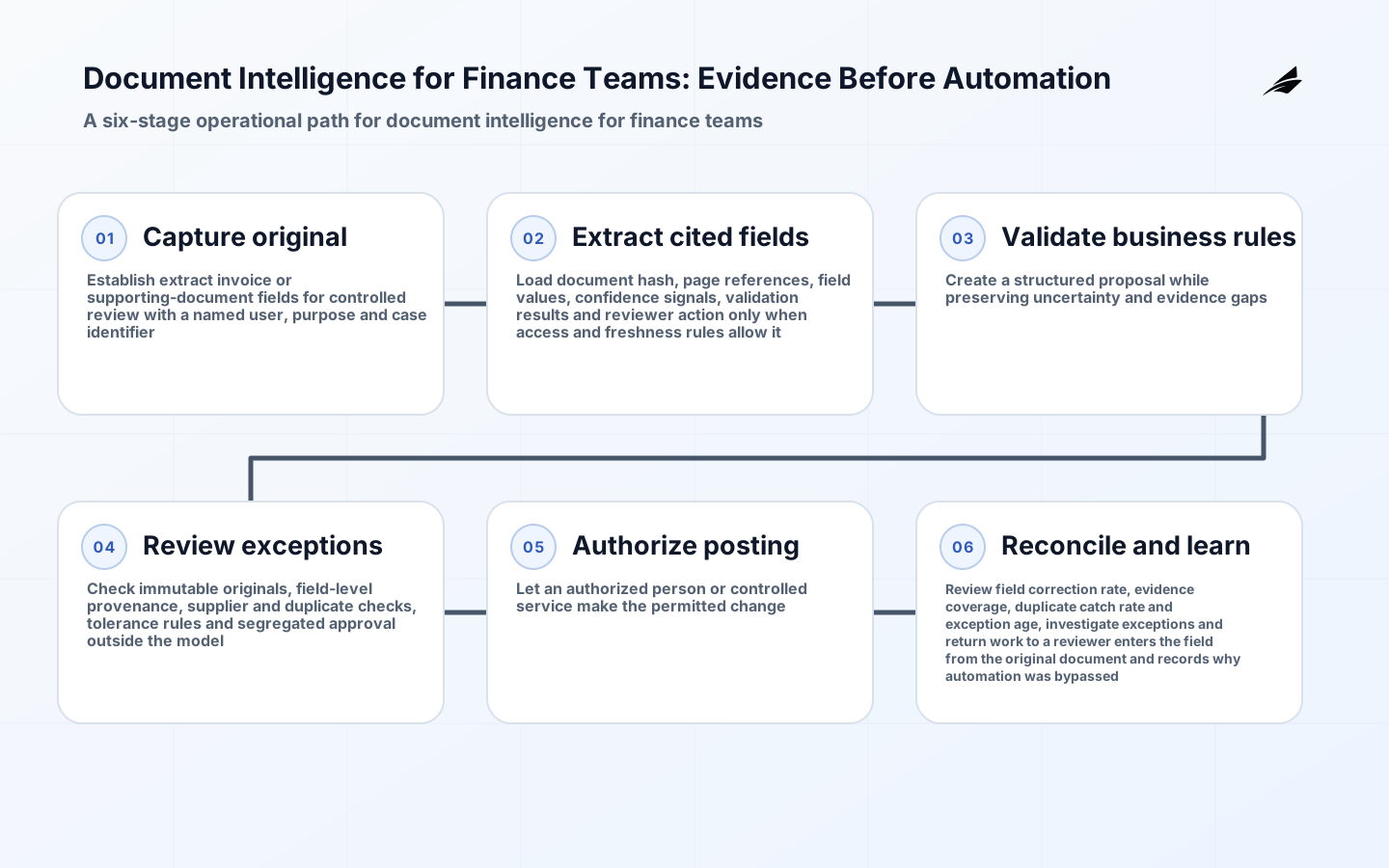
Document intelligence for finance teams is useful only when it improves a real decision without making the organization less able to explain, challenge or reverse that decision. For product leaders working with finance operations, the starting point is not a model demonstration; it is a specific promise to extract invoice or supporting-document fields for controlled review. Name the worker affected, the accountable owner, the system of record and the consequence of a wrong result. Then decide what the AI component may prepare, what it may never decide, and how a person sees the evidence before work moves on. This guide treats the workflow as a controlled service. That means the team tests ordinary work, uncomfortable edge cases and recovery before asking people to rely on it. The aim is dependable assistance, not the appearance of autonomy.
Define the operating boundary for document intelligence for finance teams
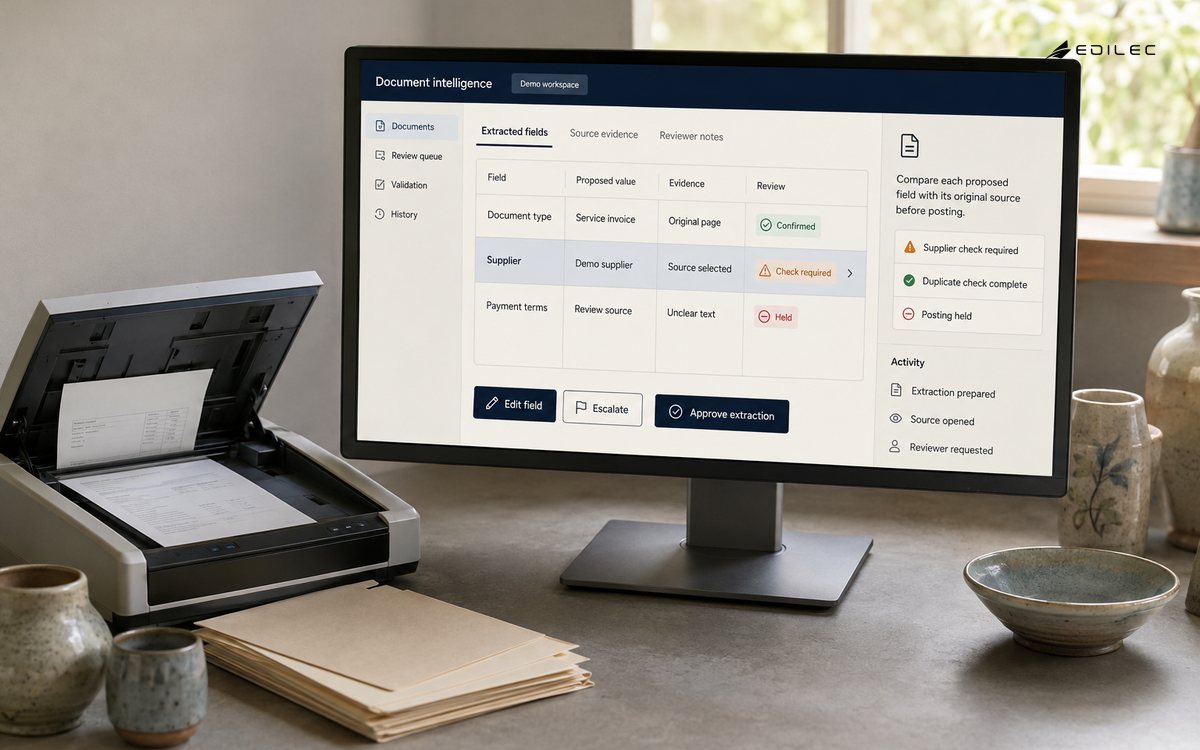
Write a one-page task contract around the original document, extracted fields, source locations and posting decision. State the initiating event, permitted users, authoritative inputs, allowed output and stop conditions. The minimum evidence record is document hash, page references, field values, confidence signals, validation results and reviewer action. These details make a later review possible and keep fluent language from being mistaken for a completed business action. Do not let an employee message become a substitute for an entitlement, an approved policy or a current record. When sources disagree, preserve the disagreement and route it to an owner. A small first boundary is a strength: support, security and the business owner should all be able to explain where the system starts, which controls are independent of the model and where responsibility returns to a person.
| Boundary question | Decision to document | Evidence retained |
|---|---|---|
| What job is being improved? | extract invoice or supporting-document fields for controlled review | Case identifier, request type and owner |
| What information is allowed? | document hash, page references, field values, confidence signals, validation results and reviewer action | Source versions, access result and timestamps |
| What may the AI do? | classification and field preparation; posting, payment release and accounting exceptions remain independently authorized | Structured proposal and policy decision |
| When must it stop? | a plausible extraction entering a financial record without a person seeing the source evidence | Exception reason, assignee and final disposition |
Put independent controls at the point of consequence
The highest-value controls are outside the language model. Start with authenticated identity, tenant or business scope, purpose and a verified record reference. Apply immutable originals, field-level provenance, supplier and duplicate checks, tolerance rules and segregated approval. Validate both inputs and outputs against an explicit schema, and keep durable writes behind a gateway that enforces authorization, parameters, limits and idempotency. This design answers a hard but practical question: can the surrounding application refuse a convincing but prohibited request? It must. A prompt can clarify behavior; it cannot grant access or replace a business rule. Where work affects money, people, access or regulated records, make the next allowed action visible to the reviewer and require a positive decision rather than treating silence as approval.
In document intelligence for finance teams, review screens should support an accountable person, not merely display a confidence number. Show the proposal, the supporting evidence, its source or age, unresolved conflicts and the action that will occur next. A reviewer needs simple choices such as approve, edit, reject or escalate, with a reason captured when the choice matters. Their corrections become labeled operating data: they may reveal a stale source, an ambiguous policy, a retrieval failure, an integration defect or an over-broad scope. That diagnosis is more useful than reflexively changing prompts. Design the review queue for the difficult cases first, including missing data, conflicting evidence, tool failure and a request that appears authorized but does not satisfy the published rule.
| Control | Why it exists | Representative test |
|---|---|---|
| Identity and scope | Binds a request to an allowed actor and record set | A changed identifier cannot expose another record |
| Schema and evidence checks | Rejects incomplete or unsupported proposals | A missing citation creates an exception |
| Action gateway | Keeps consequential effects outside model discretion | A prohibited parameter is blocked and logged |
| Human handoff | Preserves judgment for ambiguity or impact | A boundary case cannot complete unattended |
| Recovery trace | Supports reconstruction and correction | An operator can use a reviewer enters the field from the original document and records why automation was bypassed |
Evaluate document intelligence for finance teams with work that resembles production
For document intelligence for finance teams, a useful evaluation set is a versioned collection of decisions the workflow must make, not a gallery of impressive examples. Sample completed work where policy permits, then add adverse and boundary cases. Include normal inputs, missing evidence, conflicting sources, malformed requests, denied access, dependency failure and cases where abstention is the correct result. For each case, record the expected route, permitted information, required structure, unacceptable downstream effect and the evidence a reviewer should see. Run deterministic checks for access rules, required fields, citations, state transitions and tool parameters. Use expert review for nuance, usefulness and the quality of an explanation. Segment results by request class, role, source and risk tier: a strong average can conceal an unsafe subset.
- Version the test set and preserve why each document intelligence for finance teams case is included.
- Test allowed behavior, required abstention, denied access and the recovery route.
- Re-run evaluation when a model, prompt, source, tool contract or business rule changes.
- Label failures by cause so a source, integration or policy issue is not misfiled as model quality.
- Assign a release owner who can accept, narrow or stop the change.
Monitor the workflow as a living operational service
Release is the start of evidence gathering, not the end of evaluation. Instrument the case-level path without copying more sensitive content than the investigation requires: request class, configuration version, control result, reviewer intervention, downstream effect and recovery record. Watch technical health alongside decision quality. The core measures for this workflow are field correction rate, evidence coverage, duplicate catch rate and exception age. Establish a baseline during a limited rollout, assign a reader and a response to each signal, and review representative cases rather than only charts. A change in volume or input mix may be legitimate; a pattern of unexplained corrections is not. NIST’s recent work on deployed-system monitoring is a helpful reminder that pre-release tests cannot fully represent changing people, data and integrations.
An alert needs a practiced action. When a threshold moves, freeze the relevant change if necessary, sample the affected cases, compare them with the baseline and determine whether the issue sits in the source, model, integration, policy or reviewer experience. The response may be to repair content, narrow a route, add a validation rule, increase human review or withdraw a capability. It should not be an automatic expansion of authority. Make the pause path concrete: stop new automated effects, preserve enough evidence to investigate, use a reviewer enters the field from the original document and records why automation was bypassed, then reconcile items already in flight. Run a tabletop exercise before an incident forces the team to invent this process under pressure.
Release checklist
- The owner can explain the boundary, a plausible extraction entering a financial record without a person seeing the source evidence, and the fallback in plain language.
- Access, evidence, schema and action controls pass against ordinary and adverse cases.
- Reviewers can see the source, the proposed outcome and the escalation path without leaving the case.
- Metrics have a baseline, an owner, a review cadence and an action threshold.
- The team has tested pause, rollback and reconciliation before expanding use.
Key takeaways
- Document intelligence for finance teams should prepare bounded work, not silently take ownership of consequential decisions.
- Treat provenance, access and recovery as product requirements from the first release.
- Judge quality by the whole workflow: controls, human outcomes and correction effort, not just generated text.
- Expand only after the team can explain failures and return safely to the established process.
Frequently asked questions
For document intelligence for finance teams, what should be automated first? Choose a repeated, bounded task where the source of truth, required output and accountable reviewer are already known. Avoid starting with a workflow whose policy is still being debated. Is a confidence score enough to decide escalation? No. Combine defined triggers such as missing evidence, a policy conflict, restricted data, unusual value or a failed control with a named owner and a safe pending state. How much logging is appropriate? Retain the minimum protected evidence needed to reconstruct the decision and investigate harm; access to those traces should itself be controlled. When can the workflow expand? Only after evaluation, live monitoring and recovery evidence show that the current boundary is stable and that the organization can handle exceptions without hidden manual work.
Conclusion
The disciplined version of document intelligence for finance teams is not a free-form assistant attached to a critical process. It is a bounded workflow with a named owner, approved evidence, independent controls, useful human review and a recovery route that works in practice. Start small enough to observe every material failure. That produces the evidence needed to improve the service, decide what deserves automation and keep accountability where it belongs.