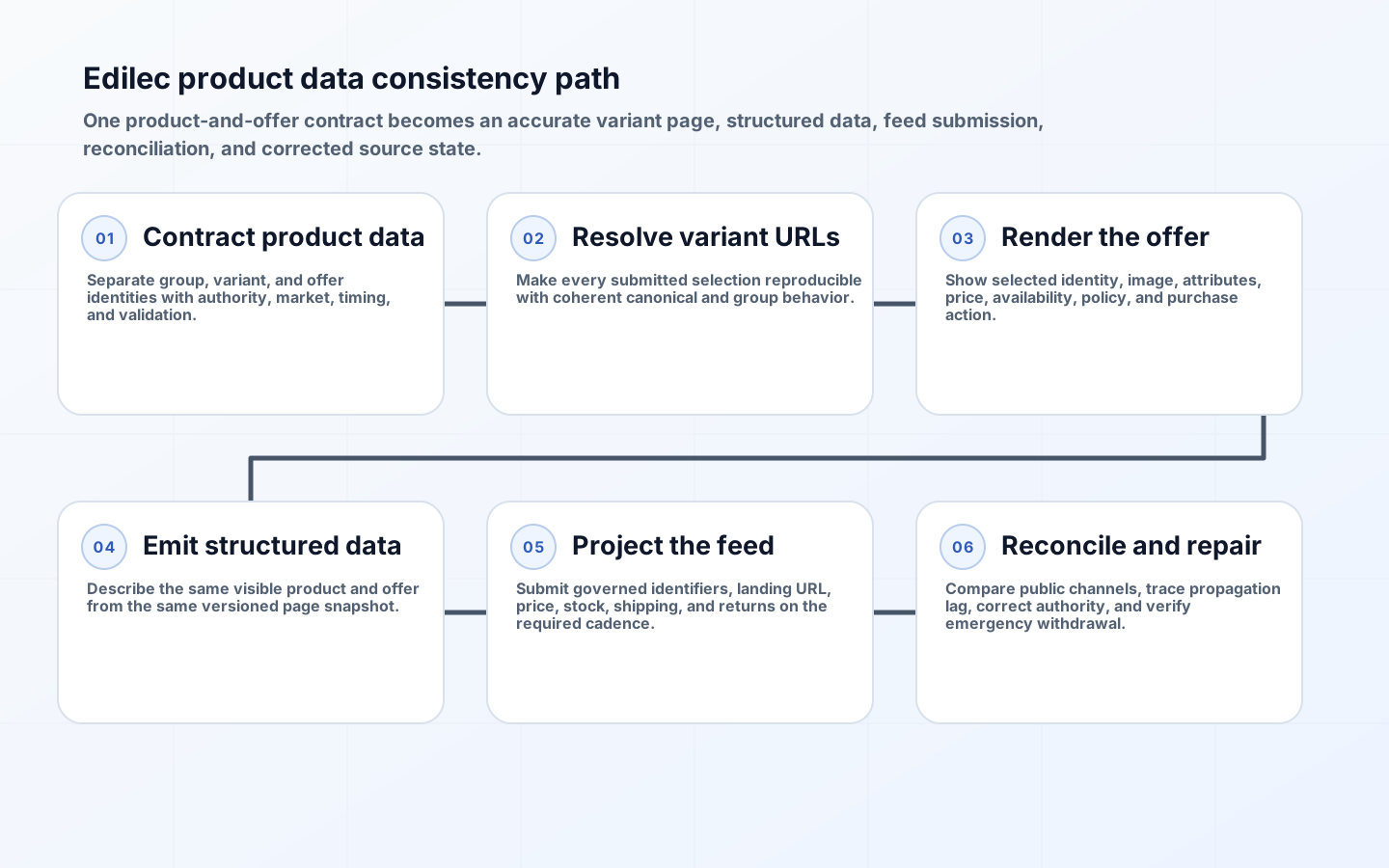
Product structured data and Merchant Center feed consistency begins in the commerce catalog, not in an SEO plugin. Google can receive product facts from rendered page content, structured data, and Merchant Center feeds. Those channels update at different speeds and may be generated by different systems. When identifiers, variants, currency, price, availability, condition, shipping, or returns disagree, shoppers see stale claims and automated verification loses confidence.
Google recommends using both page structured data and Merchant Center feeds where feasible because they support complementary experiences and help verification. That makes consistency an operating requirement. Establish one typed product-and-offer contract, define authority and freshness for every field, project it into each channel, and continuously compare public outputs. Search enhancements remain discretionary; correct markup establishes eligibility and understanding, not guaranteed display.
Define the canonical product, variant, and offer contract
Separate a product model from a sellable variant and an offer. A product group represents a family such as a coat style. Variants represent specific differentiating attributes such as color and size. An offer states seller, market, price, currency, availability, condition, and purchase URL for a sellable item. Assign stable internal IDs and map valid GTIN, MPN, brand, SKU, and group IDs without inventing identifiers that do not exist.

For each field, record semantic definition, source authority, scope, effective time, update event, validation, and channel transformation. Price needs more than a decimal: it has currency, tax and market context, active interval, membership eligibility, and sale precedence. Availability should represent whether the item can actually be purchased and delivered under the page's offer. Product description, image, condition, shipping, and returns must also agree with the visible proposition.
| Field | Authoritative source | Scope and timing | Consistency assertion |
|---|---|---|---|
| Product and group ID | Product information management or catalog master | Stable across channels; changed only through governed merge or split | Page, JSON-LD, feed, and analytics mapping resolve to same entity |
| Variant attributes | Catalog variant model | Complete differentiating set for the group | Selected URL shows and marks up the same color, size, material, or configuration |
| Price and currency | Commerce pricing service | Market, customer class, and effective interval | Public purchasable price equals visible, structured, and submitted value |
| Availability | Inventory plus fulfillment eligibility | Location, channel, safety stock, and update time | In-stock claim corresponds to a purchasable variant and destination |
| Canonical URL | Commerce routing registry | Stable destination for product or variant policy | Offer URL, canonical, links, and feed landing page resolve coherently |
| Shipping and returns | Policy service | Market, product class, destination, and effective dates | Markup and feed never promise terms contradicted on site |
Choose a coherent variant URL and ProductGroup model
Decide whether variants share one canonical product-group page or have distinct canonical pages. On a single-page model, every variant should be directly preselectable with a distinct URL state so a crawler and shopper can reach the correct image, attributes, price, availability, and add-to-cart selection. Google guidance for single-page sites expects one canonical URL for the overall ProductGroup. Do not canonicalize to whichever variant happened to be selected by a session cookie.
On a multi-page variant model, each canonical page must be self-contained and represent its variant fully. Connect variants through stable group IDs and the relevant ProductGroup properties. Each variant needs a unique identifier in structured data, and each group needs its own ID. Avoid mixed models where feed URLs target variants, page canonicals collapse unpredictably, and JSON-LD describes the unselected default. Test every submitted landing URL without cookies.
Render visible offers and structured data from the same snapshot
Generate the product page and JSON-LD from one versioned view model. The selected variant in the URL should determine visible name, image, SKU or GTIN, attributes, offer price, currency, availability, and purchase action, and the structured data should describe that same state. Include required properties for the intended product snippet or merchant listing feature and add recommended properties only when they are accurate and maintained.
Fast-changing commerce facts are poor candidates for client-only injection. Google cautions that JavaScript-generated Product markup can make shopping crawls less frequent and less reliable, especially for price and availability. Prefer initial HTML for critical product data and ensure rendering capacity can handle crawler traffic. If the client refreshes inventory after load, use the same authority and monitor mismatches rather than presenting one value visually and another in JSON-LD.
Build Merchant Center feeds as a governed projection
A feed should not maintain an independent shadow catalog. Generate submitted item ID, title, description, link, image, identifiers, price, availability, condition, brand, variant group, shipping, and other applicable attributes from the canonical contract. Map field rules explicitly and preserve the source snapshot and generation time. Validate country, language, currency, destination, and policy eligibility before submission. Quarantine records with impossible combinations rather than sending partial guesses.
Set feed cadence from business change windows. Scheduled full feeds may suit slow catalogs, while inventory or price updates may require supplemental or API-driven changes. Account for processing delay and cache behavior. Google documents automatic item updates as a way to use website data to address some price and availability discrepancies, but that is a correction layer, not a replacement for timely authoritative feeds. Investigate the upstream lag that caused the discrepancy.
| Check | Page evidence | Structured data evidence | Feed evidence | Failure action |
|---|---|---|---|---|
| Identity | Selected product and variant | Product, ProductGroup, SKU or GTIN | Item ID and item group ID | Stop affected item and repair mapping |
| Price | Visible purchasable amount and currency | Offer price and priceCurrency | Submitted price and applicable sale price | Correct authority or timing; never mask with markup-only edit |
| Availability | Variant can complete purchase for market | Recognized availability value | Availability attribute | Update all channels and inspect inventory event lag |
| Landing state | URL preselects submitted variant | Offer URL corresponds to visible state | Link resolves without session context | Remove redirect or selection ambiguity |
| Images | Primary image depicts selected variant | Image property matches visible product | Image link is crawlable and current | Correct asset association and cache invalidation |
| Policy | Shipping and returns visible and applicable | Policy properties use matching scope | Feed attributes agree for destination | Withdraw unsupported promise and reconcile policy service |
Handle price, stock, cache, and promotion races
Define an event sequence from pricing or inventory change through catalog projection, cache invalidation, page render, structured data, feed submission, platform processing, and reconciliation. Attach timestamps and version IDs. Measure maximum inconsistency windows for ordinary updates and emergency withdrawals. A price promotion with a future interval should appear only when active and should respect the same timezone and eligibility rules across page and feed.
Cache keys must include the market dimensions that change the public offer, such as country and currency, while avoiding private customer data in shared caches. When a product sells out, update the selected variant rather than marking the whole group unavailable if other variants remain. For safety recalls or legal removals, provide a high-priority withdrawal path that invalidates pages, structured claims, feeds, advertising destinations, and caches together. Preserve evidence of what each channel displayed during an incident.
Validate releases and monitor production reconciliation
Use schema validation, structured-data testing, and Merchant Center diagnostics, but add contract-level tests. Sample every template and edge state: product group, single variant, sale, out of stock, preorder, multiple currencies, missing GTIN where legitimately absent, discontinued item, and redirected URL. Fetch pages as anonymous users from target markets, parse visible values and JSON-LD, then compare to the exact feed snapshot and canonical source.
Track eligible and invalid items, identifier conflicts, page-feed price and availability mismatch, feed processing age, landing-page redirects, variant preselection failures, structured-data errors, cache staleness, and correction latency. Group failures by catalog source, template, market, and deployment. Set ownership across commerce, feed operations, SEO, and merchandising. A diagnostic should lead to the source contract and event path, not a manual edit in the final channel.
Triage incidents by customer harm and propagation breadth. A wrong public price, unsafe recalled item, or impossible purchase claim requires immediate withdrawal across channels; a missing recommended property can follow normal repair. Compare event time, page version, feed generation, submission acknowledgement, and platform diagnostic time to locate the lag. After correction, verify the landing page as an anonymous shopper, parse its structured data, inspect the next accepted feed state, and document how long stale information remained reachable.
Key takeaways
- Model product groups, variants, and market-specific offers as separate but related entities.
- Generate visible pages, structured data, and feeds from one versioned product-and-offer contract.
- Choose one coherent variant URL model and make every submitted state directly reproducible.
- Design price and availability propagation around measured inconsistency windows and emergency withdrawal.
- Reconcile public outputs continuously and repair the authoritative source rather than patching individual channels.
Frequently asked questions
Should a merchant use structured data or a Merchant Center feed?
Google recommends both where feasible. Page markup helps Search understand and verify visible products; Merchant Center feeds provide richer commerce participation and control. Both must agree with the landing page.
Can Product structured data be generated with JavaScript?
It can, but Google warns that dynamically generated Product markup may be less reliable for fast-changing price and availability. Initial HTML generated from the same current offer model is the stronger default.
Conclusion
Commerce consistency is achieved upstream. Define stable identities and precise offer semantics, project them into every channel, control freshness, and reconcile what shoppers and platforms actually receive. Product structured data and Merchant Center feeds then reinforce the same proposition instead of competing to describe it.