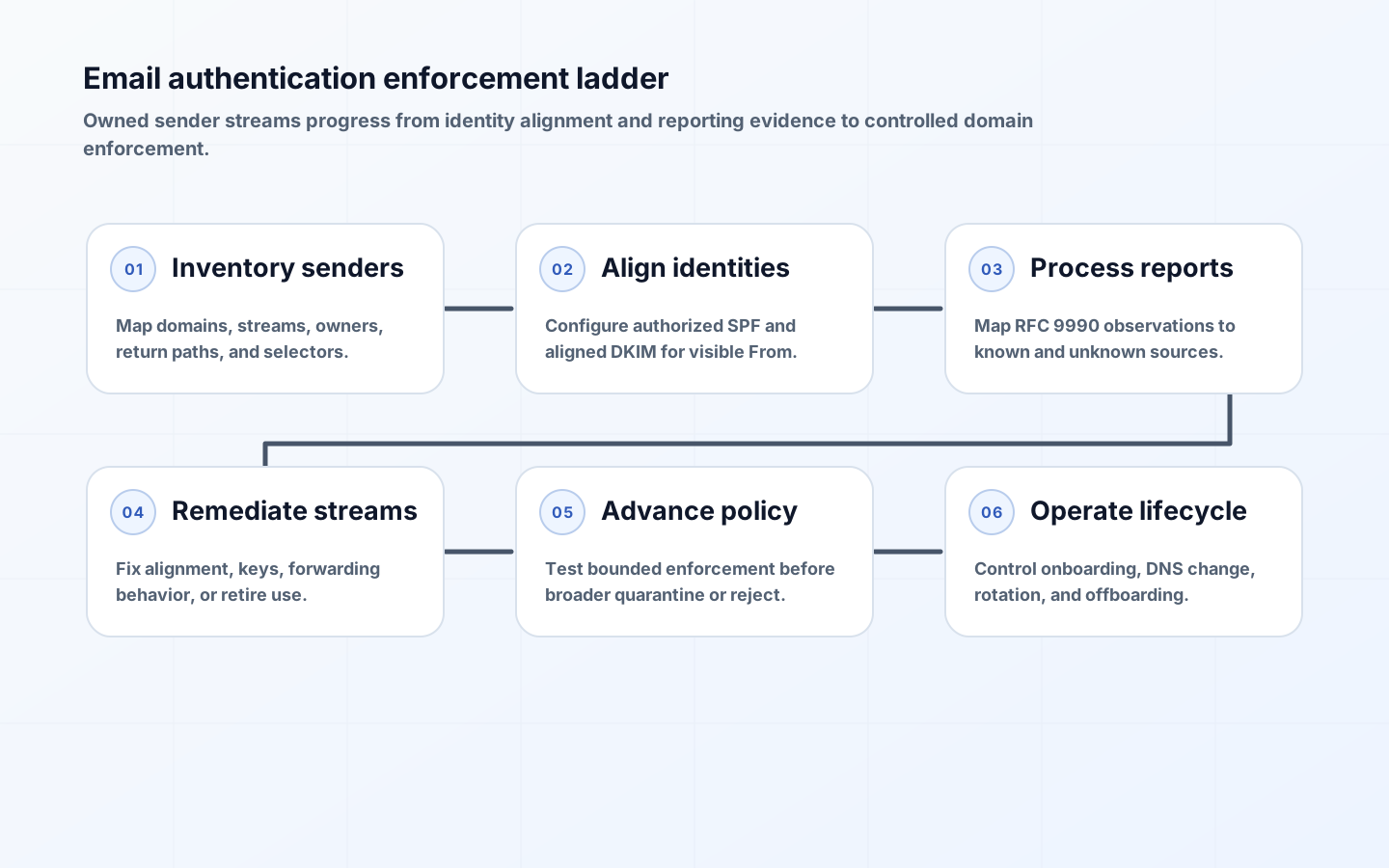
A DMARC enforcement strategy is an operating program for every system that uses an organization's domains in visible email. Publishing SPF, enabling DKIM on one mail platform, and adding a monitoring DMARC record are only the start. Marketing services, transactional providers, support tools, identity systems, partners, forwarders, and dormant subdomains continually change. Enforcement succeeds when legitimate mail is aligned and owned before receivers are asked to quarantine or reject failures.
As of July 2026, RFC 9989 is the current DMARC Standards Track specification and obsoletes RFCs 7489 and 9091; RFC 9990 defines aggregate reporting. SPF remains RFC 7208 and DKIM signatures RFC 6376. Use current standards in policy and tooling, while recognizing that receiver behavior and sender requirements can add operational constraints. Google, for example, requires bulk senders to use SPF, DKIM, and DMARC and align the visible From domain with SPF or DKIM.
Inventory domains, mail streams, and accountable owners
List organizational domains, parked domains, sending subdomains, selector records, return-path domains, sending IPs, vendors, applications, traffic type, volume, owner, and business criticality. Discover from DNS, mail gateways, provider accounts, message samples, contracts, and DMARC reports. Treat unknown sources using the domain as investigations, not immediate approvals. A sender inventory must distinguish authorization from alignment; an IP can pass SPF for a vendor domain while failing DMARC for the visible From domain.
Give each stream an owner who can change its configuration and validate delivery. Classify transactional, security, support, employee, marketing, and machine mail because failure consequences and migration windows differ. Identify non-sending domains and subdomains so they can publish restrictive policies without waiting for active programs. Prohibit new senders from entering production until authentication, alignment, unsubscribe where applicable, monitoring, and retirement ownership are verified.
Understand authentication and alignment
| Mechanism | Identity evaluated | What pass proves | DMARC requirement |
|---|---|---|---|
| SPF | SMTP MAIL FROM or HELO domain | Sending host is authorized for that domain | Authenticated domain aligns with visible From |
| DKIM | Signing domain in d= tag | Signature verifies for signed content and domain | Signing domain aligns with visible From |
| DMARC | Visible RFC5322.From domain | At least one aligned SPF or DKIM result passes | Published policy requests handling and reports |
| Aggregate report | Receiver observations by source and result | How mail evaluated at participating receivers | Operational evidence, not universal delivery proof |
SPF authorizes hosts for the envelope identity and has processing limits, including DNS-causing mechanisms. Flattening records can create stale IP lists and maintenance risk; reduce includes and separate streams before relying on generated flattening. SPF often breaks through forwarding because the forwarding host is not authorized for the original envelope domain. It can still support DMARC when the aligned return path survives direct delivery.
DKIM signs selected headers and the body with a domain-controlled key. Use sufficiently strong keys supported by receivers, protect private keys, rotate selectors, and keep old public keys long enough for mail in transit. Ensure the d= signing domain aligns with the visible From organizational domain under the chosen mode. Avoid overbroad vendor signing authority and require unique selectors where possible so one sender can be revoked and diagnosed independently.
Build an aggregate-report operating pipeline
Publish a reporting address that can receive and process compressed aggregate reports safely. RFC 9990 reports summarize authentication and disposition observations by source; they do not contain message bodies. Validate and parse defensively, normalize receiver differences, and retain original files with controlled access. Map source IP, header From, envelope domain, DKIM domain and selector, pass results, policy, and count to the sender inventory.
Dashboards should show aligned pass rate by domain and stream, unknown sources, SPF permanent errors, DKIM failures, policy disposition, receiver coverage, and trends after change. Weight by business stream, not only volume: a low-volume password-reset failure is urgent. Reports are delayed and not every receiver participates, so combine them with provider logs, sampled headers, bounce responses, and synthetic delivery tests. Protect reports because infrastructure patterns can be sensitive.
Remediate legitimate senders without weakening policy
| Observed failure | Likely cause | Preferred correction | Avoid |
|---|---|---|---|
| SPF pass, DMARC fail | Return path not aligned | Configure aligned custom bounce domain or DKIM | Adding unrelated IPs to organizational SPF |
| DKIM fail | Bad key, body change, or wrong selector | Fix signing and inspect intermediaries | Treating any DKIM signature as aligned |
| No authentication | Unconfigured or unknown sender | Owner validation and supported setup | Permanent allowlist exception |
| Intermittent SPF permerror | Lookup or syntax limits | Simplify record and test transitions | Aggressive stale flattening |
| Forwarded mail fails SPF | New forwarder IP | Rely on surviving aligned DKIM where possible | Authorize arbitrary forwarders |
| Mailing list modification | Signed content or From altered | Assess list behavior and ARC/local handling | Lowering domain policy globally |
Prefer aligned DKIM for third-party senders because it survives ordinary forwarding better than SPF, while configuring aligned SPF as an additional path where supported. Test real message types because footers, link rewriting, and gateways can invalidate signatures. For vendors unable to align, move them to a dedicated subdomain with an explicit migration or retirement plan instead of weakening the primary organizational domain.
Move from monitoring to enforcement by domain
Begin with valid SPF and DKIM, a DMARC record, aggregate reporting, and a known policy owner. During monitoring, classify every material source and drive aligned pass rates for legitimate direct mail toward the agreed threshold. Then use a controlled enforcement stage on a low-risk subdomain or bounded traffic where the current standard and receiver behavior support the intended handling. Watch authentication, delivery, complaints, and critical business transactions before broader quarantine or reject.

Policy should reflect the domain's actual use. Apply subdomain policy deliberately and secure parked domains with no-mail SPF, no active DKIM keys, and restrictive DMARC. Do not promise that receivers will always enforce the requested disposition; DMARC expresses domain-owner policy and receivers retain local handling. Maintain a rollback procedure for DNS errors, but do not use p=none as the routine response to one broken sender. Isolate and repair the stream.
Put sender changes under lifecycle control
Onboarding requires owner, purpose, From domain, aligned return path, aligned DKIM selector, DNS changes, test evidence, volume ramp, report mapping, and offboarding date. Use least-privilege DNS access and peer review. Account for DNS time to live and messages already in transit when rotating SPF or DKIM records. RFC 7208 specifically cautions that policy transitions need time so legitimate messages are checked against intended authorization.
Offboarding removes application credentials, vendor access, SPF mechanisms, DKIM keys after the safe interval, DNS verification tokens, and report mappings. Continue monitoring for residual or abusive traffic. Review domains, selectors, vendors, and owners periodically. Acquisition and brand teams should notify email security before domains or campaigns launch. Domain registration, certificate, DNS, mail, and marketing inventories should share durable identifiers but retain separate operational authority.
Separate authentication from deliverability and content safety
SPF, DKIM, and DMARC reduce unauthorized domain use and provide identity signals; they do not prove that mail is wanted, benign, or correctly addressed. A compromised authorized sender can transmit harmful mail that authenticates. Operate account security, approval, recipient consent, unsubscribe, list hygiene, complaint monitoring, TLS, reverse DNS, and volume management alongside authentication. Google's sender guidelines combine authentication with low spam rates and one-click unsubscribe for relevant bulk messages.
Create incident paths for spoofing, leaked vendor credentials, bad campaign content, key compromise, DNS takeover, and legitimate mail blocked after policy change. Be able to revoke one selector or sender without disabling all mail. Preserve headers and report evidence, coordinate with providers, communicate customer impact, and review how the source entered the inventory. Authentication operations should reduce both impersonation risk and fragile mail dependencies.
Define service objectives for the authentication program itself: report processing delay, time to classify an unknown source, selector rotation completion, critical-stream aligned pass rate, and time to revoke a compromised sender. Review exceptions with expiry dates and named owners. A temporary vendor limitation that remains for years is an unmanaged policy decision, even when dashboards label it as known.
Key takeaways
- Use current RFC 9989 for DMARC and RFC 9990 for aggregate reporting as of July 2026.
- Inventory every domain and sender with owners, streams, envelope identities, DKIM domains, selectors, and business criticality.
- Require alignment with the visible From domain; an SPF or DKIM pass alone is not a DMARC pass.
- Advance policy by domain after report-driven remediation and real delivery tests, not by a calendar alone.
- Control onboarding, DNS transition, key rotation, exceptions, and offboarding as ongoing email infrastructure work.
Frequently asked questions
Must both SPF and DKIM align for DMARC? DMARC passes when at least one authenticated mechanism passes with alignment. Operating both and aligning both where practical provides resilience and better diagnosis, and bulk-sender rules may require both mechanisms to be configured.
Does p=reject guarantee spoofed mail is rejected? No. Receivers apply local policy and may override the requested disposition. Enforcement substantially improves domain-owner signaling, but monitoring and layered controls remain necessary.
Should every vendor be added to the root SPF record? No. Prefer dedicated return-path and sending subdomains, aligned DKIM, and bounded authorization. SPF has DNS processing limits and broad includes increase dependency and revocation risk.
Conclusion
Email authentication becomes protective only when it is operated through change. Current standards, complete sender ownership, aligned identities, report processing, staged policy, and disciplined retirement turn DNS records into enforceable domain control. The durable outcome is not a perfect dashboard; it is legitimate mail that remains reliable while unauthorized use loses the organization's trusted name.