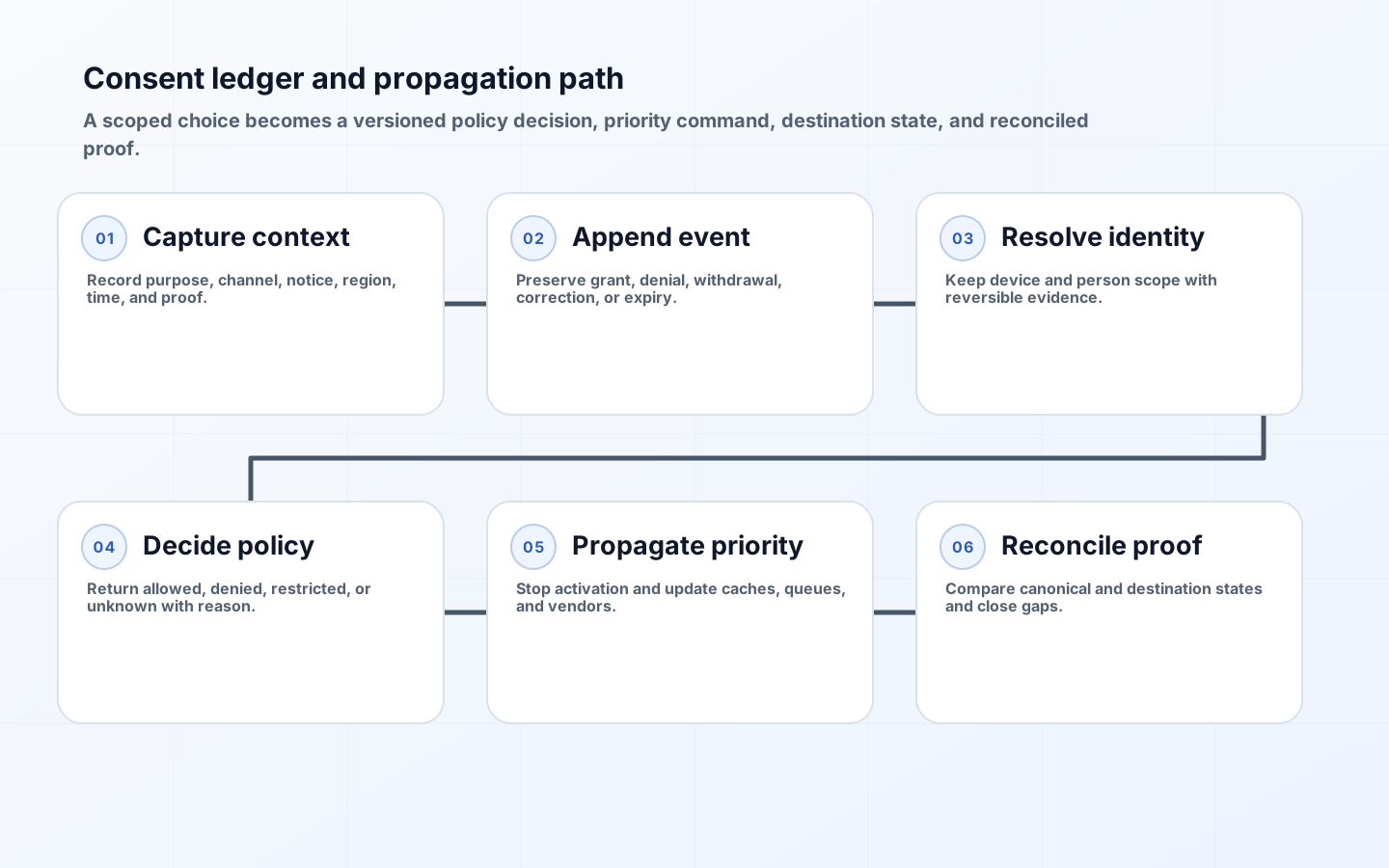
Consent orchestration architecture connects a person's choice to actual behavior across websites, mobile apps, customer relationship management, messaging, analytics, and advertising platforms. A banner or preference center is only a capture interface. The system succeeds when a valid choice is represented with enough context, resolved consistently, enforced before use, propagated quickly, and proven later.
This is an engineering and governance problem, not a single consent management platform feature. Different channels have different identifiers, offline delays, platform permissions, purposes, and legal rules. Build a canonical consent ledger and policy decision service, but preserve source-specific evidence and avoid pretending that every privacy signal means the same thing. Legal counsel and privacy owners must define policy; architecture makes that policy executable.
Model purposes and channels explicitly
Define a controlled purpose taxonomy such as service communication, product analytics, personalization, email marketing, SMS marketing, and advertising measurement. Separate purpose from vendor and channel. A person may permit email offers but deny personalized advertising, while necessary account notices may rely on a different basis. Avoid an accept-all boolean that cannot express those distinctions or explain what changed when vendors are replaced.
For each purpose, document covered processing, data categories, destinations, regions, applicable basis, default behavior, expiry, and withdrawal effect. The European Commission explains that consent must be freely given, informed, specific, clear, and withdrawable. Do not infer consent for one purpose from another. Record when the applicable rule is not consent so downstream systems do not mislabel every permission as a user grant.
Create an append-only consent and preference ledger
| Ledger field | Why it matters | Example | Validation |
|---|---|---|---|
| subject_ref | Identifies the scoped person or device | account:123 or device:abc | Namespace and issuer required |
| purpose | Limits the authorized use | email_marketing | Registered purpose version |
| state | Captures grant, denial, or withdrawal | withdrawn | Allowed transition |
| effective_at | Orders policy over time | UTC timestamp | Not replaced by ingestion time |
| source | Preserves collection context | web preference center | Authenticated channel |
| notice_version | Links the information presented | privacy-notice-7 | Immutable reference |
| region_context | Supports applicable policy | EEA | Policy-derived, not guessed silently |
| proof_ref | Locates evidence without overexposure | receipt digest | Tamper-evident and access controlled |
Append events for grant, deny, withdraw, expire, correct, and administrator action; do not overwrite a current boolean without history. Derive current state as a projection using effective time and policy version. Keep the minimum evidence needed to demonstrate the choice while restricting access to sensitive records. Hashing an identifier does not remove linkage risk, so treat consent records as protected personal data where applicable.
Resolve identity without broadening consent
A browser choice may be scoped to a cookie or device before login. An app has installation and account identifiers. CRM may have several contacts for one person. Link these subjects only with defined evidence and preserve the original scope. Logging in can allow a preference to be offered across devices, but it should not silently turn an anonymous device grant into a global person-level grant unless policy and user communication support that behavior.
Define merge and conflict rules. A restrictive state may take precedence for a given purpose, while a newer verified person-level instruction may supersede an older device state after clear synchronization. Shared devices and household contacts require caution. Record the rule and evidence used for every derived state, and support unlinking when an identity merge is wrong. Rights and revocation workflows should not depend on an irreversible profile join.
Make precedence a versioned policy decision
The decision service should accept subject evidence, purpose, channel, destination, region, event time, and requested operation. It resolves applicable records and returns allow, deny, restrict, or unknown with reason, policy version, and evidence references. Unknown must have explicit fail behavior. Collection may default to no optional processing, while a service communication may proceed under another documented rule. Do not let each destination invent its own precedence.
| Conflict | Example policy | Reason | Required evidence |
|---|---|---|---|
| Grant then withdrawal | Withdrawal governs from effective time | Choice must be reversible | Both ledger events |
| Device grant, account deny | Deny for linked account scope | Avoid broader permissive inference | Verified link and policy |
| CRM opt-out, ad grant | Evaluate separate purposes | Channel and purpose differ | Purpose mapping |
| Platform permission denied | Do not perform platform tracking | Operating-system control is independent | Current platform status |
| Missing region | Apply conservative default or stop | Policy cannot be selected confidently | Resolution error record |
Normalize capture without erasing channel semantics
Web implementations should set defaults before optional tags and update state on the page where the choice occurs. Google Consent Mode distinguishes consent types and basic versus advanced behavior; it communicates state to Google products but does not provide a banner or determine legal validity. Mobile apps must also respect operating-system permissions. Apple's App Tracking Transparency, for example, exposes a separate authorization status for cross-app and website tracking.
CRM and contact-center capture needs authenticated agents, script or notice version, channel, timestamp, and reason. Imports from events or partners require provenance and a contract that defines what the signal means. Never convert an absence of opt-out into affirmative consent. Normalize to the canonical model while retaining the source payload, version, and mapping so a disputed or updated integration can be re-evaluated.
Propagate changes as accountable commands
Publish a consent-state change with stable event ID, subject references, purpose, old and new state, effective time, policy version, and source. Consumers apply it idempotently and acknowledge the resulting state. For online collection and activation, use synchronous policy checks where stale permission is unacceptable; use events to update caches and systems of record. For offline destinations, define maximum propagation latency and a suppression layer that acts before the next send.
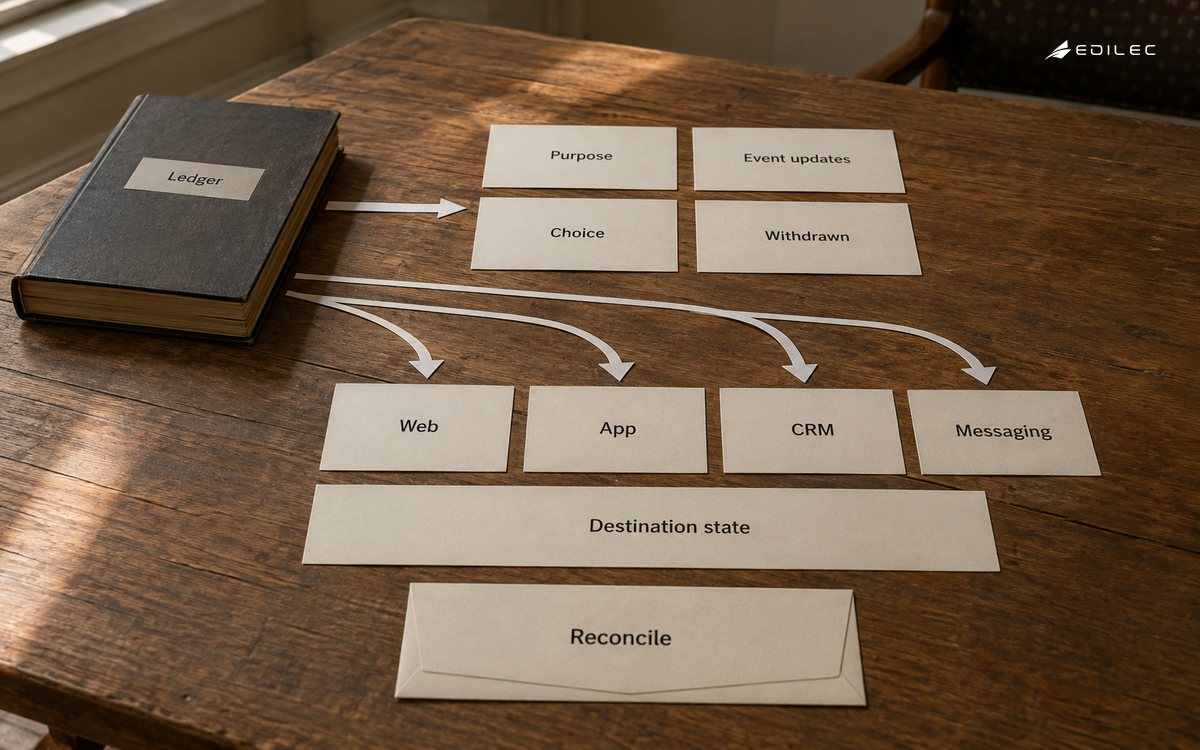
Revocation has priority over routine audience updates. Stop new activation, remove queued sends where possible, update destination suppression, and initiate deletion or restriction obligations according to policy. The European Commission states that withdrawing consent should be as easy as giving it and that processing based on that consent can no longer continue after withdrawal, subject to another valid basis. Preserve proof of withdrawal without using the underlying data for the withdrawn purpose.
Map industry privacy signals carefully
IAB Tech Lab's Global Privacy Protocol transports consent and consumer-choice strings across the digital advertising chain and supports multiple jurisdictional sections. Treat it as a transport and encoding standard, not a legal determination. Version the decoder and mapping from each section to internal purposes. Preserve the original string and section IDs, but do not expose them broadly or assume one string governs CRM, product analytics, and every first-party use.
Ad destinations often have product-specific flags, user-data controls, deletion APIs, and audience semantics. Maintain a destination mapping contract with owner, supported purposes, required signals, default behavior, and verification method. Test denied, withdrawn, unknown, and region-change cases. A successful API response proves receipt, not necessarily that all downstream copies were changed, so retain acknowledgements and reconcile vendor status where interfaces allow.
Reconcile current state across systems
Periodically compare a sampled or privacy-preserving set of canonical states with web caches, app backends, CRM fields, messaging suppressions, CDP profiles, and ad destinations. Track missing acknowledgements, stale state, unsupported purposes, mapping errors, and records updated out of band. Prioritize discrepancies that could enable prohibited processing. A green event pipeline is insufficient if a destination stores a contradictory boolean.
Audit capture, policy decisions, administrative changes, propagation, and destination acknowledgements. Restrict manual overrides and require reason, authority, expiry, and review. Measure time from withdrawal to enforcement, percentage of decisions with complete provenance, conflict rate, stale cache rate, reconciliation failures, and deletion completion. Avoid using consent acceptance rate as the engineering success metric; the objective is faithful execution of valid choices.
Deliver one purpose across all channels
Choose one consequential purpose such as email marketing. Define taxonomy and policy, create the ledger, integrate web and CRM capture, implement decision and propagation, connect the messaging platform, and test grant, denial, withdrawal, identity merge, offline delay, and destination outage. Reconcile end to end. Then extend to another channel or purpose using the same contracts rather than importing every historical preference before enforcement works.
Include privacy, legal, security, CRM, marketing, mobile, web, data, and platform owners. Run tabletop exercises for lost events, incorrect identity links, revoked consent that still activates, region-policy changes, compromised administrator credentials, and vendor API failure. Define who can halt collection or activation. A consent incident is both a technical failure and a rights-impact event, so response must include investigation, remediation, evidence preservation, and appropriate notification decisions.
Key takeaways
- Model purpose, channel, state, source, notice, region, effective time, and proof rather than one consent boolean.
- Preserve identity scope and make merge, conflict, and precedence decisions explainable and reversible.
- Use synchronous checks for sensitive operations and idempotent events with acknowledgements for propagation.
- Treat industry and platform signals as inputs with explicit mappings, not universal legal truth.
- Measure withdrawal-to-enforcement time and reconcile destination state, not just message delivery.
Frequently asked questions
Should the latest timestamp always win? No. Scope, purpose, identity confidence, source authority, effective time, and platform restrictions matter. Resolve through a versioned policy and record the reason.
Can a CMP be the consent system of record? It may own web capture, but cross-channel orchestration usually needs a canonical ledger and integrations with CRM, apps, policy, messaging, and destinations. Preserve the CMP's source evidence.
How fast must revocation propagate? Policy and context determine the requirement, but optional online processing should stop promptly. Define and monitor an explicit latency objective for every downstream system, including queued and cached uses.
Conclusion
Consent becomes trustworthy when a person's scoped choice survives every technical handoff. A canonical ledger, explainable policy, careful identity treatment, priority revocation, destination contracts, and reconciliation provide that continuity. The architecture should make restrictive outcomes dependable and exceptions visible while allowing each channel to retain the context that gives its signal meaning.