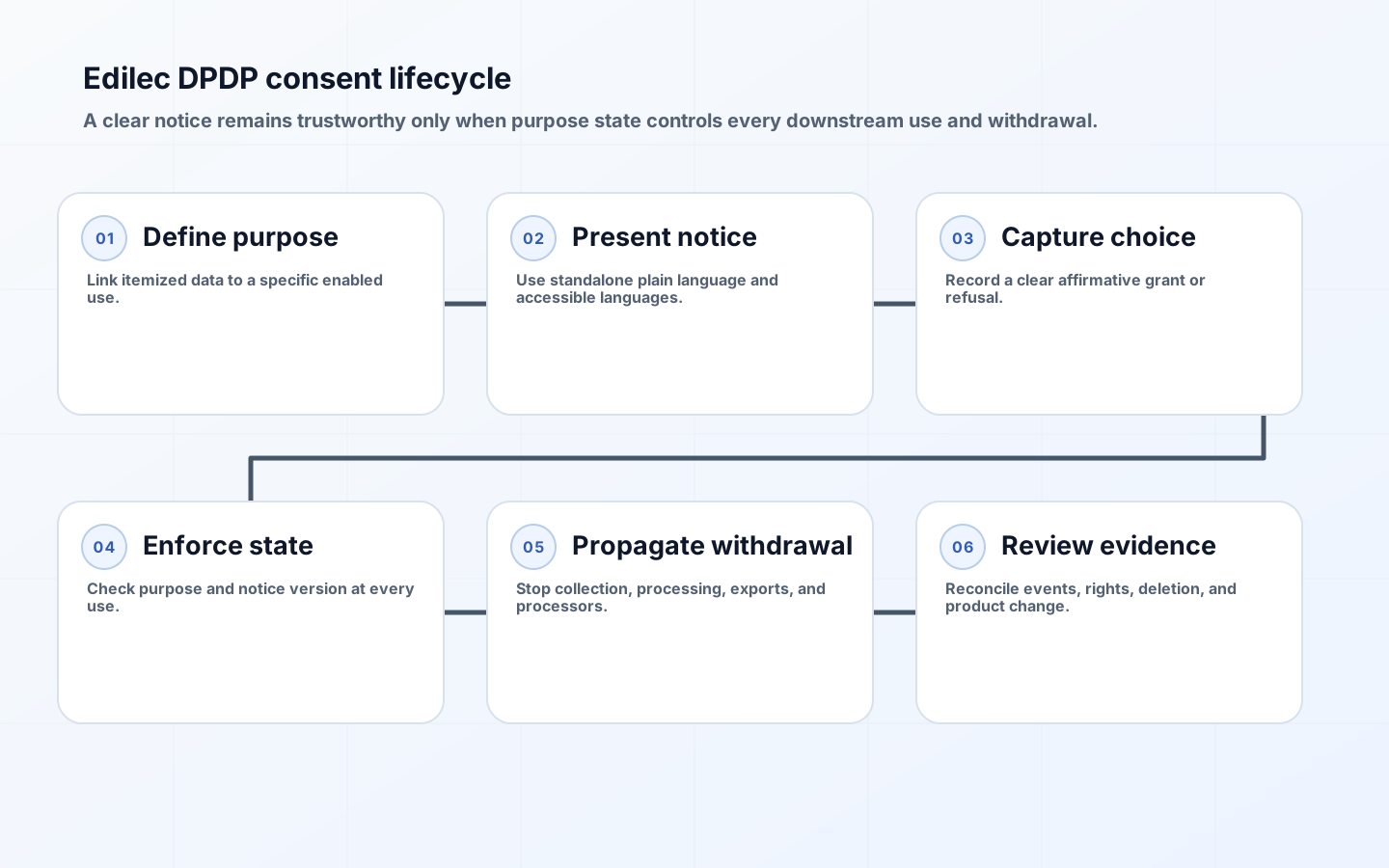
DPDP consent notice requirements are a product architecture issue, not a footer-writing exercise. The notice must correspond to a specified purpose and itemized personal data, consent must be free, specific, informed, unconditional, unambiguous, and expressed through clear affirmative action, and withdrawal must lead to cessation unless another lawful basis applies. Meeting those conditions requires a purpose catalog, data-flow controls, versioned user experience, evidence, processor instructions, rights channels, and deletion behavior that work together.
Timing matters. The final Digital Personal Data Protection Rules, 2025 were notified on 13 November 2025. Rule 3 on notice and most operational rules enter force eighteen months after publication; the associated core Act provisions follow the same phase under the official enforcement notification. As of 13 July 2026, teams should build and test toward that date, while confirming any later notification or sector obligation before launch.
Start with purposes and data, not screens
Create a processing register linking each product purpose to itemized personal data, collection point, recipient, processor, retention rule, user population, geographic flow, and lawful ground. Separate what is necessary to deliver a requested service from optional analytics, personalization, advertising, research, or partner use. A broad purpose such as improving services cannot guide an informed choice or reliable withdrawal. Name the concrete good, service, or use enabled. Product, privacy, engineering, security, and operations should approve a purpose identifier that follows events and data downstream.
Design a standalone and understandable notice
Rule 3 requires the notice to be understandable independently of other information, in clear and plain language, with an itemized description of personal data and specified purposes and enabled goods, services, or uses. It must provide a particular communication link and describe means to withdraw consent, exercise rights, and complain to the Board. The DPDP Act on India Code also requires access to notice content in English or a language in the Eighth Schedule. Layered presentation can improve comprehension, but the first layer must communicate the decision rather than hide scope behind links.
| Element | Product question | Evidence | Failure pattern |
|---|---|---|---|
| Purpose | Can a user tell what each use enables? | Purpose-specific copy | Improve your experience |
| Data | Are categories itemized at the decision point? | Data-to-purpose mapping | Information we collect |
| Choice | Is optional processing genuinely optional? | Service works after refusal | Bundled take-it-or-leave-it consent |
| Language | Can users access chosen supported language? | Translation QA and switch | English-only linked policy |
| Rights | Is a working route described? | Test request and receipt | Generic contact page |
| Complaint | Is Board complaint information reachable? | Versioned destination | Missing or stale instructions |
Build a consent state machine
Represent consent by data principal, purpose, notice version, product context, timestamp, channel, language, action, and status. States may include not requested, presented, granted, refused, withdrawn, expired, superseded, and legally restricted. Never infer consent from silence, preselected controls, continued browsing, or acceptance of unrelated terms. The enforcement point should check current state before optional processing, not only at collection. When a purpose materially changes, issue a new version and obtain a fresh decision rather than stretching historical consent.
Make withdrawal as usable as consent
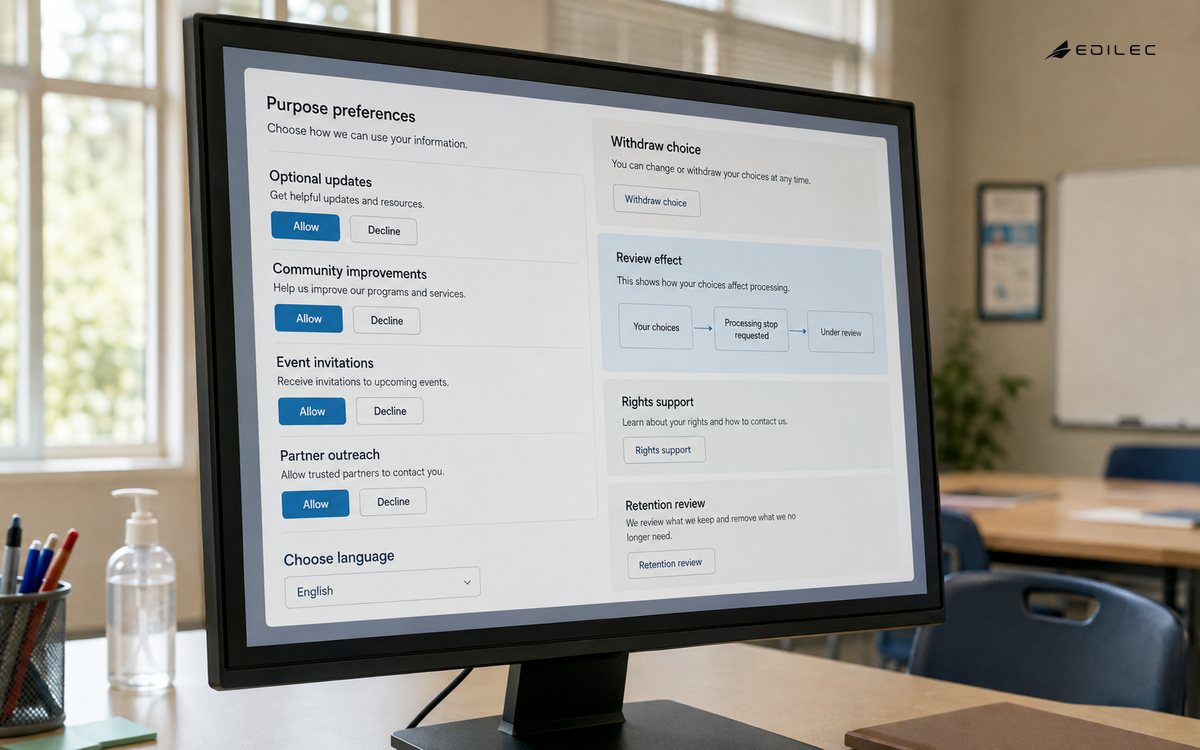
Place withdrawal in the same product context and avoid extra authentication or support steps unless proportionate to account security. On withdrawal, stop future collection and processing for that purpose, notify processors, revoke derived audiences or tokens, and erase data when required, while recording any lawful retention exception. The interface should explain immediate effects and any service feature that can no longer operate. A visual toggle is incomplete if batch jobs, models, exports, and partners continue because they cannot consume the purpose state.
| Event | System action | Downstream duty | Audit record |
|---|---|---|---|
| Grant | Activate only named purpose | Send scoped purpose state | Notice version and affirmative action |
| Refuse | Keep optional processing off | Suppress collection and export | Decision without penalty |
| Change purpose | Pause new use and request again | Do not repurpose existing data | New mapping and approval |
| Withdraw | Stop processing promptly | Processor cessation and erasure | Propagation receipts |
| Rights request | Authenticate proportionately and route | Search connected systems | Request, response, exceptions |
| Account closure | Apply purpose and legal retention rules | Delete or isolate copies | Completion and residual holdings |
Handle children and consent managers explicitly
Products likely to process children's data need an age and verifiable parental-consent design appropriate to the final rules and applicable exemptions. Avoid collecting more identity evidence than the verification requires. If integrating a registered Consent Manager, define interoperable purpose identifiers, authorization, revocation, security, receipts, error handling, and reconciliation; the Data Fiduciary still needs accurate local enforcement. Rule 4's Consent Manager provisions have a separate one-year commencement phase. Do not label an ordinary preferences dashboard a statutory Consent Manager unless registration and obligations are actually met.
Test the complete user and data journey
Test new, existing, logged-out, multi-device, assisted, child, accessibility, and low-connectivity journeys in supported languages. Verify refusal, withdrawal, stale offline clients, processor outage, duplicate events, account merge, purpose change, and deletion. Review dark-pattern risk and whether a user can understand consequences without legal help. The MeitY DPDP Rules collection includes the final Rules and corrigendum; keep legal-source monitoring attached to the product control so copy and workflow can be updated before commencement.
Prepare the consent release for commencement
Baseline Indian user journeys, purposes, fields, SDK events, processors, exports, derived profiles, retention, and interfaces that can change consent. Remove bundled purposes the product cannot explain or enforce independently. Test whether users can identify data, enabled use, refusal consequence, rights, withdrawal, and complaint paths. Translate approved meaning with qualified review, in-context screenshots, dynamic-content tests, accessibility checks, and a controlled glossary. Instrument affirmative action without excessive device collection and preserve notice version, language, context, purpose, time, state, and integrity evidence.
Treat refusal as a first-class state: optional SDK collection, cookies, messaging, profiling, exports, and partner events must remain off. Exercise withdrawal from every device and assisted channel, then reconcile processor receipts, queues, models, caches, analytics, backups, and lawful retention exceptions. Where applicable, send historical-consent notices through effective channels and monitor delivery, support, withdrawal, and unmatched identities. Validate rights and grievance routes using real case handling and proportionate identity checks. Gate release with product, engineering, privacy, security, localization, accessibility, support, and supplier approval. After launch, monitor unexplained processing events, failed propagation, stale notice versions, language defects, support overrides, refusal parity, and legal updates.
- Review service denial after refusal. If a core service genuinely requires the data for a lawful purpose, explain that basis accurately instead of presenting an artificial optional consent.
- Keep terms acceptance, account creation, marketing, analytics, personalization, and sensitive product features visually and technically distinct so one affirmative action is not overloaded.
- Design for shared phones, changed numbers, inaccessible email, account takeover, and account merge without allowing one person to alter another Data Principal's choices.
- When processors cannot enforce purpose-level state, redesign the integration, stop sending optional data, or establish a controlled deletion and suppression process before relying on the flow.
- Treat derived profiles and audiences as processing outputs tied to purpose; withdrawal cannot be effective if only raw collection stops while existing targeting continues.
- Measure consent defects by affected purpose and processing volume, not click-through rate. High acceptance can indicate coercion or confusing defaults rather than informed choice.
- Keep legal-retention exceptions isolated from active product use, access-restricted, time-bounded, and visible in the withdrawal completion record.
Create a governance record for every material purpose change. It should identify the business proposal, old and new data, enabled use, necessity, affected population, notice impact, consent action, processors, derived data, retention, withdrawal behavior, release version, and approvers. This prevents a feature flag or analytics configuration from expanding processing outside the user's decision. Emergency product changes should follow a shortened but attributable path and receive retrospective review. Periodically reconcile actual events and warehouse fields with the approved register; interface correctness cannot compensate for undisclosed backend collection.
DPDP notice and consent takeaways
- Use the final Rules and phased commencement dates; do not mistake the 2025 draft for the operative text.
- Create narrow purpose identifiers linked to itemized data and downstream uses.
- Present a standalone plain-language decision with language access, rights, withdrawal, and complaint routes.
- Record affirmative consent by purpose and notice version and enforce state at every use.
- Propagate withdrawal to processors, models, exports, retention, and deletion workflows.
- Test refusal and withdrawal across devices, languages, accessibility needs, children, and degraded dependencies.
DPDP consent notice FAQ
Are the core notice rules already in force on 13 July 2026? No. Under the final notifications, the relevant provisions are in the eighteen-month phase. Organizations should prepare and check for subsequent changes.
Can one consent cover every product use? Only where the choice remains specific and informed. Distinct optional purposes usually need separately understandable controls.
Is a privacy policy enough? Not by itself. The consent request needs the prescribed standalone information and working lifecycle controls; a long general policy may provide additional detail.
Conclusion
A compliant consent experience is a distributed control system with a humane front end. Define purposes, itemize data, make choices real, preserve proof, and ensure withdrawal changes actual processing. Building that chain during the phased preparation period is more reliable than revising copy after data pipelines and supplier contracts are fixed.