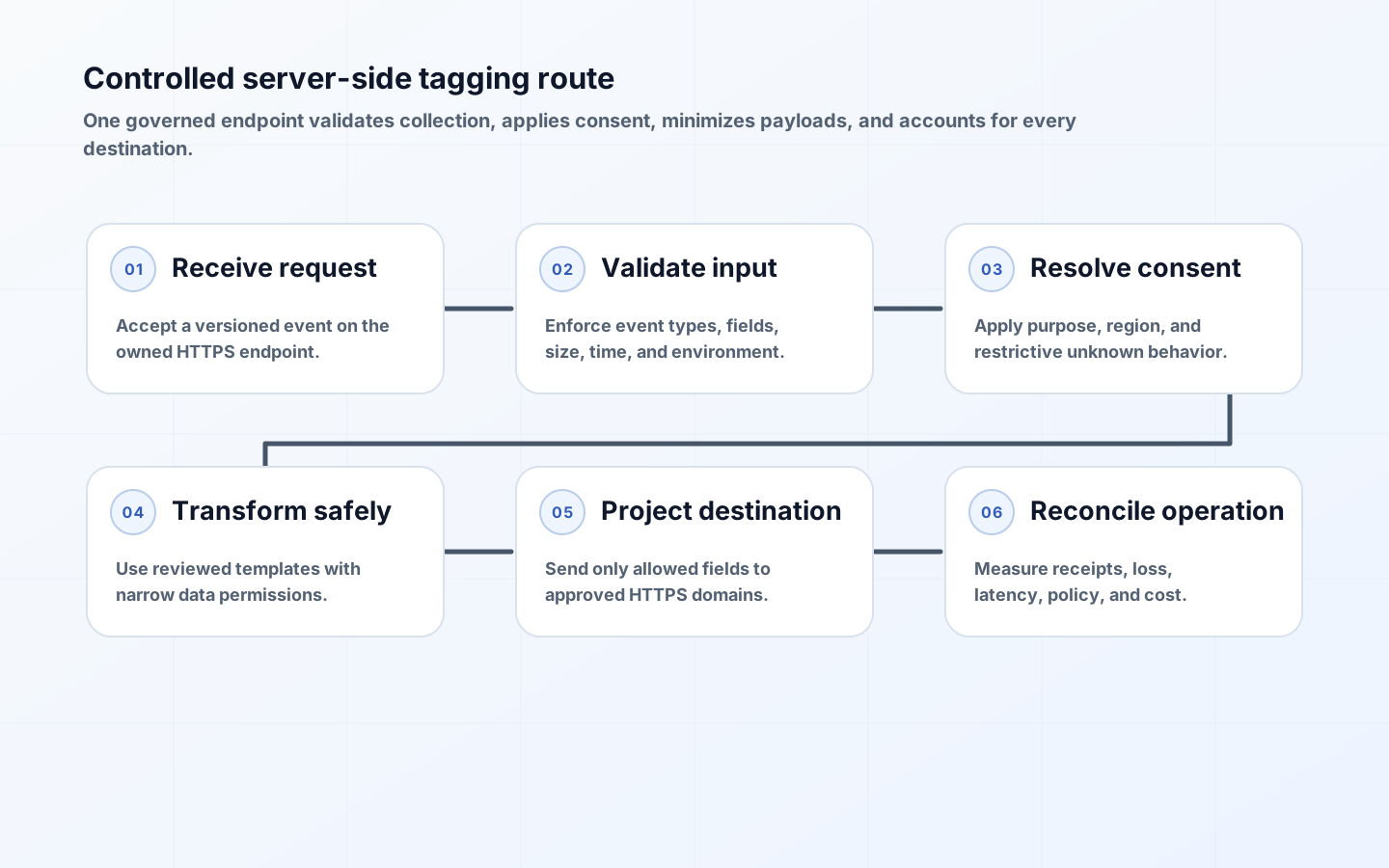
Server-side tagging moves part of measurement processing from a browser or app into a server endpoint operated for the organization. That can reduce client work, centralize outbound requests, and create a place to validate or redact data before forwarding it. It does not make collection first-party in a legal sense, manufacture consent, or prevent a destination from receiving data that the server is configured to send. Control improves only when the new boundary is deliberately governed.
Treat the tagging endpoint as a production data-routing service. It accepts untrusted requests, interprets events, may read or set identifiers, applies policy, calls external vendors, and incurs variable infrastructure cost. The business case must include data quality and control benefits alongside hosting, observability, template review, incident response, regional design, and the engineering work that remains in clients.
Define the architecture boundary
In Google Tag Manager terminology, a client receives an HTTP request and claims or parses it into event data; triggers and variables evaluate the event; tags send data onward. Other platforms use different names, but the boundary is similar. The browser or app still decides what initial request to send and may still run consent and product instrumentation. The server adds a controlled transformation and distribution layer rather than replacing source instrumentation.
Draw every path: source, DNS and load balancer, endpoint, client/parser, policy, template, destination, log, and dead-letter or failure route. Mark where raw IP addresses, URLs, cookies, user agents, customer identifiers, and consent signals are visible. A custom domain can improve cookie handling and operational control, but it also makes the organization responsible for certificates, DNS, availability, and clear disclosure of what the endpoint does.
Create an inbound and outbound data contract
Allow only named event types and fields. Validate types, length, enumerations, identifier namespaces, timestamps, and environment. Reject or quarantine unexpected payloads rather than forwarding an open-ended object. Normalize once, then define a destination projection that selects only required attributes. Avoid collecting full page URLs when query strings can contain personal data; extract approved route templates or explicitly allow parameters.
| Boundary | Required decision | Evidence | Unsafe default |
|---|---|---|---|
| Source to endpoint | Which events and fields are accepted? | Versioned schema and tests | Accept arbitrary payloads |
| Endpoint processing | What may be enriched or rewritten? | Reviewed transformation version | Add identity from any cookie |
| Consent evaluation | May this purpose proceed now? | State, region, source, effective time | Treat missing as granted |
| Destination projection | What minimum data may leave? | Field allowlist and contract | Forward the complete event |
| Logging | What is needed for operation? | Redacted structured fields | Log request bodies and identifiers |
Enforce consent at both source and server
Consent should be set before relevant collection in the browser or app and transmitted with each request or resolved from a trusted state. Google's server-side consent documentation explains that the web container sends consent parameters to the server container and consent-aware tags adjust behavior. Custom and third-party tags need explicit checks. A server cannot retroactively make an unnecessary client request compliant, and advanced product modes may still send limited requests under denied states.

Define behavior for granted, denied, unknown, stale, conflicting, and revoked states by purpose and region. The restrictive behavior should be explicit, not an accidental no-trigger result. Test that denied events do not set disallowed cookies, enrich identity, enter prohibited logs, or reach vendors. Revocation should change future routing promptly and invoke destination deletion or suppression where policy requires it.
Review templates as privileged integration code
A server template can read request and event data, set cookies, log, access storage, or send HTTPS requests. Google Tag Manager exposes permission-scoped APIs for these capabilities. Review the exact domains, paths, cookie names, event fields, credentials, and cloud resources a template can use. Prefer built-in or internally maintained templates with pinned versions and tests. Community availability is not a security approval.
Separate template authors, container publishers, infrastructure administrators, and policy owners where risk warrants it. Export configurations to version control, review diffs, and promote immutable versions across environments. Test malformed requests, redirect attempts, header injection, excessive payloads, vendor timeouts, and template exceptions. Rotate secrets through workload identity or a secret manager; never embed destination credentials in browser code or casually in template fields.
Engineer reliability and capacity
Set availability and latency objectives based on the event classes. Analytics loss may be tolerable within a budget; consent, security, or transaction telemetry may demand stronger guarantees. Decide whether clients retry, buffer, or drop when the endpoint fails, and make event IDs idempotent. Prevent measurement failure from blocking the product journey. Google's manual deployment guide exposes a health endpoint and recommends liveness checks; production operation also needs dependency and destination health.
Load-test realistic request rates, payloads, template combinations, and slow vendors. Configure minimum and maximum instances, request concurrency, timeouts, memory, regions, and rate limits. Google notes that the automatically provisioned default is for limited testing traffic and recommends additional production capacity for redundancy. Isolate preview from production and restrict preview access because it can reveal event data.
Model cost per accepted and forwarded event
| Cost driver | How it scales | Design lever | Watch metric |
|---|---|---|---|
| Compute | Requests, execution time, concurrency | Efficient templates and right sizing | CPU and request duration |
| Minimum capacity | Always-on instances and regions | Availability tier by event class | Idle versus peak utilization |
| Network egress | Payloads and destination regions | Minimize fields and co-locate where appropriate | Bytes per destination |
| Logs and traces | Event volume and field size | Sampling and redaction | Ingested observability bytes |
| Engineering | Templates, consent, testing, incidents | Reusable contracts and ownership | Change and support effort |
| Vendor fees | Events, endpoints, or profiles | Deduplicate and suppress unused routes | Billable versus useful events |
Calculate cost by environment, region, event class, and destination under normal and peak traffic. Include DNS, certificates, load balancing, compute, egress, logs, monitoring, security review, and support. Compare the result with client-side performance gains, reduced vendor requests, better data minimization, and improved collection quality. Server-side tagging is not automatically cheaper; forwarding the same oversized event to many vendors can increase both cloud and vendor bills.
Operate the endpoint as a data service
Measure requests accepted and rejected by schema, consent decision, parser ownership, tag execution, destination status, latency, retries, dropped events, cookie operations, payload size, and cost. Use synthetic requests for each consent state and destination. Reconcile source events, accepted events, and vendor receipts without logging raw identifiers. Alert on policy bypass, unexpected destination domains, schema spikes, and regional divergence, not simply HTTP availability.
Give marketing, privacy, analytics, platform, and security teams clear roles. Marketing owns measurement purpose; product teams own source semantics; privacy defines policy; engineering owns service reliability; security reviews templates and access; analytics validates outputs. Publish an incident runbook for endpoint outage, incorrect routing, data leakage, vendor failure, and consent defect. Be able to disable one destination or template without taking down all measurement.
Migrate one data flow at a time
Baseline client performance, event volume, consent behavior, vendor counts, and data quality. Stand up a nonproduction endpoint with a custom domain and production-like policy. Shadow one event without double-counting, compare fields and consent decisions, then canary traffic. Move one destination, reconcile results, and remove the superseded client tag only after rollback is tested. Dual sending is a temporary validation state, not a permanent architecture.
Set exit criteria before expansion: acceptable latency, bounded event loss, verified denied-state behavior, stable costs, tested incident controls, and destination reconciliation. Some tags should remain client-side because they affect the interface, require direct browser APIs, or gain little from server routing. The objective is a smaller, governed client surface and a purposeful server boundary, not moving every tag for architectural symmetry.
Document decommissioning as carefully as migration. Remove obsolete client code, DNS routes, templates, credentials, vendor permissions, logs, and cloud capacity only after late traffic and rollback windows close. Verify that privacy requests and historical investigations can still resolve the relevant configuration version. An abandoned endpoint or forgotten selector can preserve both cost and exposure long after the campaign that justified it has ended.
Key takeaways
- Server-side tagging adds a controlled processing boundary; it does not replace source instrumentation or consent collection.
- Validate inbound events and send destination-specific minimum projections instead of forwarding arbitrary payloads.
- Review templates, permissions, domains, cookies, and credentials as production integration code.
- Engineer availability, retries, idempotency, health, regional behavior, and destination isolation by event class.
- Compare full operating cost with measurable performance, quality, minimization, and governance benefits.
Frequently asked questions
Does server-side tagging bypass blockers or privacy choices? It should not be designed to bypass user controls. It creates an organization-operated endpoint, but collection and forwarding still require valid policy, disclosure, consent handling, and destination controls.
Must the endpoint run on Google Cloud? Google Tag Manager supports automated Cloud Run provisioning and manual container deployment elsewhere. Evaluate operational support, regional requirements, identity, scaling, and total cost for the chosen environment.
Will it always improve page speed? Removing multiple client libraries can help, but the source still sends at least one request and may run a client tag. Measure actual script, main-thread, network, and user-experience changes before claiming benefit.
Conclusion
Server-side tagging is most valuable as a governed collection and distribution service. A precise data contract, enforceable consent states, constrained templates, reliable infrastructure, and transparent cost model turn the endpoint into a real control. Without them, it merely relocates tags while adding another production system to operate.