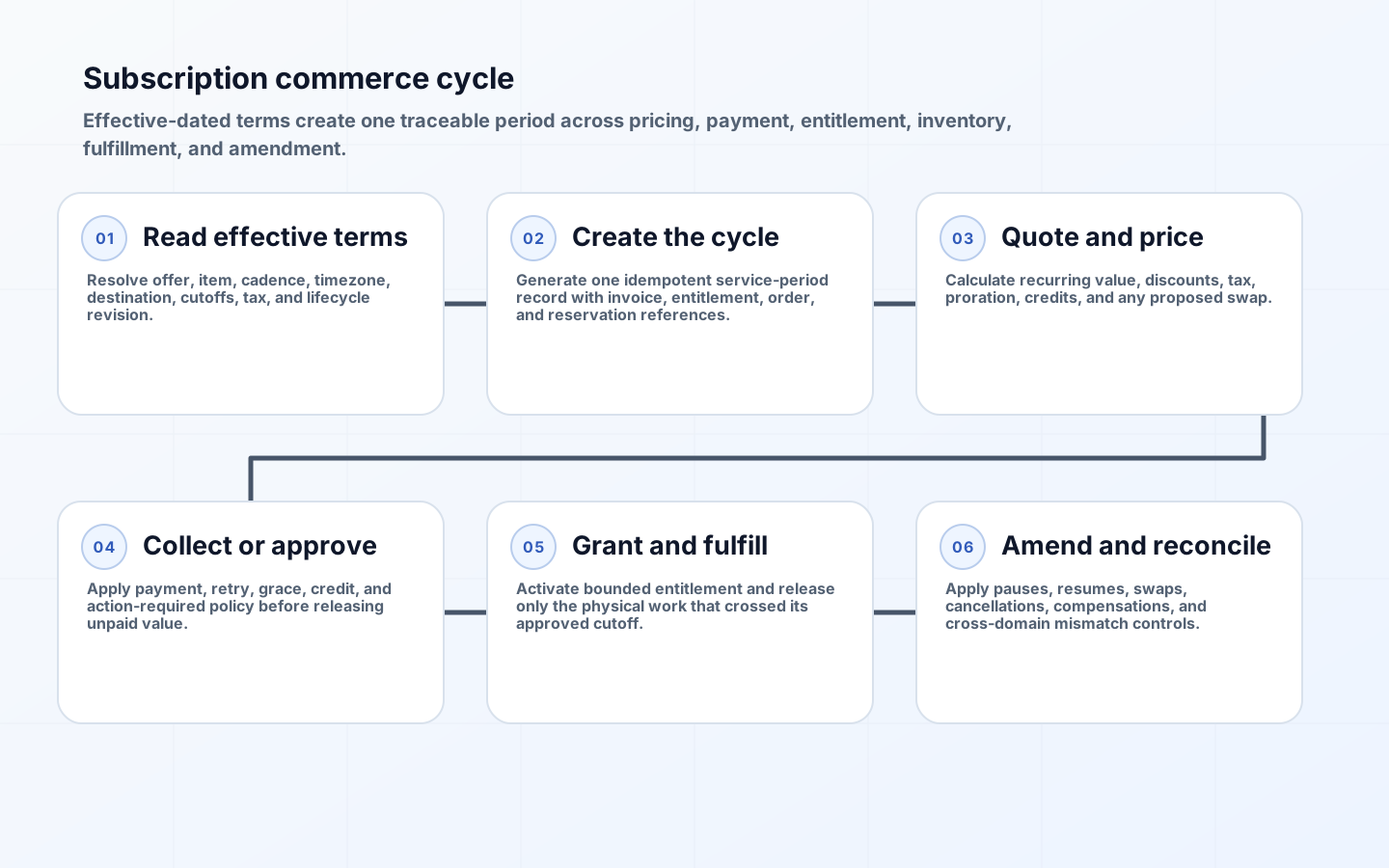
Subscription commerce architecture coordinates a continuing agreement whose billing, access, inventory, and fulfillment clocks do not always align. A customer may pause future shipments but retain paid digital access, swap a product after stock was reserved, change quantity during a billing period, or fail payment after a warehouse wave was released. Treating the billing provider's subscription status as the complete business state creates accidental shipments, lost entitlements, and irreconcilable credits.
Build around effective-dated commercial terms and domain-specific projections. Billing owns invoices and payment collection; the subscription service owns customer intent and schedule; entitlement owns usable rights; order management owns each fulfillment order; inventory owns reservations. Events connect them through idempotent transitions. The customer sees one coherent timeline even though the system preserves these separate truths.
Define the subscription contract, clocks, and domain authorities
Record account, offer and price version, items, quantities, cadence, anchor date, timezone, service period, shipment lead time, destination, tax context, payment terms, pause and cancellation policy, minimum commitment, entitlement mapping, and next decision deadlines. Keep a history of effective-dated amendments. A product catalog change must not silently alter an existing agreement unless the contract allows it and the customer receives required notice.
Distinguish billing period, entitlement period, order-generation date, inventory-reservation date, fulfillment cutoff, and expected delivery. For a monthly box delivered on the first, payment and order creation may occur several days earlier. A pause requested after carrier handoff cannot undo that parcel; it should apply from a named future cycle. Define all cutoffs in the customer's timezone but store instants with zone and calendar context to survive daylight-saving changes.
| Concern | Owner | Representative states | Downstream rule |
|---|---|---|---|
| Commercial agreement | Subscription service | Scheduled, active, pause-pending, paused, cancel-pending, ended | Effective revision drives future cycles |
| Invoice and collection | Billing platform and finance ledger | Draft, open, paid, failed, void, uncollectible | Paid or approved credit policy releases value |
| Entitlement | Entitlement service | Future, active, grace, suspended, expired | Never infer solely from invoice text |
| Physical cycle | Order management | Planned, reserved, released, shipped, cancelled | Cutoff determines reversibility |
| Inventory | Inventory service | Available, held, allocated, deducted, released | Reservation identity binds cycle and item |
Generate idempotent cycles before irreversible cutoffs
Create a cycle record for each service or shipment period with a deterministic key from subscription, period, and revision. It contains item snapshot, price basis, tax context, destination, decision deadlines, invoice reference, entitlement grant, fulfillment order, and reservation. A scheduler can safely retry cycle creation because duplicates converge on that identity. Late events are applied only if their expected state and version still match.

Use a saga rather than a distributed transaction. Draft the cycle, price it, reserve inventory if policy requires, create or finalize the invoice, collect or approve credit, activate entitlement, and release physical fulfillment. Compensations cancel an unfinalized invoice, release a reservation, or revoke a future grant. They should not pretend to reverse a downloaded benefit or shipped parcel; those require credit, return, or service remedies.
Handle product swaps and subscription proration as quoted changes
Treat a swap as a proposed amendment with requested effective cycle. Validate product eligibility, price, tax, inventory, compatibility, minimum term, discounts, and already-generated cycles. Quote old and new recurring amount, immediate charge or credit, next shipment, and loss of benefits before confirmation. Once accepted, store the quote inputs and resulting revision. Do not mutate a released order; create an exchange or apply the swap to the next reversible cycle.
Proration needs an explicit convention: exact seconds, calendar days, full periods, or no proration. Decide treatment for discounts, usage, tax, shipping, credits, and unpaid invoices. Stripe's subscription change documentation identifies billing-related changes such as price or quantity changes and recommends previewing prorations. Stripe's proration guidance also notes that prorations are invoice items rather than automatic refunds; your customer and ledger design must account for that distinction.
| Customer action | Default effective point | Financial effect | Physical or entitlement effect |
|---|---|---|---|
| Pause | Next cycle before cutoff | No new cycle invoice; existing balance remains | Stop future grants and orders, preserve already paid rights |
| Resume | Named future cycle | Resume recurring invoice | Re-check inventory, address, payment, and eligibility |
| Upgrade | Immediate or next cycle by offer | Prorated debit or full-period price | Grant incremental rights only after payment policy |
| Downgrade | Usually next cycle | Credit or lower future amount | Avoid removing consumed or committed value retroactively |
| Product swap | Next reversible shipment | Quoted difference and tax | Reserve replacement; leave released parcel unchanged |
| Cancel | End of period or immediate by policy | Final invoice, credit, or fee | Expire future rights and cancel only reversible orders |
Design pause semantics instead of overloading payment collection
A pause can mean stop invoicing, stop collecting an already-issued invoice, stop service accrual, stop entitlement, stop physical order generation, or some combination. Name the product promise. Stripe distinguishes pausing payment collection from changing a subscription's broader business lifecycle in its pause payment collection documentation. Your service must project the chosen pause into billing, entitlement, and fulfillment rather than assuming one provider field handles all three.
Set maximum pause, earliest start, restart behavior, inventory revalidation, price protection, minimum commitment, and customer notification. A resume should run preflight checks for discontinued items, changed delivery coverage, expired payment methods, tax changes, and capacity. If the original item is unavailable, present alternatives instead of silently substituting. Record who initiated the pause and whether it was voluntary, support-assisted, risk-driven, or due to payment failure.
Recover failed payments without shipping unpaid value
Classify payment failure as temporary, action-required, hard decline, mandate issue, or operational error. Enter a grace or payment-past-due state under policy, schedule retries where appropriate, request a new method, and communicate the exact consequence date. Stripe's revenue recovery guidance includes retries and customer notifications, but fulfillment and entitlement actions remain product decisions.
Place physical cycles on hold before warehouse release, not after. Digital services can offer a bounded grace period where marginal cost and abuse risk permit. If a payment later succeeds, resume from the same cycle idempotently. If recovery ends, void or mark the invoice under accounting policy, release inventory, expire pending entitlement, and preserve debt where applicable. Avoid repeatedly creating new subscriptions to work around failed states; that fragments history and can duplicate benefits.
Reconcile lifecycle events and measure customer outcomes
Consume provider webhooks into an inbox with event identity, raw payload retention under policy, signature verification, deduplication, and ordered domain application. Poll or reconcile for missed events. Compare subscription cycles, invoices, payments, entitlements, reservations, orders, shipments, credits, and ledger postings. Every orphan should enter a queue: paid invoice without grant, shipment without paid or approved cycle, active entitlement after end, reservation without live cycle, or provider status that disagrees with the internal projection.
Measure activation success, first-value time, cycle-generation failures, involuntary and voluntary churn, recovery rate by failure class, unwanted shipment contacts, pause and resume success, swap completion, proration disputes, entitlement mismatches, inventory write-offs, and reconciliation age. Segment by offer, cadence, payment method, product class, and lifecycle revision. Optimize for retained customer value and correct fulfillment, not retry count alone.
Test lifecycle changes at every cutoff boundary
Use a model-based test matrix around one minute before, exactly at, and one minute after invoice finalization, payment attempt, reservation expiry, warehouse release, service-period start, and cancellation deadline. Combine a swap with a failed payment, a pause with an already generated order, and a resume with a discontinued product. Assert the effective revision, invoice lines, entitlement interval, reservation, fulfillment action, communication, and compensating entry. Timezone and daylight-saving transitions deserve explicit fixtures.
In a production rehearsal, replay duplicate and out-of-order provider events and suspend one downstream domain. The inbox should retain events, processors should retry without duplicate grants or orders, and reconciliation should reveal the lag. Verify customer support can explain the current state from the timeline. A technically consistent database is insufficient if the customer receives a renewal notice after cancellation or a shipment while the account is visibly paused.
Subscription commerce takeaways
- Represent commercial terms as effective-dated revisions and each period as an idempotent cycle.
- Keep billing, entitlement, inventory, and fulfillment states separate and reconcile their references.
- Define every operational clock and the last reversible point for a customer change.
- Quote swaps and prorations with preserved inputs before applying an amendment.
- Specify whether a pause affects accrual, collection, entitlement, orders, or all of them.
- Hold unpaid physical value before warehouse release and use bounded grace where appropriate.
Subscription commerce FAQ
How is pausing different from cancelling?
A pause preserves an agreement for a bounded interval and defines how it resumes. Cancellation establishes an end and usually prevents future cycles. Both need explicit treatment for open invoices, paid entitlements, already released shipments, and stored customer data.
Must every mid-cycle change be prorated?
No. The contract can use immediate proration, next-cycle changes, full-period upgrades, or no proration. The rule must be disclosed, tax-aware, consistently calculated, and previewed before confirmation. Simplicity can be more valuable than theoretical precision.
Can entitlement rely on billing subscription status?
It should not rely on it alone. Trials, grace periods, credits, manual invoices, refunds, disputes, and delayed webhooks create legitimate differences. Use a dedicated entitlement projection with reason, source cycle, effective interval, and reconciliation.
Conclusion
Recurring commerce becomes manageable when each future period is planned, priced, protected, and fulfilled as a traceable cycle. Effective-dated terms and explicit cutoffs let customers pause or swap without corrupting released work. Separate domain states and daily reconciliation then keep invoices, rights, stock, shipments, and communications aligned through both routine renewals and failed payments.