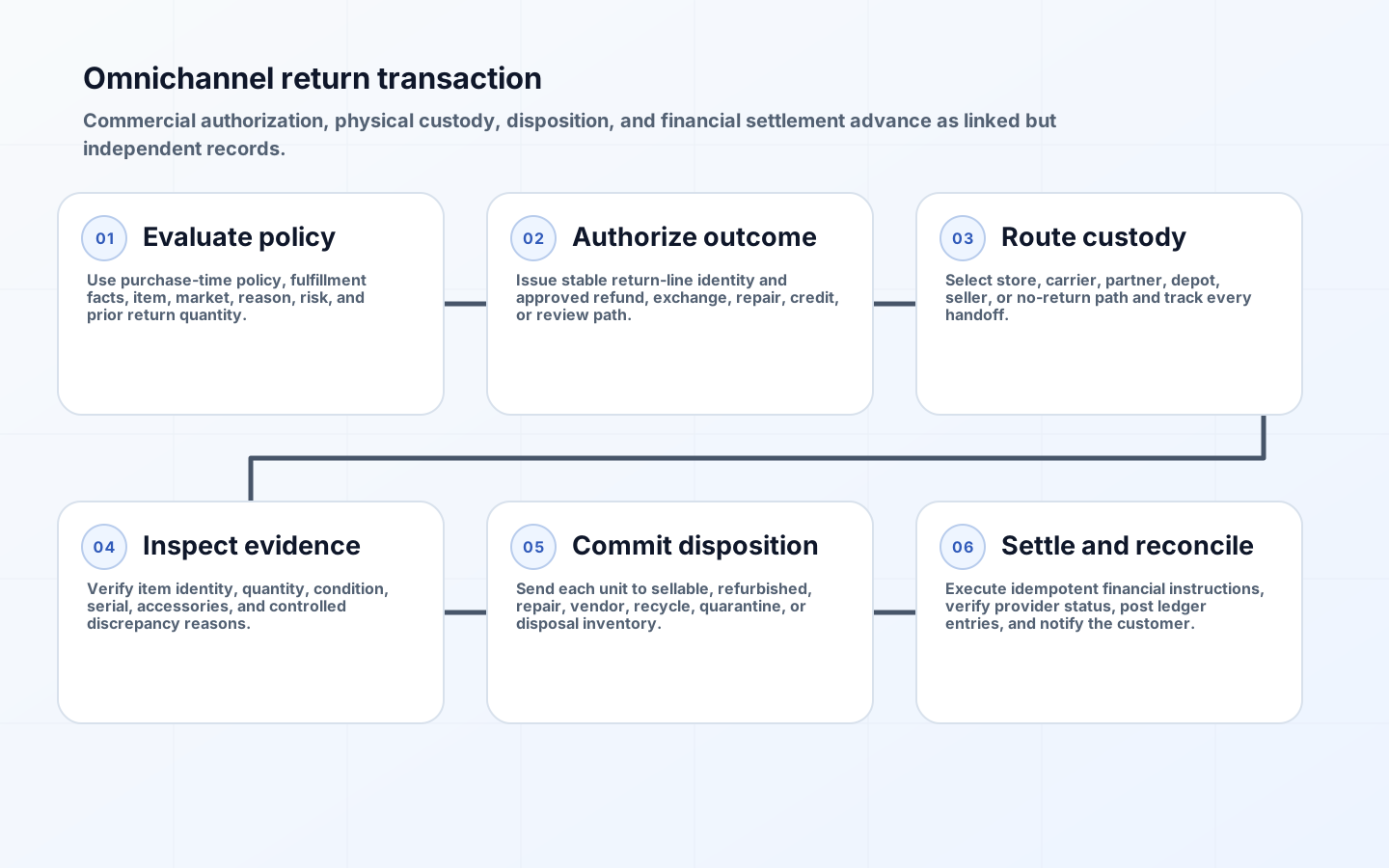
Omnichannel returns management is an end-to-end transaction, not a refund button. A web purchase may be returned to a store, sent to a consolidation center, exchanged from another warehouse, refunded through the original tender, and later rejected during inspection. Each step changes a different truth: customer eligibility, custody, inventory condition, tax, payment liability, revenue, and customer expectation.
A robust architecture gives the return its own identity and lifecycle while retaining immutable references to the original order, fulfillment, payment, and item. It separates authorization from receipt, inspection from disposition, and refund instruction from proven settlement. That separation supports instant refunds for low-risk cases without pretending every item has arrived or every payment processor has completed the transfer.
Model the return as linked commercial, physical, and financial state
Create a return merchandise authorization with customer, original order and fulfillment line, quantity, reason, policy version, eligibility result, expected route, refund method, promised timing, and risk decision. Generate stable identities for each return line and parcel. Never use a carrier tracking number as the return identifier because labels can be replaced, parcels consolidated, and several items received together. Keep original and presentment currency amounts so finance can reconcile cross-border refunds.
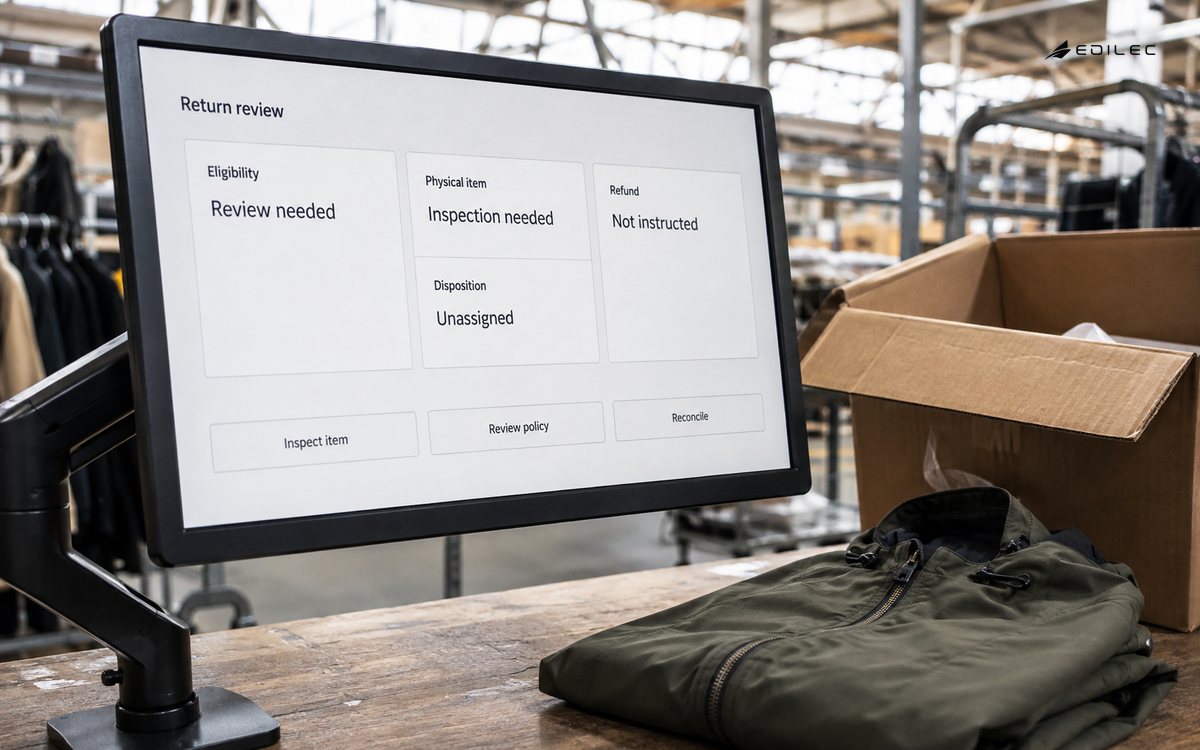
Use separate state machines. Commercial state can move from requested to approved, declined, cancelled, or closed. Physical state can move from expected to in transit, received, inspected, and disposed. Financial state can move from not instructed to pending, succeeded, failed, or reversed. Shopify's current Return object distinguishes requested, approved, processing, and closing behaviors and links returns to reverse fulfillment; it is a useful concrete example of why one status is insufficient.
| State dimension | System of record | Key evidence | Common mistake |
|---|---|---|---|
| Eligibility and authorization | Returns service | Policy version, purchase facts, reason, exception approval | Re-evaluating an old return under a new policy |
| Custody and receipt | Store, WMS, and carrier events | Parcel, item, location, time, actor | Treating label creation as receipt |
| Condition and disposition | Inspection workflow | Condition code, photos where justified, test result, destination | Restocking before inspection |
| Refund liability | Order and finance ledger | Refund allocation, tax, tender, approval | Equating refund record with paid refund |
| Payment execution | Payment provider | Provider reference and terminal status | Retrying without idempotency |
Evaluate eligibility from the policy that applied at purchase
Snapshot or reference the effective return policy at checkout. Eligibility considers delivery date, category, condition promise, final-sale flag, market, seller, channel, warranty path, tender, quantity already returned, and regulatory rights. A policy engine should return reason codes and permitted resolutions: refund, exchange, store credit, repair, or manual review. Customer-service overrides need an actor, authority, reason, and limit; they should not overwrite the original rule result.
Expose policy consistently on product, checkout, order history, and return initiation surfaces. Schema.org MerchantReturnPolicy provides structured properties for policy scope and conditions, but published metadata is not the operational decision engine. Test that the customer-facing representation and effective rules agree. For marketplace orders, resolve which seller policy applies and who owns support, shipping cost, and refund liability before accepting the request.
Orchestrate reverse logistics without losing item identity
Choose the route from item value, size, hazardous status, expected condition, seller, customer location, consolidation economics, and required inspection capability. Options include store drop-off, carrier label, label-free partner drop, customer keep-and-refund, repair depot, or seller-direct return. Validate the handoff location against the authorization. A store that accepts any web parcel but cannot identify or safely hold it creates an inventory and privacy problem rather than convenience.
At receipt, scan return, parcel, and product identifiers; record quantity, custody location, and discrepancies. Use event identity and deduplication because carriers and warehouses resend milestones. GS1's Core Business Vocabulary 2.0 supplies standardized business-step and disposition concepts that can improve cross-party interpretation. Do not force those events to serve as the accounting ledger; link them to the return line and retain both event time and ingestion time.
Inspect condition and make disposition explicit before restocking
Define inspection profiles by product class. Apparel may need identity, wear, tags, and contamination checks. Electronics may need serial verification, activation-lock status, accessories, diagnostic result, and data-erasure handling. Record controlled condition codes and evidence proportionate to value and dispute risk. Free-text notes alone prevent consistent routing and analysis. Quarantine unknown, counterfeit, recalled, or hazardous items instead of increasing available inventory.
Disposition is a business decision: return to sellable stock, open-box or refurbished stock, vendor return, repair, recycle, donation, destruction, investigation, or customer return. Each path names a destination inventory class and financial treatment. Restock only after disposition commits, and publish inventory with the correct condition. An exchange reservation should be independent of returned-item restock; otherwise the customer waits for the same unit to traverse inspection.
| Case | Release point | Controls | Fallback |
|---|---|---|---|
| Low-value, trusted customer | Carrier or drop-off acceptance | Return count, item exclusions, verified handoff | Post-refund investigation and account review |
| Normal merchandise | Confirmed receipt | Identity and quantity scan | Inspection queue if mismatch |
| High-value serialized item | Successful inspection | Serial, condition, accessories, fraud checks | Manual adjudication |
| Damaged or wrong item | Evidence-based approval | Customer evidence plus fulfillment history | Prepaid return or support review |
| Marketplace seller return | Contracted milestone | Seller policy, liability, reserve, event proof | Platform case management |
Execute refunds idempotently and reconcile settlement
Calculate refundable merchandise, discounts, tax, shipping, duties, fees, gift value, and prior refunds at line level. Create an immutable refund instruction with idempotency key, amount allocation, tender routing, liability party, and reason. A mixed-tender order may require several provider operations and store-credit issuance. Define whether an exchange creates a new sale, an even exchange, or net settlement; finance and tax teams must approve that model.
A provider's accepted refund is not final settlement. Stripe notes in its refund documentation that refunds have states and can fail, including when balance is insufficient for some methods or contexts. Shopify similarly states that a Refund record does not prove money returned; associated transaction status does, in the Refund API documentation. Consume provider events idempotently, reconcile to cash and ledger, and route stale or failed refunds to an owned queue.
Communicate milestones and measure the whole return outcome
Tell customers what has actually happened: request received, approved, label issued, carrier accepted, item received, inspection complete, refund initiated, and refund completed. Distinguish merchant processing time from bank posting time. Suppress duplicate messages when events replay and localize dates, currency, and instructions. Give support the same timeline, reason codes, evidence, and next owner so agents do not promise a refund that is still blocked.
Measure initiation completion, approval time, days to first scan, days to receipt, inspection cycle time, disposition yield, time to refund instruction, time to settlement, failed refunds, return contacts, loss, and resale recovery. Segment by product, reason, channel, route, node, seller, and policy version. A lower return rate can indicate a better product or a broken initiation flow, so pair it with customer contacts and denied-return outcomes.
Reconcile return exceptions across stores, warehouses, and finance
Create daily controls for approved returns without a first scan, delivered parcels not received by a facility, receipts without an authorization, inspected lines without disposition, restocked quantities without condition evidence, refund instructions without provider reference, and successful provider refunds without ledger posting. Age each exception from the milestone when action became due and route it to the team that can change the authoritative record. Do not clear a mismatch by copying whichever system updated last.
For example, if a store scans two units against an RMA authorized for one, preserve the observed receipt, quarantine the additional unit, and create an adjudication case. The returns service should not silently increase authorized quantity, and inventory should not publish the extra item before identity and condition are resolved. The eventual decision may amend the return, send the item back, or investigate fraud, but the custody evidence remains intact.
Omnichannel returns takeaways
- Give each return line and parcel stable identity linked to the original order and fulfillment.
- Separate commercial authorization, physical custody, condition, disposition, and payment state.
- Evaluate against the effective policy and preserve override authority and reasons.
- Restock only into the condition-specific inventory pool after disposition.
- Treat refund creation, processor acceptance, and financial settlement as different milestones.
- Measure customer elapsed time and recovered inventory value, not only return count.
Omnichannel returns management FAQ
Can a refund be released before the item is received?
Yes, for a deliberately bounded risk tier. Use verified carrier or drop-off acceptance, customer and item eligibility, value limits, exclusions, and post-refund monitoring. High-value, serialized, regulated, or fraud-sensitive goods usually require receipt and inspection.
Should every store accept every online return?
Only when the store can validate authorization, identify the item, hold it safely, record custody, and route it onward. Product hazards, marketplace ownership, cross-border tax, and lack of inspection capability may require another route.
Is an RMA the same as a refund?
No. An RMA authorizes and tracks a return. A refund is a financial instruction and settlement. Some authorized returns end in exchange, repair, denial after inspection, or no-return refund; some refunds correct price or service without any return.
Conclusion
A return remains trustworthy when every channel shares one authorization and timeline but each domain owns its state. Preserve policy evidence, custody, condition, disposition, liability, and settlement separately, then join them through stable identifiers. This lets teams offer fast, flexible returns without losing inventory control, financial reconciliation, or honest customer communication.