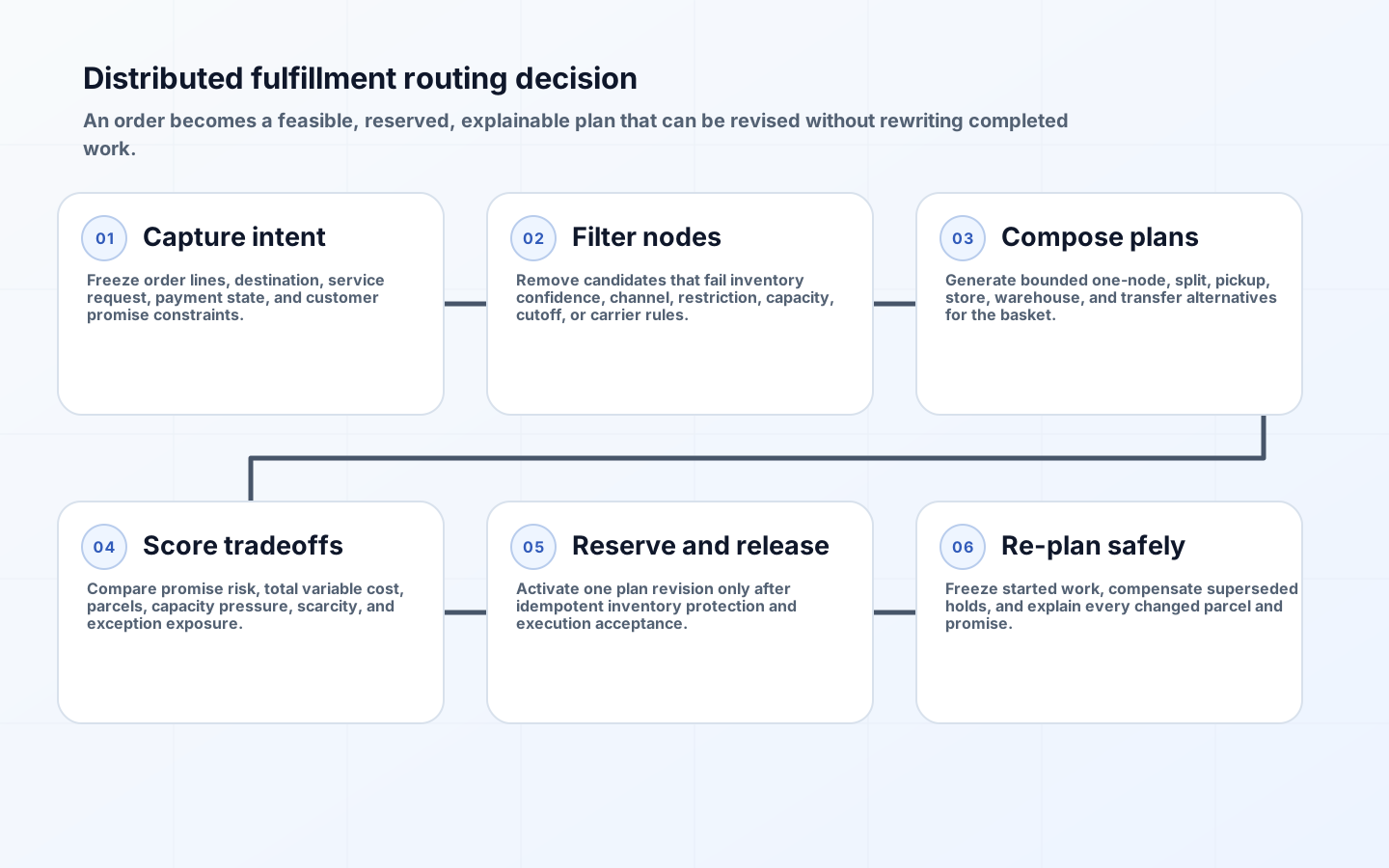
A distributed order management architecture decides how each sellable line becomes a credible customer promise and then a completed pickup or shipment. That decision is harder than selecting the nearest location. A node may show stock while the units are damaged, already promised, inaccessible to store staff, or incompatible with the required carrier cutoff. A cheap route may create two parcels, miss the promised date, or consume scarce store capacity needed for local demand.
The useful design separates order intent, inventory evidence, promising, reservation, assignment, and execution. It preserves the facts used for every routing decision and can reconsider an unstarted assignment without rewriting financial history. The result is not a mathematically perfect plan. It is an explainable operating policy that makes good decisions quickly, protects commitments, and contains inevitable exceptions.
Define order, inventory, promise, and fulfillment authority
Give every important fact one owner. The commerce order owns what the customer bought, price, tax, payment state, destination, and requested service. Inventory services own on-hand, reserved, safety stock, and salable quantity by item and node. The distributed order manager owns promise alternatives and fulfillment-plan revisions. Warehouse, store, and carrier systems own execution milestones. Do not let a tracking event silently rewrite the order or let a search index become the source of available-to-promise truth.
Model a fulfillment plan as immutable revisions. A revision identifies order lines, quantities, assigned nodes, service levels, promise dates, reservation references, policy version, input snapshot, score components, and reason codes. Activation uses optimistic concurrency so two re-planners cannot both reserve the same line. commercetools Orders likewise expose versioned updates and line-level shipment states; the broader lesson is to make transitions explicit rather than infer them from mutable notes.
| Concern | Authoritative record | Consistency need | Failure treatment |
|---|---|---|---|
| Customer and financial intent | Commerce order | Strong within an order revision | Reject conflicting mutation; never reconstruct from fulfillment |
| Salable stock | Inventory service by SKU and node | Atomic reservation for scarce units | Expire or compensate an orphaned hold |
| Promise and assignment | Order orchestration plan | One active revision per line quantity | Re-plan only unstarted work |
| Physical execution | WMS, store, carrier events | Ordered and deduplicated per fulfillment | Reconcile late or duplicate milestones |
| Analytics | Event warehouse | Eventually consistent with lineage | Correct by replay, not operational overwrite |
Build a feasible candidate set before scoring routes
Start with hard constraints. A candidate node must serve the destination and channel, hold the correct item condition, support the delivery or pickup method, satisfy hazardous-material and export restrictions, and have enough confidence-adjusted supply. It must also meet labor, packaging, cutoff, and carrier constraints. Excluding an infeasible node before ranking prevents a high commercial score from masking an impossible plan. Record which constraint removed each candidate so operations can distinguish policy from stale data.
Generate plans at basket level, not independently per line. Candidate generation should include one-node fulfillment, bounded split combinations, ship-from-store, warehouse shipment, transfer-then-ship where allowed, and pickup alternatives. Cap combinatorial growth with business rules: maximum parcels, maximum nodes, no split for a kit, and no transfer after a promised cutoff. Adobe's current source-selection tutorial demonstrates priority and distance algorithms and partial shipment feasibility; a production DOM normally adds confidence, capacity, promise, and broader cost dimensions.
Score promise, cost, capacity, and exception risk transparently
Use a lexicographic policy or a normalized weighted score, but expose its precedence. A common policy first rejects late plans, then minimizes customer-impact risk, then minimizes parcels and variable cost, while preserving scarce inventory. A weighted model can express score = promise risk + fulfillment cost + split penalty + capacity pressure + stock scarcity + exception risk. Normalize every component and document units; otherwise a currency value can overwhelm a probability or a one-day delay.
Estimate promise from ready time plus carrier or pickup transit, including calendars and cutoff uncertainty. Cost should include pick labor, packaging, carrier charge, transfer cost, expected cancellation, and expected return impact, not only postage. Capacity pressure should rise as committed work approaches a node's usable throughput. Stock confidence should reflect age of last count, discrepancy history, unprocessed receipts, and reservations. Keep commercial boosts subordinate to feasible customer commitments.
| Candidate plan | Promise | Variable cost | Operational risk | Decision |
|---|---|---|---|---|
| Warehouse A, one parcel | Both lines in 2 days | $11.40 | Low; fresh stock and open capacity | Preferred baseline |
| Store B, one parcel | Both lines next day | $18.20 | Medium; low stock confidence | Choose only for premium promise |
| Warehouse A plus Store C | One and two days | $16.80 | Higher; two parcels and contacts | Reject unless one-node plans fail |
| Transfer C to A, then ship | Both lines in 4 days | $9.70 | Transfer and cutoff dependency | Offer only for economy service |
Reserve atomically, release deliberately, and re-plan bounded work
A routing recommendation is not inventory protection. Activate a plan only after reservations succeed for all required allocations, or use a documented partial policy. Give each reservation an idempotency key derived from order, line, plan revision, node, and quantity. Set expiry from the next operational milestone rather than a universal timer. A payment-pending cart may need minutes; a store pick accepted by an associate needs an execution hold that does not disappear mid-pick.
Re-plan on reservation rejection, node refusal, missed pick deadline, inventory correction, carrier disruption, or customer-approved change. Freeze quantities already picked, packed, manifested, or handed over. Release old holds only through a compensating transition tied to the superseding plan. This prevents a late message from releasing the new reservation. Track physical movement with event time, read point, business step, and disposition concepts consistent with GS1 EPCIS 2.0.1, while preserving the DOM's own business decision history.
Operate routing policy with simulations and exception feedback
Before enabling a policy revision, replay representative historical orders against the new rules. Compare promised-date feasibility, projected cost, splits, node concentration, stock-outs, and underserved regions. Replay is directional because historical stock and capacity were influenced by the old policy. Follow it with shadow scoring, a small geography or channel, and explicit stop conditions. Version calendars, cutoffs, weights, and constraints together so a decision can be reproduced.
Measure promise kept, cancellation before fulfillment, re-route rate, split rate, cost per fulfilled line, assignment acceptance, time to first execution, stock discrepancy, and customer contacts. Slice by node, service, market, item class, and policy version. An aggregate cost improvement that creates missed promises in remote postcodes is not an improvement. Shopify's model permits multiple fulfillments for one order and ties tracking to fulfillment records in its Fulfillment documentation, reinforcing the need to measure line and parcel outcomes separately.
Test routing with adversarial fulfillment scenarios
Build scenario tests around operational races, not only ideal baskets. Simulate two orders competing for the final unit, a node accepting after its reservation expired, a carrier cutoff moving during plan activation, partial pick followed by node outage, customer cancellation while re-planning, duplicated inventory events, and a stale plan arriving after its replacement. Assert active plan revision, reservation balance, customer promise, and immutable execution history after every interleaving. Load tests should include hot SKUs and regional concentration because average catalog traffic hides contention.
Run an operator game day in which a store rejects assignments and one warehouse loses capacity. Verify that dashboards expose why candidates disappeared, that re-planning does not recall shipped work, and that customer communication reflects new parcel dates. Reconcile total ordered, reserved, allocated, released, cancelled, and fulfilled quantities by line. This proof is more valuable than testing that the score function returns a preferred node for a static example.
Distributed order management takeaways
- Separate commercial order intent from inventory, promise, planning, and physical execution authority.
- Filter infeasible nodes before scoring and preserve exclusion reasons for operators.
- Score complete basket plans with explicit promise, cost, split, capacity, confidence, and risk terms.
- Make reservations idempotent and tie release to a specific superseded allocation.
- Re-plan only work that has not crossed a physical execution boundary.
- Evaluate policy changes through replay, shadow decisions, constrained rollout, and customer-outcome metrics.
Distributed order management FAQ
Is a distributed order manager the same as an order management system?
Not necessarily. An order management system may own capture, customer service, financial status, and lifecycle records. Distributed order management is the planning capability that promises and assigns fulfillment across nodes and revises that plan. They can be one product, but the authority boundary should remain clear.
Should routing always avoid split shipments?
No. Splits increase cost and customer complexity, but a split can preserve a critical date or avoid cancellation. Treat the split penalty as policy, cap parcel count, and show customers accurate per-parcel promises rather than hiding the tradeoff.
Does the DOM need perfectly real-time inventory?
It needs explicit freshness and atomic reservation more than an impossible promise of perfection. Combine recent counts with reservation state, safety stock, discrepancy history, and node confidence. Where confidence is poor, reduce available quantity or exclude the node until reconciliation.
Conclusion
Distributed fulfillment works when routing is treated as a controlled business decision, not a nearest-node lookup. Establish authority, generate only feasible plans, score the full customer and operating consequence, reserve against a specific revision, and preserve the evidence needed to re-plan. That architecture makes lower cost and faster promises sustainable because every promise remains connected to capacity and executable stock.