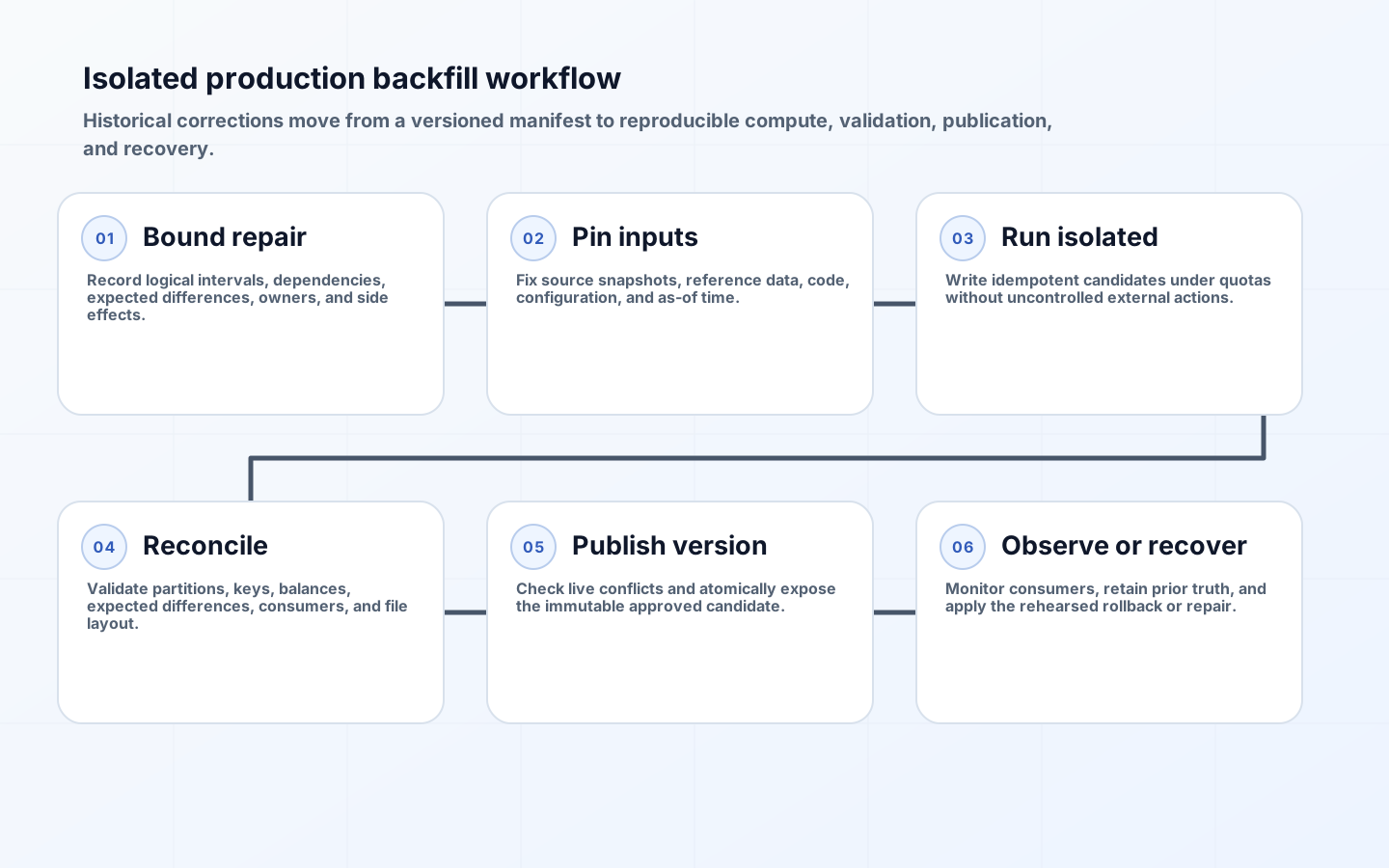
Backfills are normal maintenance for long-lived data products. A transformation defect, late source, new business rule, or restored dataset can require historical reprocessing. The danger is that a large backfill competes with current production, reads a mixture of old and new inputs, overwrites fresher results, repeats external side effects, or publishes partial history. Data pipeline backfill best practices treat the work as a versioned data change with a bounded scope, isolated computation, independent validation, controlled publication, and rehearsed rollback.
An orchestrator can create runs for past intervals and control concurrency, but scheduling is only one layer. Airflow, for example, distinguishes logical dates and data intervals and provides explicit reprocessing behavior. Correctness still depends on what each task reads and writes. A successful historical task is not evidence that its inputs were reproducible, its output is idempotent, or downstream consumers saw one coherent release.
Define the repair boundary
Write a backfill manifest before execution: incident or change reason, affected datasets and columns, first and last data interval, source versions, transformation revision, expected row and partition changes, downstream dependencies, side effects, owner, approver, and expiry. Use data intervals rather than run timestamps. A daily run executed on Tuesday may represent Monday's data; confusing those concepts creates gaps and overlaps at daylight-saving, timezone, or schedule boundaries.

Prove why the selected range is sufficient. Trace the defect to its earliest possible input, account for rolling windows and slowly changing dimensions, and include downstream aggregates that depend on corrected partitions. For stateful models, a change in one day may affect later balances. When the boundary is uncertain, process a wider isolated range and use reconciliation to establish the minimal publish set rather than guessing narrowly in production.
| Manifest field | Question answered | Evidence | Owner |
|---|---|---|---|
| Interval range | Which logical data is recomputed? | Partition and dependency analysis | Data producer |
| Input version | Can the calculation be reproduced? | Snapshot IDs or immutable paths | Platform owner |
| Code revision | Which business logic applies? | Commit and build digest | Pipeline owner |
| Output target | Can live data remain untouched? | Staging namespace or branch | Storage owner |
| Publish and rollback | How does truth change safely? | Atomic operation and prior version | Data product owner |
Pin immutable inputs and code
Prefer source snapshots, versioned object paths, table snapshot IDs, or transaction positions that identify the input state. If upstream corrections are part of the backfill, sequence them and record each new version. Reading current mutable tables during a week-long historical run can make early and late partitions reflect different source states. Pin reference data, exchange rates, model artifacts, libraries, and configuration as carefully as fact data.
Build the transformation from an immutable artifact and pass the interval explicitly. Eliminate calls to current time from business logic or inject a deterministic as-of time. Keep environment secrets separate from calculation configuration. Run a small historical sample twice and compare outputs byte-for-byte or through canonicalized business values. Reproducibility makes failures diagnosable and turns rerun from a gamble into an expected operation.
Make outputs idempotent and side effects explicit
An idempotent task can process the same manifest and produce the same intended state. Use deterministic keys and overwrite only the owned staging partition, or merge with source version and ordering controls. Append-only output needs a run identity and deduplication contract. A retry must not duplicate invoices, notifications, feature publication, model training registration, or downstream triggers. Disable external side effects during computation and emit a reviewed change set for a separate publication step.
Avoid blind overwrite of live partitions. Current processing may have already published a later correction, and a historical job can replace it with an older assumption. Compare expected and actual destination versions before publish. For tables with transactional snapshot support, commit candidate files atomically and retain the previous snapshot. For systems without atomic partition replacement, use a new versioned table or path and switch a view, pointer, or consumer configuration after validation.
| Output pattern | Retry behavior | Publication method | Primary risk |
|---|---|---|---|
| Partition overwrite | Replace owned candidate partition | Atomic partition/table commit | Overwriting newer truth |
| Keyed merge | Upsert by key and source version | Transactional merge | Incorrect ordering or delete logic |
| Append history | Unique event/run identity | Append then checkpoint | Duplicate facts |
| Versioned dataset | Write new immutable version | Pointer or view switch | Consumers bypass pointer |
| External side effect | Inbox/idempotency key | Separate approved dispatcher | Irreversible duplicate action |
Isolate compute, storage, and scheduling
Give backfills separate queues, pools, warehouses, priorities, or quotas so historical work cannot starve current service-level objectives. Limit active intervals and bytes scanned, then increase gradually from observed headroom. Airflow's backfill concurrency and run-order controls are useful, but also account for database connections, object-store requests, shuffle, catalog commits, and downstream APIs. Reverse chronological execution can provide recent repairs sooner, yet dependency order must remain correct.
Write to a staging namespace, table branch, or run-specific prefix with lifecycle controls. Production readers should not discover candidates through broad wildcards. Encrypt and authorize staging to the same sensitivity standard as live data. Monitor source load, scheduler delay, task duration, retry rate, compute cost, storage growth, file counts, and current-pipeline latency. Define stop conditions before the run, including source saturation, runaway cost, unexpected output cardinality, and current SLA degradation.
Validate at partition and business levels
Compare candidate outputs to immutable input controls and the current production version. Validate schema, row count, key uniqueness, nulls, accepted domains, referential integrity, partition coverage, and aggregate balances. Quantify expected differences from the change request. A candidate that exactly matches production may indicate the fix did nothing; a large difference may be legitimate but needs explanation. Use stratified samples for diagnostic detail, not as the only proof.
Run downstream acceptance against the candidate: critical dashboards, regulatory totals, features, exports, and consumer queries. Check performance and file layout because a logically correct backfill can produce millions of small files or eliminate useful clustering. Route discrepancies to a ledger with interval, key class, magnitude, and disposition. Require data-owner approval for material unexplained differences instead of relaxing tests until they pass.
Publish atomically and preserve rollback
Freeze the candidate snapshot after validation and bind approval to its immutable identifier. Immediately before publication, verify that the live destination is still the expected version. If current processing advanced overlapping partitions, reconcile or regenerate; do not overwrite through the conflict. Publish with a transactional commit, fast-forward under valid lineage, or pointer swap. Record old and new versions, actor, manifest, validation result, and time.
Keep the prior version and code path for the defined rollback window. Monitor consumer errors, freshness, totals, performance, and business reports after the switch. Rollback should restore the previous visible version without deleting candidate evidence. If new live data arrives after publication, a simple pointer reversal may lose it, so define whether rollback means version restore, compensating forward repair, or consumer-specific fallback. Rehearse that distinction before approval.
Run a staged operational sequence
Dry-run interval selection, then process a small representative slice through compute, validation, and a nonproduction publication. Increase batches while watching current workloads. Checkpoint completed intervals and immutable output IDs so a pause resumes without ambiguity. Communicate progress in data intervals and validated rows, not task count alone. Hold a go/no-go review before the production switch and keep operators available through the observation window.
After completion, reconcile the full range, close discrepancies, remove temporary side-effect blocks, and confirm downstream catch-up. Retain the manifest and audit evidence according to data policy. Expire staging only after rollback and investigation windows close. Feed runtime, cost, skew, and failure lessons into normal pipeline design; frequent emergency backfills often reveal missing replayability, tests, lineage, or source retention that deserves permanent repair.
Coordinate retention with every affected layer. Source snapshots, staging files, scheduler logs, validation samples, and the prior production version need compatible lifetimes. Deleting one early can make an otherwise documented rollback impossible. Calculate the storage cost before execution, tag temporary assets with the run identity, and require evidence that recovery and audit windows ended before automated cleanup proceeds.
Key takeaways
- Define historical work with logical data intervals and dependency impact.
- Pin source, reference data, code, configuration, and as-of time.
- Write idempotently to an isolated candidate and suppress uncontrolled side effects.
- Throttle against current service objectives and validate business differences independently.
- Publish an immutable approved version atomically with conflict checks and a real rollback path.
Frequently asked questions
Is a retry the same as a backfill?
No. A retry repeats a failed execution attempt for an intended interval. A backfill deliberately creates or reprocesses historical runs, often under a new code or input version. Both require idempotency, but approval and validation differ.
Can a backfill write directly to production?
Only when the store provides appropriate atomicity, version conflict protection, and rollback, and the change is low risk. Isolated candidate output is safer for material corrections because it permits complete validation before visibility.
Should recent intervals run first?
It can restore recent usefulness sooner, and Airflow supports reverse ordering, but only when intervals are independent or dependencies are honored. Stateful calculations may require chronological execution.
Conclusion
A production backfill is a release of corrected historical truth, not merely a scheduler command. Immutable inputs, deterministic code, idempotent candidate writes, resource isolation, business reconciliation, and versioned publication make the operation repeatable and reviewable. Those controls protect current results while giving teams a dependable way to repair the past.