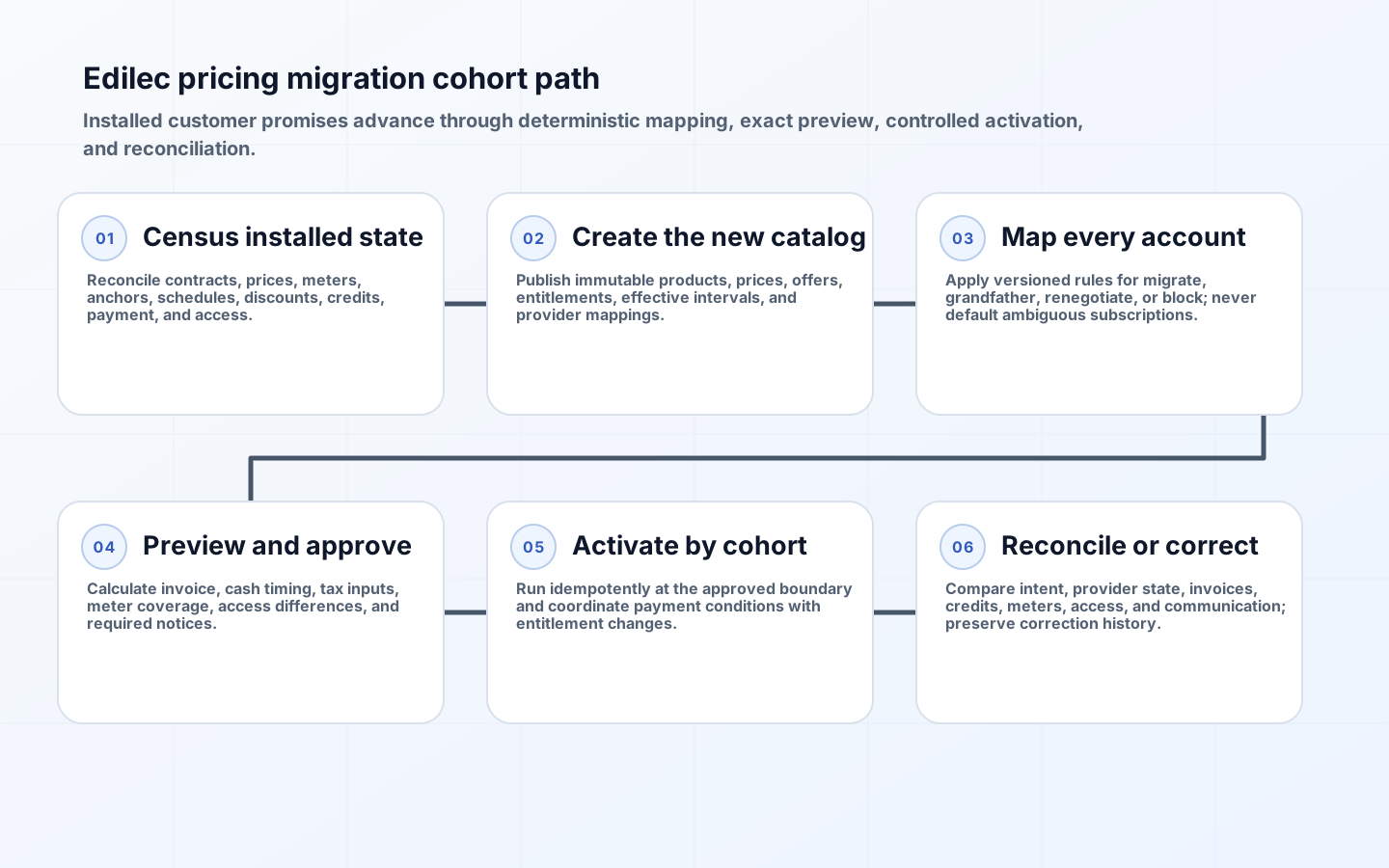
A SaaS pricing migration is a temporal systems change, not a bulk update from one price ID to another. Active customers carry signed terms, renewal dates, discounts, credits, minimums, usage meters, taxes, scheduled changes, and access promises. Moving billing without moving entitlements can charge for a feature the product withholds; moving access first can grant an unpaid capability. The migration needs one effective-dated commercial snapshot and coordinated projections.
The safest design preserves the old catalog, creates a new immutable version, maps each installed subscription through explicit rules, previews economic and access outcomes, and activates by cohort at a defined boundary. Grandfathering is then an intentional offer with an owner and review rule, not an accidental legacy branch that nobody can explain.
Inventory installed commercial state
Build a subscription census containing customer, legal entity, contract and amendment, product and price IDs, quantities, meters, billing interval and anchor, currency, tax location, discounts, credits, minimum commitment, renewal and notice dates, cancellation status, scheduled phases, payment state, entitlements, overrides, and source system. Reconcile it to recent invoices and product access before designing mappings. Orphaned overrides and duplicate subscriptions become migration failures later.
| Segment | Primary risk | Likely boundary | Required approval |
|---|---|---|---|
| Self-serve monthly | Unexpected proration or anchor shift | Next renewal or explicit immediate upgrade | Customer confirmation where terms change |
| Annual prepaid | Double charge or lost paid access | Contract renewal | Commercial and finance policy |
| Negotiated enterprise | Violation of amendment or ramp | Contract-specific milestone | Account owner and legal process |
| Usage-based | Meter or tier discontinuity | Closed usage interval and watermark | Billing engineering and finance |
| Discounted or credited | Benefit lost during mapping | Preserved expiry or replacement value | Revenue operations |
| Past due or paused | Credit for unpaid time or accidental reactivation | Resolved payment state | Collections and support policy |
Do not decide eligibility from current plan name. Use contract facts and installed object lineage. Two customers on a label called Business may have different feature sets or caps from different sales periods. Classify every account into a named migration rule and put unmatched accounts into a blocked queue. A default mapping is convenient precisely where it is most dangerous.
Version the catalog, offer, and entitlement contract
Model products as stable commercial capabilities; prices as immutable amount, currency, interval, meter, tiers, and tax behavior; offers as effective-dated bundles of prices and entitlements; and subscriptions as customer acceptance of an offer plus overrides. Stripe's price management guidance recommends creating a new price rather than changing the amount of an existing one. Preserve old price identifiers for invoice history and active contracts.
Entitlements should resolve from the same offer version used for billing, then apply explicit customer amendments. Record limits, feature states, effective time, source, and policy version. During transition, support old and new snapshots simultaneously. Feature code asks the entitlement service; it does not inspect billing provider nicknames. This lets a customer remain on a grandfathered catalog without freezing the application implementation.
Write deterministic mapping rules and invariants
| Change | Billing decision | Access decision | Verification |
|---|---|---|---|
| Same capability, new amount | Replace price at approved boundary | No entitlement delta | Invoice preview equals notice |
| Bundled features change | Map to new offer | Add or remove at effective instant | Access diff reviewed |
| Monthly to annual | Define anchor, prepayment, and credits | Keep uninterrupted access | Period and cash schedule preview |
| New usage meter | Close old meter at watermark | Keep capability while meter switches | Old plus new totals cover interval once |
| Retired feature | Define grandfather, substitute, or removal | Preserve contract until authorized | Affected workflows tested |
| Custom discount | Carry, expire, or replace explicitly | Usually no access effect | Net price and expiry reconcile |
Implement mapping as version-controlled data or pure code over an immutable subscription snapshot. Output target offer, target prices, carried discounts and credits, effective time, proration behavior, entitlement diff, notices required, and reasons. Assert invariants: no currency changes without approval; no gap or overlap in effective intervals; quantities remain nonnegative; meter usage is assigned once; paid access is not reduced early; and projected invoice matches the approved scenario.
Choose an effective boundary that matches the promise
Common boundaries are immediate, next billing renewal, contract renewal, a fixed announced date, or the end of a scheduled phase. Stripe explains in change price guidance that changing prices can create prorations, and switching billing intervals can reset the billing date. Preview with the exact timestamp, currency, quantities, discounts, taxes, and unpaid invoice state. Avoid calendar assumptions across time zones and month lengths.
For usage pricing, close a deterministic interval. Publish a watermark for old-meter events, rate them under the old offer, switch the meter or price reference, and accept new evidence under the new version. Decide how late events are treated. Mid-cycle switching without event-time rules can double-bill, drop usage, or apply a new tier schedule to consumption the customer made under old terms.
Orchestrate the migration through controlled cohorts
- Freeze and hash each account's source commercial snapshot and assign a mapping rule.
- Generate billing, entitlement, cash timing, tax input, and customer-notice previews.
- Route exceptions and material changes to accountable commercial, finance, legal, or support owners.
- Schedule an idempotent transition at the approved effective boundary.
- Apply billing and entitlement projections through one migration state with compensating actions.
- Reconcile invoice preview, actual invoice, product access, meter coverage, and customer communication.
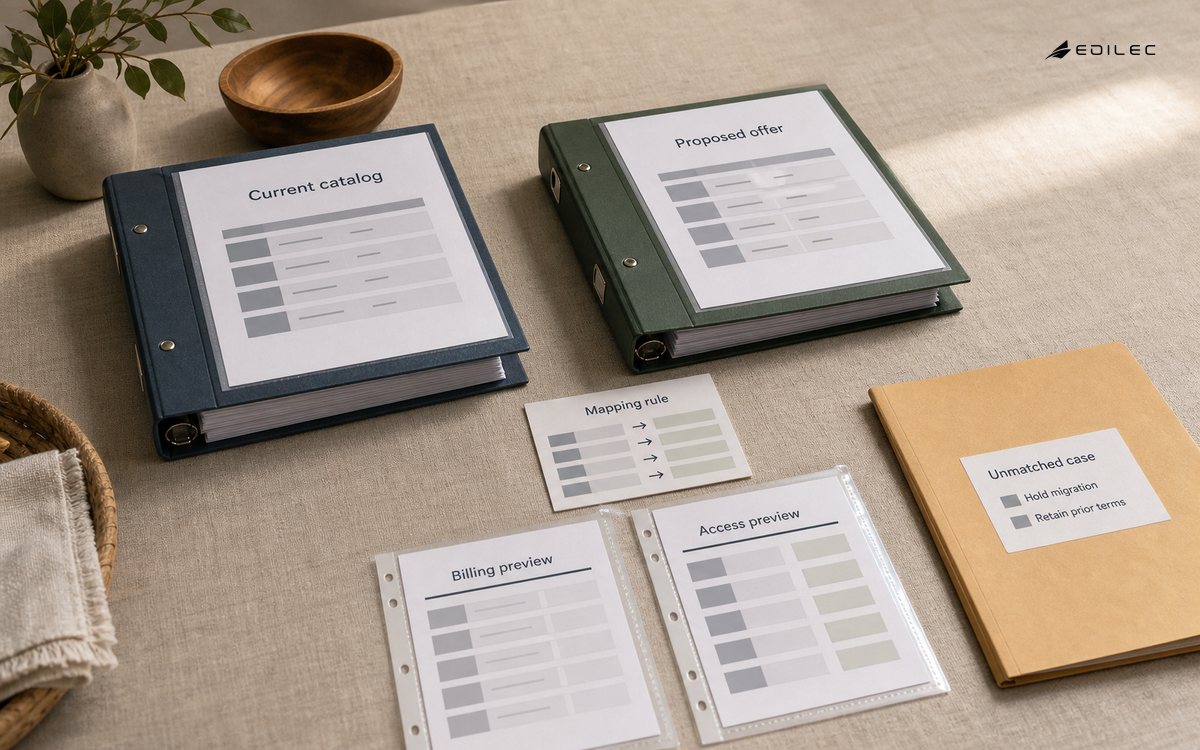
Use cohorts that represent payment state, billing interval, currency, tax treatment, meter type, discounts, enterprise schedules, and custom entitlements. Start with internal and synthetic accounts, then a small customer cohort whose support can be observed. Hold through invoice creation, payment attempt, entitlement refresh, and renewal jobs. Volume alone is not risk coverage.
Handle schedules, proration, and payment failure explicitly
Subscription schedules can express future phases and automatic transitions. Stripe's subscription schedule documentation distinguishes proration behavior when updating the current phase from behavior at a phase transition. When importing an existing contract, preserve all future commitments, not just today's items. Detect operator edits made after the migration preview and require a fresh snapshot rather than overwriting them.
An immediate upgrade may require payment before premium access is granted. Use a pending state: request change, create and finalize the invoice or payment condition, confirm success, then activate the entitlement snapshot. On failure, retain prior terms unless the agreement says otherwise. For downgrades, decide whether access changes immediately or at period end and how unused value is credited. Never infer payment success from a subscription-update API returning successfully.
Preserve grandfathered contracts without permanent ambiguity
Represent a grandfathered population as a named offer version with eligibility, effective date, renewal behavior, supported capabilities, and owner. Keep it in catalog reporting and regression tests. Define whether customers can change quantity, add products, pause, or return after cancellation without losing grandfathered status. Customer support needs a readable explanation and a simulator, not a hidden conditional in billing code.
Financial reporting remains a professional accounting responsibility. The IFRS 15 overview centers recognition on contracts, performance obligations, transaction price, allocation, and satisfaction of obligations. Engineering should retain contract versions, notices, price and discount lineage, entitlement delivery, credits, refunds, and effective timestamps so finance can assess modifications and revenue treatment.
Reconcile outcomes and prepare rollback
Compare source snapshot, migration intent, billing provider state, internal subscription, entitlement snapshot, meter bindings, invoice lines, credits, and notification. Alert on accounts changed without a migration ID, migrated accounts still using an old price unexpectedly, entitlement diffs outside the rule, invoice variance from preview, and unresolved exceptions near effective time. Reconciliation must occur before and after invoice finalization.
Rollback depends on stage. Before effective time, cancel the schedule. After billing changes but before invoice finalization, restore the prior snapshot where provider semantics permit. After payment or invoice finalization, use credit notes, corrective invoices, or forward adjustments under policy rather than deleting evidence. Access can often return to the prior entitlement snapshot quickly, but the team must consider actions the customer took while the new capability was active.
Key takeaways
- Inventory the installed contract, billing, meter, discount, credit, schedule, and entitlement state.
- Create immutable catalog versions and bind billing and access through effective-dated offers.
- Use deterministic account mappings and block unmatched or ambiguous subscriptions.
- Preview exact invoice and access outcomes at the real effective timestamp.
- Roll out cohorts covering commercial variance, not just a percentage of accounts.
- Reconcile across systems and use corrective financial artifacts after finalization instead of erasing history.
SaaS pricing migration FAQ
Should every customer move to the new plan?
That is a commercial and contractual decision. Engineering should support explicit migrate, grandfather, renegotiate, and cancel-at-boundary outcomes. Forcing a default mapping can breach terms or remove paid access. Each population needs ownership and an end state.
Is renewal always the safest migration time?
It often minimizes proration, but annual contracts create a long rollout and scheduled amendments may conflict. A fixed date may be appropriate with notice and credits. Select the boundary from contract, customer experience, accounting, and operational risk together.
Should the billing provider be the catalog source of truth?
It can be authoritative for provider objects and invoices, but the product usually needs a broader commercial model containing contracts, entitlements, amendments, and migration intent. Maintain explicit mappings and reconcile; do not rely on loosely governed metadata as the only contract record.
Conclusion
Pricing can evolve without breaking trust when every customer's installed promise is treated as versioned state. A complete census, immutable catalogs, deterministic mappings, exact previews, coordinated billing and access, representative cohorts, and durable reconciliation make the migration explainable to customers, support, and finance.