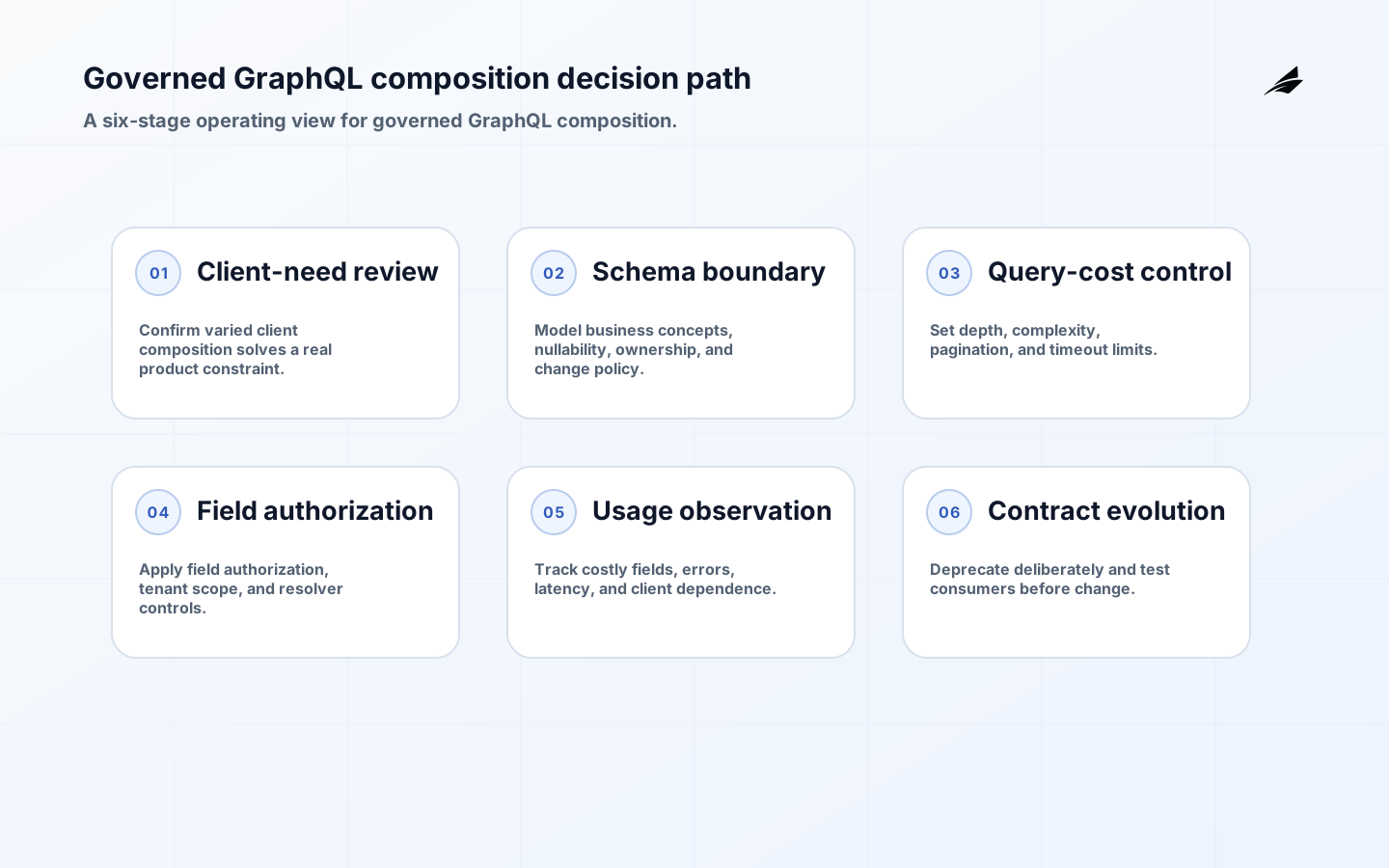
GraphQL is most useful when a known client-composition problem justifies a shared query surface. It also introduces choices around schema ownership, authorization, query cost, caching, evolution, and failure visibility. This guide lays out those tradeoffs so a team can decide whether GraphQL fits the product before the first build hardens an expensive boundary.
Choose GraphQL for a real client-composition problem for governed GraphQL composition
Ask which client coordination problem is expensive today. If one well-defined REST resource already matches the task, adding a graph can create a second way to express the same behavior. A useful discovery session follows one representative case from its trigger through the durable outcome and the support path. Include the normal path, a late or duplicate event, an access refusal, a dependency outage, and the person who decides when an exception is resolved. This exposes hidden coupling early. It also creates a narrow first release: one outcome, one accountable owner, and evidence that the result is both correct and understandable.

| Question | Decision evidence | Failure avoided |
|---|---|---|
| What is authoritative? | Name the source, owner, update path, and correction rule. | Two components silently make different claims. |
| What changes the fact? | Record command, authorization, validation, and audit expectation. | A convenient interface bypasses business policy. |
| What can fail? | List dependency, timeout, retry, and user-visible recovery. | A transient fault becomes ambiguous manual work. |
| What proves success? | Choose behavior and operational measures before release. | A fast launch hides a declining service. |
Design GraphQL tradeoffs boundaries that survive change for governed GraphQL composition
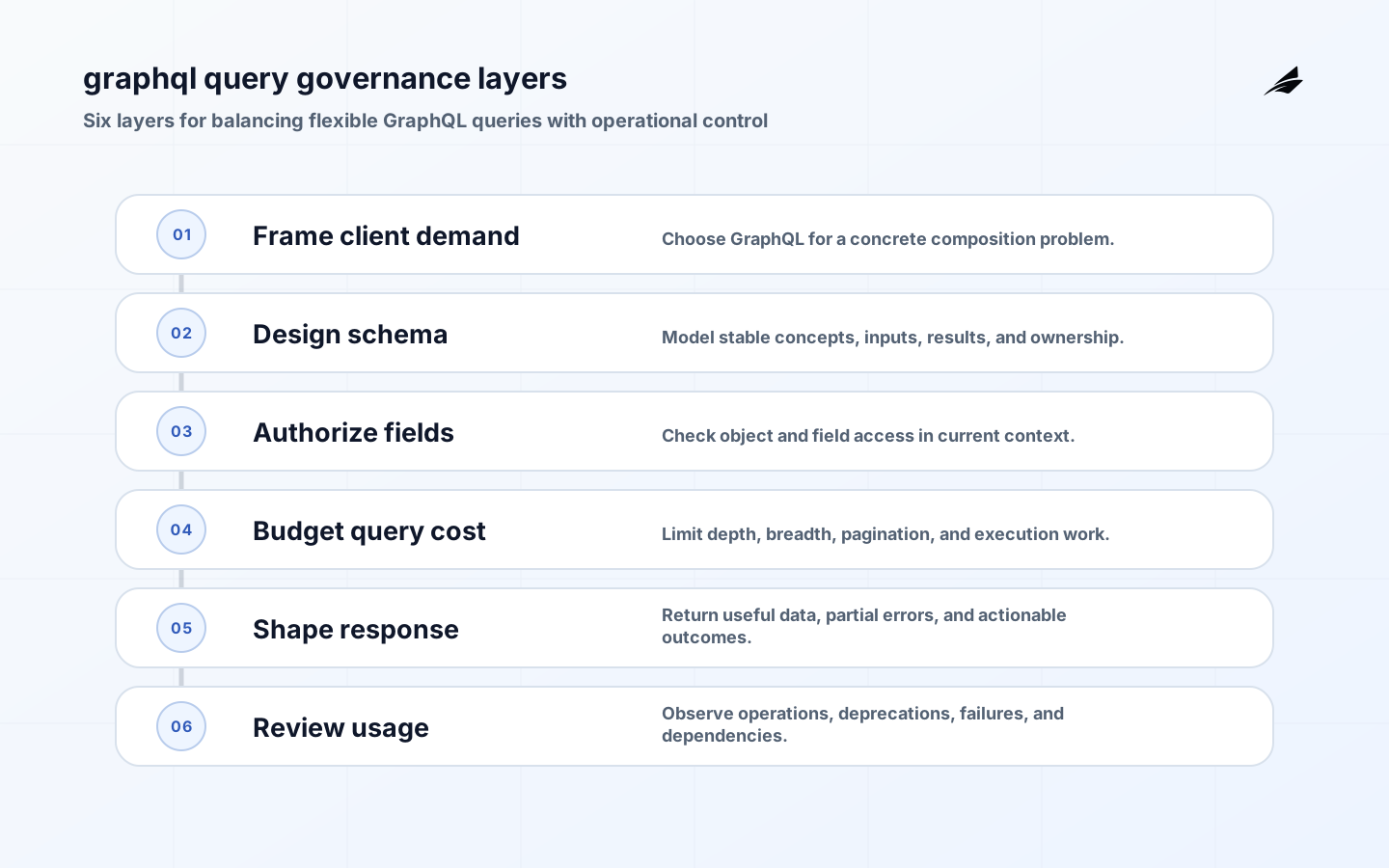
The design choice is to design around product concepts and ownership, authorize at resolver boundaries, and place limits on traversal, pagination, persisted operations, and batching. Do not make every concern global because it might be shared someday. Put the rule with the capability that owns its outcome, expose a small interface to its neighbors, and make translation happen at the edge. This produces more useful reviews: reviewers can ask whether an operation preserves a named invariant or contract, rather than trying to infer intent from framework wiring. The same boundary gives test authors a stable place to exercise failure behavior.
Evidence should shape the boundary. Look for operation registry data, query depth and cost, resolver fan-out, authorization failures, field usage, and latency by operation rather than endpoint. Each signal tells a different story: an incident may reveal a missing recovery path; a delayed change may reveal broad coupling; a security finding may reveal that identity is being assumed rather than checked. Read these signals alongside product context. A rare but irreversible error can deserve earlier work than a common inconvenience, while an elegant refactor without a credible consequence should wait. This is the judgment behind effective technical debt planning.
Make the change safe to release for governed GraphQL composition
The implementation plan should start with a thin graph, document nullability and error behavior, prevent N+1 access patterns, define field ownership, and remove unused fields through observed deprecation. Break risky work into observable steps and decide what evidence unlocks the next step. Compatibility is a requirement, not a hope: clients, stored data, operators, and support tools may all depend on behavior that was never written down. Give every irreversible action a stop condition and an owner who can call it. For cross-service work, preserve correlation identifiers and record the semantic outcome as well as the transport result so a later investigation does not depend on one ephemeral log line.
Operate with signals, not assumptions for governed GraphQL composition
After release, measure query cost, resolver latency, partial-error rate, unauthorized field attempts, client migration progress, and service fan-out per operation. Use a baseline where possible, but do not wait for perfect historical data. A small dashboard and a weekly review can reveal whether the change made the intended path easier or simply moved the burden. Pair quantitative data with examples from users and on-call staff. When a number moves, inspect a trace, a support case, or a representative record before assigning a cause. The most reliable operating habit is to keep ownership, expected behavior, and next review date beside the metric.
| Signal | Interpretation to test | Response |
|---|---|---|
| A success metric improves but complaints rise | The metric may omit a confusing exception path. | Review real user journeys and add a quality signal. |
| Errors shift after a rollout | The change may have displaced a contract or dependency assumption. | Compare representative requests and restore a known-safe path. |
| Manual overrides increase | The workflow may be too rigid or its authority unclear. | Inspect override reasons before automating further. |
| A rare high-impact event occurs | Average performance is hiding exposure. | Run a focused incident and recovery review. |
Write a decision record for governed GraphQL composition
A GraphQL decision record should begin with ownership questions. For every field, identify the service or capability that can answer it authoritatively, the policy that governs access, and the cost it can impose on dependencies. A schema is not a database diagram: it is a consumer language, so expose concepts that remain useful even when storage changes. Avoid using nullable fields to hide unknown semantics. If an operation can return partial data, document which errors are recoverable and what a client should display or retry. Persisted operations can reduce unbounded query variation when a product needs stronger operational control, while ad hoc exploration may belong in a separate environment. Query limits need practical tuning: measure real operation shapes, then cap depth, breadth, nodes, or execution time in ways that protect services without breaking a valid screen. Review resolver batching and caching with authorization context in mind; a fast shared result is unsafe if it crosses tenant or field permissions. By making these choices visible, the team retains GraphQL's composition benefit without accepting opaque workload or access behavior as the cost of flexibility.
The graph remains a product boundary rather than a convenient pass-through, which makes future schema evolution, incident response, and client coordination much easier to manage.
Delivery checklist for governed GraphQL composition
- Write the GraphQL tradeoffs decision in product language, including the user or operator outcome.
- During client-need review for governed GraphQL composition, map the normal case and at least three uncomfortable cases before implementation.
- During client-need review for governed GraphQL composition, name the source of truth, owner, identity rule, and correction path for important data.
- Add tests for compatibility, authorization, error behavior, and the recovery path.
- Instrument the primary outcome, the failure mode, and the manual workaround.
- Schedule a review after representative production traffic has exercised the change.
Key takeaways: GraphQL tradeoffs
- GraphQL tradeoffs is a production decision with business, operational, and security consequences.
- During client-need review for governed GraphQL composition, start from a bounded capability and its evidence, rather than a preferred framework or wholesale replacement.
- Keep authority, invariants, and translation boundaries explicit so change remains local.
- Treat failure and recovery as part of the contract users receive.
- During client-need review for governed GraphQL composition, measure the intended result and its undesirable side effects after the release.
When should a team begin? During client-need review for governed GraphQL composition, begin when a recurring constraint has a named consequence, an owner, and a plausible small experiment. What belongs in the first release? Include one valuable path, the failure behavior a user will actually encounter, and enough monitoring to decide whether the result is trustworthy. How much design is enough? Design until the team can describe authority, important states, dependencies, compatibility needs, and recovery without hand-waving; do not wait for every future feature. Can the work be iterative? Yes, provided each step leaves the system observable and safe. The relevant references are GraphQL Specification, GraphQL Best Practices, OWASP GraphQL Cheat Sheet, and OWASP API Security Top 10.
GraphQL tradeoffs earns its place in a roadmap when it makes a real capability easier to change, operate, or trust. Take one representative case, record its authority and failure behavior, then make the smallest change that improves the constraint without obscuring the next decision. The related guides on software modernization, authentication flows, and database schema design can help teams carry that discipline across adjacent architecture decisions.
Practical decisions for governed GraphQL composition
Prove the client problem before choosing GraphQL. Compare two real journeys with a conventional API and examine schema ownership, field authorization, query complexity, caching, nullability, partial errors, and evolution. A resolver must enforce tenant and field rules rather than relying on a UI hiding data. Apply depth, breadth, timeout, pagination, and batching controls. Measure expensive operations by client and give deprecated fields an owner and removal date. The graph is a contract, not a substitute for domain modeling.
Related reading for governed GraphQL composition
Compare this guide with React State Design Decisions That Matter before the First Build, Rest API Contracts Decisions That Matter before the First Build, GraphQL Tradeoffs: Security Review. During client-need review for governed GraphQL composition, these adjacent articles help connect the implementation choice to ownership, delivery, and operations.
GraphQL Tradeoffs: Decisions to Make Before the First Build FAQ
When is GraphQL worth the added governance?
GraphQL earns its governance cost when several clients need different compositions and the team can enforce schema ownership, query limits, and field authorization.
What is the practical starting point?
Compare two real client journeys, test the alternative service boundary, and set query-cost and field-policy rules before building the schema.
When should the team scale the approach?
Add more composition only after field usage, expensive queries, authorization decisions, and deprecation impact are visible to a named owner.
Conclusion: governed GraphQL composition
GraphQL is a useful composition boundary when its flexibility is paired with limits and ownership. Start with real client variation, control query cost and field access, observe usage, and evolve the schema with consumer evidence.