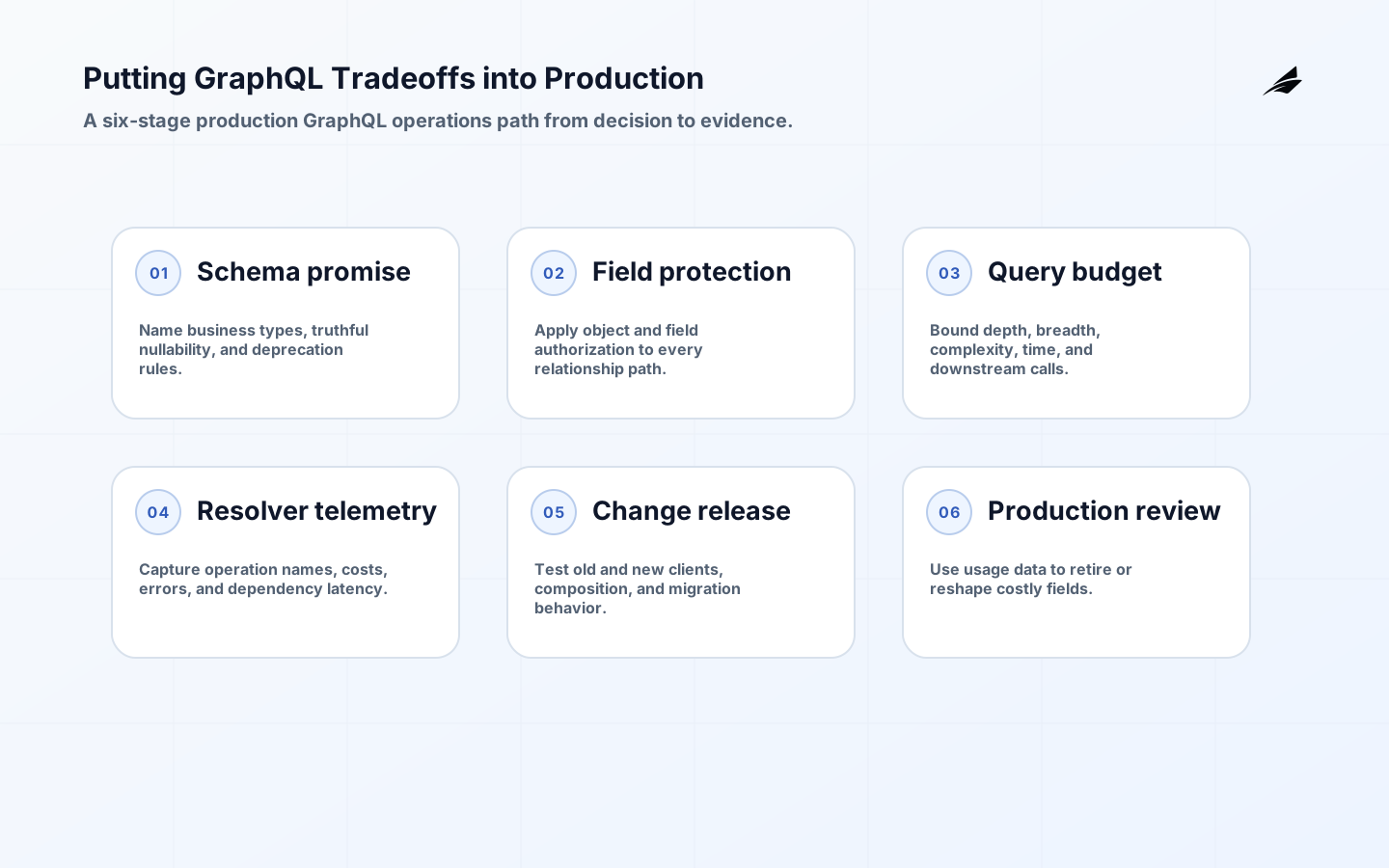
Production changes the GraphQL cost model. In development, a query that feels elegant may still issue hundreds of database calls, return an unexpectedly large list, or expose a resolver that assumes a trusted caller. Production adds tenant isolation, traffic bursts, schema compatibility, partial dependency failure, and clients that keep old documents for months. Run representative operations under realistic concurrency and inspect downstream work, not only the GraphQL response time.
GraphQL tradeoffs become concrete in production because the choice shifts responsibility, rather than removing it. A graph can give clients a flexible way to ask for related data through a strongly described schema. That can improve a product with several client surfaces, evolving view requirements, or a genuinely connected domain. It can also move query planning, authorization, cost control, caching, and schema governance into a new central boundary. GraphQL is not automatically a replacement for REST, and REST is not automatically too rigid. The useful question is which interface helps the product express stable capabilities while keeping performance, security, and change ownership understandable to the people who will operate it. Compare those choices with authentication flows in production when the graph crosses identity boundaries.
Choose GraphQL for a real client and domain fit
Start with the tasks clients need to complete, not with a desire to expose every table as a type. A graph is a good fit when clients need different projections of related business concepts and the organization can own a shared schema over time. It is less compelling for a small command-oriented integration, a simple public capability, or a system where caching at standard HTTP boundaries is the central concern. List the client queries, mutations, subscriptions if any, data authorities, permission rules, and expected volume. Then compare the alternative REST resources or event contracts honestly. A GraphQL schema should model business language and workflows; a database relationship should not dictate the public contract because storage and authorization rules must remain changeable.
| Situation | GraphQL advantage | Tradeoff to accept |
|---|---|---|
| Several tailored client views | Clients request relevant fields in one operation | Resolver and query-cost governance |
| Connected domain data | Schema expresses relationships | Field-level authorization complexity |
| Simple partner command | May add little over REST | Extra tooling and operational surface |
| Highly cacheable public content | Can still work | HTTP caching may require more deliberate design |
Model a GraphQL schema as a durable public contract
The GraphQL specification defines a type system, validation, execution model, and introspection rules. Use those capabilities to make a small, coherent surface rather than an unrestricted read portal. Name types and fields for the language users and product teams share. Make nullability reflect an actual guarantee, and represent expected business alternatives explicitly instead of collapsing every problem into an unstructured error. Design mutations as intentional commands with input and result types that reveal accepted, completed, and recoverable states. Deprecate fields before removal and inspect actual field usage so a cleanup does not silently break an older mobile client. Schema review needs domain ownership; a federated graph without clear ownership can turn local service coupling into a harder-to-diagnose graph-wide coupling.
- Does the type name represent a business concept rather than a storage artifact?
- Can a caller understand whether a mutation completed, is pending, or needs correction?
- Which team owns the field, its freshness, and its deprecation decision?
- Is nullability a truthful guarantee or a workaround for uncertain behavior?
- Can a client request an expensive or sensitive relationship without a deliberate rule?
Control GraphQL query cost and authorization
GraphQL lets a client compose a query, so the server must defend execution deliberately. Apply authentication before resolving protected data and authorization at the object and field level where the business rule requires it. Avoid relying on a client-visible identifier as proof of access. Establish depth, breadth, complexity, pagination, time, and rate limits based on measured workload, then return an actionable failure when a query exceeds a policy. Prevent N+1 data access with batching or careful resolver design, but do not let batching blur tenant or authorization boundaries. Disable or restrict introspection only as part of a broader threat model; it is not a substitute for authorization. Monitor resolver latency and downstream call counts by field so the team can see the actual cost of a useful query.
| Risk | Control | Signal |
|---|---|---|
| Expensive nested query | Depth and complexity budgets | Rejected cost and resolver duration |
| N+1 access | Batching and request-scoped loaders | Downstream calls per operation |
| Data exposure | Object and field authorization | Denied access by field |
| Schema drift | Deprecation and usage review | Traffic to deprecated fields |
Operate the graph as an observed composition layer
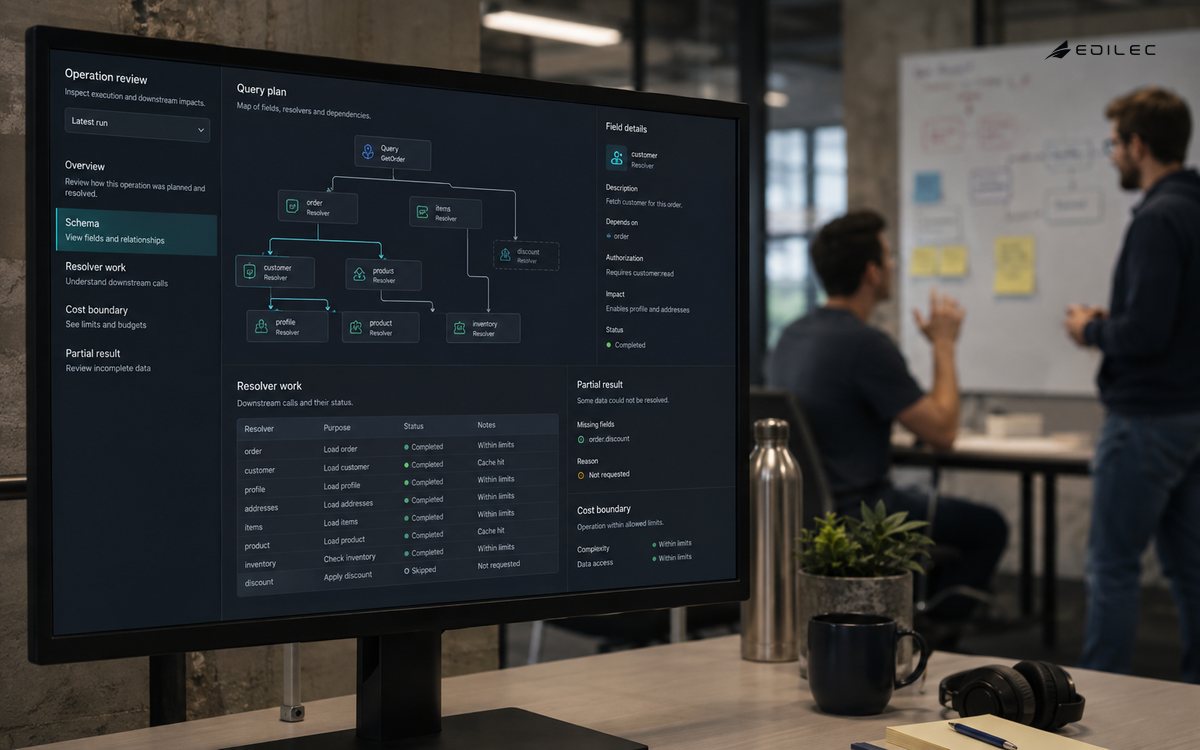
A GraphQL endpoint can make several downstream calls for one client operation, so aggregate service health is not enough. Capture operation name, schema version, selected high-level fields, complexity outcome, resolver timings, error class, and correlation identifiers while avoiding sensitive argument values. Encourage named operations and persisted queries where they improve observability and reduce arbitrary-query exposure. During an incident, operators should be able to identify whether a field, a client operation, or a downstream service is causing the degradation. Authentication flows in production is a useful companion because identity and session claims are inputs to every GraphQL authorization decision, not middleware details to assume away.
Deliver GraphQL changes with schema discipline
Treat a schema change as a release to every client, not only a change to the service that owns a resolver. Review proposed fields for naming, ownership, authorization, query cost, error behavior, and source-of-truth freshness. Publish additions before clients depend on them, and use deprecation metadata plus usage telemetry before removal. In a federated environment, test composition and query planning in automation, but also evaluate whether a cross-service field creates coupling that should be an explicit domain workflow. Keep the schema registry or review record accessible to product and operations people, not only API specialists. They often know that a field's business meaning, retention expectation, or customer promise changed before that fact is visible in resolver code. Apply the same ownership discipline as design systems in production when shared schema decisions affect multiple surfaces.
Review a GraphQL operation as a production workload
- Name the field's domain owner, authoritative source, freshness expectation, authorization rule, and deprecation responsibility before the schema makes it available to every client.
- Run representative nested operations against production-like data and measure resolver calls, batching behavior, downstream latency, memory use, and rejection at configured query limits.
- Try the same object through users, tenants, roles, and relationship paths that should differ to prove field-level authorization is not bypassed by graph composition.
- Confirm mutations return useful business outcomes and recoverable errors instead of forcing clients to infer completion from a null payload or a generic transport failure.
- Review operation names and persisted-query policy so dashboards can distinguish a costly released client operation from arbitrary exploration or abusive requests.
- Deprecate rather than silently repurpose a field, then use actual usage data and consumer communication before the old behavior is removed from the schema.
Do not let a successful query conceal a poor product boundary. If every client operation must join several unstable fields and then repair inconsistent states itself, the schema may be exposing implementation topology instead of a capability. Consider a purpose-built mutation, a server-side composition, or a simpler REST resource when it gives responsibility and failure behavior a clearer home. The best interface reduces decisions for its callers without hiding consequences from its operators.
Authoritative GraphQL references
The GraphQL Specification is the source for the language, validation, type system, and execution model. The GraphQL Foundation's resource hub organizes current production topics, while OWASP's GraphQL Cheat Sheet provides security controls to review. The OpenAPI Specification remains relevant when comparing an HTTP resource contract. Choose the boundary that makes your product's capabilities and operating costs clearest.
GraphQL tradeoffs takeaways
- A demonstrated client and domain reason for a graph.
- Schema ownership, truthful nullability, and a deprecation practice.
- Field-level authorization and bounded query execution.
- Resolver telemetry that exposes downstream cost and failures.
- A conscious comparison with REST and event contracts for each capability.
GraphQL tradeoffs FAQ
Production GraphQL workload check
Operate the schema as a living contract
| Decision | Concrete test | Owner evidence |
|---|---|---|
| Scope | Name one journey and its non-goal. | Approved outcome and boundary |
| Authority | Identify the source of truth and correction route. | Owner, identifier, and audit record |
| Failure | Exercise timeout, duplicate, stale, and denied cases. | Observed response and recovery step |
| Change | State what can evolve without surprising a consumer. | Compatibility note and review date |
Track operation name, client identity, schema version, depth, estimated cost, resolver latency, error path, and downstream dependency. Deprecate fields with usage evidence, keep an explicit owner for each domain type, and publish a safe response for authorization and dependency errors. A mutation needs idempotency and a clear outcome when the client times out after the server committed.
Is GraphQL faster than REST? It can reduce client round trips for some workflows, but it can also create expensive resolver plans; measure the actual operation and downstream work. Can GraphQL and REST coexist? Yes. Many systems use each where it expresses a capability and operating constraint best. The related REST API contract decisions help frame that boundary before implementation. Does a schema prevent authorization bugs? No. Types describe capability shape; every protected object and field still needs an authorization decision. Should introspection be disabled? Decide from your threat model and developer needs, but do not mistake introspection settings for a data-access control.
Conclusion: choose the graph with its responsibilities included
GraphQL is valuable when it clarifies how clients use connected domain capabilities. It earns that value only when schema ownership, authorization, query budgets, and observability are treated as first-class parts of the interface.
Production GraphQL needs an operating budget, not only a valid schema. Set limits for depth, breadth, aliases, response size, resolver time, and downstream fan-out; reject or defer work that exceeds the budget with a client-safe error. Track named operations and field usage so a deprecated field has an evidence-backed retirement path. Review slow traces with the owning domain team, then test the proposed fix against representative queries and authorization cases. This turns query governance into a repeatable release practice rather than an emergency reaction to a noisy endpoint.
A production GraphQL review should treat each operation as a workload with a budget. Set limits for depth, breadth, response size, aliases, resolver time, and downstream calls, then return a useful client-safe outcome when a query exceeds them. Track named operations and field usage so deprecation decisions rely on evidence. Pair traces with authorization tests and representative data; a fast query that leaks a field or produces an incomplete business result is not healthy. Assign the schema, cost policy, and incident response to named owners.
A bounded workload is easier to secure, price, debug, and change than an unlimited query surface.
Production review should include old clients, expensive queries, partial errors, authorization boundaries, and a rollback or deprecation path. Keep the workload budget visible to the teams that own the schema and the downstream services, then revisit it after representative traffic.
Frequently asked questions
For GraphQL in production, make query cost, schema ownership, dependency failure, mutation idempotency, and client migration visible before traffic expands. What should a team decide first? Production GraphQL needs a bounded decision, an accountable owner, and evidence for the next change; this case records checkpoint 1 for that topic. How much design is enough? Production GraphQL needs a bounded decision, an accountable owner, and evidence for the next change; this case records checkpoint 2 for that topic. Can the work be iterative? Production GraphQL needs a bounded decision, an accountable owner, and evidence for the next change; this case records checkpoint 3 for that topic. Which evidence matters after launch? Production GraphQL needs a bounded decision, an accountable owner, and evidence for the next change; this case records checkpoint 4 for that topic. Production GraphQL needs a bounded decision, an accountable owner, and evidence for the next change; this case records checkpoint 5 for that topic.