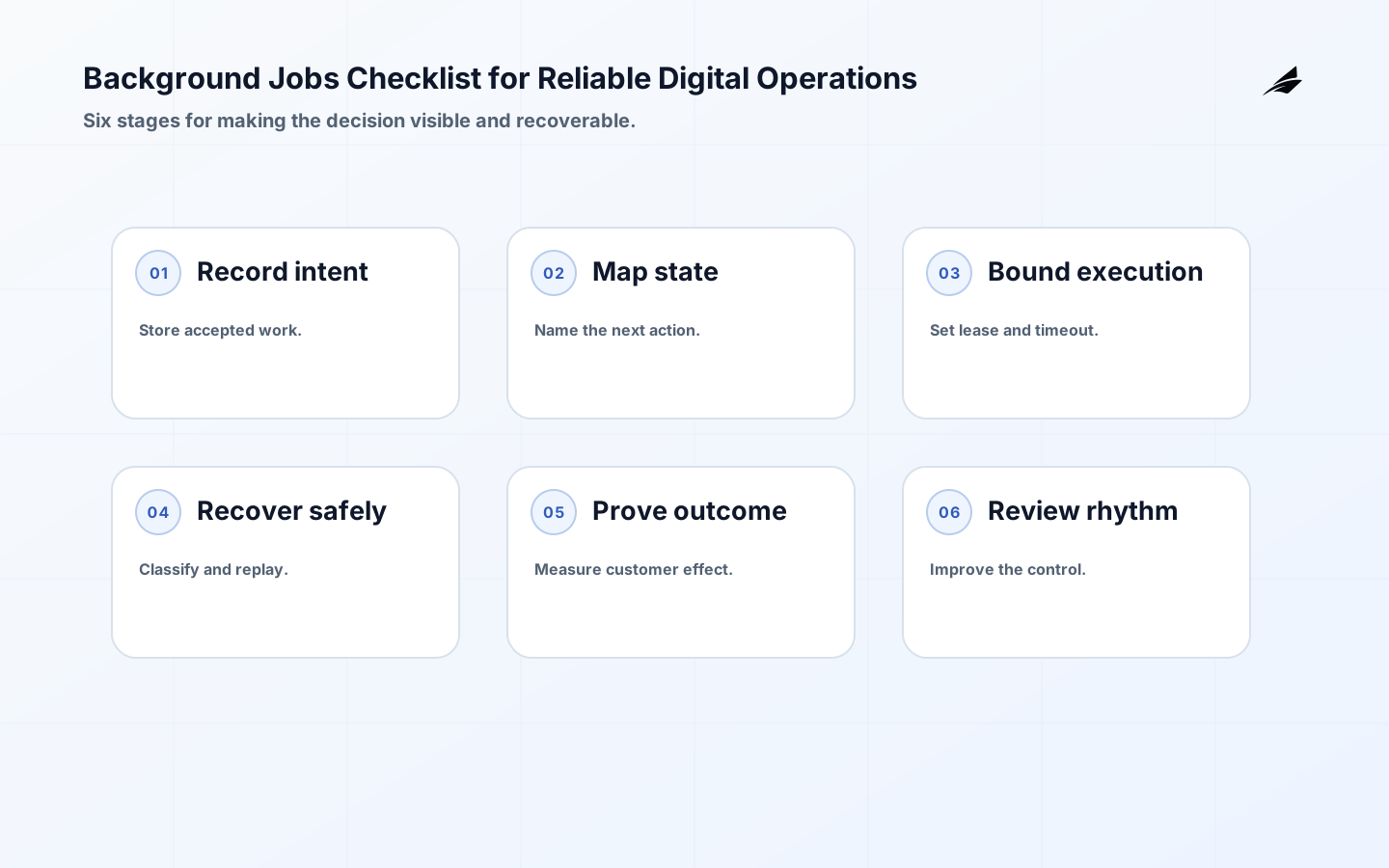
Background jobs are a delivery decision, not a checklist pasted into a project plan. For engineering teams, the practical question is whether a change can be understood by the people who build, use, support, and govern the system. The decision becomes expensive when work moved off a request path must still have a clear owner, delivery promise, and record of what actually happened. Start with one representative journey: name the actor, the data they supply, the promise the system makes, and the person who owns an exception. That small model reveals the real trade-offs between speed, consistency, recoverability, and cost. It also stops a team from treating a technology choice as an answer before it has described the operational behavior it needs.
Make the background processing decision explicit
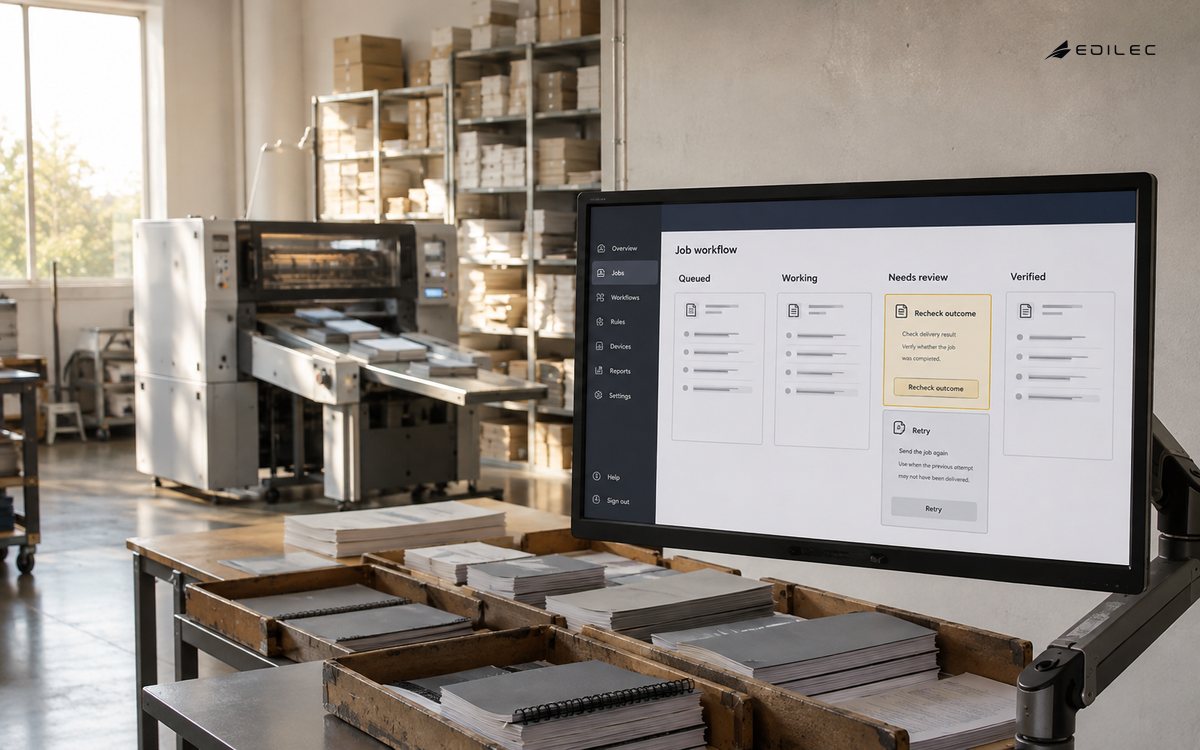
The first artifact should define the asynchronous work-item boundary: enqueueing, payload versioning, idempotency key, worker lease, retry policy, dead-letter path, and final effect. Put the normal path beside failure drills. Test a missing input, a delayed dependency, partial completion, conflicting records, and a human request to reverse the outcome. A useful design lets someone outside the implementation team inspect the accepted record, transition history, and recovery decision. Treat the durable queue record, job-linked worker logs, effect store, and operator retry policy as authorities; screenshots and derived dashboards are supporting views. This keeps support from reconstructing business rules from scattered evidence.
| Question | Decision to record | Evidence to keep |
|---|---|---|
| What promise is being made? | work moved off a request path must still have a clear owner, delivery promise, and record of what actually happened | A reviewed example of expected and failed behavior. |
| Where is the boundary? | enqueueing, payload versioning, idempotency key, worker lease, retry policy, dead-letter path, and final effect | An owner and a testable interface or workflow. |
| What is the consequential failure? | a message is delivered more than once, a worker fails after the side effect, or a poison job blocks useful work behind it | A negative-path test and recovery record. |
| How is progress judged? | oldest queued-job age, retry attempts, dead-letter volume, duplicate-effect alerts, worker saturation, and repair time | A baseline and a recurring operational review. |
Define queue authority and job state
Treat background jobs as a contract among product, engineering, operations, and users. State which record wins, which input may be rejected, which work can be retried, and which outcome needs human review. Duplicate delivery, a worker crash after an effect, or a poison job that blocks useful work is not an edge case to hide; each failure changes the data shape, observability, and support load. Favor decisions that make uncertainty visible. A pending-review state is safer than a confident invented answer, while a bounded failure response is kinder than an endless spinner or a generic success message.
| Area | Practical control | Review question |
|---|---|---|
| Authority | the durable queue record, worker logs linked by job ID, effect store, and an operator-owned retry policy | Can a new maintainer identify the record that decides the result? |
| Protection | idempotent consumers, bounded retries with backoff, visibility timeouts, dead-letter queues, deduplication evidence, and replay tooling | Does the idempotency control prevent a duplicate effect or only report it afterward? |
| Recovery | A documented owner, visible state, and reversible or compensating action. | Can support resolve one representative exception without developer archaeology? |
| Observation | oldest-work age, dead-letter volume, duplicate-effect alerts, worker saturation, and time to repair a stuck job | Does the queue-age signal separate a slow batch from a stuck job? |
Pilot a recoverable job cohort
The safest first release of background jobs is narrow enough to observe. Use one representative integration, one limited user group, or a bounded traffic slice, then compare the promised outcome with production evidence. Idempotent consumers, bounded backoff, visibility timeouts, dead-letter queues, deduplication records, and replay tooling are operating controls, not ornaments. Give every flag, compatibility bridge, and manual review queue an exit condition. If observed behavior diverges from the model, pause expansion and decide whether the model, instrumentation, or implementation needs correction.
- Write one ordinary and one high-consequence background processing example before implementation.
- Make the durable queue record, worker logs linked by job ID, effect store, and an operator-owned retry policy discoverable to product, support, and the delivery team.
- Exercise the failure case where a message is delivered more than once, a worker fails after the side effect, or a poison job blocks useful work behind it.
- Release with an owner who can read oldest-work age, retry attempts, dead-letter volume, duplicate-effect alerts, worker saturation, and repair time and make a stop-or-expand decision.
- Record a production surprise as a revised control, regression test, or accepted-risk note.
Use queue evidence to verify the promise
Standards and official documentation help a team separate a queue preference from a delivery or security constraint. For this background-jobs decision, compare Amazon SQS At-Least-Once Delivery, Amazon SQS Dead-Letter Queues, Google Cloud Tasks Retry Configuration, and the Secure Software Development Framework with real job traces. These references inform failure and recovery choices; they do not replace measuring the behavior of the system being built.
Run queue reviews that protect the customer
After release, review background jobs with evidence rather than anecdotes. Track the oldest queued job, retry attempts, dead-letter volume, duplicate-effect alerts, worker saturation, and repair time. Establish a baseline before setting a target, because a healthy average can conceal one costly tenant, device, or workflow. Pair the numbers with a small sample of real cases: trace the input, applied rule, resulting state, and resolution. Use that review to retain the design, tune a control, remove unused complexity, or fund a bounded improvement. Ownership matters here: unnamed queues and dashboards do not improve themselves.
Run the checklist as an operating decision
A useful review asks what happens when the normal path is interrupted. For a nightly reconciliation, inspect the accepted run record, the source snapshot, the lease, the retry history, and the final business totals. If the operator cannot tell whether a provider accepted a request, the system needs a reconciliation step before it offers a replay. If the job is waiting on a rate limit, the user-facing state should explain delay without exposing internal noise. This is why Cloud Tasks retry configuration should be paired with application-level failure classes and age limits.
Keep the checklist close to release and service review. At launch, ask whether the first job has a durable intent, bounded execution, a duplicate-effect test, a terminal failure path, an age alert, and an owner who can repair it. At the next review, compare those controls with real cases. A queue that has never failed is not evidence of resilience; a rehearsed recovery that produces one final business effect is stronger evidence.
The practical stop condition is clear: do not add a second job type while the first one has unexplained stuck work, unowned dead letters, or a result state that disagrees with the business record. Fix the boundary, document the reason, and then expand. This keeps asynchronous processing from becoming an invisible second application made of retries, dashboards, and manual buttons.
A small operations card can make the decision repeatable: job name, accepted record, idempotency key, owner, retry window, terminal states, alert, safe replay, and retirement trigger. Review it with support because support sees the awkward cases first. Link the card to the error-handling guide and the service runbook so a person can move from a customer question to evidence without asking the original implementer to reconstruct the design.
Do not hide maintenance in the worker. Queue pauses, schema changes, provider limits, and credential rotation need a visible maintenance state and a clear resume test. An operator should know whether to wait, correct input, replay, or escalate. That simple vocabulary reduces unsafe button pressing and gives the team a consistent way to explain why a delayed result is still controlled.
| Review question | Good evidence | Decision |
|---|---|---|
| Can work repeat safely? | Business key and effect record. | Allow bounded replay. |
| Can a person repair it? | Redacted context and audited action. | Enable review queue. |
| Can customers trust status? | State tied to durable outcome. | Expose progress and result. |
| Can the team learn? | Run ID, metrics, and incident record. | Tune or redesign control. |
Key takeaways
- Background-job processing starts with a concrete promise and a named boundary, not a tool selection.
- Design for the specific consequence that a message is delivered more than once, a worker fails after the side effect, or a poison job blocks useful work behind it.
- Keep the durable queue record, worker logs linked by job ID, effect store, and an operator-owned retry policy and recovery evidence close to the workflow.
- Use oldest-job age, retry attempts, dead-letter volume, duplicate-effect alerts, worker saturation, and repair time to decide whether to expand, contain, or redesign the approach.
Frequently asked questions
Where should a team start with background jobs?
Start with the job whose uncertainty already costs time, trust, revenue, or support effort. Describe one end-to-end journey, name its authoritative record, and test the first harmful failure before expanding the platform.
How should an operator handle an unknown external effect?
Reconcile the provider response or durable effect record before replaying the job. Preserve the decision and actor in the run history so a second operator can see why replay was safe or why the item required review.
Which signals show that a background job is healthy?
Watch the oldest-job age, retry pattern, dead-letter volume, duplicate-effect alerts, worker saturation, and repair time together. A healthy queue also produces the promised business result and gives support a bounded recovery action.
Conclusion
Background-job processing becomes dependable when its promise, authority, failure behavior, and recovery owner are visible. Keep the initial cohort narrow, test the point where another person or system relies on the result, and let production evidence choose the next investment. Related reading: Test Strategy Checklist for Reliable Digital Operations, Frontend Performance Checklist for Reliable Digital Operations, and GraphQL Tradeoffs Checklist for Reliable Digital Operations.
This article was checked against primary guidance including Amazon SQS At-Least-Once Delivery, Amazon SQS Dead-Letter Queues, Google Cloud Tasks Retry Configuration. The sources establish the technical meaning; the examples and decisions here apply that guidance to practical software delivery and operations.