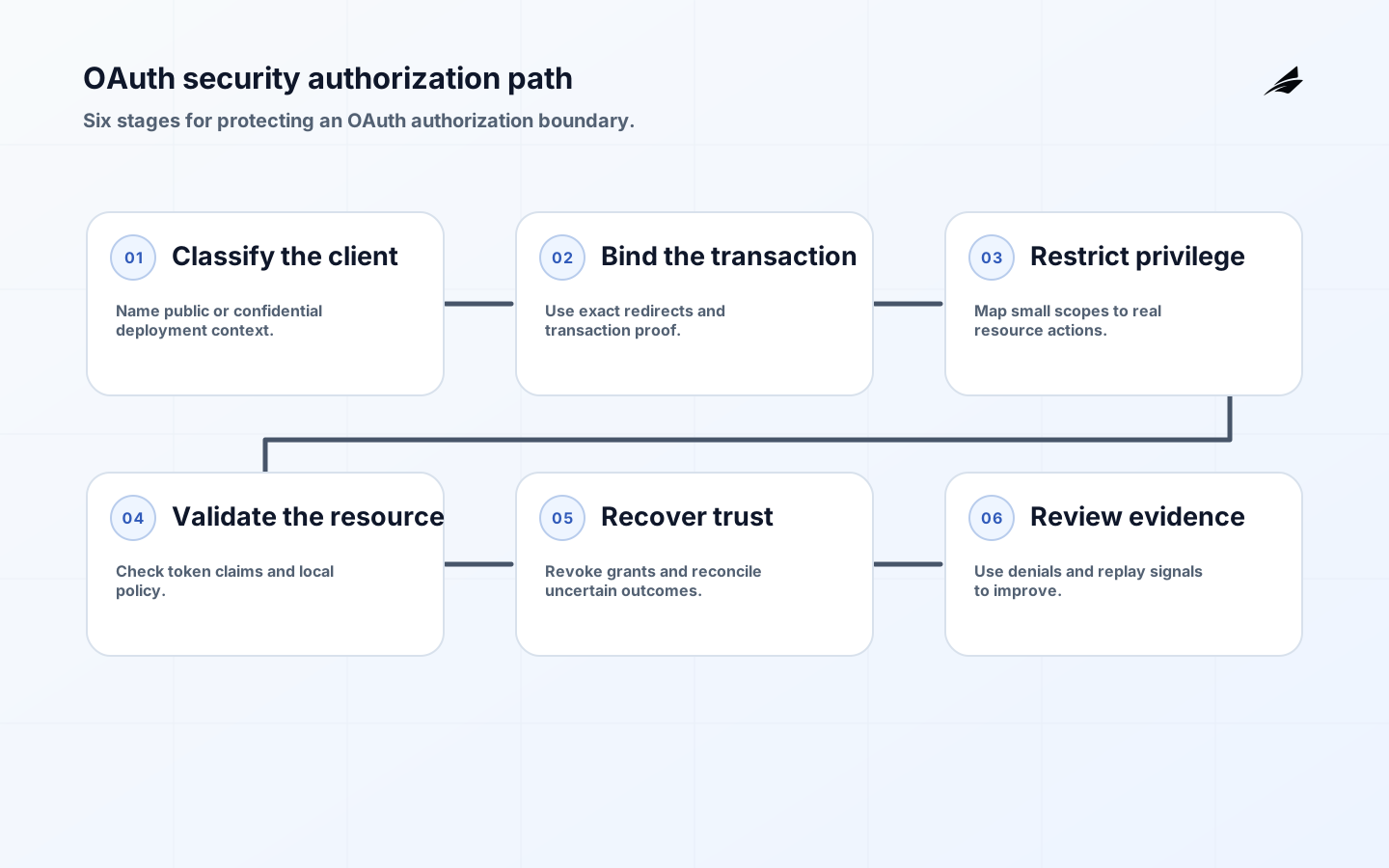
OAuth security is not a library setting; it is the collection of decisions that determines who may obtain a token, what that token can do, and how a team responds when the flow is abused. Before the first build, write those decisions in terms of a user, a client, an authorization server, a resource server, and a consequence. A native app, a browser application, and a server-side web app do not have the same ability to keep credentials secret. Treating them as interchangeable creates a false sense of protection. This guide turns the OAuth security problem into a reviewable boundary: choose the flow, restrict the redirect, keep privileges small, validate tokens at the resource, and retain enough evidence to recover when a client or token is no longer trusted.
Set the OAuth security boundary before choosing a flow
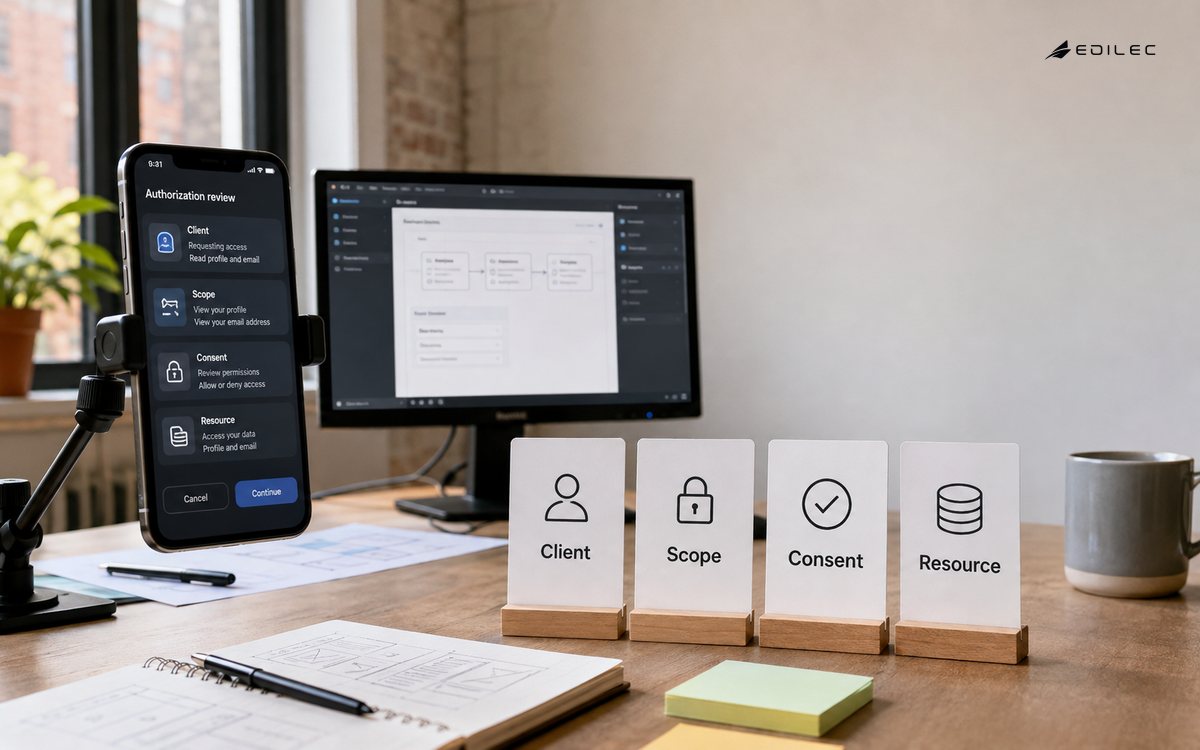
Start with a short authorization statement: which person or service is granting access, which client is asking, which resource is protected, and what action is permitted after consent. The OAuth roles described in RFC 6749 are useful because they separate the client that initiates a request from the resource server that ultimately enforces access. That separation prevents a common design error: assuming that a successful callback or a decoded token is itself proof that an action is authorized. Name the resource owner, authorization server, client, and resource server explicitly in the design record. Then list the data and operations behind each scope. If the same client requests profile data, payment actions, and administrative changes, the problem is already visible before any endpoint is written.
| Decision | Concrete question | Evidence to retain |
|---|---|---|
| Client type | Can this client keep a credential secret, or is it public? | Client classification and deployment context. |
| Redirect | Which exact return addresses are allowed? | Registered URI list and change approval. |
| Privilege | Which resource and action does each scope represent? | Scope definition, owner, and consent text. |
| Enforcement | Which service decides whether the requested action is allowed? | Resource policy and denied-path test. |
Match the client and redirect rules to the threat model
The first implementation choice is the client profile, not the framework. A public client such as a native app or browser application cannot safely hold a long-lived client secret in shipped code. A confidential server application can authenticate to the token endpoint, but it still needs protection against code injection, redirect abuse, session confusion, and leaked credentials. The current OAuth 2.0 Security Best Current Practice calls for exact redirect URI matching, with only the documented localhost exception for native applications. Record redirect URIs as controlled configuration, review changes like code, and reject a request that is merely similar to a registered address. A wildcard or prefix match turns a convenient integration into an unbounded token-delivery path.
Separate public and confidential client responsibilities
For public clients, use the authorization code flow with PKCE and keep the verifier transaction-specific. RFC 7636 defines the code challenge and verifier binding that prevents an intercepted authorization code from being redeemed by a different party. For a confidential web application, PKCE remains valuable even when client authentication is present because it binds the browser transaction to the exchange. The server should also bind state to the user session, verify the issuer when multiple authorization servers are possible, and close the transaction after one successful code exchange. These checks belong at the callback and token-exchange boundaries; placing them only in front-end code makes them optional.
Keep browser sessions and tokens out of accidental channels
Decide where tokens live, how long they live, and which logs must never contain them. Access tokens should travel only to the intended resource server over protected transport. Avoid putting tokens or authorization codes in URLs that may be copied into history, analytics, referrer headers, or support tickets. A browser session normally benefits from a server-managed, secure cookie and a narrow session record rather than exposing long-lived bearer material to every script. A mobile client needs a platform-appropriate protected store and a recovery path when the device is lost. Document the assumption, because a storage decision that is safe for one client type may be unsafe for another. The OWASP OAuth2 Cheat Sheet is a useful review companion for these implementation boundaries.
- Register exact redirect URIs and treat every change as a high-consequence configuration change.
- Use a transaction-specific PKCE verifier with the authorization code flow for public clients and as an additional binding for confidential clients.
- Keep authorization codes, access tokens, and refresh tokens out of URLs, ordinary logs, and unprotected browser storage.
- Make issuer, session, and client identity checks explicit when more than one authorization server or client is in play.
Make scopes and token lifetimes express real privilege
A scope should name a bounded capability that a resource server can enforce, not a vague promise such as full_access. Start with the smallest useful resource and action pair, then decide whether the client needs that privilege at all. Separate read, create, approve, export, and administrative actions when their consequences differ. Give every scope an owner, a consumer, a consent explanation, and an expiry or review expectation. The authorization server may issue a token, but the resource server still has to check audience, issuer, signature, expiry, and application policy before acting. RFC 9700 also emphasizes privilege restriction and stronger protection for refresh tokens; make those recommendations visible in the design rather than leaving them to a default configuration.
| Token decision | Practical starting rule | Review trigger |
|---|---|---|
| Audience | Issue for one resource or a deliberately bounded set. | A client asks to call a new resource. |
| Scope | Use resource-oriented permissions with separate write and approval actions. | A feature requests broader data or mutation access. |
| Lifetime | Keep access tokens short enough to limit replay impact. | Risk, device, or user session changes. |
| Refresh | Rotate or otherwise protect refresh tokens and record reuse signals. | Reuse, revocation, device loss, or suspected theft. |
| Sender constraint | Consider DPoP or mutual TLS when replay consequence justifies it. | Bearer-token theft is a material risk. |
Make the resource server the final authorization gate
Token validation is authentication input, not the whole business decision. The resource server should check that the token was issued by the expected issuer, is intended for this audience, has a valid signature and lifetime, and carries only claims that the local policy understands. It should then evaluate the current user, tenant, record, action, and resource state. For example, orders:write may authorize an order mutation in general but not a refund above a delegated limit or an action against another tenant. Put the policy near the side effect, where the service can see the current record and can write an audit event. A gateway can reject malformed traffic, but downstream services must not assume that gateway filtering replaced their own authorization logic.
When stolen-token replay would be costly, evaluate sender-constrained access tokens. RFC 9449 describes DPoP as an application-level proof-of-possession mechanism that can bind a token to a key. It does not make a compromised client safe: an attacker who obtains both the token and the key may still act. Use it when it reduces a credible offline replay path, and pair it with short lifetimes, safe key storage, revocation, and detection. Be precise about what the mechanism protects and what it does not. A control that is difficult to explain will be difficult to operate during an incident.
Design failure and recovery before the happy path
OAuth security becomes tangible when a request is denied, delayed, repeated, or made with stale trust. Write the user-visible result and operator action for each case. An invalid redirect should stop the flow without attempting to guess the intended address. An invalid code verifier should consume or reject the code and produce a traceable event without disclosing sensitive detail. A revoked grant should make the next action fail clearly and provide a sign-in or re-consent route. A resource-server key rotation should allow a controlled overlap while the new verification material is published and monitored. Do not turn every authentication failure into a generic success page; ambiguity makes support and incident response slower.
- For redirect, issuer, state, nonce, code, and verifier failures, record a correlation identifier and a safe reason category.
- Make repeated refresh-token use or unexpected audience failures visible to the security owner.
- Define how a grant, client, signing key, session, or device is revoked and who can approve the action.
- Exercise the recovery path with a test client so the team knows what the user sees and what evidence is retained.
Roll out the boundary as an operating capability
A secure flow can still fail at rollout if configuration, clients, and resource servers move at different speeds. Start with one client and one resource server, use a non-production audience, and make the denied paths observable before widening traffic. Track authorization starts, callback failures by reason, code-exchange failures, scope requests, token validation denials, refresh reuse, and revocation completion. Metrics should distinguish a user who canceled consent from a client that sent an invalid redirect, because the response is different. Keep an inventory of clients, redirect URIs, scopes, signing keys, and owners. The related OAuth Security for Cybersecurity guide, OAuth Security in Production: Tokens, Redirects, and Recovery Controls, and OpenID Connect Before Build: Trust Boundaries, Claims, and Recovery are useful companion reads when the design becomes a deployment plan.
Review the boundary after a new client, tenant, data class, or privileged action appears. Re-run a small set of contract tests after identity-provider changes, key rotation, redirect edits, and scope migrations. If the team cannot answer which resource accepted a token, why the action was allowed, and which owner can revoke the grant, the system is not yet operable. Treat the authorization inventory as living evidence, not a document created once for a launch review.
OAuth security takeaways
- Choose the client profile and authorization boundary before selecting a library or provider setting.
- Use exact redirects, transaction-specific PKCE, protected session state, and narrow resource-oriented scopes.
- Validate tokens at the resource server, then apply current tenant, record, and action policy at the side effect.
- Use sender-constrained tokens only when their threat-model benefit is clear and their key lifecycle is operable.
- Measure denials, replay signals, revocations, and key changes so the team can contain and recover safely.
OAuth security FAQ
Is PKCE only for mobile applications?
No. PKCE was designed for public clients, but the current IETF security guidance recommends using it broadly with authorization code flows, including web applications where it strengthens the binding between the browser transaction and token exchange. It complements, rather than replaces, client authentication for a confidential server. The important implementation detail is that the verifier is generated for the transaction, protected from the authorization request, and checked at the token endpoint.
How many OAuth scopes should a product have?
There is no useful universal count. Start with the smallest permissions that map to real resource-server decisions, and split scopes when data access, mutation, approval, or administration has a different consequence. A scope that grants a broad set of unrelated actions makes consent hard to understand and incident containment harder. Review scope use from actual client behavior and remove permissions that no longer serve a current journey.
Can an API gateway handle all OAuth authorization?
A gateway can centralize token parsing, rate limits, and coarse routing, but it cannot see every record-level rule or current business state. Each resource server should validate the token assumptions it relies on and enforce the action policy close to the protected side effect. This is especially important for tenant boundaries, delegated approval limits, and records whose state can change after the token was issued.
Conclusion: make OAuth security reviewable and reversible
Good OAuth security is a small set of explicit boundaries that remain understandable after the first release: the client is classified correctly, redirects are exact, PKCE binds the transaction, scopes express limited privilege, and the resource server makes the final decision. Add evidence for denials, revocations, rotation, and recovery, then release the flow in a slice a named team can support. When the system can explain why access was granted or refused and can remove trust without guesswork, OAuth becomes a dependable part of the product rather than an opaque identity dependency.