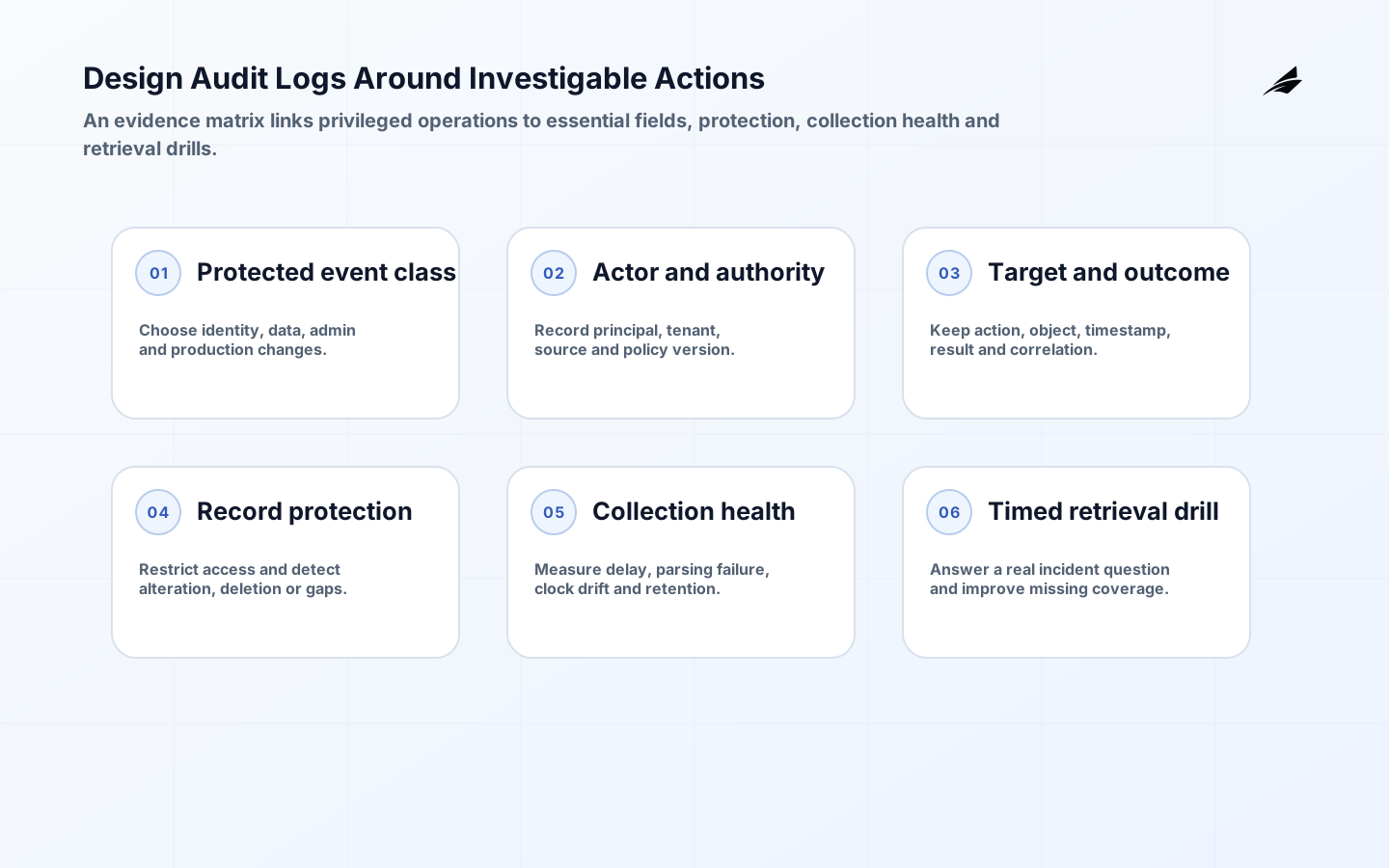
Audit logs for cybersecurity matters when it changes how a team protects privileged actions, data changes, identity events, and security-relevant operational activity. For CTOs, the question is not whether a feature is switched on; it is whether a sensitive request is understandable and bounded. A sound design identifies the actor, action, target, trusted context, safe failure result, and evidence that will be available after an unusual event. Treat audit logging as an operating decision with owners, tests, and a retirement path for temporary arrangements. That gives builders a usable contract and gives incident responders something better than guesswork. A useful first boundary is a data export without a correlation identifier.
Define the protected decision and scope
Start with recognizable situations: an administrator changing a role, a user exporting customer data, and automation altering a production setting. For each, name the action, target, consequence, and accountable owner. Decide whether the system should allow, deny, require another approval, or hold a request when essential context is unavailable. The boundary must include APIs, scheduled work, support tools, and background services, not just a visible screen. That prevents the comforting but unsafe conclusion that an ordinary interface proves the protected operation is actually controlled. The local design must make actor, action, target, outcome, timestamp, tenant, and policy version reviewable before access or processing continues.
Document the facts that can change the decision: actor, action, target, outcome, timestamp, correlation identifier, tenant, source, policy version, and data sensitivity. Record the authority for each fact, how fresh it must be, how it can be changed, and the behavior for a missing or disputed value. Context without an owner is a hidden dependency. NIST SP 800-92: Computer Security Log Management gives a useful baseline for the control; the engineering work is translating it into rules that product owners and on-call engineers can apply consistently. That evidence is especially valuable when a reviewer must explain a data export without a correlation identifier.
| Decision element | Question to settle | Evidence to retain |
|---|---|---|
| Protected operation | What action can cause material harm? | Actor, target, consequence, and owner |
| Trusted context | Which facts change the result? | Source, freshness, and missing-data behavior |
| Exception | When is a bypass justified? | Approver, scope, expiry, and review |
| Verification | How will behavior be proven? | Test result, event record, and version |
Design the control where work happens
Place the final check at the service that performs the sensitive work. A gateway, dashboard, or front end may shape a request, but it cannot be the only protection for privileged actions, data changes, identity events, and security-relevant operational activity. Build around an event schema, protected centralized collection, time synchronization, limited log access, retention rules, and investigation exercises. Send the minimum context needed, validate its origin and format, and make the response safe for callers that retry. OWASP Logging Cheat Sheet emphasizes the core discipline: do not infer enforcement from a prior user-interface decision. For audit logging, the decision record should show the protected target and accountable owner.

Begin with a small surface that is easy to explain. Keep the active policy, configuration, or control version alongside important outcomes. When requests cross services, use a common correlation identifier and agree on who owns each decision. Avoid forcing a downstream system to reconstruct sensitive facts from loosely interpreted headers, stale caches, or remembered assumptions. This also makes future migration safer because the team can compare results before and after a change. The most important implementation discipline here is central collection, time synchronization, and limited log access.
Test hard paths before broad rollout
A successful normal request is only one test. Exercise normal allow and deny results, malformed context, stale context, conflicting permissions, dependency loss, and the emergency path. The recurring risk for audit logging is collecting unstructured messages while omitting actor, target, outcome, or correlation. Assert the protected outcome and every relevant side effect, not just a status code. A denial that still starts an export, writes configuration, or issues a token has not contained the event. This is where teams can remove ambiguity about how downstream services receive trusted context.
Use realistic scenarios with the people who own the workflow. Related work includes RBAC Implementation: Testable Access Controls and Change Recovery, Secrets Rotation for Founders: Architecture and Operating Signals, Secure Admin Panels: Protecting Privileged Actions in Production. Ask whether a caller can retry safely, whether an operator can tell an attack from an integration fault, and whether the customer receives a useful response without unnecessary security detail. NIST SP 800-53 Rev. 5 offers relevant implementation guidance; its value is in testing it against the actual workflow rather than treating it as a generic checklist. A realistic negative test for this subject is a data export without a correlation identifier.
| Test case | Expected result | Operational check |
|---|---|---|
| Ordinary permitted request | Only the intended action completes | Record actor, target, result, and control version |
| Ordinary denied request | No protected side effect occurs | Return a bounded, diagnosable response |
| Context or dependency failure | Apply the documented safe default | Alert the responsible owner when safety or availability is affected |
| Emergency exception | Access is narrow and time-bounded | Capture reason, approver, expiry, and review |
Roll out deliberately and own change
Rollout is a series of reversible decisions, not a date on a project plan. Map dependencies before changing defaults, choose a pilot that includes real edge cases, and define rollback without reopening broad access or exposure. Train support and operations teams on the evidence they will need. Every policy, integration, key, limit, or account should have someone able to approve a change and assess its effect on the rest of the system. For audit logging, a pilot should show whether the investigation fields survive collection and retrieval.
Exceptions need first-class records. State the business reason, allowed action, target, compensating control, approver, end time, and reviewer. Never let a workaround become invisible configuration merely because the normal path is inconvenient. Repeated exceptions usually indicate a design or ownership problem. MITRE ATT&CK supports continuous governance and measurement, the posture needed to spot that drift before it becomes an unwritten policy. A pilot should expose the impact on evidence for privileged actions and data changes before the rule reaches every user.
Measure behavior and investigate with evidence
After release, review event coverage, ingestion delay, parsing failures, clock drift, privileged log access, retention gaps, and investigation time. A count by itself rarely explains anything. Segment activity by application, tenant, action, caller type, and time window, then ask what changed: a client release, an expired dependency, a new integration, an attack, or a human decision. Pair every important signal with an owner and expected response. This turns monitoring into a way to improve operating decisions rather than a dashboard of unresolved ambiguity. The exception register should make recurring reliance on a data export without a correlation identifier impossible to ignore.
Keep sufficient evidence to reconstruct a decision, but do not collect passwords, secrets, raw sensitive payloads, or unnecessary personal information. Run timed investigation drills: ask a realistic question, retrieve the records, identify the effective configuration, and confirm that a reviewer can explain the result. Drills reveal schema gaps, clock problems, inaccessible systems, and unclear ownership more reliably than a documentation review. Reviewing ingestion delay and investigation time turns operational activity into a meaningful control signal.
Handle failures and exceptions safely
When behavior looks wrong, stop further high-risk changes where that is proportionate. Identify the effective path, preserve evidence, and make the smallest correction that contains the risk. Avoid a broad reversal that creates an outage or exposes more data. Then determine whether the actor was identified correctly, the context was authoritative and fresh, enforcement happened at the intended point, an exception changed the result, and monitoring surfaced the condition in time. The retrieval drill should include a question about a data export without a correlation identifier.
A durable corrective action is concrete: update a contract, owner map, policy test, dependency guard, or runbook. Do not settle for a vague instruction to be more careful. Incident review for audit logging should ask whether the product made unsafe behavior too easy to request or too hard to notice. That may require a product constraint as much as a security setting, which is a useful distinction when prioritizing engineering work. Containment plans should state how evidence for privileged actions and data changes remain protected during corrective work.
Key takeaways
- Define Audit logs for cybersecurity around named actions, targets, consequences, and owners.
- Treat actor, action, target, outcome, timestamp, correlation identifier, tenant, source, policy version, and data sensitivity as security dependencies with provenance and freshness rules.
- Enforce the final decision where the sensitive operation occurs.
- Test denial, degradation, cross-boundary behavior, and emergency use before expansion.
- Use event coverage, ingestion delay, parsing failures, clock drift, privileged log access, retention gaps, and investigation time to find drift and improve the control.
Frequently asked questions
Where should a team begin? Start with one high-impact workflow and make its decision path explainable end to end. A narrow, fully tested implementation of audit logging is more valuable than a broad inventory of controls. Use the first workflow to settle evidence fields, escalation ownership, and standards for exceptions, then extend that pattern to neighboring services. A follow-up owner should verify that central collection, time synchronization, and limited log access now covers the observed weakness.
How much evidence is enough? Retain enough context to answer who acted, what was attempted, which target was involved, what occurred, and which version made the decision. The record should support investigation without retaining secrets or raw sensitive payloads. Validate detail with a timed retrieval exercise rather than guessing from a generic event schema. The first workflow can be chosen around a data export without a correlation identifier.
When is an exception acceptable? An exception can be reasonable when a legitimate operation cannot safely wait, but it must be narrower than the normal rule and have a named owner, expiry, and review. Emergency access without expiry or evidence is a weaker parallel system. Repeated use is a signal to improve the ordinary workflow. Evidence for audit logging is most useful when it includes actor, action, target, outcome, timestamp, tenant, and policy version.
Conclusion
Audit logs for cybersecurity becomes dependable when it is operated as an accountable decision instead of an isolated setting. Define the protected work, verify the facts that influence it, enforce close to the action, rehearse difficult conditions, and keep evidence that people can use. The architecture differs across privileged actions, data changes, identity events, and security-relevant operational activity, but this discipline gives builders clear contracts, operators useful signals, and leaders a defensible view of how security protects real work. A legitimate exception still needs central collection, time synchronization, and limited log access.