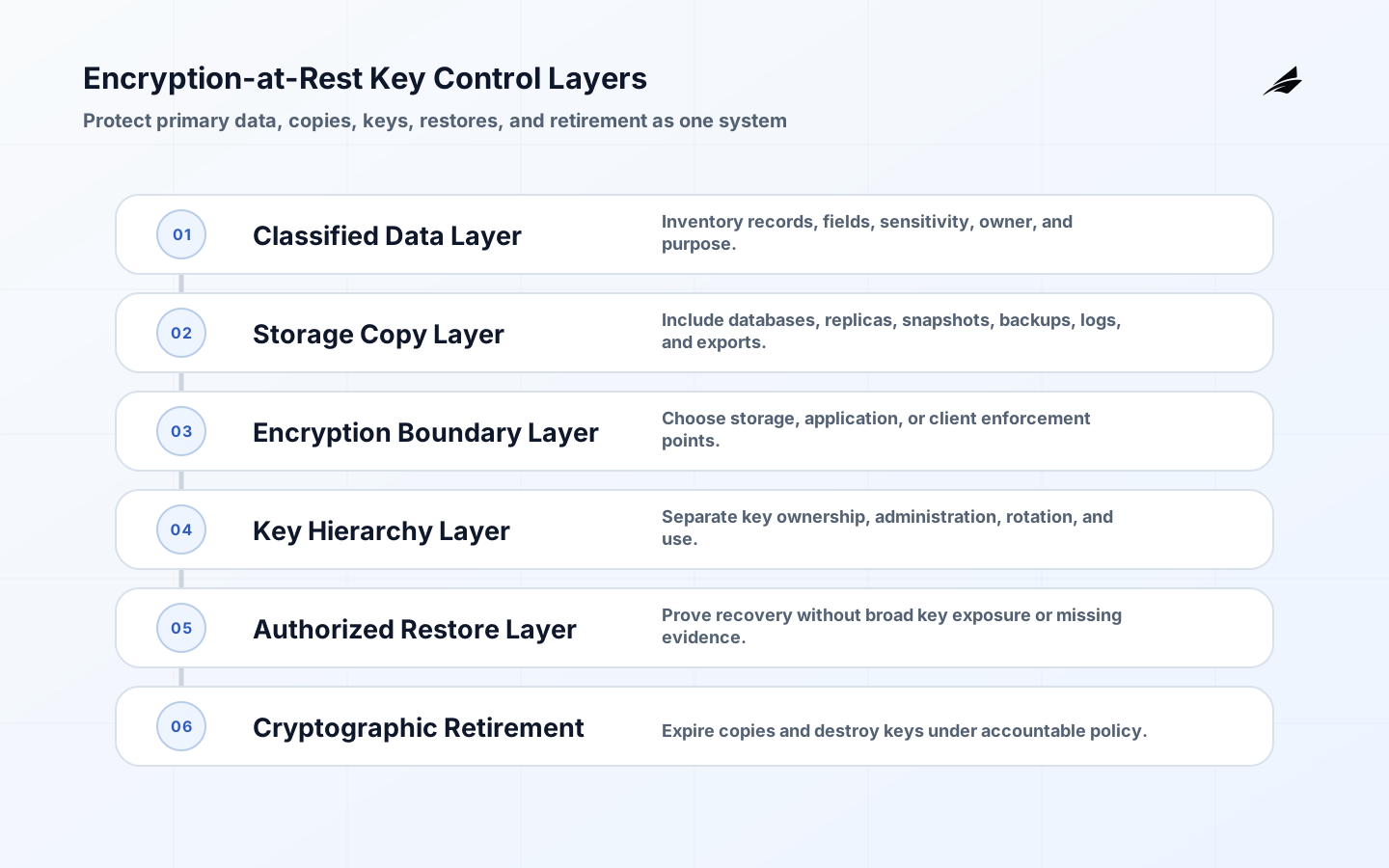
Encryption at rest becomes consequential before any policy engine, identity provider, dashboard, or pipeline is selected. For engineering teams, the practical question is whether the organization can make a repeatable decision about data stores, backups, exports, replicas, and the keys that make recovery possible. A strong first build treats the work as an operating capability: it identifies the people who own the decision, the facts that are allowed to influence it, the systems that enforce it, and the evidence needed when something surprises the team. NIST SP 800-57 Part 1 Rev. 5: Key Management establishes a useful baseline; the local design must still state what is protected, what fails closed or pauses for review, and who can change the rule. This guide turns encryption at rest from a broad label into a buildable, reviewable plan. For this design choice, name the accountable owner, supporting evidence, exception route, and next measurable check.
Define the work before selecting a tool
Begin with one concrete workflow rather than a catalogue of features. Describe the trigger, the actor, the resource or metric affected, the decision that follows, and the consequence of a bad result. In this topic, the critical facts are data class, storage location, backup copy, encryption mode, key owner, key hierarchy, rotation event, and restore authorization. For each fact, identify its system of record, its expected freshness, and whether a missing value should deny, delay, or route the work to a human. This avoids a familiar failure: a team chooses a capable platform but cannot explain what it should decide. The design is ready for engineering when a reviewer can read a normal case and an uncomfortable edge case and predict the expected outcome without interpreting an unwritten convention. Within this part of the system, name the accountable owner, supporting evidence, exception route, and next measurable check.
| Protection layer | What it covers | Question to test |
|---|---|---|
| Storage encryption | Lost media and storage access paths | Are backups and snapshots included? |
| Application encryption | Selected fields before storage | Who can decrypt and where? |
| Key management | Key creation, use, rotation, and destruction | Can recovery work without broad access? |
Design the control and its boundaries
The central design decision is a clear encryption boundary and a key-management design that survives restore, incident response, and personnel change. Keep that decision visible in the architecture. Put the authoritative evaluation close to the thing being protected or published; a client screen, notebook, or documentation page may guide behavior, but it cannot be the only safeguard. OWASP Cryptographic Storage Cheat Sheet is especially useful for distinguishing the model from a particular vendor implementation. Draw the normal route as well as administrative, batch, support, recovery, and integration routes. Those paths often carry the same authority or data value but are tested less often. Make exceptions explicit, time-bound, attributable, and reviewable. When implementing this control, name the accountable owner, supporting evidence, exception route, and next measurable check.

A useful design records both permission and context. Permission answers who is generally eligible; context answers whether this particular action, data point, or release is appropriate now. That distinction limits brittle rules and makes change discussions healthier. Teams should reject the temptation to encode policy in naming conventions, screen visibility, or tribal knowledge. Instead, maintain a small decision record that names the rule owner, affected parties, inputs, expected result, failure behavior, and testing method. The record should survive a staff change and give incident responders a starting point that is more precise than “the system normally handles that.” This encryption at rest decisions that matter before the first build guide keeps that operational context explicit.
| Control signal | Concern | Response |
|---|---|---|
| Untracked export | A copy may be outside the boundary | Classify and protect the path |
| Key-use anomaly | A key may be used unexpectedly | Investigate actor and purpose |
| Restore failure | Encryption and recovery are misaligned | Exercise documented restoration |
Prove the first release with real cases
Release evidence should show more than a successful demonstration. Exercise representative normal cases, boundary cases, revoked or expired conditions, dependency failures, and an authorized emergency path. The evidence for encryption at rest should include data classification, encryption boundary, key identifier, key-use event, backup coverage, restore exercise, and retention decision. Test the place where the decision actually takes effect, not only a configuration screen or a mocked interface. NIST SP 800-111: Storage Encryption Technologies provides practical control guidance that can help teams turn these checks into acceptance criteria. A short, repeatable test set is more valuable than a long policy document that nobody can execute under release pressure. Before releasing this operating step, name the accountable owner, supporting evidence, exception route, and next measurable check.
- Write five real examples of encryption at rest, including one failure and one exception.
- Name the owner for every input that can change the outcome.
- Test the protected boundary with both allow and deny cases.
- Capture evidence that another responder can retrieve quickly.
- Set a review date for exceptions and temporary changes.
Operate with evidence, not assumptions
Production changes the quality of the questions. Instead of asking whether the design exists, ask whether it produces trustworthy outcomes under normal load, staff turnover, and partial failure. Treating a storage-provider setting as complete coverage while exports, snapshots, logs, or keys follow weaker paths is a signal that the model and the operating practice have separated. Monitor the leading indicators in the second table, but retain enough context to distinguish a bad request, a stale source, a product workflow gap, and a possible attack or incident. A denial, alert, correction, or failed validation is not automatically a defect. It is evidence that needs an owner, a clear path to investigation, and a bounded response time. While operating this evaluation, name the accountable owner, supporting evidence, exception route, and next measurable check.
Manage change as part of the design
Every material change can alter assumptions: a new integration, customer segment, administrator, data source, endpoint, recovery procedure, or business definition. Treat the change request as an opportunity to re-check scope, inputs, enforcement, and evidence. FIPS 197: Advanced Encryption Standard frames this mindset as continuous verification rather than a one-time perimeter decision. The smallest practical governance loop is simple: propose the change, identify affected decisions and consumers, test representative outcomes, publish the result, then observe the behavior after release. This keeps the operating model responsive without normalizing unreviewed drift. When changing this design choice, name the accountable owner, supporting evidence, exception route, and next measurable check.
Internal reading can help a team keep adjacent choices connected. Encryption in Transit: Boundaries, Failure Paths, and Operations is a useful companion because it approaches a related operational boundary. Use internal links as a way to deepen the implementation conversation, not as a substitute for checking the systems and obligations in front of you. Where regulation, contracts, or safety requirements apply, have the accountable security, privacy, legal, or data owner interpret them for the actual environment. During support for this design choice, name the accountable owner, supporting evidence, exception route, and next measurable check.
Implementation practice
For engineering teams working on encryption at rest for engineering teams, this operating decision should connect identity, assets, policy enforcement, security evidence, exceptions, and recovery to evidence an accountable owner can inspect. Start with an inventory that is narrow enough to finish and rich enough to expose dependencies. Assign a named owner to the protected workflow, each authoritative source, the technical control, the monitoring route, and the exception process. Build a trace from input to decision to outcome. That trace should let a support engineer answer what happened without reading source code, while still allowing an engineer to reproduce the logic. Prefer defaults that limit harm when required facts are unavailable; where a workflow must continue, route it through a visible, accountable exception rather than silently relaxing the rule. In this operating review, move beyond the operating decision only after the owner can show the accepted result, the exception path, and the signal for another review.
- Keep policy, schema, metric, or configuration changes under reviewable version control.
- Make ownership and escalation visible beside the work rather than in an isolated handbook.
- Practice the recovery or rollback route before relying on it during an incident.
- Remove tests, rules, fields, roles, routes, or dashboards that no longer support a decision.
Review the evidence
In encryption at rest for engineering teams, engineering teams should make the relationship between identity, assets, policy enforcement, security evidence, exceptions, and recovery explicit and reviewable. A regular review should compare the intended workflow with operational reality. Sample recent outcomes, inspect exceptions, test one negative case, and ask the people doing the work where they leave the designed path. Look for concentration of privilege, unexplained delays, recurring manual corrections, stale values, and evidence that cannot be retrieved. The aim is not perfect documentation. It is a dependable feedback loop that makes the next correction smaller, cheaper, and easier to justify. Record decisions in plain language so leaders can see the trade-off between speed, risk, cost, and reliability. This operating review should close the information boundary only when the result, unresolved exception, and next review condition are recorded.
Key takeaways
- Encryption at rest should begin with a concrete decision and named owner.
- Authoritative facts need provenance, freshness expectations, and defined failure behavior.
- The first release needs evidence from the real enforcement or publication boundary.
- Exceptions require attribution, expiry, and review.
- Operational signals should feed a planned change loop rather than ad hoc fixes.
Frequently asked questions
Does encryption at rest require a large platform first? Usually no. A focused workflow, a clear source of truth, and a testable control or data product can create better evidence than a broad rollout. What should be measured? Measure the quality and timeliness of the decision, the rate and age of exceptions, the reliability of the underlying facts, and whether users can act without leaving the governed workflow. How often should it be reviewed? Review after material change, a concerning signal, or an incident; establish a regular cadence for long-lived controls and high-impact data. When explaining this part of the system, name the accountable owner, supporting evidence, exception route, and next measurable check.
Conclusion
The first build for encryption at rest should make one important decision safer, clearer, and easier to explain. Define the work, state the boundary, test representative outcomes, preserve evidence, and keep a disciplined change loop. That is how a technical capability becomes something the organization can operate and trust. For this part of the system, test one expected case, one ambiguous case, and one failure with a documented recovery action.