How CTOs Should Think About Session Security
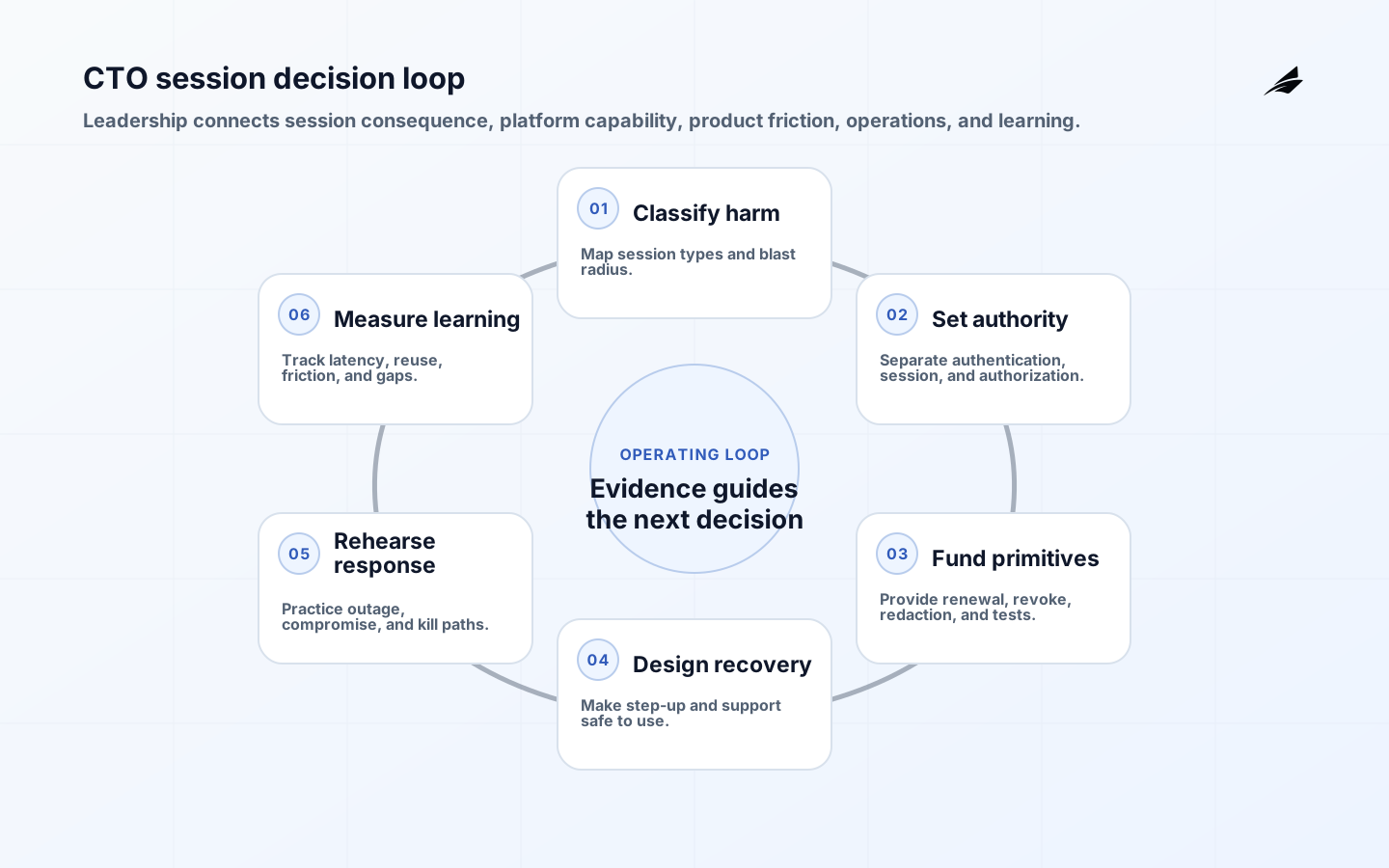
For a CTO, CTO session security is the boundary between a successful sign-in and every consequential action that follows. It affects product trust, incident response, customer support, architecture, and delivery speed. The executive question is not whether the team set a cookie flag. It is whether the organization can explain who held authority, what that authority could do, how long it lasted, how it changed, and how quickly it can be revoked when risk changes.
Start with the failure you must contain
Define the consequences of a stolen browser session, refresh token, service token, or privileged support session. A read-only analyst session, customer administrator session, and deployment session should not have identical lifetime or recovery. Map the maximum blast radius, detection signal, revocation path, and manual fallback. This makes tradeoffs visible when teams argue about friction or convenience.
| Session class | Primary risk | Leadership decision |
|---|---|---|
| Customer user | Account and data access | Recovery and device revocation |
| Customer admin | Tenant-wide changes | Fresh auth and approval |
| Operator | Support or impersonation | Time limit and evidence |
| Service | Automated side effects | Scope, rotation, and replay control |
Separate authentication, session, and authorization
Authentication establishes an identity; session management carries authority; authorization decides each resource action. OWASP emphasizes the relationship because frameworks often do not enforce the separation for you. Make these boundaries visible in architecture reviews. A valid session should not imply access to every tenant, and a valid access token should not bypass resource-server checks.
NIST's zero-trust architecture provides a useful executive lens: protect resources, authenticate and authorize explicitly, and avoid treating network location or ownership as implicit trust. For browser and OAuth clients, current IETF guidance and WebAuthn standards help the team choose stronger authentication and safer token flows, but they do not replace a product-specific authorization model.
Invest in platform capabilities
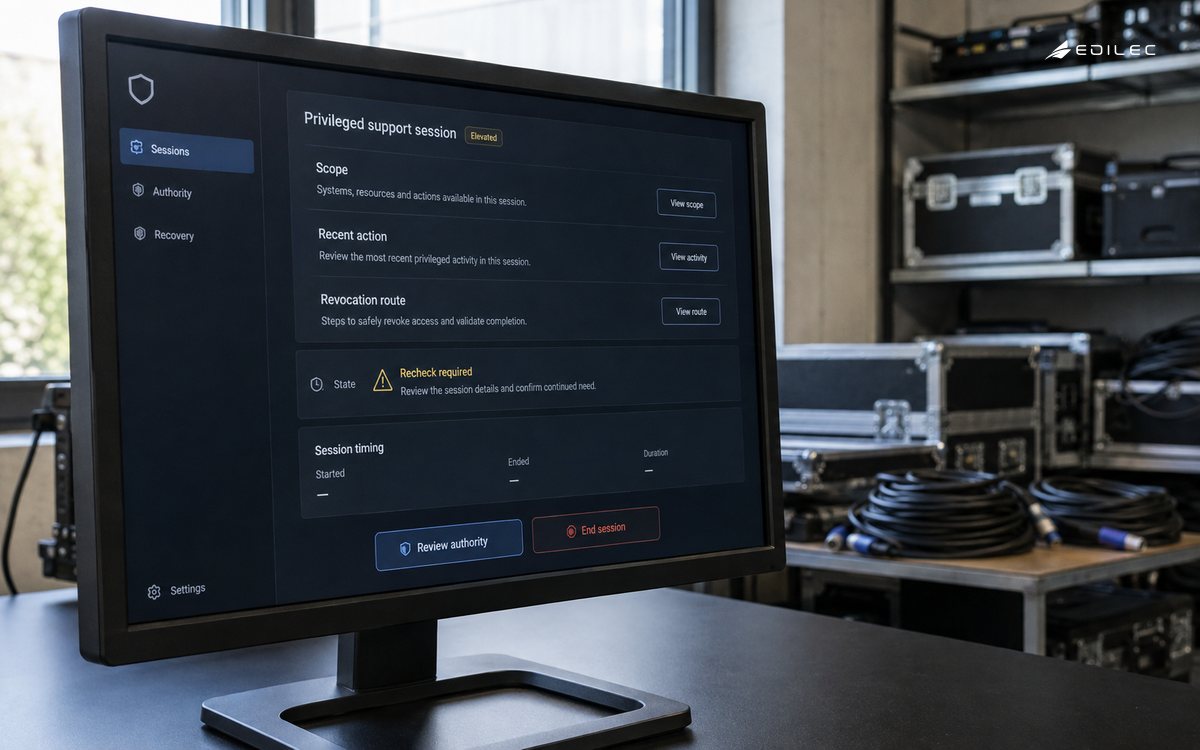
Give product teams a maintained session library or service with secure defaults, renewal hooks, revocation, audit events, risk-event callbacks, and test fixtures. Centralize policy primitives without forcing every product into one user experience. Provide a session inventory, device/session revoke action, redaction helpers, and a way to simulate expiry and provider failure. This is a platform investment because duplicated session code multiplies incident and migration cost.
Treat security friction as a design problem
A fresh-authentication challenge is easier to accept when the product explains the reason, preserves safe work, and offers recovery. Define when step-up is required, which factor is acceptable, and what happens if the identity provider is unavailable. Phishing-resistant public-key credentials can improve high-value authentication, but enrollment, replacement, and account recovery must be designed together. Do not measure security only by successful login rate; measure safe completion and support effort.
| Metric | What it reveals | Action |
|---|---|---|
| Revocation latency | How quickly authority ends | Improve propagation |
| Step-up completion | Friction at sensitive actions | Fix UX or factor choice |
| Unknown sessions | Visibility gap | Repair inventory |
| Refresh reuse | Possible theft or client bug | Revoke and investigate |
Make incident response executable
Set ownership across the session boundary
Session security crosses teams, so ownership must be explicit. The identity team may own authentication and factor enrollment; the platform team may own session storage, revocation propagation, and shared libraries; product teams own resource authorization and user experience; security owns threat modeling and incident response; support owns the safe customer workflow. Write the handoffs into the service contract. A provider can authenticate a person, but it cannot decide whether that person may export a particular tenant's data.
Give each session class a service owner and a risk owner. The service owner keeps the mechanism available and tested; the risk owner decides the acceptable lifetime, friction, and recovery evidence. This distinction prevents platform defaults from becoming accidental policy. It also makes investment conversations concrete: a missing device-revoke capability is a platform gap, while an unclear customer-admin approval rule is a product and governance gap.
Choose tradeoffs by consequence
Security friction is not uniformly bad. Requiring a fresh factor before changing a payout account may be the correct product behavior, while forcing a new challenge for every low-risk read can create fatigue and unsafe workarounds. Use a consequence ladder: read, create, approve, export, administer, and recover do not need identical authority. Document why each level has its lifetime, factor, device, and approval requirements, then test whether users can complete the safe path without support intervention.
| Decision | Low-consequence example | High-consequence example |
|---|---|---|
| Lifetime | Longer working session | Shorter absolute lifetime |
| Fresh auth | Not every read | Required before payout change |
| Device | Useful signal | Fresh managed posture |
| Approval | Self-service action | Second person or case reference |
| Recovery | Routine factor replacement | Verified escalation and review |
Use an executive scorecard that drives action
A useful scorecard connects technical signals to customer and business outcomes. Report active sessions by class, revocation latency, unknown-device coverage, refresh-token reuse, step-up completion, recovery time, support impersonation age, and the number of protected actions performed in a degraded mode. Each metric should have a threshold and an owner. For example, a rise in revocation latency may trigger a platform capacity review; a rise in recovery time may require product and support design work rather than another alert.
Review the scorecard after incidents and major product changes. New mobile clients, embedded applications, regional deployment, acquisition of another identity system, and a new support workflow can change the session threat model. Keep a decision record that states what changed, which assumptions were tested, and what remains an accepted risk. That record gives the next team a starting point instead of forcing them to rediscover why a control exists.
A response plan should answer which sessions can be revoked globally, by tenant, by user, by device, or by token family. Test it with a staged compromise. Include customer communication, support verification, audit preservation, and a safe way to restore access. Keep an emergency path narrow and monitored; a global kill switch that nobody rehearses can create a second outage during the first incident.
Sequence the roadmap
Start with inventory and evidence: session classes, storage, lifetime, revocation, token exposure, and owner. Next fix the highest-consequence transitions, then add device/session visibility, step-up authentication, and replay-resistant token design. Expand only after the team can test the baseline. Edilec's session checklist and mistakes and fixes provide implementation-level companions.
Key takeaways
Invest where consistency reduces risk
The highest-leverage platform capabilities are usually not another dashboard. They are safe defaults, a shared session contract, reliable revocation, redacted lifecycle events, test fixtures, key-rotation support, and a customer-visible session inventory. Give teams a paved path that is easier to use than copying a token example from an old service. Then allow product-specific authorization and recovery decisions to remain explicit rather than hiding them behind an over-generalized platform API.
Fund rehearsals as part of delivery. A tabletop for a stolen refresh token, a regional logout test, or a support impersonation review can reveal a missing owner faster than a compliance checklist. Track the time from detection to scoped revocation and from revocation to customer confirmation. Those measures help leadership decide whether to invest in propagation, recovery UX, or identity-provider resilience.
- Classify sessions by consequence and recovery cost.
- Keep authentication, continued authority, and resource authorization distinct.
- Fund shared lifecycle primitives: renewal, revocation, visibility, redaction, and testing.
- Design step-up and recovery as product journeys, not isolated controls.
- Rehearse global, scoped, device, and token-family revocation.
- Measure revocation latency, unknown sessions, safe completion, and replay signals.
Frequently asked questions
A quarterly review can stay short if it is evidence-led: inspect one revocation drill, one recovery case, one client migration, one support session, and the current risk metrics. The purpose is to keep ownership and assumptions current.
Leadership can keep this work focused by reviewing the highest-consequence session class first and requiring each product to name its owner, resource authorization, revocation path, and recovery evidence.
Architecture choices should also account for acquisition and exit. If a company adds a mobile client, embeds the product in another host, or acquires a service with its own identity system, the session boundary changes. Require an inventory and threat-model update before connecting the new surface. The executive owner should know which artifacts can cross the boundary, how customers revoke them, and which team will answer for an incident.
A quarterly review can remain short if it is evidence-led: inspect one revocation drill, one recovery case, one client migration, one support session, and the current risk metrics. The purpose is to keep ownership and assumptions current, not to create a large report.
The board-level question is simple: if this authority were stolen today, could the company identify its scope, end it, support the affected customer, and explain what happened? The roadmap should close the gaps in that answer in consequence order.
A useful executive decision record states the consequence, the authority model, the customer friction accepted, the recovery path, the owner, and the evidence that will show the investment is working.
Leadership need not choose between a frictionless product and a secure one. It should require the organization to make consequence, authority, recovery, and evidence explicit enough that each product can choose a proportionate control and prove that it works.
What should leadership ask after a session incident?
Ask what authority was exposed, how quickly it was bounded, which customers or resources were in scope, how recovery worked, and what evidence proves the old authority is no longer usable. Turn unanswered questions into owned roadmap work.
Should session management be centralized?
Centralize secure primitives, telemetry, and revocation where consistency helps, while allowing products to choose workflows and resource policies appropriate to their customers.
Is MFA the end of session security?
No. MFA strengthens authentication but does not prevent a stolen live session, over-broad authorization, weak logout, or poor recovery. The session lifecycle still needs controls.
Conclusion
For implementation detail, connect this strategy to Edilec's session security checklist, session mistakes guide, and production session guide. The WebAuthn Level 3 specification informs phishing-resistant authentication; RFC 6819 catalogs OAuth threats; Google Cloud's audit-logging guidance supports evidence; and MDN's Cache-Control reference explains cache behavior relevant to authority.
CTOs should make session security a visible operating capability. Classify authority, invest in safe defaults, design recovery, and rehearse revocation. The result is a platform that can support product growth without turning every identity incident into a company-wide improvisation.