Session Security: Mistakes and Fixes
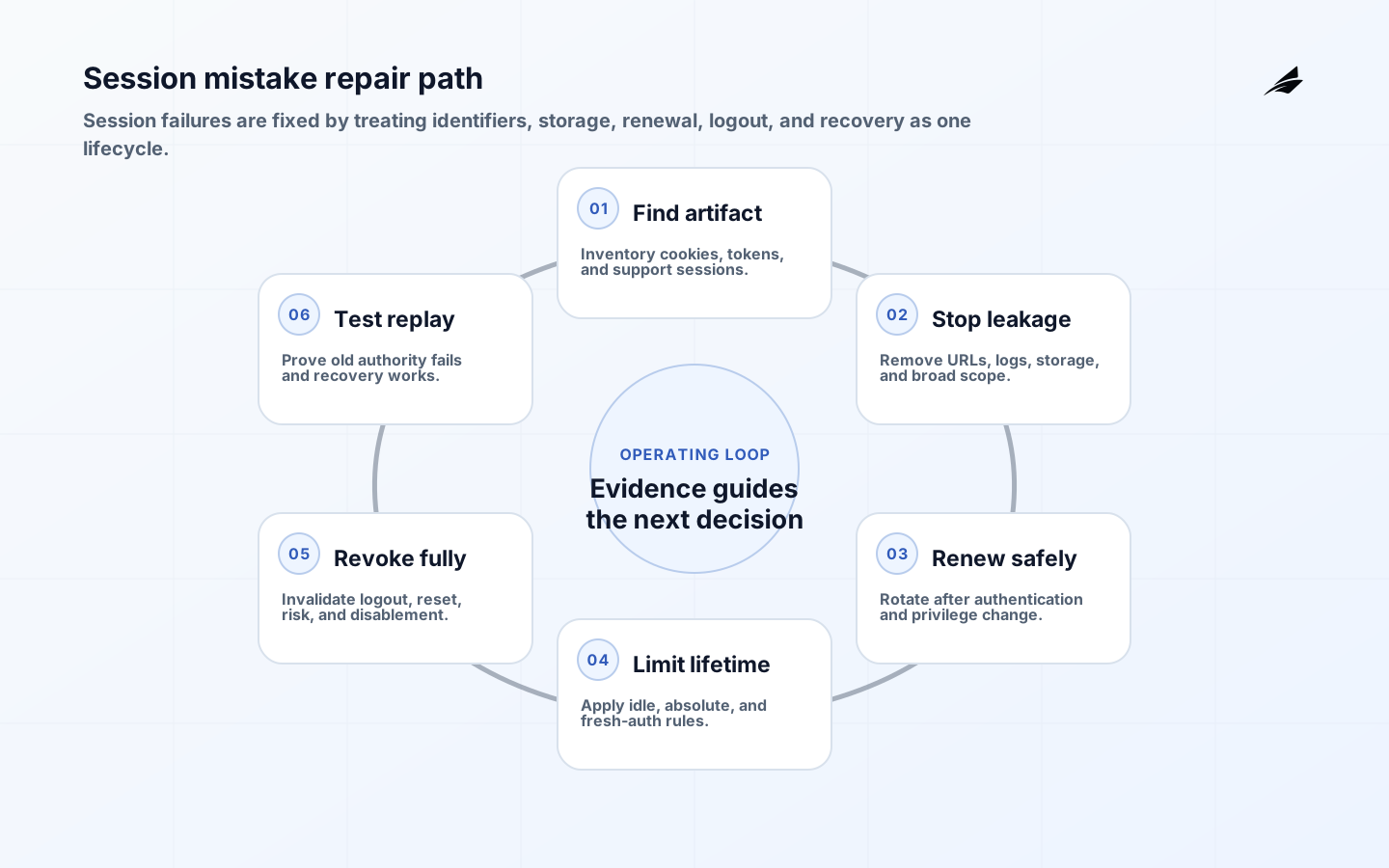
A session is a continuing security decision, not proof that login happened once. The most damaging session failures are ordinary implementation shortcuts: an identifier survives privilege change, a cookie leaks into a log, logout only clears the browser, or a refresh token can be replayed forever. OWASP's session guidance is valuable because it treats creation, use, renewal, and destruction as one lifecycle.
Mistake 1: keeping the pre-authentication identifier
If an application accepts a session identifier before sign-in and keeps it after sign-in, an attacker may try to fix the identifier and wait for the victim to authenticate. Generate a fresh identifier after authentication and after privilege changes. Invalidate the old one where appropriate. Test the transition rather than checking only the final cookie flags.
Mistake 2: leaking tokens through storage and logs
Tokens in URLs, analytics events, exception messages, browser history, screenshots, or support tickets become credentials in places nobody expects to revoke. Keep sensitive cookies out of script when the design allows it, redact values in telemetry, and ensure support tools show a reference rather than the artifact. RFC 6265 describes cookie mechanics; the application must still decide which host, path, and lifetime are safe.
| Failure | Why it matters | Fix to verify |
|---|---|---|
| Stable ID after login | Enables fixation | Renew and invalidate |
| Broad cookie domain | Shares authority across apps | Narrow host and path |
| Token in URL | Leaks to history and referrers | Use protected channel |
| Raw token in logs | Creates copy outside revocation | Redact and test logging |
Mistake 3: one timeout for every risk
Idle timeout, absolute timeout, and fresh authentication solve different problems. A long-running analyst session may be acceptable for low-risk work but not for changing payment details or administering an identity provider. Define the consequence, interruption cost, and recovery flow. Explain expiry in the interface so users do not create unsafe workarounds such as sharing a browser or disabling protections.
Mistake 4: logout that is only cosmetic
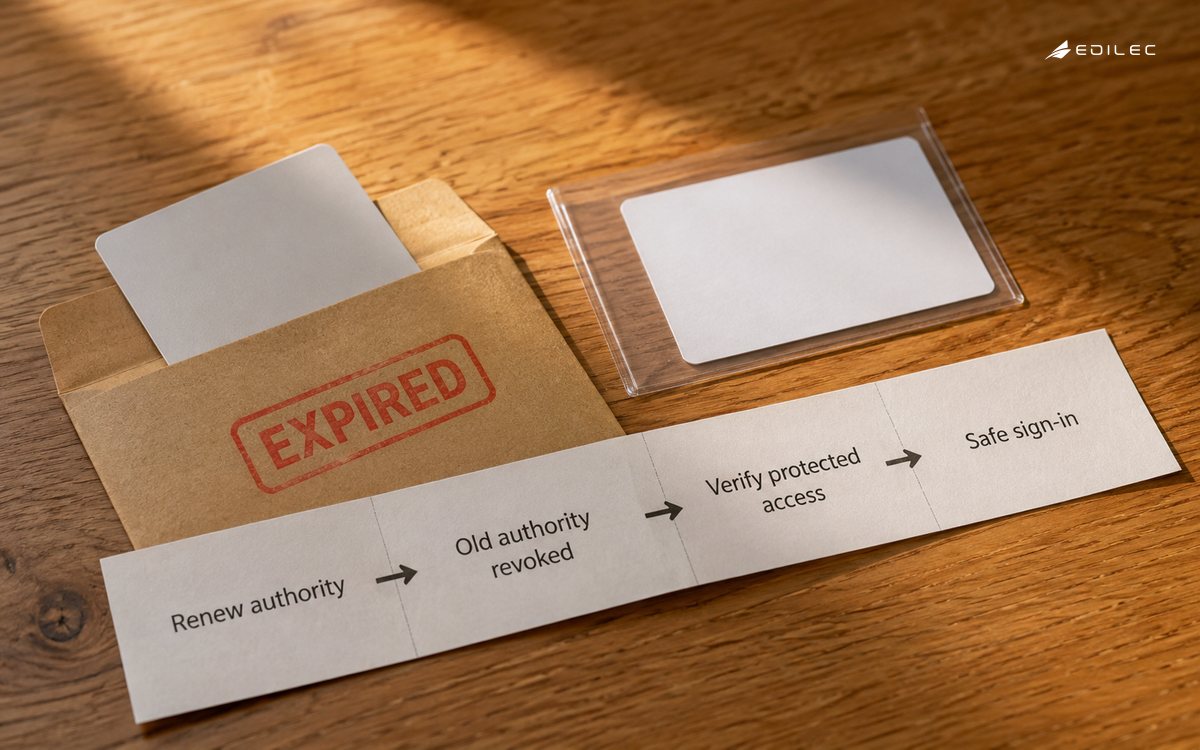
Clearing a cookie does not necessarily revoke a server-side session or refresh-token family. Test logout by replaying a captured test artifact, using another browser, and starting a new access token flow. Revoke active sessions after password reset, account disablement, suspected compromise, and material role removal. Provide a session list so users can see and end other devices.
Mistake 5: copying obsolete OAuth examples
Current IETF guidance in RFC 9700 favors authorization-code based flows, PKCE where applicable, careful redirect validation, and replay resistance. Do not use an implicit flow because an old blog post did. Validate issuer, audience, scope, nonce where required, and token expiry. Protect refresh tokens and treat the resource server as an independent enforcement point.
Mistake 6: ignoring risk events
A password reset, new MFA factor, unfamiliar device, impossible travel signal, or administrator elevation can change the risk of a session that was valid moments earlier. Define which events require renewal, reauthentication, revocation, or review. Do not make a risk score the only decision; show the user and operator the concrete protective action.
| Event | Default response | Evidence |
|---|---|---|
| Password reset | Revoke active sessions | Session revocations |
| MFA enrollment | Renew and notify | Factor and actor record |
| Role elevation | Fresh authentication | Policy decision |
| Device loss | Revoke device sessions | User confirmation and time |
Build a failure-focused test set
Handle concurrent sessions deliberately
Users commonly have several browser tabs, a phone, a tablet, and a support session open at once. Decide whether a password reset, MFA change, role removal, or device revoke ends all sessions or only a class of sessions. Make the result predictable and visible in the session list. A global logout that leaves a refresh token alive is confusing at best and a security gap at worst; a global logout that interrupts a critical workflow without a recovery path can push operators toward unsafe sharing.
Test races between renewal and revocation. A client may renew just as an administrator disables the account; a background request may be in flight when the user clicks logout; a regional cache may still accept a token after the central session is revoked. Define the ordering and record it. When the system cannot guarantee immediate global invalidation, choose the maximum acceptable delay by consequence and compensate with shorter lifetimes or stronger checks for sensitive actions.
Do not make recovery the weakest path
An account recovery flow can create fresh authority, so it deserves the same threat model as sign-in. Separate proof of identity from possession of a previously trusted browser, require stronger evidence for high-value accounts, notify the user, and revoke artifacts whose compromise may have triggered the recovery. Avoid support questions whose answers can be found on a public profile. Give support a narrow escalation path and record why it was used.
| Scenario | Unsafe shortcut | Safer decision |
|---|---|---|
| Lost device | Keep all sessions active | Revoke device and review others |
| MFA reset | Trust a single weak signal | Step up identity proof and notify |
| Provider outage | Extend every session indefinitely | Restrict by consequence and time |
| Support request | Ask for a token screenshot | Use verified, scoped recovery |
Measure the repair, not the login rate
Track how long revocation takes, how many sessions remain unknown, how often refresh reuse occurs, how many step-up challenges complete safely, and how much support effort recovery requires. Segment by session class and consequence. A drop in sign-in failures may mean the product became easier to use, or it may mean a control was bypassed. Pair convenience measures with replay tests and authorization outcomes so the team does not optimize the wrong signal.
Test fixation, stolen-cookie replay, cross-subdomain behavior, CSRF, idle expiry, absolute expiry, concurrent sessions, logout, password reset, refresh-token reuse, and administrator recovery. Include failures in the identity provider, session store, clock, and network. A secure result must be understandable: the user knows what happened, the operator can see why, and the old authority is no longer accepted.
Key takeaways
Make session changes safe to deploy
Session changes are migrations when they alter cookie scope, token claims, signing keys, refresh behavior, lifetime, or browser storage. Test them with old and new clients, multiple tabs, a revoked user, an administrator, and a user in a second tenant. Roll out to a representative cohort, watch renewal and logout, and keep a bounded compatibility path. A rollback plan must include data and revocation state, not only application code.
Keep support informed about the user-visible result. If a rollout intentionally signs people out, say why and give a safe sign-in path. If a risk rule challenges a user more often, measure completion and recovery requests. Clear communication reduces the chance that a person will disable a protection, share a browser, or submit a credential to someone offering help.
- Renew identifiers at authentication and privilege transitions.
- Keep tokens out of URLs, logs, analytics, screenshots, and broad browser storage.
- Choose timeout and fresh-authentication behavior by consequence.
- Make logout, recovery, and session revocation verifiable.
- Use current OAuth guidance and validate tokens at the resource server.
- Treat risk events as lifecycle transitions, not merely alerts.
Frequently asked questions
A durable repair records the old behavior, chosen control, reproducing test, and proof that the old authority is rejected.
Use separate test accounts for a normal user, administrator, support operator, and service client. Their sessions have different consequences, so a control acceptable for one may be unsafe for another.
Do not judge a session fix by the absence of an error page. Confirm that the protected resource rejects the old artifact, the renewal path cannot recreate it, logs contain no secret, and the user receives a safe explanation. These checks distinguish real revocation from cosmetic logout.
The safest recovery path is designed at the same time as the session path. It should state what evidence is sufficient, what artifacts are revoked, who is notified, and how the user returns without teaching support staff to handle raw credentials.
A safe client should treat session failure as a state transition. Stop protected mutations, preserve only safe local work, clear or quarantine expired artifacts, and ask the user to authenticate through the normal route. Do not copy a failing token into a new request, silently downgrade to an unauthenticated endpoint, or keep retrying a provider that has already rejected the session. The service should be able to tell the difference between expiry, revocation, insufficient authorization, and a temporary dependency failure.
Do not judge a session fix by the absence of an obvious error page. Confirm the artifact is not accepted by the protected resource, the renewal path cannot recreate it, logs contain no secret, and the user receives a safe explanation. These checks distinguish a real lifecycle fix from a cosmetic logout.
Create distinct test accounts for a normal user, administrator, support operator, and service client. Their sessions have different consequences, so a control that is safe for one may be unsafe for another.
Keep a test artifact and a replay result for every significant lifecycle fix; this makes later browser, provider, and regional changes safer to review.
What should a session recovery test prove?
It should prove that old artifacts fail, renewal cannot recreate revoked authority, support can help without seeing secrets, and the user has a safe route back through normal authentication. Record the expected result and evidence.
A session repair should leave a durable record of the old behavior, the chosen control, the test that reproduced the issue, and the test that proves the fix. Without that record, later client or provider changes can quietly reintroduce the same lifecycle gap.
Does using JWT remove session risks?
No. It changes where authority is stored and complicates revocation, rotation, leakage, and audience validation. A signed token can still be stolen and replayed.
What proves logout works?
A previously valid test artifact cannot perform a protected request or mint a new token after logout, reset, disablement, or the defined revocation event.
Conclusion
Fixing session security means closing the gaps between authentication, continued authority, and revocation. Test those transitions as carefully as the login screen.
Continue with the session security checklist, CTO guide, and production guide. The JWT best-current-practice RFC addresses token validation risks; RFC 9068 defines JWT access tokens; Microsoft's access-token guidance explains lifecycle choices; and Kubernetes' authentication reference shows how system identity fits the boundary.