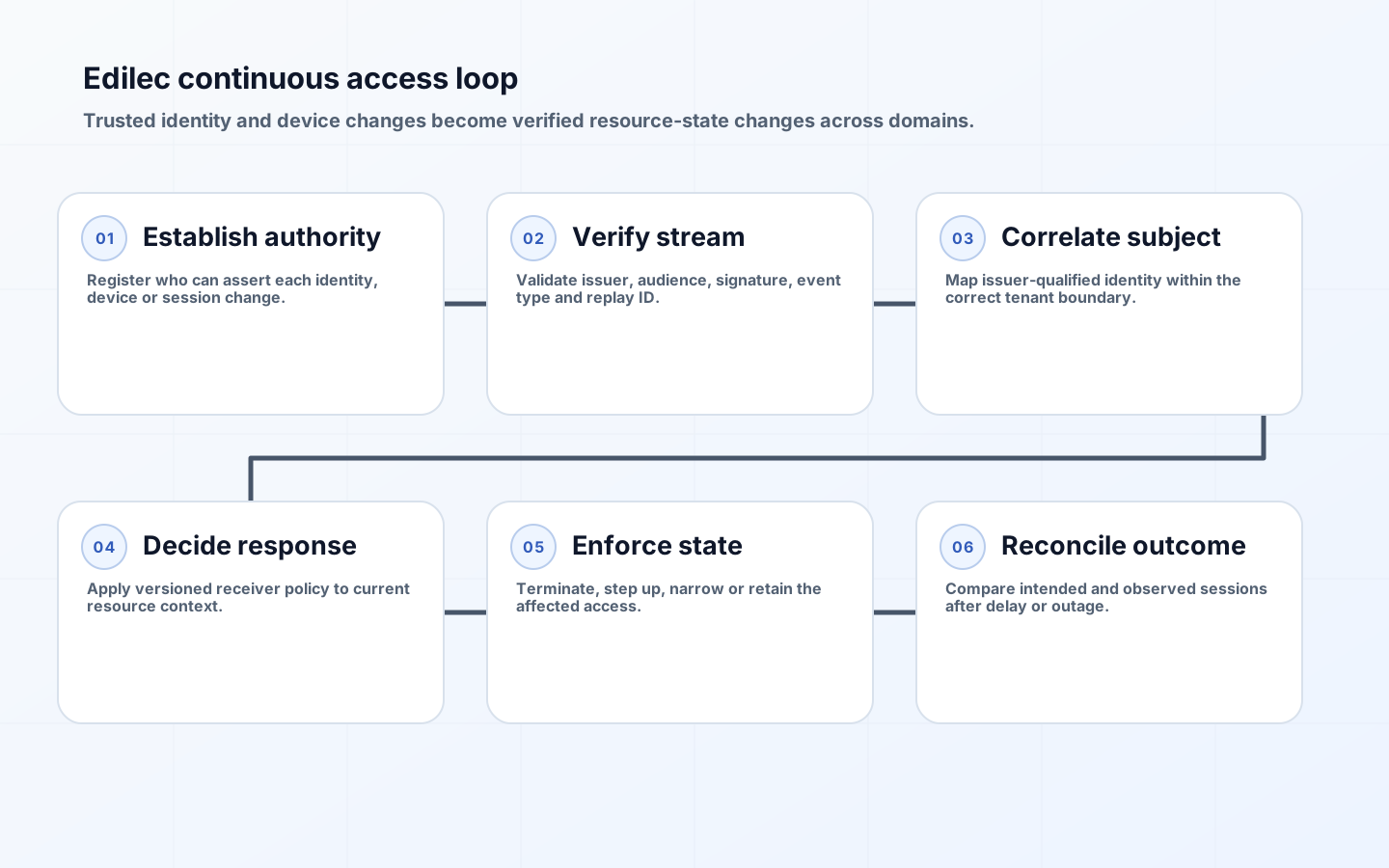
Continuous access evaluation closes the gap between an identity or device change and the next application decision. Without it, a SaaS session can remain useful after an account is disabled, a credential changes or device compliance falls. Shared signals do not create magical continuous authorization. They give cooperating systems a standard way to report security-relevant state changes so each receiver can reduce, challenge or end access under its own policy.
The engineering work spans identity, event delivery, session inventory, application policy and reconciliation. Begin with Edilec's session security decisions guide to define session renewal and termination locally. Then use shared signals where state crosses organizational or product boundaries. The outcome should be measurable: a qualified event reaches the right receiver, maps to the right subject and produces a bounded policy action within an agreed objective.
Define the continuous access evaluation boundary
List state authorities and access holders. An identity provider may know that a workforce account is disabled; endpoint management may know a device is noncompliant; applications know their own sessions and resources. The NIST Zero Trust Architecture frames access as a resource-focused decision made with current evidence rather than implicit network trust. Continuous evaluation supplies fresher evidence but does not move resource ownership out of the application.
Select a small event set tied to concrete actions. Session revoked can terminate matching sessions. Credential change may trigger reauthentication or refresh-token invalidation. Device compliance change may block sensitive actions while retaining low-risk access. Risk-level change may require step-up verification. Avoid subscribing to every available signal before policy exists; unused events increase privacy exposure and operational noise without improving a decision.
| Signal | Potential receiver action | Required correlation | Decision caution |
|---|---|---|---|
| Session revoked | Terminate one named session | Issuer, subject and session identifier | Do not revoke every user session unless intended |
| Credential change | Require fresh authentication | Stable account subject | Change may be recovery, not compromise |
| Device compliance change | Restrict device-bound access | Device plus user or workload context | Stale posture can lock out legitimate work |
| Risk level change | Step up, narrow or suspend | Risk subject and event time | Receiver defines threshold and duration |
| Token claims change | Refresh effective entitlements | Subject and affected claim context | Re-evaluate local authorization |
Establish a trusted Shared Signals stream
The Shared Signals Framework defines roles including transmitter and receiver, stream configuration and delivery methods for security event tokens. Treat stream setup as a bilateral trust contract. Register issuer, receiver audience, signing algorithms, keys, delivery endpoint, authorization, subject formats and event types. Keep production and test streams separate, and verify endpoint ownership before a transmitter sends security information.
A receiver validates the security event token's signature, issuer, audience, issuance time and unique identifier before examining the event. Reject unexpected event types and subject formats. Store replay identifiers for an appropriate bounded period and make handlers idempotent because delivery can repeat. A valid signature proves the configured transmitter produced the message; receiver policy still determines whether that transmitter is authoritative for this subject and signal.
Translate CAEP events into receiver policy
The CAEP 1.0 specification defines event types such as session revoked, token claims change, credential change, assurance-level change, device compliance change and risk-level change. Build a mapping table in configuration: event, trusted issuer, subject format, freshness limit, affected resources, action, expiry and escalation. Version the mapping so an audit can explain why the same signal produced different behavior after a policy change.
Prefer graduated actions where risk permits. A device posture downgrade could block exports and administration immediately, ask for remediation, and leave a read-only session available. A confirmed account disablement should terminate all matching sessions. Set action precedence when several events arrive out of order. Event time can inform freshness, but the receiver should query authoritative state when a late or contradictory event could cause material harm.
Correlate subjects without crossing tenants
Identity correlation is the most consequential data-model decision. Use issuer-qualified subject identifiers and explicit subject formats; an email address alone is mutable and may be reused. Keep tenant in the lookup boundary. Map external subjects to internal accounts, sessions, devices and applications through controlled records created during federation or enrollment. Never search all tenants for a matching display identifier when a signal arrives.
Sessions need durable identifiers and indexes that support targeted revocation. Record authentication issuer, subject, client, device context, authentication time, assurance and refresh family without storing tokens. If an event identifies only a user, policy may fan out to that user's sessions under the same issuer and tenant. If it identifies a specific session, do not expand scope for convenience. Edilec's audit log guide helps separate identity evidence from event payload retention.
| Failure scenario | Immediate behavior | Reconciliation | Metric |
|---|---|---|---|
| Duplicate event | Return success without repeated side effects | Confirm prior decision by event ID | Duplicate rate |
| Unknown subject | Quarantine; do not guess mapping | Refresh federation map or contact transmitter | Unmapped subject count |
| Delivery outage | Apply local token and session limits | Replay or poll stream after recovery | Oldest unprocessed event |
| Out-of-order recovery event | Preserve stricter current state | Query authoritative transmitter state | State conflict count |
| Receiver action fails | Retry idempotently and alert | Compare active sessions with intended state | Revocation completion latency |
Limit signal data and design for outages
Security signals reveal account, session, device and risk information. Collect only event types and subject attributes required for a documented access decision. Encrypt transport and protected storage, limit receiver access, define retention by operational need, and redact event bodies from general logs. Do not repurpose a risk feed for employee analytics or customer profiling. Contractual terms should identify controllers, processors, locations, incident duties and deletion behavior where applicable.
Continuous evaluation must degrade predictably. If the stream is unavailable, applications still enforce token expiry, local session limits and direct account controls. Choose fail-closed behavior for privileged actions that require fresh external state and bounded fail-open behavior only where business and safety analysis supports it. Alert on stream age, signature failures, mapping failures and unfinished receiver actions rather than reporting mere event receipt as success.
Use the six-stage Edilec continuous access loop
The Edilec loop covers signal authority, stream verification, subject correlation, receiver decision, session enforcement and state reconciliation. Attach a service objective to the full loop, not only transport latency. A signal delivered in seconds but left in a failed application queue for an hour has not reduced exposure. Assign operational ownership at every handoff and make the final session state queryable.
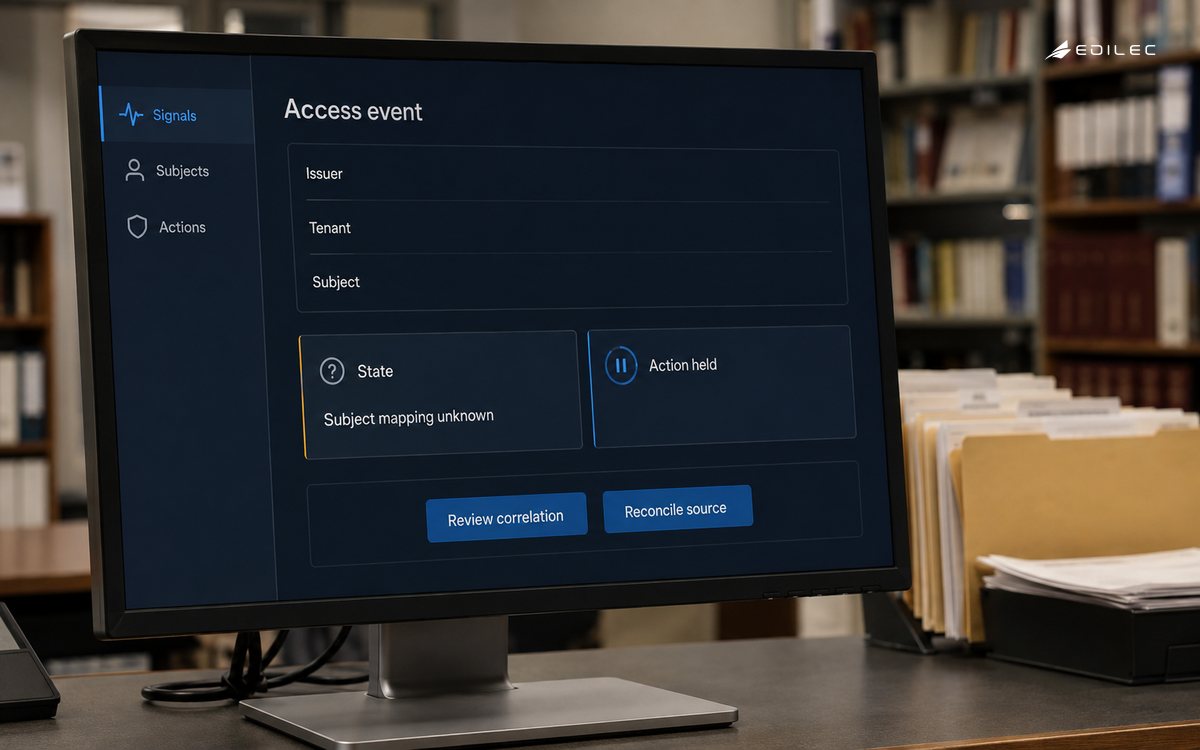
Pilot with account disablement and one application. Generate a known session, disable the account at the authority, receive and validate the event, terminate the session, reject refresh, and prove the user cannot regain access without restored authority. Then test duplicates, delayed order, wrong tenant, unknown subject and receiver outage. Use the identity, device, network, application and data pillars in the CISA Zero Trust Maturity Model to identify adjacent owners without claiming that event transport alone matures every pillar. Expand to device and risk events only after the simpler end-to-end control remains dependable.
Govern signal authorities and test policy changes
Maintain a registry of every stream with business owner, transmitter, receiver, event types, subject formats, affected applications, retention, delivery mode, key-rotation process and termination date. Approval should identify why the transmitter is authoritative for each event. A device-management service may be authoritative for compliance state but not employment status; an identity provider may revoke its session but not every independent application session. Review the registry when contracts, tenants or identity issuers change.
Test policy updates against recorded synthetic events before release. Include several accounts in different tenants, multiple sessions, shared devices, service identities and recently changed mappings. Verify the new rule's action and its inverse: an intended subject changes state while an unrelated subject remains unaffected. Deploy by receiver cohort, monitor action rates and keep a rollback that restores prior policy without replaying stale permissive state. A mistaken mass-revocation rule is an availability incident; a mistaken no-op rule is a security incident.
Periodically reconcile stream configuration with actual receiver subscriptions and keys. Remove abandoned endpoints so sensitive events are not sent to unowned systems. Exercise transmitter key rotation, receiver credential rotation and stream deletion. The receiver should reject events immediately after a trust relationship ends while retaining enough protected decision history to explain prior actions. These lifecycle tests matter because shared-signal integrations often run quietly for years after the project team disbands.
Key takeaways
- Use shared signals to carry state changes; let each resource owner decide and enforce the access response.
- Trust events only from registered transmitters and validate issuer, audience, signature, freshness and replay identifiers.
- Correlate issuer-qualified subjects and sessions within an explicit tenant boundary.
- Design idempotency, outage behavior and authoritative reconciliation before promising near-real-time revocation.
- Measure completed access change from event occurrence through receiver enforcement, not delivery alone.
Frequently asked questions
Does continuous access evaluation require token introspection?
No. A receiver can act on shared events by updating session or policy state while continuing to validate self-contained tokens. Introspection can provide current token state in another architecture. The important requirement is that the resource decision reflects the event within its objective.
Does CAEP guarantee instant revocation?
No. CAEP standardizes event meaning; delivery, processing and enforcement still take time and can fail. Publish a measured completion objective, retain short token lifetimes where appropriate, and reconcile receiver state after interruptions.
Should every risk signal end a session?
No. The receiver should map signal authority, confidence and resource sensitivity to a proportionate action. Some events justify termination; others justify step-up authentication, restricted capability or a fresh state query. Unqualified automatic termination can create availability and abuse risks.
Conclusion
Continuous access evaluation is an operating loop, not an event-feed purchase. It works when authoritative state changes travel through a trusted stream, map to the correct subject and cause an application policy decision that is both enforceable and observable. Shared Signals and CAEP supply common language for that cross-domain handoff.
Start with one revocation outcome and prove it across identity provider, receiver and application session store. Align the rollout with Edilec's zero trust guide so signals remain inputs to resource decisions. Once reconciliation can find and repair missed actions, add richer events with deliberate privacy and availability constraints.