What Changes When Session Security Moves into Production
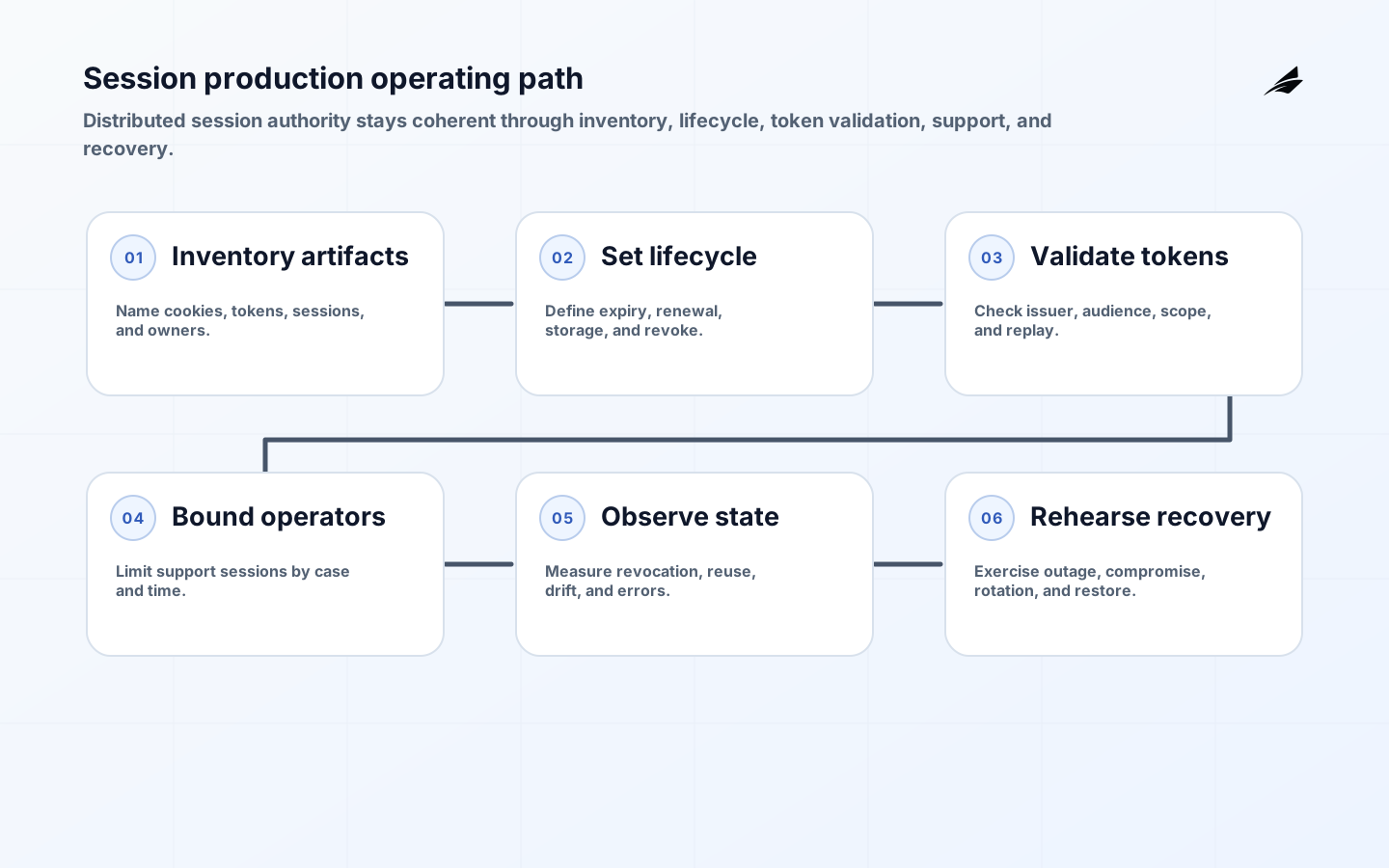
Session security in production is distributed. Browser cookies, identity providers, session stores, gateways, resource servers, job runners, caches, support tools, and incident responders must agree about authority. Inventory every artifact that can create or carry access, including refresh tokens, device entries, service credentials, and support sessions.
Define one lifecycle contract
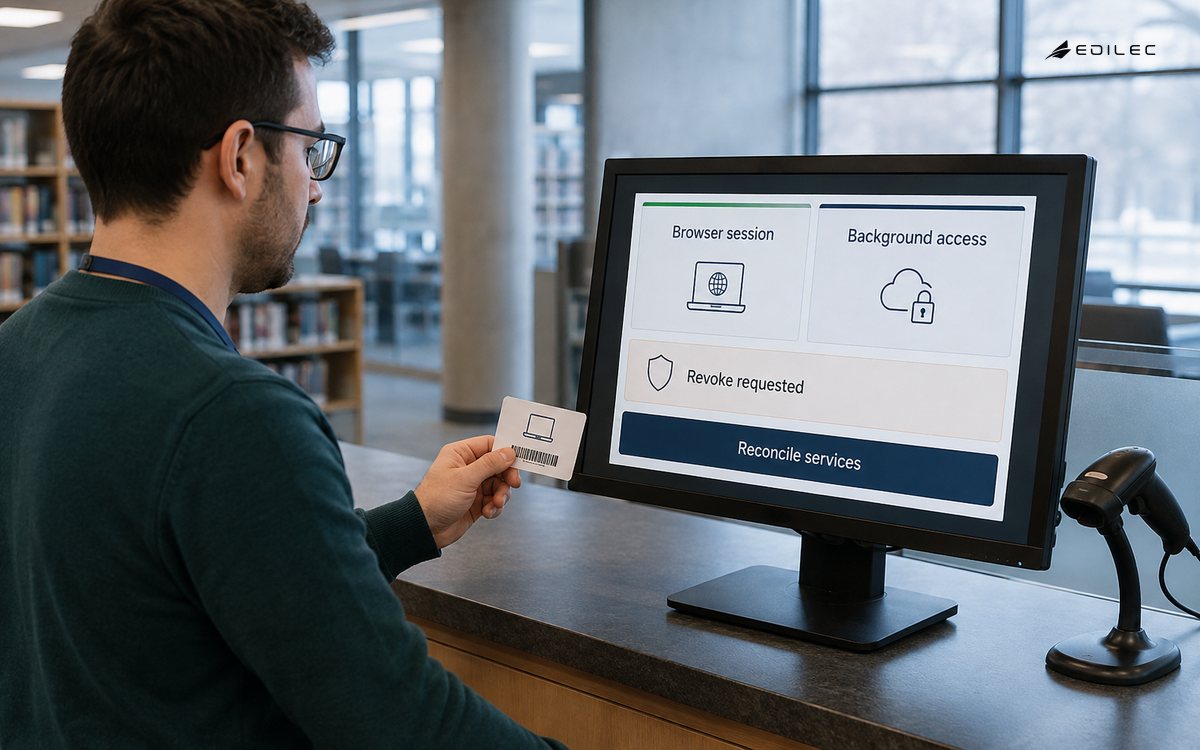
For each session class, set idle and absolute limits, renewal points, revocation behavior, storage, logging policy, and owner. Renew after authentication and privilege change. Propagate logout, password reset, disablement, and compromise revocation across regions and caches. A browser clear alone is not enough when a server-side session or token family remains valid.
| Artifact | Question | Test |
|---|---|---|
| Cookie | Which host and path receive it? | Browser and replay test |
| Access token | Who validates audience and scope? | Wrong resource request |
| Refresh token | What prevents reuse? | Rotation and reuse test |
| Support session | Who approved and when does it end? | Expiry and audit |
Operate token flows as dependencies
Give every artifact an owner and failure mode
Production teams often know about the main browser cookie but forget remember-device records, mobile refresh tokens, API keys issued during onboarding, one-time recovery links, and support impersonation sessions. For each artifact, name the issuer, audience, storage location, maximum lifetime, renewal rule, revocation mechanism, telemetry, and owner. Decide whether a failure should reject the request, require fresh authentication, or allow a restricted operation. An artifact with no owner will eventually become an undocumented permanent credential.
Keep time semantics consistent. Use a trusted clock for expiry and record both issued-at and observed-at when requests cross regions or queues. Allow only a bounded clock-skew window and monitor when clients exceed it. When signing keys rotate, accept old keys only for the documented compatibility period and ensure that a retired key cannot validate a newly issued artifact. These details matter during incidents because an operator must know which authority should still be accepted.
Test regional and dependency failure
A multi-region service needs a clear answer to where session truth lives and how quickly revocation travels. Exercise a user who logs out in one region and immediately requests a protected resource in another. Repeat the exercise for password reset, administrator disablement, device loss, and refresh-token reuse. Also test an unavailable session store, a delayed identity-provider response, a stale signing-key cache, and a queue that retries after the user has been revoked. The expected result should be defined by consequence, not by whichever component happens to be healthy.
| Failure | Unsafe response | Production decision |
|---|---|---|
| Session store down | Trust every old session | Restricted mode or fail closed |
| Key rotation lag | Accept any known key indefinitely | Bounded compatibility window |
| Provider timeout | Extend authority forever | Retry safely or step up |
| Revocation delay | Assume logout is complete | Show state and limit consequence |
Make customer recovery part of readiness
Customers need to recover from a lost device, a compromised browser, a replaced authenticator, and an account administrator who is unavailable. Design those journeys before enabling a strong factor or a long-lived session. The recovery path should prove the appropriate identity, revoke artifacts that may be compromised, notify the account, and create evidence support can review. For enterprise customers, document who can request tenant-wide revocation and how the action is approved. Recovery that bypasses the normal boundary is part of the threat model, not an exception to it.
Use current IETF OAuth guidance: authorization code and PKCE where applicable, redirect validation, claim checks, protected refresh tokens, and replay resistance. The resource server must independently check issuer, audience, scope, and expiry. Monitor provider metadata, signing-key rotation, clock skew, and token endpoint errors.
Make support access narrow
Separate evidence viewing from action. Require a case reference, named operator, customer and target resource, time limit, and audit event. Never ask a user to send a session artifact. A verified recovery path protects customers and keeps staff from becoming credential collectors.
| Control | Weak pattern | Reliable pattern |
|---|---|---|
| Revocation | Clear local cookie | Invalidate server/token family |
| Impersonation | Permanent access | Approved expiring session |
| Monitoring | Raw token logs | Redacted lifecycle events |
| Recovery | Ad hoc questions | Bounded verified flow |
Rehearse outage and compromise
Exercise identity-provider failure, session-store failure, signing-key rotation, stolen refresh token, mass logout, and device loss. Decide whether the service fails closed or offers a restricted mode by consequence. Preserve enough evidence to determine which authority was valid during the incident window. Test restoring revocation data with integrity checks.
Key takeaways
- Inventory every authority artifact and owner.
- Make renewal, expiry, logout, and revocation consistent across services.
- Validate tokens independently at the resource server.
- Bound support sessions by case, scope, approval, time, and evidence.
- Measure revocation latency, reuse, unknown sessions, and provider failures.
- Rehearse outage, compromise, key rotation, and recovery.
Frequently asked questions
Keep the exercise repeatable, documented, and connected to a named recovery owner and customer communication path.
Keep the exercise repeatable.
Review the exercises after every identity-provider, client, browser, or deployment change.
Production readiness is a customer promise as well as a security property. A logged-out user should understand why access ended and have a safe route back in. An administrator who revokes a device should see when it took effect. A support agent should help without viewing a raw token. A responder should distinguish a real replay from a client retry. Keep a small recurring exercise set: replay a revoked browser session, revoke a refresh-token family, rotate a signing key, lose a region, disable a user, replace an authenticator, and recover a tenant administrator. Record the expected user experience, operator action, evidence, and recovery time. Repeating the exercises after client or infrastructure changes is more useful than assuming a previously safe implementation remains safe forever.
The production contract should cover the whole customer journey, not only a protected API call. A new user enrolls a factor, opens several clients, changes a role, loses a device, contacts support, and eventually closes the account. Each transition creates or ends authority. Define the expected session and token state after every transition, then test the transition from two regions and through a delayed dependency where practical. Keep the customer-facing explanation separate from the internal forensic detail, but make both available: the user needs a safe next step, while responders need actor, artifact class, policy version, region, and timing. Review these scenarios after every identity-provider, client, browser, or deployment change. A production session system is ready when the team can contain a stolen artifact, preserve customer trust during an outage, and prove that old authority no longer works.
Session readiness is a customer promise as well as a security property. A user who is logged out should understand why and have a safe route back in. An administrator who revokes a device should see when the action took effect. A support agent should be able to help without viewing a raw token. A security responder should be able to distinguish a real replay from a client retry. Design those outcomes before the implementation is declared complete.
Keep a small set of recurring exercises: replay a revoked browser session, revoke a refresh-token family, rotate a signing key, lose a region, disable a user, replace an authenticator, and recover a tenant administrator. Record the expected user experience, operator action, evidence, and recovery time. Repeating the exercises after client or infrastructure changes is more useful than assuming a previously safe session implementation remains safe forever.
How should session changes be rolled out?
Treat changes to cookies, token claims, refresh rules, keys, or lifetimes as migrations. Inventory clients, use a compatibility period and cohort, watch renewal and logout signals, and make rollback account for already-issued artifacts and revocation records.
Roll out session changes as migrations
Changing a cookie domain, token claim, refresh-token rule, signing key, or lifetime can affect every active client. Treat the change as a migration with an inventory, compatibility period, cohort, health signals, and a defined end state. Test old and new clients, multiple tabs, mobile background behavior, a revoked user, a user in another tenant, and a support session. Observe renewal failures and logout results before expanding the cohort. A rollback must account for issued artifacts and revocation records, not only deployed code.
Key rotation deserves a separate exercise. Publish the new key, verify that validators refresh metadata, issue new artifacts, and confirm that the old key is accepted only for the documented window. Test a stale validator and a client whose clock is wrong. The team should know whether it will reject a token, request fresh authentication, or offer a restricted path when a dependency cannot establish trust. Silent extension of authority is rarely a safe fallback.
Observe authority without collecting secrets
Lifecycle events should contain a stable session reference, actor, client class, region, operation, policy or token version, reason, and correlation ID. They should not contain raw cookies, access tokens, refresh tokens, recovery links, or sensitive customer payloads. Monitor creation, renewal, revocation, step-up, refresh reuse, provider errors, unknown devices, and support impersonation age. Give each signal a threshold and a response owner. A dashboard that shows sign-in volume but cannot demonstrate that a revoked session is rejected is not measuring session security.
Connect technical events to customer impact. If a region loses the session store, which users see a challenge, which operations pause, and which support queue receives the cases? If a refresh-token family is revoked, can the customer sign in safely without creating another recovery gap? If a mass logout is required, can the team prove completion and communicate clearly? These are product and operations questions as much as cryptographic ones.
| Readiness area | Pass condition | Owner |
|---|---|---|
| Artifacts | Every credential and session has a lifecycle owner | Identity platform |
| Revocation | Scoped and global invalidation are tested | Platform operations |
| Clients | Old and new clients fail safely | Product teams |
| Support | Recovery never requires raw credentials | Support lead |
| Incident | Outage and compromise paths are rehearsed | Security response |
Why does multi-region deployment matter?
Revocation, cache, clock, and replication behavior can diverge. Define freshness and test logout or compromise across regions.
When is production session security ready?
It is ready when the team can contain stolen artifacts, revoke authority, support users safely, preserve evidence, and prove behavior across clients, regions, dependencies, and recovery paths.
Conclusion
Production session security coordinates authority across clients, services, operators, and recovery. Use the session checklist, mistakes and fixes, and CTO guide. The WebAuthn Level 2 specification informs authenticator behavior; RFC 6750 defines bearer-token risks; Microsoft's OAuth authorization-code guidance covers client flows; and Amazon Cognito's access-token documentation describes token use in a managed identity service.