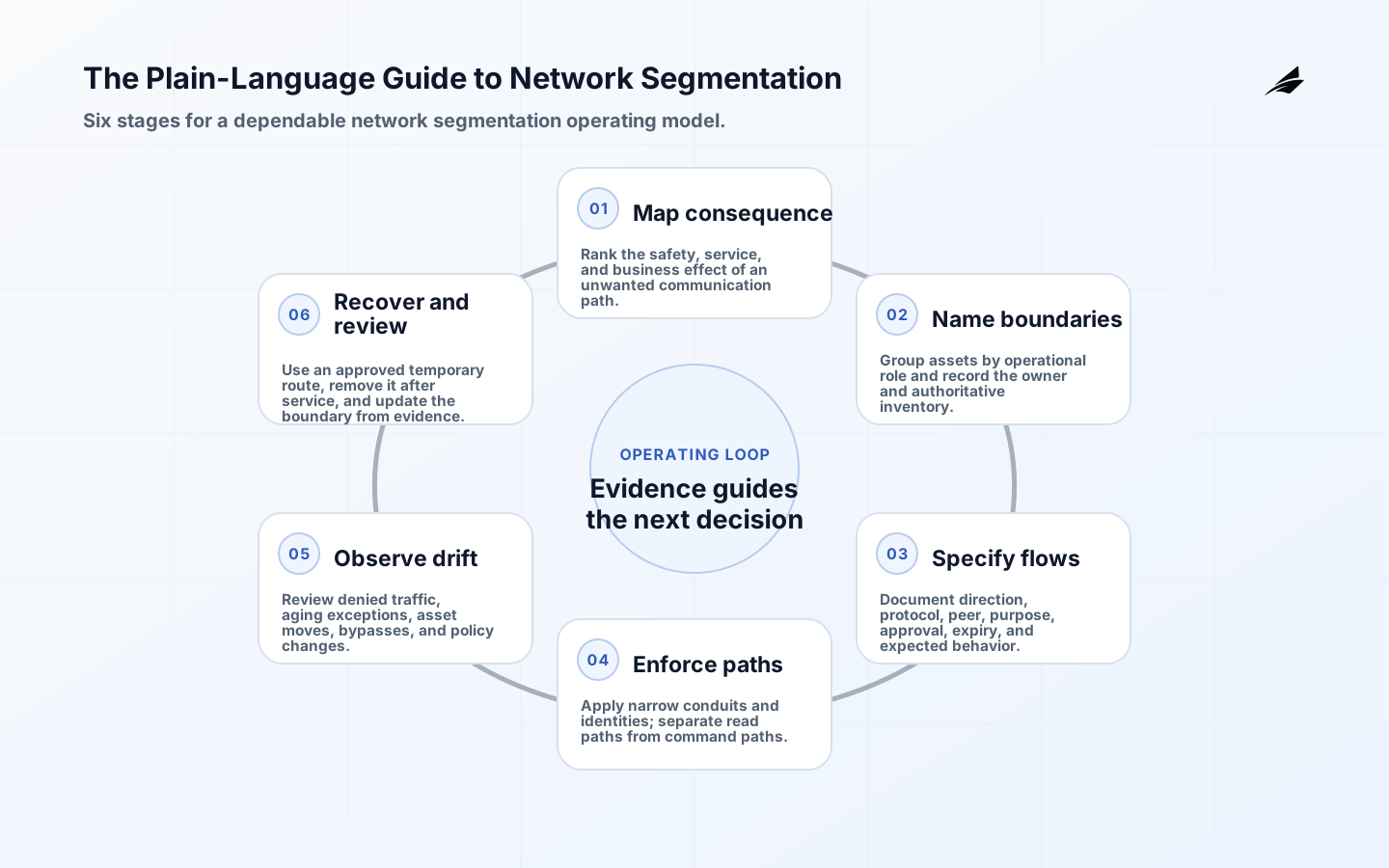
Network segmentation limits which systems can communicate, for which purpose, through which controlled path, and under whose authority. It is not the same as drawing VLANs on a diagram. A useful boundary separates consequence, trust, ownership, or maintenance needs and makes permitted flows testable.
What Network Segmentation Means
In plain language, network segmentation divides systems into controlled zones and permits only the communication each zone needs to perform its job. For a segmentation boundary, the distinction between a technical capability and an operational promise matters. For a segmentation boundary, a capability can be installed; an operational promise must survive shift changes, supplier maintenance, partial outages, and ordinary human error. For a segmentation boundary, describe the business or safety consequence first, then identify the data, interface, and authority needed to support it. For a segmentation boundary, the phrase becomes useful when it answers a concrete question rather than decorating an architecture diagram.
For network segmentation, make the expected communication state explicit before writing a firewall rule. Record the asset role, peer, service, direction, port or protocol, purpose, source of approval, and review date. A denied connection is useful only when the operator can tell whether it is an attack, an overlooked dependency, or a legitimate maintenance activity. Capture normal behavior during startup, shutdown, alarm, and vendor-support conditions, because a quiet baseline often misses the flows that matter most. The resulting policy should explain both what is allowed and why a route is not allowed.
| Operating question | Design answer | Network-segmentation evidence |
|---|---|---|
| For network segmentation, answer this question: What job is being improved? | In network segmentation, name the workflow, response window, and accountable owner. | In network segmentation, a current workflow map and agreed success measure |
| For network segmentation, answer this question: What must be true to act? | In network segmentation, use attributable data inside a known authority boundary. | For network segmentation, retain source, time, identity, quality, and approval context. |
| For network segmentation, answer this question: What changes when something fails? | In network segmentation, show a degraded state and route it to a person who can decide. | For network segmentation, retain failure test, escalation path, and recovery record. |
| For network segmentation, answer this question: How will the team know it works? | For network segmentation, review operational signals instead of launch completion. | unauthorized flows blocked, unexplained flows awaiting review, rule-change lead time, and time to isolate a suspect asset |
Build zones and conduits around consequence
A practical network segmentation architecture starts with inventorying assets and expected communications, grouping them by operational consequence, and reviewing the narrow paths between groups. For a segmentation boundary, draw the journey from device or source through gateway, service, storage, and user action. For a segmentation boundary, mark which component is authoritative, which values may be cached or estimated, what identity is used, and where human approval is required. For a segmentation boundary, these details are less glamorous than platform selection, but they expose dependencies before those dependencies become outages or unsafe workarounds.
The failure to guard against is straightforward: a flat network can turn one compromised workstation or exposed service into a route toward control assets. For a segmentation boundary, design inconvenient cases before scale makes them harder to change. For a segmentation boundary, define a known-safe behavior, give users a visible indication that the system is degraded, and rehearse how state is restored or reconciled. For a segmentation boundary, oT-adjacent work adds particular constraints because availability, safety, and reliability may matter differently than they do in ordinary business software.
Choose a boundary the team can operate
Start with one bounded network segmentation workflow. For a segmentation boundary, specify the actor, input, decision, output, exception path, and recovery check in plain language. For a segmentation boundary, a narrow first release creates a baseline for latency, accuracy, operator effort, and failure recovery. For a segmentation boundary, it also gives security and operations teams something concrete to review. For a segmentation boundary, expand only when the first path is understood, supported, and used; a broad platform promise is not evidence of operational value.
- List the real assets, people, records, and approvals involved in network segmentation.
- In network segmentation, write normal and degraded behavior before choosing an implementation detail.
- In network segmentation, keep source, time, quality, and ownership visible at consequential actions.
- In network segmentation, use versioned configuration or contracts for changes that affect operations.
- In network segmentation, exercise an exception path with the team that will support it.
- In network segmentation, review recurring friction before adding a second workflow.
Control flow changes, exceptions, and ownership
Every consequential network segmentation change needs a named owner, a review point, and a reversible path. For a segmentation boundary, the change record should capture the reason, affected assets, configuration or contract version, approver, implementation window, verification result, and rollback condition. For a segmentation boundary, that creates a useful history for the next person on call. For a segmentation boundary, it also helps distinguish a planned behavior change from a fault, which is often the first step toward faster restoration.
| Risk pattern | Network-segmentation control | Review signal |
|---|---|---|
| For network segmentation, flag an unknown current state. | In network segmentation, expose freshness, quality, and source identity next to the decision. | For network segmentation, define records that are stale, missing, or unowned. |
| Uncontrolled change | For network segmentation, use versioned configuration, approval, and tested recovery. | For network segmentation, define changes without verification or an accountable requester. |
| Ambiguous authority | For network segmentation, separate observation, recommendation, and irreversible action. | For network segmentation, retain actions that bypass the intended review boundary. |
| For network segmentation, define hidden dependency failure. | In network segmentation, test degraded behavior and document the support handoff. | For network segmentation, retain exception age, failed retries, and recovery duration. |
Measure whether the boundary is trustworthy
For a segmentation boundary, use metrics that reveal whether the workflow is trustworthy, rather than merely whether a component is online. For network segmentation, track unauthorized flows blocked, unexplained flows awaiting review, rule-change lead time, and time to isolate a suspect asset. For a segmentation boundary, pair quantitative signals with a short review of actual exceptions: what happened, what evidence was present, where the team hesitated, and whether the recovery rule was clear. For a segmentation boundary, this combination exposes the gap between nominal availability and operational usability and prevents an SLA or dashboard from becoming a substitute for understanding work.
Decisions connected to segmentation
Network segmentation is easier to assess alongside its neighbors. For a segmentation boundary, Network Segmentation: Cost and Scaling Guide offers a focused companion view; Device Provisioning: A Security Review for IoT Teams covers a dependency that commonly shapes design choices; and Network Observability: Mistakes and Fixes helps frame an operating consequence. In a segmentation program, these choices form one operating boundary rather than a shopping list. For a segmentation boundary, the right design is the one that leaves operators with clearer authority and stronger evidence when the normal path stops being normal.
Primary references for segmentation decisions
For network segmentation, NIST SP 800-82 Rev. 3: Guide to Operational Technology Security is the central operational-technology reference, while NISTIR 8259A: IoT Device Cybersecurity Capability Core Baseline, NIST SP 800-207: Zero Trust Architecture, and NIST SP 800-213A: IoT Device Cybersecurity Requirement Catalog help frame device capabilities, identity boundaries, and acquisition requirements. They support the principle of allowing known behavior and reviewing exceptions. They do not replace site-specific safety analysis, vendor documentation, or contractual responsibilities.

The language of a trustworthy segmentation boundary
For network segmentation, document each permitted flow as a bounded relationship: asset role, peer, direction, protocol, purpose, owner, approval, expiry, and evidence that the path was tested. A denied connection should lead to an explainable review, not an automatic widening of access. Use NIST SP 800-41 Rev. 1, NIST SP 800-82 Rev. 3, NIST SP 800-207, and NIST SP 800-213A to frame firewall, OT, identity, and device-requirement concerns. Related Edilec context is in the segmentation cost guide, device-provisioning security review, and network-observability review.
Pilot one boundary around a well-understood operational workflow, capture normal traffic during startup and maintenance, and test a planned interruption with an owner watching the denied-flow evidence. Review a temporary route for approval, compensating control, expiry, and removal. Measure unowned assets, aging rules, unexpected denies, manual bypasses, and recovery time so the team can improve the boundary without mistaking fewer alerts for safer operation.
| Decision area | Network-segmentation question | Network-segmentation evidence |
|---|---|---|
| Purpose | For network segmentation, answer this question: Which real decision does the system change? | For network segmentation, record the scenario, owner, and acceptance example. |
| Boundary | For network segmentation, identify what is allowed, and what is deliberately excluded? | For network segmentation, retain policy, identity, and version details. |
| Failure | For network segmentation, identify what happens when data, network or dependency fails? | For network segmentation, retain a contingency test and visible status. |
| Change | For network segmentation, answer this question: Who can alter rules, mappings or access? | For network segmentation, retain approval, diff and rollback point. |
| Review | For network segmentation, answer this question: What shows the design remains useful? | For network segmentation, retain outcome, exception and correction record. |
Segmentation takeaways for design review
- Network segmentation should serve a named operational decision and owner.
- In network segmentation, keep source, time, quality, identity, and authority context near consequential actions.
- In network segmentation, design normal behavior, degraded behavior, and recovery before expanding integrations.
- In network segmentation, treat configuration and contract changes as operating events with evidence.
- In network segmentation, use recurring exceptions to improve the workflow rather than normalize uncertainty.
Before enforcing a segmentation policy, run a joint review with network, controls, and maintenance owners. Walk through the asset inventory and ask what each device must contact during normal production, an alarm, a restart, and approved remote support. For every proposed conduit, name the initiating system, destination, service, purpose, and emergency owner. Test the rule set in a monitored mode where practical, then document both the expected denied traffic and the escalation route for a suspected missed dependency. The review is successful when an engineer can explain an allowed path without relying on tribal knowledge and an operator can isolate a zone without guessing which control function will be affected.
Keep the policy review alive after deployment. New devices, remote-access requests, and changed production recipes can invalidate an earlier traffic assumption. A short recurring review of denied flows, expiring exceptions, and unexplained communications is usually more effective than a large annual cleanup.
FAQ: network-segmentation questions in plain language
Label traffic or asset state as current, delayed, estimated, rejected, or disputed; preserve the source and route consequential ambiguity to the person authorized to resolve it. A dashboard should not turn an unknown path into an apparently safe one.
Change the boundary when recurring exceptions, a new asset class, or a safety and reliability requirement shows that the existing rule no longer matches the operation. Record the reason, affected flows, approver, test evidence, and removal or review condition.
Conclusion: make permitted paths explainable
Reliable network segmentation makes ordinary work, exceptional work, and recovery understandable to the people responsible for the outcome. For a segmentation boundary, establish the decision, protect the evidence, constrain authority, stage change deliberately, and review actual exceptions with the team that operates the system. For a segmentation boundary, that is how a connected capability becomes an operational asset instead of another opaque dependency.