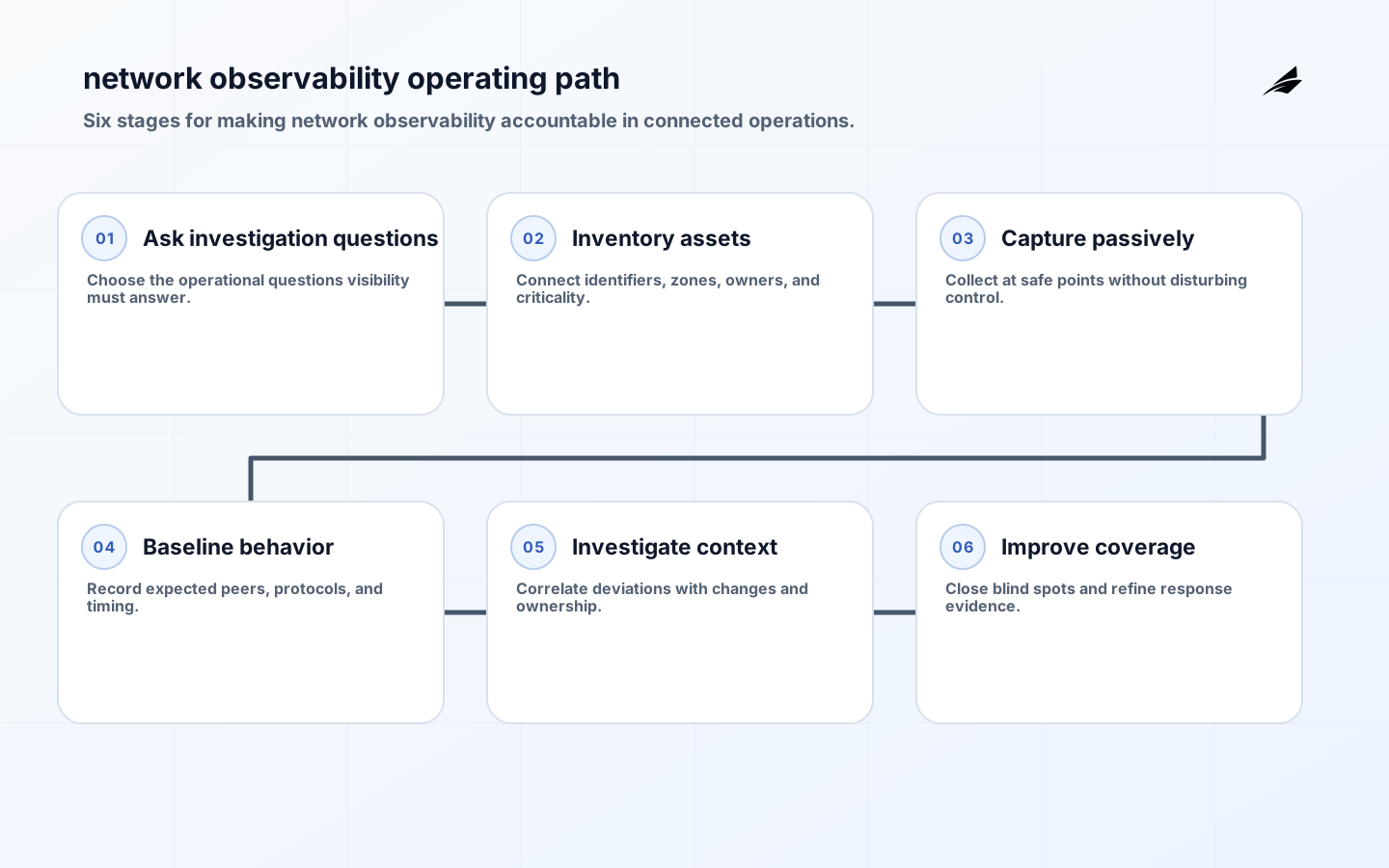
Network Observability for Connected Systems: a Practical Guide is for operations leaders who need to understand connected-system behavior before, during, and after a disruption who need network observability for connected systems to support an operating decision, not merely a technical diagram. The practical objective is to answer what changed, which assets and flows were involved, and who can take the next safe action without turning monitoring into another opaque alert source. That requires a shared account of what the system may do, what evidence it produces, and who decides when the normal path no longer holds.
The first useful question is not which product to buy. It is which real-world consequence the connected workflow must protect: a delayed field task, a misleading operator view, an unauthorized command, a lost record, or an avoidable outage. Making that consequence concrete keeps network observability tied to safety, service, and accountable work.
Set the decision boundary for network observability
Define the promise in plain language before implementation. For this topic, the promise is to answer what changed, which assets and flows were involved, and who can take the next safe action without turning monitoring into another opaque alert source. Name the reader of the outcome, the authoritative record, the acceptable delay, the person allowed to override the rule, and the point at which the workflow must stop for review. A boundary is valuable because it excludes attractive but unowned work from the first release.
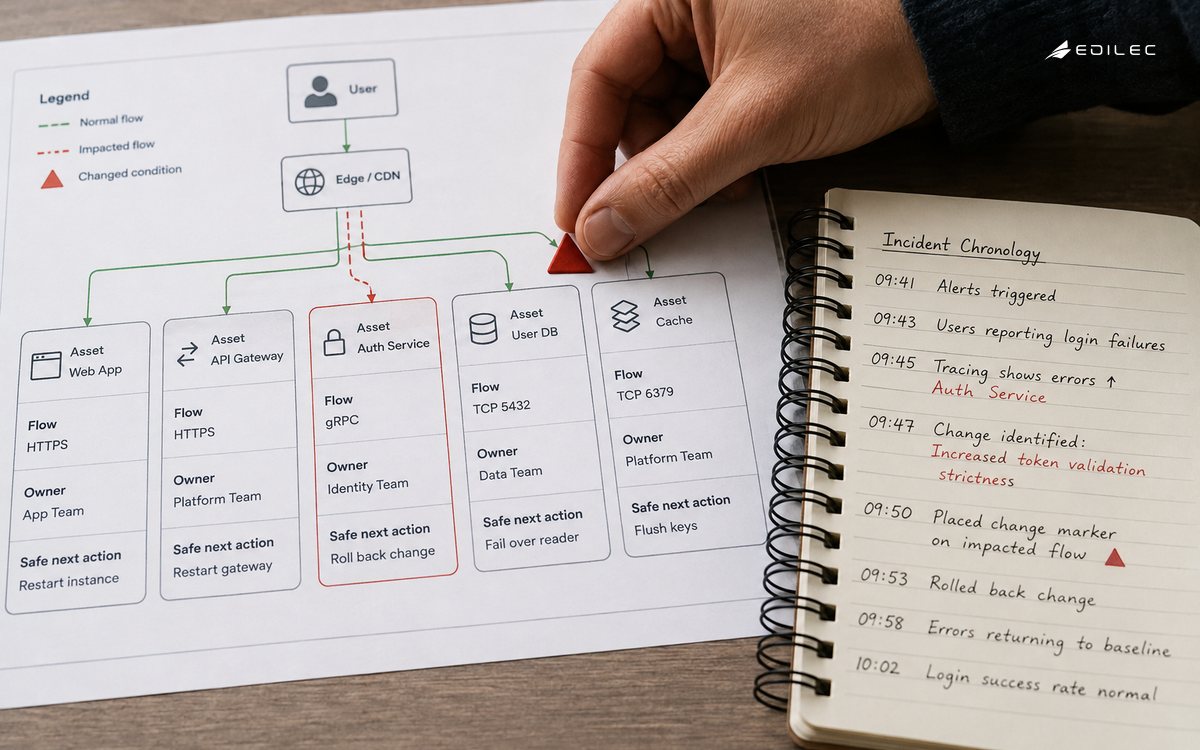
Build the inventory around asset identity, zone, expected peer, protocol, baseline behavior, capture point, retention, change event, detection owner, and response procedure. This is more than documentation. It lets an engineer, operator, or reviewer reconstruct why a particular behavior was allowed, rejected, or escalated. In connected operations, small omissions become expensive when an incident occurs outside the people and network conditions assumed during a demonstration.
| Question | Decision to record | Evidence to retain |
|---|---|---|
| What outcome is protected? | answer what changed, which assets and flows were involved, and who can take the next safe action without turning monitoring into another opaque alert source | A concrete scenario and acceptance condition. |
| What changes the risk? | whether a change in connected behavior needs containment, maintenance, or simple documentation | A named threshold and accountable owner. |
| What constrains the system? | passive collection, contextual asset records, baselines, retention limits, and a safe escalation path | A reviewable rule and its effective period. |
| What proves the result? | an investigation drill that traces an unexpected flow from sensor through owner, change record, response, and closure | A trace, test, or observed operating record. |
Design an operating model, not an isolated component
A workable network observability model uses passive collection at deliberate visibility points, an asset and flow inventory, behavior baselines, contextual detection, and an investigation view that preserves OT safety boundaries. Draw the trust and responsibility boundaries before the technology choices harden. The diagram should show where inputs become trusted, which state is authoritative, where a person can intervene, and how a later investigator finds the same context without relying on private knowledge.
A captured packet or anomaly is evidence of behavior, not a verdict about intent. Preserve asset identity, zone, baseline, change context, and collection point so investigators can interpret it safely.
| Boundary | Good default | Question to challenge |
|---|---|---|
| Authority | Keep the accountable record and decision rule explicit. | Which component may make or reverse this decision? |
| Change | Use named approvals and a visible rollback or isolation path. | Can this change be explained during a busy operating period? |
| Exception | Make failure states visible to the responsible role. | Who sees this first, and what can that person safely do? |
| History | Retain the records needed to explain material outcomes. | Can the team reconstruct the path after a delayed report? |
Implement one complete, observable path
For the first delivery, establish asset and communication baselines before tuning detection; prefer passive methods in sensitive networks; connect telemetry to ownership and approved change records; then validate a small set of investigation questions. Treat the chosen slice as a learning instrument: include the normal path, a realistic degraded case, the visible status a user receives, and the support action that follows. A narrow path with evidence is more useful than a broad integration whose behavior can only be guessed from infrastructure health.
For network observability, passive capture design, asset records, expected-flow baselines, investigation notes, and retention decisions should make a deviation explainable without disrupting production.
- Write the accountable outcome and the unsafe or unacceptable outcome beside it.
- Record asset identity, zone, expected peer, protocol, baseline behavior, capture point, retention, change event, detection owner, and response procedure for the first production path.
- Exercise an interrupted or degraded case before expanding scope.
- Show the relevant user the current state and the next safe action.
- Document the approval, correction, and communication path for a material exception.
Design the failure path before scale
The failure case to make tangible is this: a tool actively probes a fragile asset, a baseline treats known drift as malicious, telemetry is retained without context, or security staff cannot tell whether an unusual flow is operationally dangerous. Treat it as a product and operations scenario, not solely a technical edge case. Specify what becomes visible, what is automatically contained, what may continue, and who decides when normal operation can resume. That work prevents a reassuring green status from hiding a process that is no longer safe or complete.
Observability recovery means closing the evidence gap, correlating the deviation with approved changes or owners, and containing only after the process consequence is understood.
Operate network observability from evidence
Track asset coverage, unknown communications, baseline exceptions, collection gaps, detection precision, investigation time, and unexplained topology changes. Establish a baseline before the first material change and annotate releases, maintenance, supplier changes, and unusual operating conditions. Metrics become useful when they connect technical behavior to a defined owner and a real consequence, rather than encouraging a team to optimize a graph that nobody uses to decide anything.
Review individual investigations with detection metrics. A high alert count can conceal a blind spot at the boundary where the most consequential connected behavior occurs.
| Signal | What it may indicate | Useful response |
|---|---|---|
| Unexpected change | Drift, misuse, or an unrecorded operational dependency. | Check ownership, recent changes, and the affected process. |
| Delayed outcome | Capacity pressure, a disconnected dependency, or an unclear handoff. | Trace the first delayed record and verify the recovery path. |
| Repeated exception | A weak rule, missing context, or a workflow that does not fit reality. | Improve the decision rule before automating around it. |
| Missing evidence | A blind spot in instrumentation or ownership. | Restore the record before declaring the condition resolved. |
Use standards as decision support
This guide is grounded in NIST SP 1800-23, Energy Sector Asset Management, NIST SP 800-82 Rev. 3, Guide to Operational Technology Security, NIST NCCoE OT asset management and visibility, NIST IoT Cybersecurity Program. These materials inform the engineering vocabulary and controls discussed here; they do not replace local assessment of safety, legal obligations, device limitations, or process ownership. Read the primary guidance when a deployment needs exact protocol, security, or procurement requirements.
Here, the standards material is most useful for linking passive monitoring, asset visibility, expected communications, and safe incident response in operational technology environments.
Related connected-operations reading
These adjacent guides help connect network observability to architecture, field behavior, and operational ownership: IoT guide 0014, IoT guide 0206, IoT guide 0174. Read them as complementary decision aids; the right implementation still begins with observing the specific workflow and constraints in front of the team.
Key takeaways for network observability
- Network observability is a commitment to answer what changed, which assets and flows were involved, and who can take the next safe action without turning monitoring into another opaque alert source, not a configuration exercise.
- Start with one accountable path that includes real state, an exception, and a recovery decision.
- Keep authority, identity, freshness, and change history visible where people operate the workflow.
- Expand only after observed behavior shows that the promise holds under normal and degraded conditions.
Network observability FAQ
Why baseline before alerting?
A baseline gives an observation meaning. Without expected peers, timing, and change context, a difference is only a difference.
Can monitoring be passive?
Often it should be in sensitive OT environments. Choose collection methods that respect performance and safety requirements.
What is a useful first question?
Start with a real investigation question, such as which asset began a new cross-zone communication and whether that change was approved.
Conclusion: make network observability accountable before expanding it
The durable test for network observability for connected systems is straightforward. Can the team show the promised outcome, identify the authoritative record, recognize a known failure, and explain the next safe action to the person affected? Begin with that accountable slice, keep the evidence close to the work, and widen adoption only when the operating behavior earns trust.