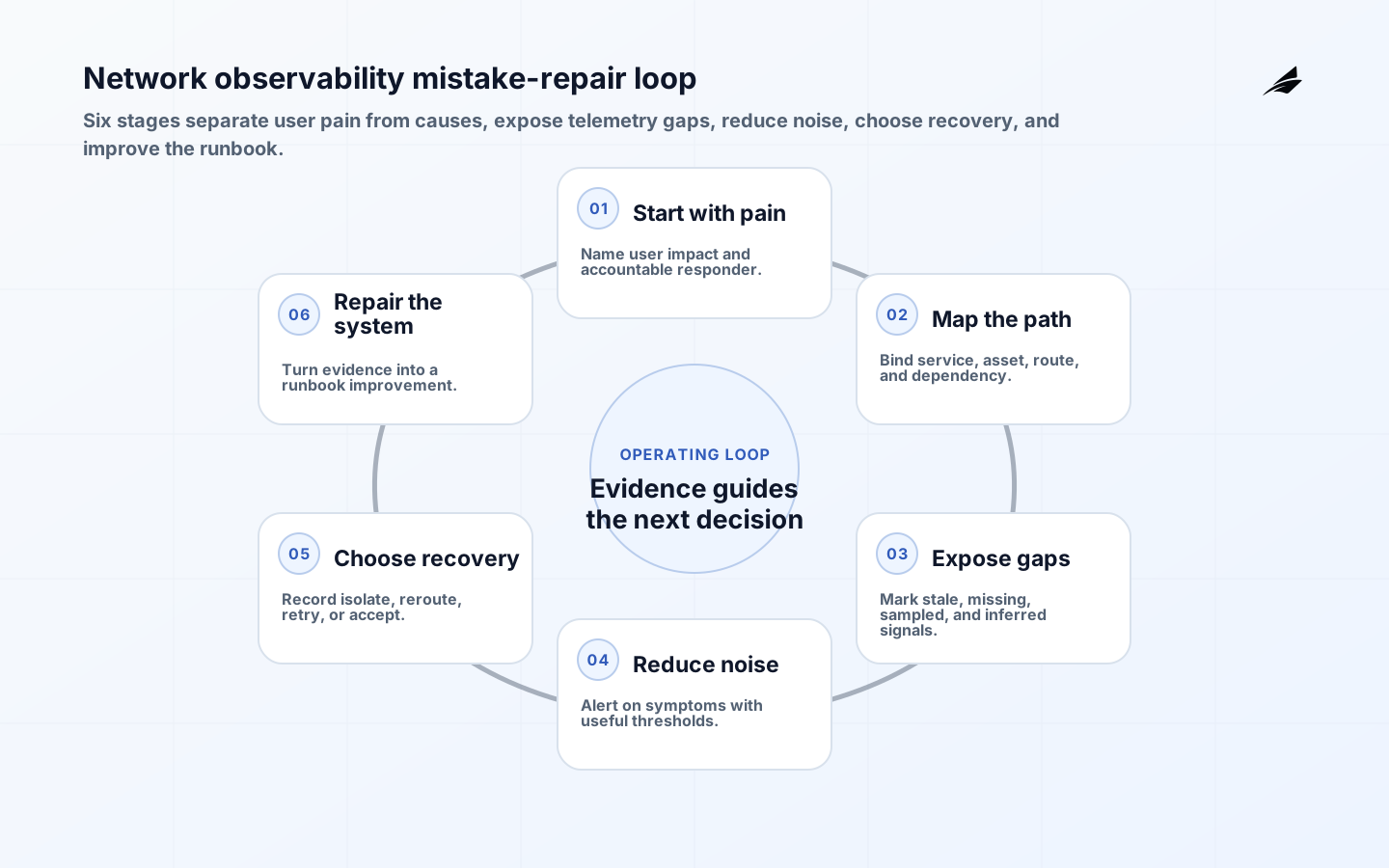
Network observability mistakes are expensive when they make a visible symptom look like a diagnosis. The repair starts with a user-facing consequence, the path that carries the work, the evidence that can be trusted, and the recovery choice a named person can make during an incident.
What Network Observability Means in Connected Operations
At its core, network observability establishes how people, equipment, services, and evidence should behave around a shared operational need. The work starts by naming the outcome that matters, the consequences of getting it wrong, and the person who can accept or reject a change. A design becomes supportable when that agreement survives shift changes, vendor involvement, and the pressure of an incident.
Begin with responder questions: who is affected, when did behavior change, where is loss introduced, and what changed nearby? Choose reachability, paths, device health, logs, and change records that answer them without unnecessary payload collection. Keep the decision record small enough to use: the normal state, the trigger for attention, the permitted action, the escalation point, and the evidence that proves the action was completed. This turns ambiguous technical discussion into a practical agreement that operations and engineering can both test.
| Decision area | Question to settle | Evidence to keep |
|---|---|---|
| Scope | Which assets and workflows belong to network observability? | Owner, boundaries, and exclusions |
| Data and access | What is authoritative and who may act? | Identity, time, policy, and permissions |
| Exception path | What happens when the normal path fails? | Safe alternative, acknowledgement, and disposition |
Architecture Choices for Network Observability
Model service paths rather than isolated tools. A field device may depend on radio, gateway, DHCP or DNS, broker, identity service, and application; show normal objectives and evidence at each boundary. State the authoritative records, allowed access paths, retention rule, and expected behavior when an upstream or downstream component is unavailable. These choices are where a design either protects operational context or quietly discards it.
A robust network observability architecture distinguishes healthy, delayed, uncertain, rejected, and manually overridden states. A plausible value without its source time, quality, or policy context can lead to a bad decision. Preserve the information a later reviewer needs to understand what the system knew at the time, not merely what a dashboard says now.
The adjacent work in Protocol Selection Security Review for Connected Operations is relevant here because connected operations depend on deliberate boundaries between observation, administration, decision support, and control. Integration is valuable only when it leaves those boundaries more understandable, not less.
Controls That Make Network Observability Trustworthy
Protect observation data with access and retention rules. Align time where possible, mark collector gaps, describe derived measures, and alert on sustained patterns or change correlation rather than every counter movement. Reviewers should be able to see who acted, which policy or version applied, what data was available, and how an exception was resolved. Keeping that evidence close to the workflow limits the need to reconstruct a decision from scattered tickets and informal memory.
Access should be as narrow as the task allows, with distinct identities for people, services, and devices. A temporary exception needs a reason, owner, and expiry. An emergency route needs a documented approval and recovery procedure. Review the exception against the affected service path and record whether the route was removed after the incident.
| Review signal | What it can reveal | Practical response |
|---|---|---|
| Collector gaps | A condition may be outside the expected operating model. | Inspect context before widening access or suppressing the signal. |
| Path loss | A decision or recovery path may lack ownership. | Assign a reviewer and make the next step visible. |
| Manual bypass | The designed path may not fit daily work. | Document the reason and improve the operating procedure. |
A Practical Network Observability Rollout
Baseline one critical path during known-good operation. Run investigations with injected loss, failed lookup, rejected identity, and gateway restart, then verify a responder can reach a defensible conclusion from retained data. A focused first release creates evidence that a broad platform promise cannot: support demand, manual workarounds, late or bad data, and the actual effort required to restore normal operation. Expand only once the responsible team can operate the first scope repeatedly and explain its limits.
Before expanding, run a planned exercise with interruption, malformed or disputed data, restart, and a handoff between roles. State the operating condition that requires human review and the signal that identifies it. Leave behind a runbook update, an owner for open issues, and a short record of the design change. Use the exercise to prove that the monitored path still represents the work the responder must protect.
Measure What the Team Can Improve — symptom-to-cause triage
Track collector gaps, path loss, configuration changes, credential rejects, time skew, and service-path coverage. Interpret each measure with operating context. A lower count is not automatically better if staff have stopped reporting a condition or moved work outside the governed path. Measures should give an owner a clear place to inspect, a question to ask, and an improvement to test.
Use incident reviews and planned exercises to test whether the metrics remain meaningful. If a measure cannot tell the team what to inspect or change next, it is reporting decoration. Keep definitions, thresholds, data-quality treatment, and calculation changes visible to the people who depend on the results. Recheck the metric against the service-path question whenever a collector, route, or dependency changes.
Operational Detail — symptom-to-cause triage
Time is a primary observability dependency. Devices, gateways, collectors, and services do not need perfect clocks to be useful, but the system must expose drift and record both event and receipt time where they differ. Without that, responders can form a convincing but false sequence of events. Include time synchronization health in the service-path review and explain how late records are handled.
Observability data needs its own reliability checks. A missing collector, a dropped export, or an overloaded logging pipeline can turn a healthy-looking dashboard into a blind spot. Monitor the coverage of the observation system, record planned gaps, and make uncertainty explicit in investigations. The right response to absent evidence is not to assume normal behavior; it is to restore visibility and bound the conclusion.
Separate visible symptoms from actionable causes
A common network observability mistake is to treat a larger telemetry volume as better understanding. More packets, logs, and counters do not help if the team cannot associate them with a service path, asset owner, policy decision, or time boundary. Start with a small set of questions: what is the user experiencing, which path carries the work, what changed, and what can the responder safely do now? Map the signals needed to answer those questions and label their confidence. A missing collector, stale clock, or denied query is evidence about the observability system itself. NIST SP 800-82 Rev. 3 emphasizes the operational context around connected environments, while NISTIR 8259A and SP 800-193 provide useful prompts for device capability and platform resilience.
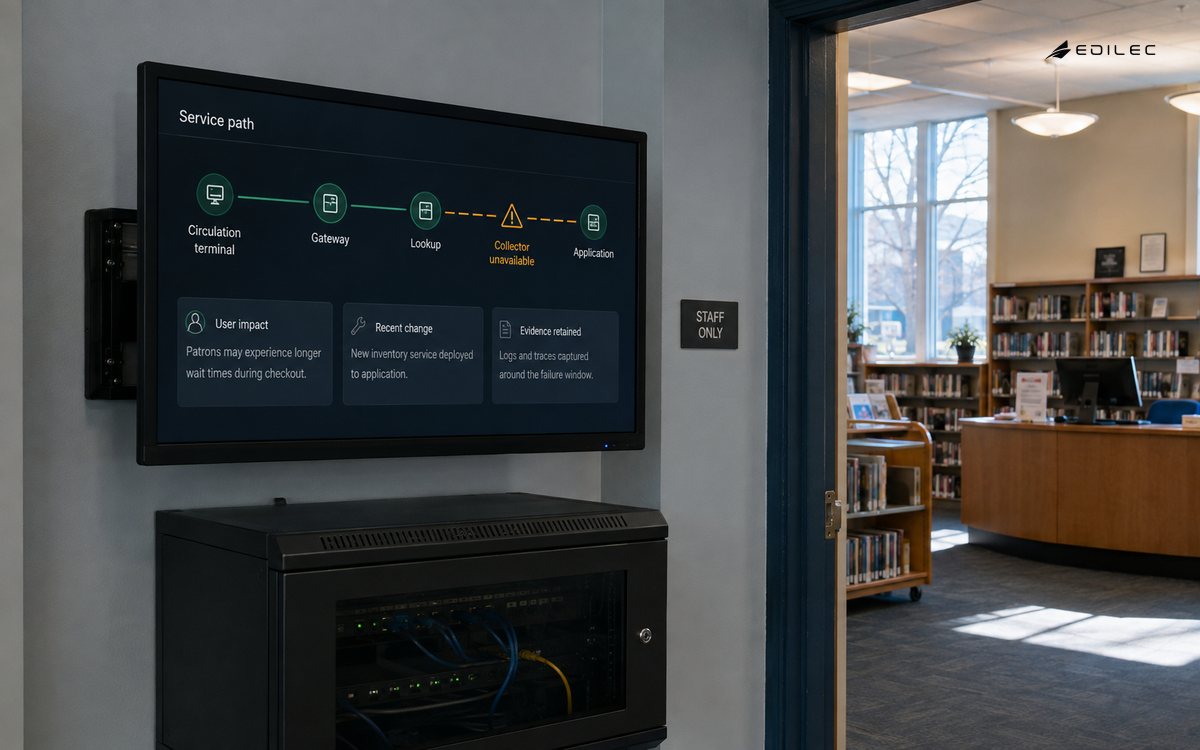
For observability investigation practice, compare Protocol Selection Security Review for Connected Operations, How Founders Should Think About IoT Telemetry, How Founders Should Think About SCADA Integrations; together they frame observability triage, ownership, and recovery without asking the reader to infer the operating boundary.
- Start from user pain and an owner, then choose the minimum evidence needed.
- Mark telemetry age, confidence, and gaps instead of implying a healthy state.
- Correlate symptoms with paths, identities, policies, and recent changes.
- Keep an incident trace that records the recovery decision and outcome.
Network observability mistakes and fixes takeaways for operators
- Network observability should begin with a concrete operational outcome and accountable owner.
- Expose degraded, uncertain, and exceptional states beside the decision for the accountable responder.
- Keep permissions narrow, changes versioned, and evidence retained so a responder can support the workflow after handoff.
- Test interruption, bad data, recovery, and handoff before expanding the pattern.
- Walk through real exceptions with operations staff, then write the correction into the maintained response procedure.
Network-observability repair questions for responders
How can a team separate a symptom from a cause?
Start with user impact and time, map the service path, correlate route, identity, dependency, and change evidence, then test the smallest hypothesis that can explain the symptom.
Should packet content always be collected?
No. Begin with metadata, counters, logs, and synthetic checks; use deeper capture only when necessary, lawful, bounded, access-controlled, and retained for a stated purpose.
Primary references
Use these primary references when testing network-observability triage: NIST SP 800-53 Rev. 5, NIST SP 800-94, NIST SP 800-137, and RFC 7011: IP Flow Information Export Protocol. Apply them with site procedures and the obligations of the deployment context.
- NIST SP 800-53 Rev. 5 — primary context.
- NIST SP 800-94 — primary context.
- NIST SP 800-137 — primary context.
- RFC 7011: IP Flow Information Export Protocol — primary context.
Conclusion: keep observability triage explainable
Network observability is successful when staff can detect an exception, understand its consequence, take an authorized next step, and recover with evidence instead of improvisation. Start with the accountable workflow, make assumptions and degraded states visible, and improve the design from the exceptions that real operations reveal.
A practical investigation should leave a trace that another responder can replay. Record the user-visible symptom, the service path under review, the clocks and collectors involved, the policy or release changes nearby, and the confidence assigned to each signal. Compare a healthy interval with the failure interval so the team can separate a route change from a collector gap or a real dependency failure. When the evidence is incomplete, state the boundary of the conclusion and choose a reversible action such as isolating one path, rerouting a bounded cohort, or asking an owner to verify the source. After recovery, compare the predicted effect with the observed result and update the runbook, threshold, or collection rule that failed to guide the response. This gives network observability a clear purpose: reducing the time and uncertainty required to make the next safe decision.