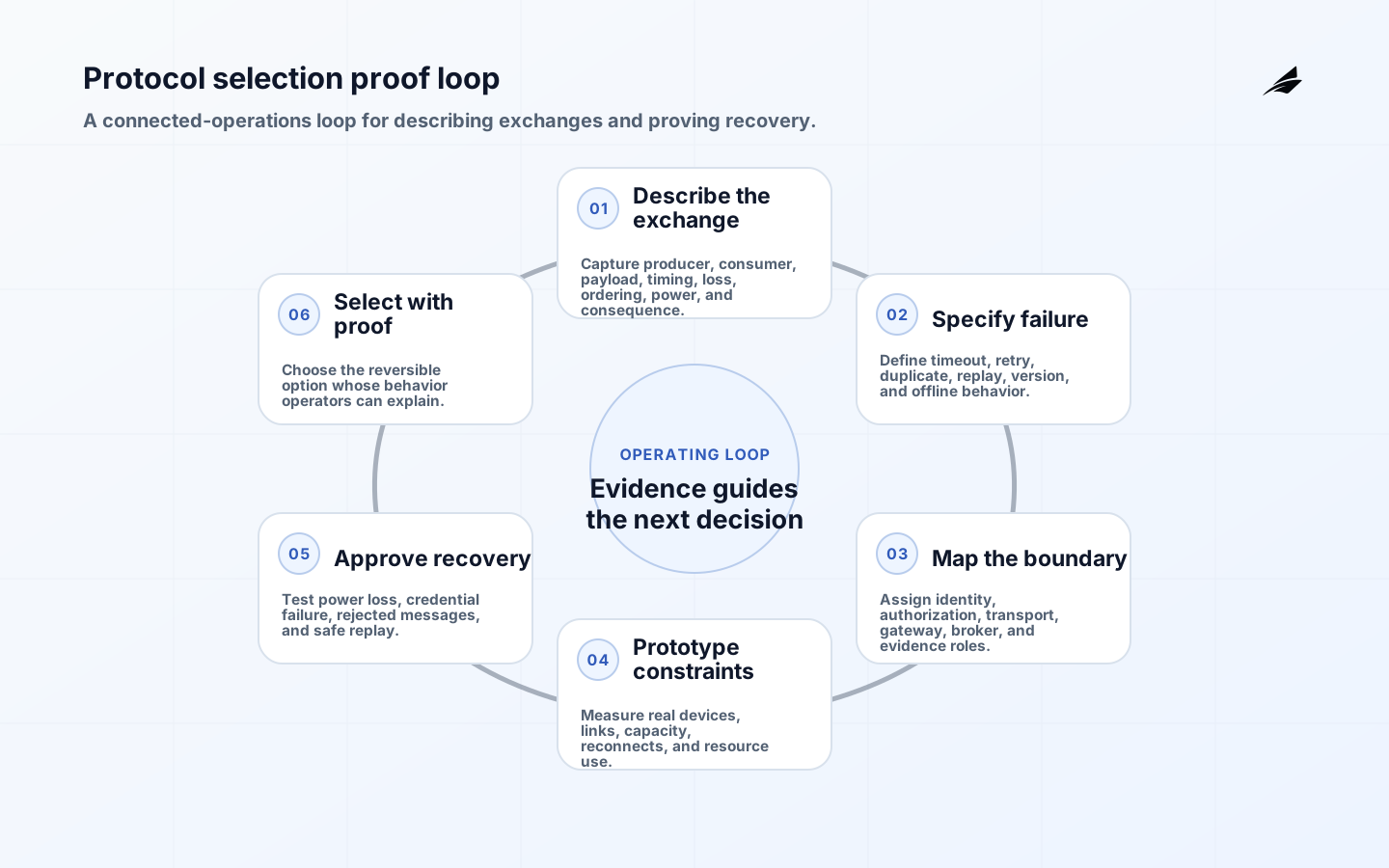
Protocol selection is an operating choice for product teams and systems engineers, not a product label. In a connected environment, the useful question is whether it helps people make a timely, defensible decision when devices, networks, and dependencies are imperfect in protocol selection. Protocol selection chooses a communication protocol by the delivery, latency, power, interoperability, security, and operational requirements of a real device workflow. Begin with the real work: name the decision, the accountable owner, the evidence they need, and the safe action when that evidence is late or disputed in protocol selection.
Start with the exchange, not the protocol name
In plain language, protocol selection chooses a communication protocol by the delivery, latency, power, interoperability, security, and operational requirements of a real device workflow. The distinction between a technical capability and an operational promise matters in protocol selection. A capability can be installed; an operational promise must survive shift changes, supplier maintenance, partial outages, and ordinary human error in protocol selection. Describe the business or safety consequence first, then identify the data, interface, and authority needed to support it in protocol selection. The phrase becomes useful when it answers a concrete question rather than decorating an architecture diagram in protocol selection.
For protocol selection, write the message contract before debating a protocol name. Identify producer and consumer roles, payload limits, ordering needs, retry behavior, acknowledgement, session continuity, and what a receiver does with an unsupported version. Then test the contract under the links and devices that will actually carry it: constrained bandwidth, reconnects, power loss, clock disagreement, and credential failure. The operational evidence is not a benchmark alone; it is proof that the system can explain and recover from a missed, duplicate, late, or rejected message.
| Operating question | Design answer | Evidence to retain |
|---|---|---|
| What job is being improved? | Name the workflow, response window, and accountable owner. | A current workflow map and agreed success measure |
| What must be true to act? | Use attributable data inside a known authority boundary. | Source, time, identity, quality, and approval context |
| What changes when something fails? | Expose the failure state and assign a human decision owner. | Failure test, escalation path, and recovery record |
| How will the team know it works? | Review operational signals instead of launch completion. | connection success, delivery latency, retry volume, payload rejection, battery or bandwidth cost, and protocol-version adoption |
Design protocol behavior for disruption
A practical protocol selection architecture starts with documenting message direction, payload expectations, ordering and delivery needs, session behavior, security controls, and gateway translation boundaries. Draw the journey from device or source through gateway, service, storage, and user action in protocol selection. Mark which component is authoritative, which values may be cached or estimated, what identity is used, and where human approval is required in protocol selection. These details are less glamorous than platform selection, but they expose dependencies before those dependencies become outages or unsafe workarounds in protocol selection.
The failure to guard against is straightforward: selecting a familiar protocol without testing reconnects, constrained links, ordering, or authorization moves complexity into gateways and support incidents. Design inconvenient cases before scale makes them harder to change. Define a known-safe behavior, give users a visible indication that the system is degraded, and rehearse how state is restored or reconciled in protocol selection. OT-adjacent work adds particular constraints because availability, safety, and reliability may matter differently than they do in ordinary business software in protocol selection.
Bound the first protocol proof
Start with one bounded protocol selection workflow. Specify the actor, input, decision, output, exception path, and recovery check in plain language in protocol selection. A narrow first release creates a baseline for latency, accuracy, operator effort, and failure recovery in protocol selection. It also gives security and operations teams something concrete to review. Expand only when the first path is understood, supported, and used; a broad platform promise is not evidence of operational value in protocol selection.
- List the real assets, people, records, and approvals involved in protocol selection.
- Write normal and degraded behavior before choosing an implementation detail.
- Keep source, time, quality, and ownership visible at consequential actions.
- Use versioned configuration or contracts for changes that affect operations.
- Exercise an exception path with the team that will support it.
- Review recurring friction before adding a second workflow.
Assign protocol authority and change ownership
Every consequential protocol selection change needs a named owner, a review point, and a reversible path. The change record should capture the reason, affected assets, configuration or contract version, approver, implementation window, verification result, and rollback condition in protocol selection. That creates a useful history for the next person on call. It also helps distinguish a planned behavior change from a fault, which is often the first step toward faster restoration in protocol selection.
| Risk pattern | Control to build | Review signal |
|---|---|---|
| Unknown current state | Expose freshness, quality, and source identity next to the decision. | Records that are stale, missing, or unowned |
| Uncontrolled change | Use versioned configuration, approval, and tested recovery. | Changes without verification or an accountable requester |
| Ambiguous authority | Separate observation, recommendation, and irreversible action. | Actions that bypass the intended review boundary |
| Hidden dependency failure | Test degraded behavior and document the support handoff. | Exception age, failed retries, and recovery duration |
Measure whether protocol behavior is trustworthy
Use metrics that reveal whether the workflow is trustworthy, rather than merely whether a component is online in protocol selection. For protocol selection, track connection success, delivery latency, retry volume, payload rejection, battery or bandwidth cost, and protocol-version adoption. Pair quantitative signals with a short review of actual exceptions: what happened, what evidence was present, where the team hesitated, and whether the recovery rule was clear in protocol selection. This combination exposes the gap between nominal availability and operational usability and prevents an SLA or dashboard from becoming a substitute for understanding work in protocol selection.
Connected decisions that shape protocol choice
Protocol selection is easier to assess alongside its neighbors. Protocol Selection: Security Review offers a focused companion view; MQTT Brokers: Architecture Guide covers a dependency that commonly shapes design choices; and Edge Gateways: An Implementation Checklist That Holds Up helps frame an operating consequence in protocol selection. These are connected choices, not a shopping list. The right design is the one that leaves operators with clearer authority and stronger evidence when the normal path stops being normal in protocol selection.
Primary references for protocol selection
Protocol-selection work is informed by NIST SP 800-82 Rev. 3: Guide to Operational Technology Security, NISTIR 8259A: IoT Device Cybersecurity Capability Core Baseline, NIST SP 800-207: Zero Trust Architecture, and CISA Internet Exposure Reduction Guidance. They guide protected interfaces, logical access, device state, and security requirements. Check the actual protocol specification and interoperability profile before committing to message semantics or gateway behavior.
Turn protocol selection into an operational test
Start protocol selection with an exchange inventory. For every producer and consumer, capture payload size, frequency, latency, loss tolerance, ordering, duplicate handling, connection pattern, offline behavior, confidentiality, identity, and command consequence. The same protocol can be suitable for one exchange and risky for another because the operational meaning changes. A periodic temperature report may tolerate delay and replay protection through sequence checks; a command to alter a set point may require stronger authorization, freshness, confirmation, and evidence. Compare protocols against those requirements instead of against popularity or a benchmark performed on a clean network.
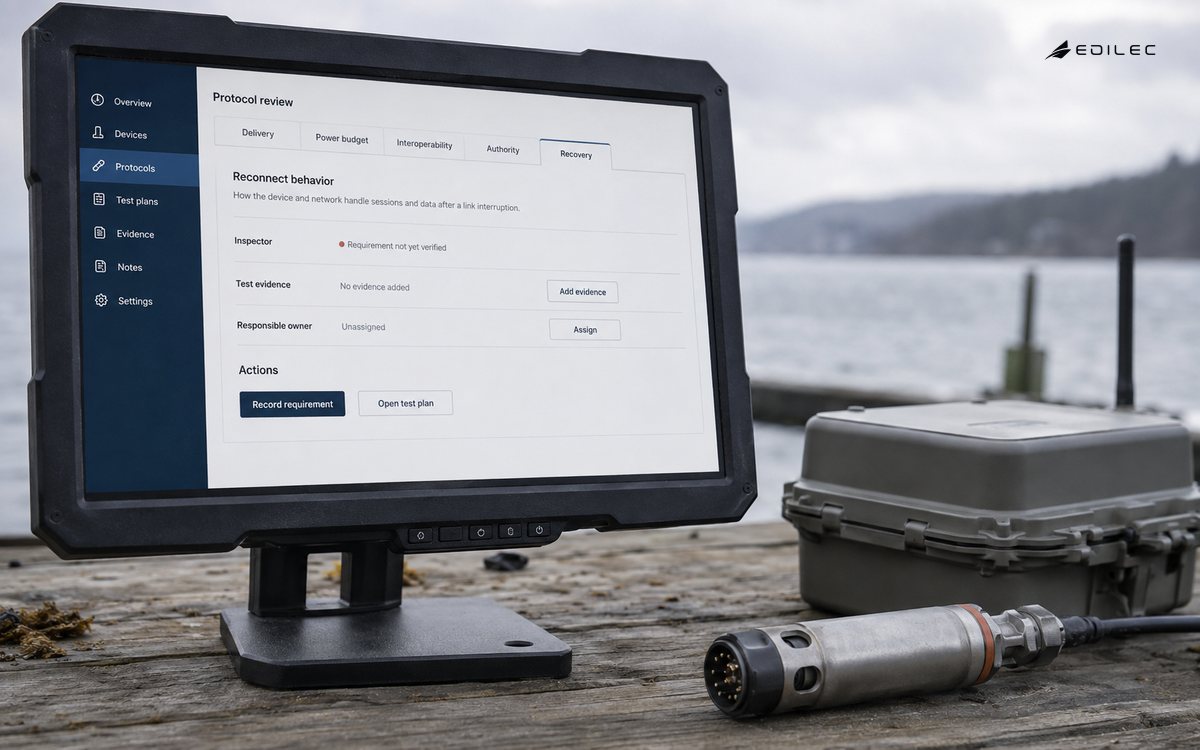
Write failure semantics before choosing implementation options. State what a sender does after timeout, what a receiver does with an unknown version, whether retries can duplicate an action, and how a consumer distinguishes a late reading from a current one. Decide who owns a dead-letter or rejected message and how it is replayed safely. For constrained devices, document power, memory, connection, and certificate limits. If a gateway translates protocols, preserve source identity, original time, quality, and correlation information so the translation does not create a second ambiguous truth.
Security is part of the protocol contract, not a wrapper added after functionality. Define how endpoints authenticate, how authorization maps to topics or resources, how keys or certificates rotate, how sessions expire, and what an operator sees when a request is denied. Protect transport where the threat model requires it, but do not confuse encryption with authorization. Test unknown credentials, revoked credentials, downgrade attempts, malformed payloads, oversized messages, and a broker or gateway restart. Keep the policy and observed behavior tied to a version so a later incident can identify what was actually enforced.
Select a protocol through a reversible proof. Use representative devices, radio or wired links, broker or gateway capacity, and a real message mix. Measure delay distribution, reconnect time, duplicate rate, rejected versions, resource use, and recovery after power loss. Include operations in the acceptance review: can support diagnose the exchange, can security identify the principal, and can the product owner explain the consequence of a missed message? A protocol is ready when those answers remain clear under normal and degraded conditions.
| Check | Evidence to capture | Decision if missing |
|---|---|---|
| Identity and ownership | Stable asset, service, site, and accountable owner. | Hold the action and route the exception. |
| Freshness and quality | Observation time, state, source, and known delay. | Qualify or reject the result according to risk. |
| Change and authority | Policy version, permitted role, approval, and expiry. | Do not widen access or automate the action. |
| Recovery | Tested degraded path, reconciliation, and named responder. | Keep the cohort narrow until recovery is proven. |
For adjacent implementation context, see protocol security review, MQTT broker architecture, and edge gateway implementation. These references help separate the protocol selection decision from neighboring concerns such as data movement, connected operations, and support in protocol selection. Use them to compare boundaries, not to copy a design: the right choice depends on the asset, consequence, timing, people, and evidence in the local workflow in protocol selection.
The official references should be read alongside the operating record. NIST OT Security connects protocol behavior to physical consequence; NIST IR 8259A helps define device capability needs; NIST zero trust architecture supports explicit communication authorization; and CISA exposure-reduction guidance helps turn security needs into procurement requirements. Taken together, they support a practical rule: select the smallest capability that satisfies the named decision, make its authority explicit, test degraded behavior, and retain enough evidence to explain both normal and exceptional outcomes in protocol selection.
Protocol selection: practical takeaways
- Protocol selection should serve a named operational decision and owner.
- Keep source, time, quality, identity, and authority context near consequential actions.
- Design normal behavior, degraded behavior, and recovery before expanding integrations.
- Treat configuration and contract changes as operating events with evidence.
- Use recurring exceptions to improve the workflow rather than normalize uncertainty.
Protocol selection should end with an interoperability and failure exercise, not an architecture slide. Use the intended client, gateway, broker or server, security configuration, and payload version. Then test connection loss, delayed acknowledgement, duplicate delivery, unsupported fields, expired credentials, and a device restart during an exchange. Record what the sender believes happened, what the receiver accepted, and how either side detects disagreement. This turns delivery semantics into observable behavior. It also reveals whether the support team has the diagnostics and contract versioning needed to explain an incident after deployment rather than inferring the cause from incomplete logs.
Document the reason for the chosen protocol in the repository and runbook. Future teams need to know which delivery, resource, security, or interoperability constraint drove the choice. That context makes a later migration an engineering decision instead of a rediscovery exercise.
Protocol selection questions
What is the smallest credible first release? One bounded protocol selection workflow with a real user, an authoritative record, an exception route, and a recovery exercise. How should uncertainty be handled? Label the state as stale, pending, estimated, or disputed; preserve source evidence; and route consequential ambiguity to the person authorized to resolve it in protocol selection. When should the design change? Change it when recurring exceptions, a changed asset class, or a safety and reliability requirement shows that the original rule no longer matches the operation in protocol selection.
Conclusion: choose a protocol operators can recover
Reliable protocol selection makes ordinary work, exceptional work, and recovery understandable to the people responsible for the outcome. Establish the decision, protect the evidence, constrain authority, stage change deliberately, and review actual exceptions with the team that operates the system in protocol selection. That is how a connected capability becomes an operational asset instead of another opaque dependency in protocol selection.