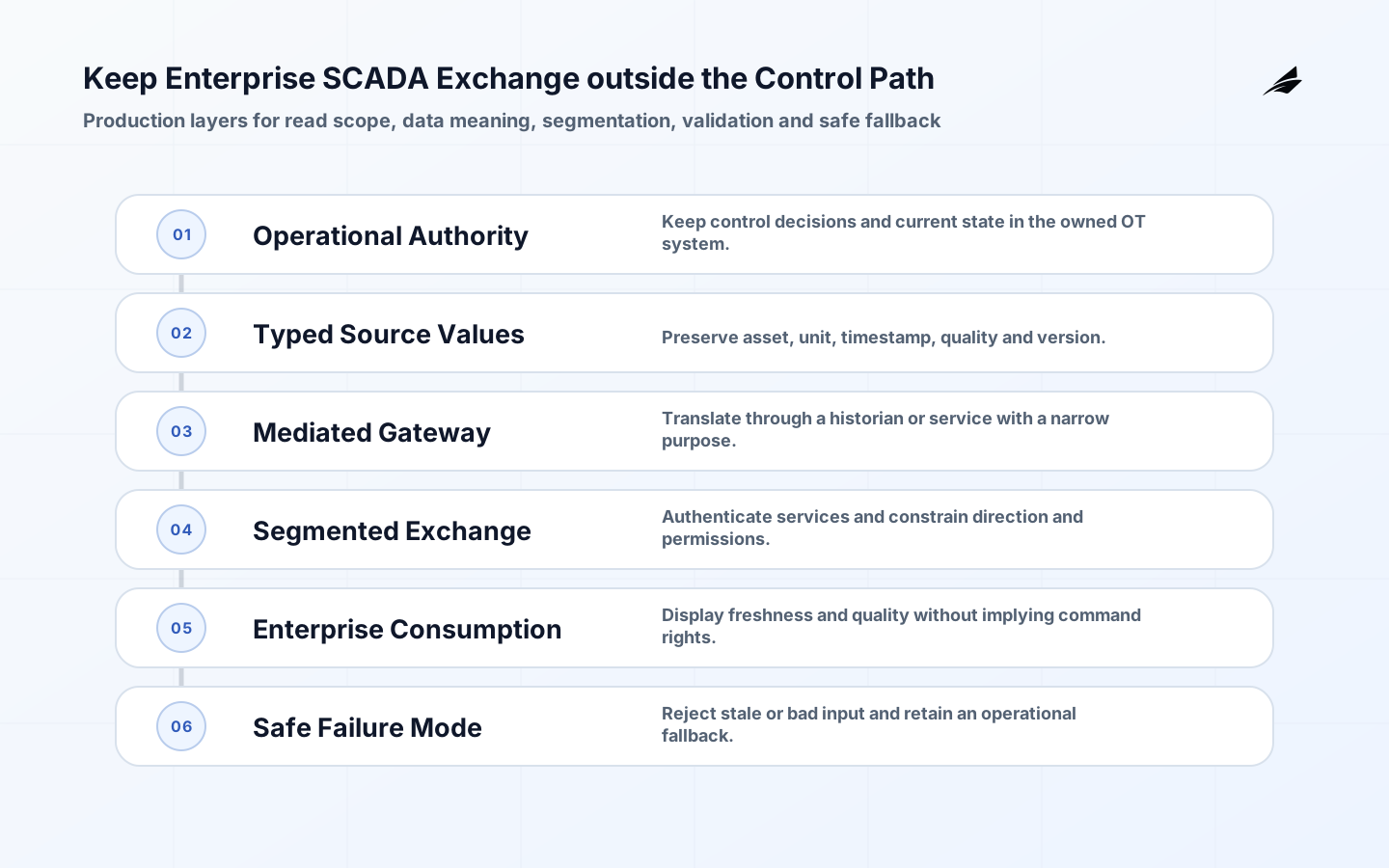
SCADA integrations in production is an operating commitment, not a component choice. It joins equipment, local networks, cloud or enterprise services, and people who must act when normal assumptions fail. The first design question is therefore not which product to buy. It is which decision the capability supports, what evidence makes that decision reliable, and what should happen when the evidence is absent. SCADA integrations fail when an enterprise application, analytics service, or vendor connector is treated as a harmless reader but gains an undocumented path to influence availability, operator context, or control behavior. NIST's Guide to Operational Technology Security is a useful anchor because it treats security alongside the performance, reliability, and safety characteristics that distinguish operational environments. A durable implementation gives field staff and system owners a way to recognize a degraded state, make a bounded decision, and later explain what occurred. For this data handoff, name the accountable owner, supporting evidence, exception route, and next measurable check.
Key takeaways for SCADA integrations
- Define the operational decision before expanding SCADA integrations.
- Keep authority, current state, and recovery visible to the people who carry consequences.
- Test delayed, duplicated, unavailable, and changed inputs as deliberately as normal flow.
- Use staged release evidence to decide expansion rather than a successful demonstration.
Set the decision boundary for SCADA integrations
For every integration, state whether it observes, receives a replicated history, requests a report, writes a configuration, or issues a command. Name the authoritative system for each fact and define the safe behavior when data is stale, unavailable, malformed, or contradictory. Write this as an operational contract that a site lead, engineer, and security reviewer can challenge. It should identify the subject, authoritative inputs, acceptable delay, allowed actor, policy version, outcome, and recovery route. That contract prevents an interface label, cached status, or vendor default from quietly becoming policy. It also makes network segmentation useful context: adjacent capabilities should exchange explicit facts and constraints, not assumptions that only survive in a particular product configuration. Within this decision boundary, name the accountable owner, supporting evidence, exception route, and next measurable check.
| Question | Decision to record | Evidence after release |
|---|---|---|
| Purpose | What action does this capability enable or constrain? | Named owner and measurable operating outcome. |
| Authority | Who or what may change the relevant state? | Actor, source, time, and policy version. |
| Failure | What is safe when a needed dependency is uncertain? | Visible pending, denied, or manual-review state. |
| Recovery | Who resolves an exception and how is it closed? | Case record, reason, and reconciliation result. |
Design the SCADA integrations operating path
Use an interface contract that identifies assets, tags or information models, units, quality, timestamp source, update behavior, allowed commands, and versioning. Prefer a mediated boundary such as a historian, gateway, or purpose-built service when it reduces coupling between enterprise workloads and control networks. A point-to-point shortcut can be expensive long after the first demo succeeds. Keep semantics close to the source: record identity, event or observation time, quality, version, and ownership before information crosses into another system. Avoid promising a single source of truth when the workflow legitimately has local and central states; instead, state which is authoritative for each decision and how disagreement is repaired. The NIST IoT baseline is particularly relevant here because device capabilities must support the controls that protect devices, data, systems, and ecosystems, not merely pass a connection test. When implementing this design choice, name the accountable owner, supporting evidence, exception route, and next measurable check.

Apply controls without blocking legitimate work
Segment integration paths, authenticate each service, constrain permissions, and require deliberate authorization for any write or command. Protect engineering and administrative interfaces separately from ordinary data exchange. Changes to mappings, tags, certificates, and endpoints require an operational change record because they can alter the meaning or availability of a process without changing application code. Use change records for policy, configuration, credentials, schema, and route changes that can alter a production outcome. A control is credible only if it has an owner, a testable rule, and an exception procedure. Design exceptions to be narrow, time bounded, observable, and reviewed after use. This is how availability pressure is kept from gradually turning an emergency workaround into the normal architecture. Before releasing this part of the system, name the accountable owner, supporting evidence, exception route, and next measurable check.
| Control area | Practical test | Failure to avoid |
|---|---|---|
| Identity | Can each actor and system prove the scope it needs? | Shared access that cannot be investigated. |
| Integrity | Can a changed record, package, or rule be detected? | Trusting a label or transport result as final proof. |
| Availability | Is degraded behavior explicit and rehearsed? | Automatic retry that hides an unsafe or stale state. |
| Accountability | Can a material outcome be reconstructed? | Logs that lack subject, time, reason, or owner. |
Operate SCADA integrations with evidence
Observe connection state, data freshness, quality flags, rejected writes, mapping errors, queue depth, and mismatches between source and consuming records. Make stale or bad quality visible to downstream users rather than filling gaps with a plausible-looking last value. Reconcile important derived totals against the authoritative record on a scheduled basis. Build an operating review around real cases, including the ones that were resolved manually. Compare expected and actual behavior across sites, device versions, user roles, and network conditions. The aim is not a decorative scorecard; it is a repeatable answer to what changed, who was affected, whether the system made the right state visible, and what must be improved before the same condition returns. Keep diagnostic data proportionate to risk and access-controlled, because operational telemetry can itself expose sensitive assets and activity. While operating this evaluation, name the accountable owner, supporting evidence, exception route, and next measurable check.
Release and recover deliberately
Test against a representative but safe environment with network delay, source restart, bad values, tag changes, and access denial. Pilot a read-only use case before considering writes. A write-capable integration needs an explicit owner, independent verification of the target, an abort path, and evidence that operators understand its effect. Before each change, name the cohort, acceptance checks, stop conditions, rollback or containment route, communications owner, and evidence owner. Test the recovery path before it is needed: restore an approved configuration, re-establish trusted identity, reconcile pending work, and verify the business or physical outcome rather than only a technical heartbeat. This makes a failed release bounded work instead of a wide investigation across teams that disagree about the current state. When changing this operating step, name the accountable owner, supporting evidence, exception route, and next measurable check.
Review SCADA integrations in context
Review SCADA integrations with both the control-room and enterprise owners. Trace a selected value from source through mapping, quality handling, display or downstream use, and any write acknowledgement. This catches unit conversion, timestamp, naming, and stale-data mistakes that look plausible in isolation. Keep the review focused on whether the integration changes an operational decision, not merely whether a connector reports a healthy session.
SCADA integrations FAQ
What should be decided first?
For delivery teams working on SCADA integrations, this operating decision should connect search intent, canonical URLs, rendered content, structured metadata, crawl paths, and measurable search outcomes to evidence an accountable owner can inspect. Start with the consequential decision, the source that may support it, the owner, the maximum useful delay, and the safe fallback. Technology selection comes after those facts. This order makes trade-offs visible and prevents a pilot architecture from silently deciding policy. In this operating review, move beyond the operating decision only after the owner can show the accepted result, the exception path, and the signal for another review.
What should the team measure?
In SCADA integrations, delivery teams should make the relationship between search intent, canonical URLs, rendered content, structured metadata, crawl paths, and measurable search outcomes explicit and reviewable. Measure the health of the full path: input quality, authorization or validation failures, delay, exception age, recovery time, and whether an accountable person took the intended action. Pair counts with reviewed examples, because averages can conceal a small site or asset group that is repeatedly harmed. This operating review should close the operating signal only when the result, unresolved exception, and next review condition are recorded.
How do security and operations stay aligned?
A dependable SCADA integrations design makes search intent, canonical URLs, rendered content, structured metadata, crawl paths, and measurable search outcomes visible to the owner responsible for this access-control decision. Use a shared change and exception record. Security should understand the operational consequence of an unavailable control, while operations should understand the trust boundary being changed. A narrowly scoped, recorded temporary exception is more defensible than an unobservable permanent shortcut. The next step in this operating review is justified when the team can trace the accepted outcome, the fallback route, and the owner of follow-up.
Conclusion: make SCADA integrations reviewable
Reliable SCADA integrations comes from a defined decision, explicit authority, controlled change, and evidence that remains useful after a difficult day. Build one representative path that survives uncertainty and recovery, then use operating evidence to extend it. That is slower than a broad promise on the first week and much faster than repairing an unexplainable fleet later. When explaining this part of the system, name the accountable owner, supporting evidence, exception route, and next measurable check.
Authoritative sources
This information boundary for SCADA integrations is strongest when search intent, canonical URLs, rendered content, structured metadata, crawl paths, and measurable search outcomes can be reviewed as one operating record. This guide draws on the NIST OT security guide, the IoT device cybersecurity capability baseline, the NIST Cybersecurity Framework, and NIST SP 800-53. Apply the requirements of the relevant equipment, sector, contracts, and jurisdiction before changing a live environment. For this part of the system, test one expected case, one ambiguous case, and one failure with a documented recovery action. Acceptance in this operating review requires a visible outcome, a bounded exception path, and a measurable reason to revisit the decision.